What Is the Business Cycle? Understanding Economic Growth, Recessions, and Market Cycles


Hello, this is MasterMind.
Why do bull markets seem unstoppable at certain times, while at other times investors suddenly become obsessed with recession risks?
Why do stock prices soar even when the economy still looks weak, and why do markets sometimes fall despite strong economic data?
The answer often lies in one of the most important concepts in economics and investing: the Business Cycle.
Understanding the business cycle helps investors see beyond headlines and focus on the larger forces that drive corporate profits, interest rates, liquidity, and asset prices.
Rather than trying to predict every market move, investors who understand the cycle gain a framework for understanding where capital is flowing and why.
Key Takeaway
The business cycle is the natural expansion and contraction of economic activity. Understanding where the economy sits within that cycle can help investors better interpret market behavior, liquidity conditions, and long-term opportunities.
What Is the Business Cycle?

The business cycle refers to the recurring pattern of economic expansion and contraction over time.
Economic activity does not move in a straight line. Instead, economies experience periods of growth, followed by slowdowns, recessions, and eventually recoveries.
The cycle is influenced by several interconnected forces
- Consumer spending
- Business investment
- Employment
- Credit conditions
- Interest rates
- Government and central bank policies
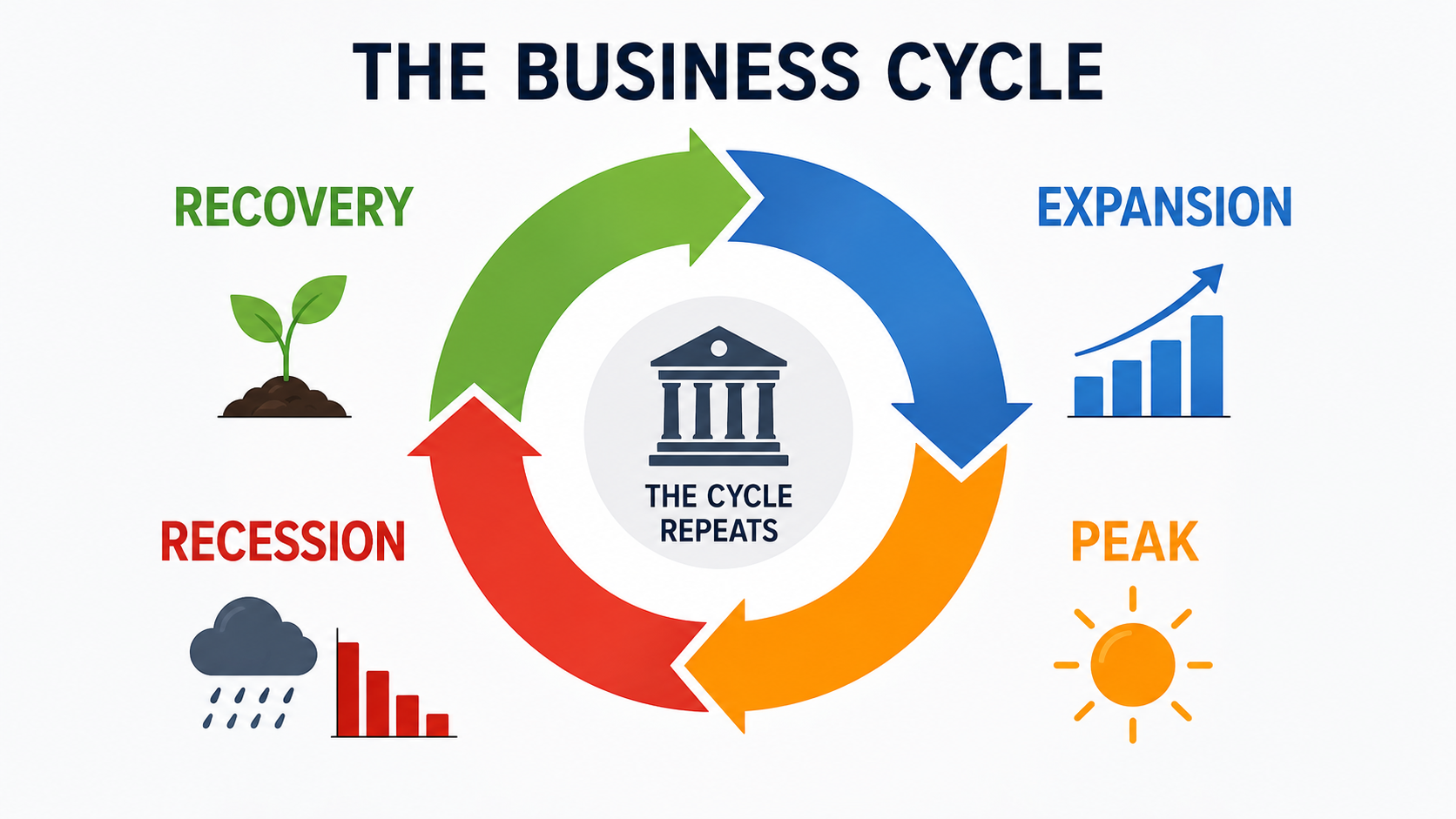
While every cycle is unique, economists generally divide the business cycle into four stages
| Stage | Description |
| Recovery | Economic activity begins improving after a downturn |
| Expansion | Growth accelerates and corporate profits increase |
| Peak | Growth reaches maximum momentum and inflation pressures emerge |
| Recession | Economic activity contracts and demand weakens |
The cycle does not follow a fixed timetable. Some expansions last many years, while others end much sooner.
Why Does the Business Cycle Exist?
At its core, the business cycle is driven by human behavior, credit creation, and monetary policy.
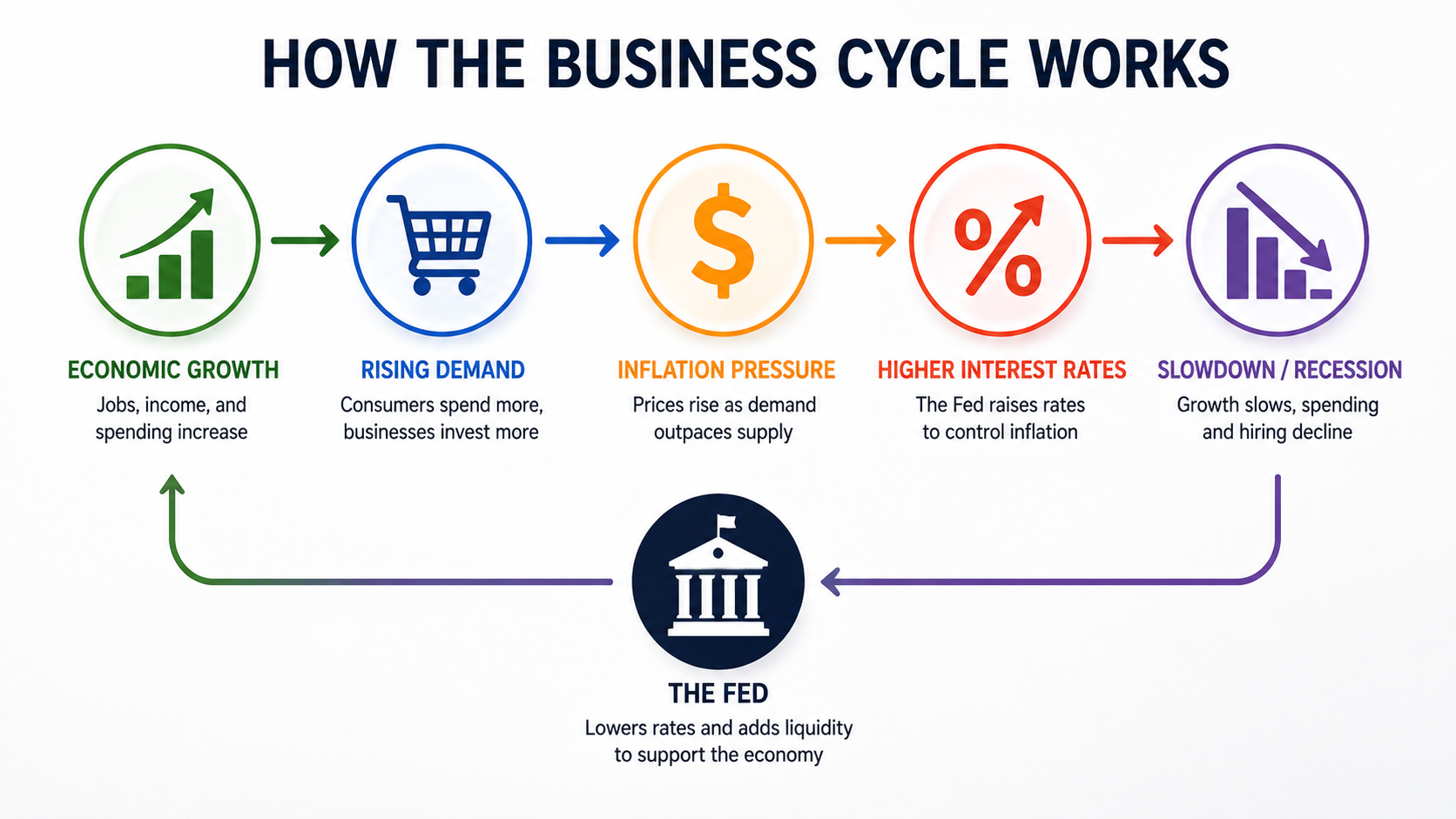
When economic conditions improve, consumers spend more money.
Businesses respond by increasing production, hiring workers, and expanding operations.
Higher employment generates more income, which fuels additional spending.
This creates a positive feedback loop.
However, growth eventually creates inflationary pressure.
As demand rises faster than supply, prices begin to increase.
To control inflation, the Federal Reserve often raises interest rates.
Higher borrowing costs reduce spending and investment.
Corporate growth slows.
Economic momentum weakens.
Eventually, the economy may enter a recession.
Once inflation falls and economic conditions deteriorate, the Federal Reserve typically shifts toward lower rates and more accommodative policy.
The next recovery then begins.
The Four Stages of the Business Cycle
1. Recovery
Recovery begins after a recession.
Interest rates are often low.
Credit conditions improve.
Consumer confidence slowly returns.
Corporate earnings begin stabilizing.
Historically, stock markets often recover before economic headlines improve.
2. Expansion
Expansion is characterized by rising employment, growing consumer spending, and increasing corporate profits.
Business confidence strengthens.
Investment activity increases.
This is typically the longest phase of the cycle.
Equity markets often perform well during this period because earnings growth supports higher valuations.
3. Peak
At the peak stage, economic growth remains strong, but signs of overheating emerge.
Inflation becomes a concern.
Labor markets tighten.
The Federal Reserve may raise rates aggressively.
While economic data still appears healthy, financial markets often begin looking ahead to slower growth.
4. Recession
A recession occurs when economic activity declines.
Consumer spending slows.
Businesses reduce investment.
Unemployment rises.
Corporate earnings come under pressure.
However, one of the most important lessons for investors is that markets typically move before the economy.
Stock prices often begin recovering long before recession headlines disappear.
Why Investors Pay Attention to the Business Cycle
The business cycle influences nearly every major asset class.
Stocks depend on corporate earnings.
Bonds depend heavily on interest rates and growth expectations.
Real estate responds to credit availability and financing costs.
Gold and Bitcoin often react to inflation expectations and liquidity conditions.
The business cycle helps investors understand the broader environment in which these assets operate.
But there is another important reality.
Markets are forward-looking.
Investors do not price today's economy.
They price expectations about tomorrow's economy.
This explains why markets frequently rally during periods of bad news and decline during periods of strong economic data.
How Different Assets Perform During the Business Cycle

| Asset Class | Expansion | Peak | Recession | Recovery |
| Stocks | Strong | Mixed | Weak | Improving |
| Bonds | Weak to Neutral | Weak | Strong | Strong |
| U.S. Dollar | Mixed | Stronger | Often Strong | Mixed |
| Gold | Moderate | Strong | Strong | Moderate |
| Bitcoin | Liquidity Driven | Volatile | Volatile | Potentially Strong |
These are broad tendencies rather than guaranteed outcomes.
Liquidity conditions can sometimes matter more than economic growth itself.
A weak economy combined with aggressive monetary stimulus may support asset prices.
Conversely, a strong economy facing aggressive tightening can pressure financial markets.
Key Lessons for Investors
Focus on Position, Not Prediction
Accurately predicting recessions is extremely difficult.
Even professional economists and central bankers regularly miss turning points.
Instead of trying to forecast the exact future, investors should focus on identifying where the economy may currently sit within the cycle.
Watch the Federal Reserve
The Federal Reserve plays a critical role in shaping liquidity and credit conditions.
Interest rate decisions often influence market behavior long before they affect the broader economy.
Understanding monetary policy can provide valuable context for investment decisions.
Markets Move Before Economic Data
Economic indicators are often backward-looking.
By the time unemployment rises significantly, markets may already be pricing the next recovery.
This is why investors should avoid relying solely on headlines when making long-term decisions.
What Wealthy Investors Look For During the Cycle

Most successful long-term investors focus less on economic forecasts and more on capital flows.
They ask different questions than the average investor.
Where Is Money Moving?
Capital constantly shifts between asset classes.
From stocks to bonds.
From bonds to cash.
From cash to gold.
From speculative assets to defensive assets.
Understanding these flows often provides more insight than following daily news.
Which Businesses Can Survive?
During economic downturns, companies with strong balance sheets and durable cash flows tend to outperform weaker competitors.
Professional investors pay close attention to financial resilience.
Survival often matters more than growth.
Is Liquidity Expanding or Contracting?
Liquidity remains one of the most powerful forces in financial markets.
Asset prices frequently respond more to changes in liquidity than to changes in economic growth itself.
Following liquidity trends can help investors better understand market behavior.
Questions Every Investor Should Ask
- Could my portfolio withstand a recession?
- Am I chasing optimism at the wrong point in the cycle?
- Do I have enough cash or liquidity for future opportunities?
- Am I paying attention to where capital is flowing?
Investing success is rarely about predicting every market move.
It is often about staying financially resilient long enough to benefit from future opportunities.
Final Thoughts
The business cycle is one of the most important concepts in economics and investing.
Economic expansions and recessions are not random events.
They are recurring features of a dynamic economic system.
While every cycle is different, the underlying pattern remains remarkably consistent.
The goal is not to predict the future perfectly.
The goal is to understand the environment, manage risk, and position yourself for long-term success.
In investing, survival is often more important than prediction.
This was MasterMind. Designing success.
'[Global] Success Blueprints' 카테고리의 다른 글