What Is Dollar Liquidity and Why Does It Matter for Stocks and Bitcoin?


Hello, this is MasterMind.
Why do stocks often rally when the Federal Reserve starts easing policy?
Why does Bitcoin tend to surge when financial conditions become more accommodative?
And why do investors around the world pay so much attention to the Federal Reserve, even if they never buy a single U.S. Treasury bond?
The answer often comes down to one critical concept: dollar liquidity.
While many investors focus on earnings reports, economic growth, or interest rates, the flow of dollar liquidity is often the hidden force driving asset prices across the globe.
Today, we'll explore what dollar liquidity is, how it works, and why it may be one of the most important indicators for long-term investors.
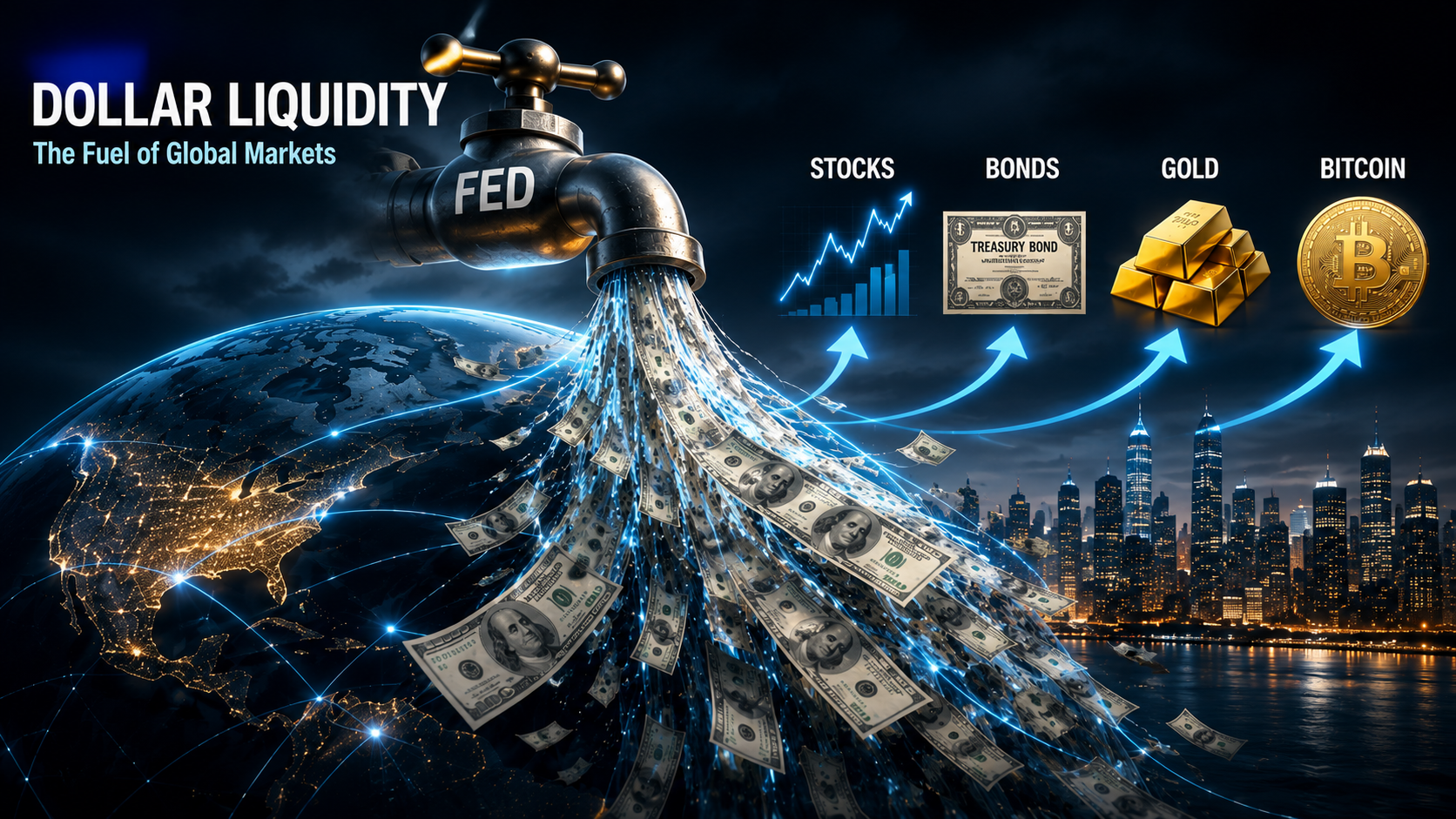
Key Takeaway
Dollar liquidity is the lifeblood of the global financial system. When liquidity expands, asset prices tend to rise. When liquidity contracts, financial markets often face increased stress and volatility.
What Is Dollar Liquidity?
Dollar liquidity refers to the availability of U.S. dollars within the global financial system.
This concept goes far beyond physical cash or money sitting in bank accounts.
It reflects how easily businesses, banks, investors, and governments can access and use dollars for borrowing, investing, and conducting transactions.
Because the U.S. dollar serves as the world's primary reserve currency, dollar liquidity affects far more than just the American economy.
It influences global trade, international capital flows, commodity markets, and financial conditions across developed and emerging economies alike.
Why Does Dollar Liquidity Matter So Much?
The U.S. dollar functions as the operating system of global finance.
Most international trade is settled in dollars.
Key commodities such as oil, natural gas, and agricultural products are largely priced in dollars.
Central banks around the world also hold a significant portion of their foreign exchange reserves in dollar-denominated assets.
As a result, changes in dollar liquidity can affect everything from Wall Street to emerging markets.
When dollars become abundant, investors are generally more willing to take risk.
When dollars become scarce, capital tends to flow toward safety.
This is why a shift in dollar liquidity often has a larger impact on markets than many headline economic reports.
How Is Dollar Liquidity Created?
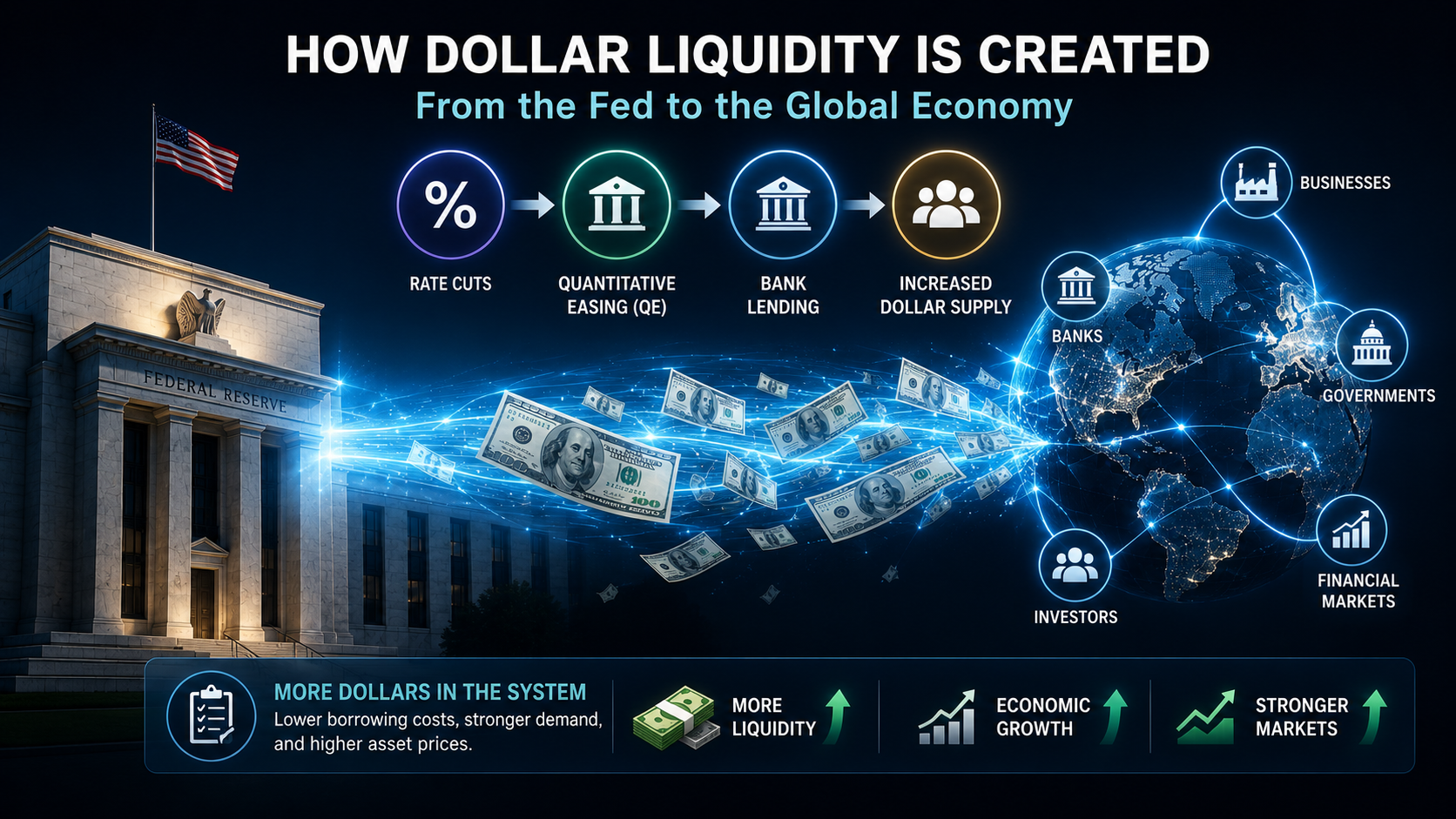
Federal Reserve Policy
The Federal Reserve is the most powerful driver of dollar liquidity.
When the Fed lowers interest rates or purchases assets through Quantitative Easing (QE), liquidity generally increases.
When the Fed raises rates or shrinks its balance sheet through Quantitative Tightening (QT), liquidity tends to decrease.
| Policy | Impact on Liquidity |
| Rate Cuts | Increase |
| Rate Hikes | Decrease |
| Quantitative Easing (QE) | Increase |
| Quantitative Tightening (QT) | Decrease |
These policy decisions influence borrowing costs, financial conditions, and ultimately the amount of money circulating throughout the economy.
Commercial Bank Lending
Banks also create liquidity through lending.
When businesses and consumers borrow money, new purchasing power enters the economy.
Expanding credit conditions often support economic growth and asset prices.
Conversely, tighter lending standards can reduce liquidity and slow economic activity.
Government Spending
Fiscal policy can also influence liquidity.
Large government spending programs inject money into the economy, while increased Treasury issuance and cash accumulation can temporarily drain liquidity from financial markets.
This is one reason investors closely monitor U.S. Treasury cash balances and government funding activity.
Why Investors Pay Attention to Dollar Liquidity
Many investors believe stock prices move primarily because of earnings growth.
While earnings certainly matter, liquidity often determines how much investors are willing to pay for those earnings.
A company's fundamentals may remain unchanged, but if liquidity conditions improve, valuations can expand.
This highlights a fundamental truth about markets
Asset prices are not driven solely by value. They are also driven by the amount of money available to purchase that value.
When liquidity expands, capital often flows toward risk assets.
When liquidity contracts, investors become more selective and defensive.
How Dollar Liquidity Affects Major Asset Classes

Stocks
Expanding liquidity generally supports higher valuations and stronger investor sentiment.
Growth stocks often benefit the most because future earnings become more valuable when financial conditions are easy.
Bonds
Bond prices tend to rise when liquidity increases and interest rates decline.
Conversely, tightening liquidity can pressure bond prices as yields move higher.
The U.S. Dollar
An increase in dollar supply can contribute to dollar weakness.
A shortage of dollars often has the opposite effect, supporting dollar strength.
Gold
Gold frequently benefits when liquidity expands and real interest rates decline.
Many investors view gold as a hedge against currency debasement and monetary expansion.
Bitcoin
Bitcoin has increasingly become a liquidity-sensitive asset.
Periods of abundant liquidity often coincide with stronger demand for speculative and high-growth assets, including cryptocurrencies.
Key Indicators Investors Should Watch

Federal Reserve Balance Sheet
The size of the Fed's balance sheet provides insight into whether liquidity is being added to or removed from the financial system.
Treasury General Account (TGA)
The Treasury General Account represents the U.S. government's primary cash account.
Large changes in the TGA can influence short-term liquidity conditions.
High-Yield Credit Spreads
Widening credit spreads often indicate growing financial stress and tightening liquidity conditions.
This can serve as an early warning signal for risk assets.
What Do Wealthy Investors See in This Trend?

Successful investors rarely focus solely on predicting market movements.
Instead, they focus on understanding capital flows and managing risk.
Following the Money
They ask where capital is moving.
Is money flowing into equities?
Treasuries?
Cash?
Gold?
Bitcoin?
Following these shifts often provides more insight than following headlines.
Prioritizing Cash Flow and Resilience
During periods of tightening liquidity, balance sheet strength becomes increasingly important.
Investors tend to favor businesses with
- Strong cash flow
- Manageable debt levels
- Durable competitive advantages
Liquidity cycles often expose which assets are truly resilient.
Markets Price the Future
One of the most important lessons in investing is that markets are forward-looking.
Assets often move before liquidity actually changes because investors are constantly pricing future expectations.
This is why expectations about Federal Reserve policy can be just as important as policy itself.
Questions Long-Term Investors Should Ask
- Is global liquidity expanding or contracting?
- Where is capital flowing today?
- Would my portfolio survive a prolonged liquidity squeeze?
- Am I investing based on fundamentals, liquidity conditions, or both?
- Which assets can generate sustainable cash flow regardless of market conditions?
These questions can help investors think beyond short-term market noise.
Final Thoughts
Dollar liquidity is far more than an economic buzzword.
It is one of the most important forces influencing stocks, bonds, gold, Bitcoin, and global financial markets.
Understanding dollar liquidity is not simply about tracking money supply.
It is about understanding where capital is flowing, what investors expect, and which assets are most likely to survive across different market cycles.
Many investors chase prices.
Long-term investors study the forces that move prices.
And among those forces, few are more important than dollar liquidity.
Remember this
Markets ultimately follow the direction of money.
This was MasterMind. Designing success.
'[Global] Success Blueprints' 카테고리의 다른 글