What Is Fiscal Policy? How Government Spending Affects Stocks, Bonds, and Inflation


Hello, this is MasterMind.
When Congress approves a massive spending bill, why does the stock market pay attention?
Why do investors care so much about tax cuts, infrastructure programs, and government deficits?
Most people understand that the Federal Reserve influences the economy through interest rates. However, another powerful force operates alongside monetary policy: fiscal policy.
Fiscal policy directly affects economic activity by determining how much money the government spends, where that money goes, and how much is collected through taxes.
For long-term investors, understanding fiscal policy is not just about following political headlines. It is about understanding how capital moves through the economy and how those movements eventually influence stocks, bonds, real estate, gold, and even Bitcoin.
Today, we'll explore what fiscal policy is, how it works, and why investors should pay close attention to it.
Key Takeaway
Fiscal policy is the government's use of spending and taxation to influence economic growth, employment, and inflation, making it one of the most powerful drivers of liquidity and financial market performance.
What Is Fiscal Policy?
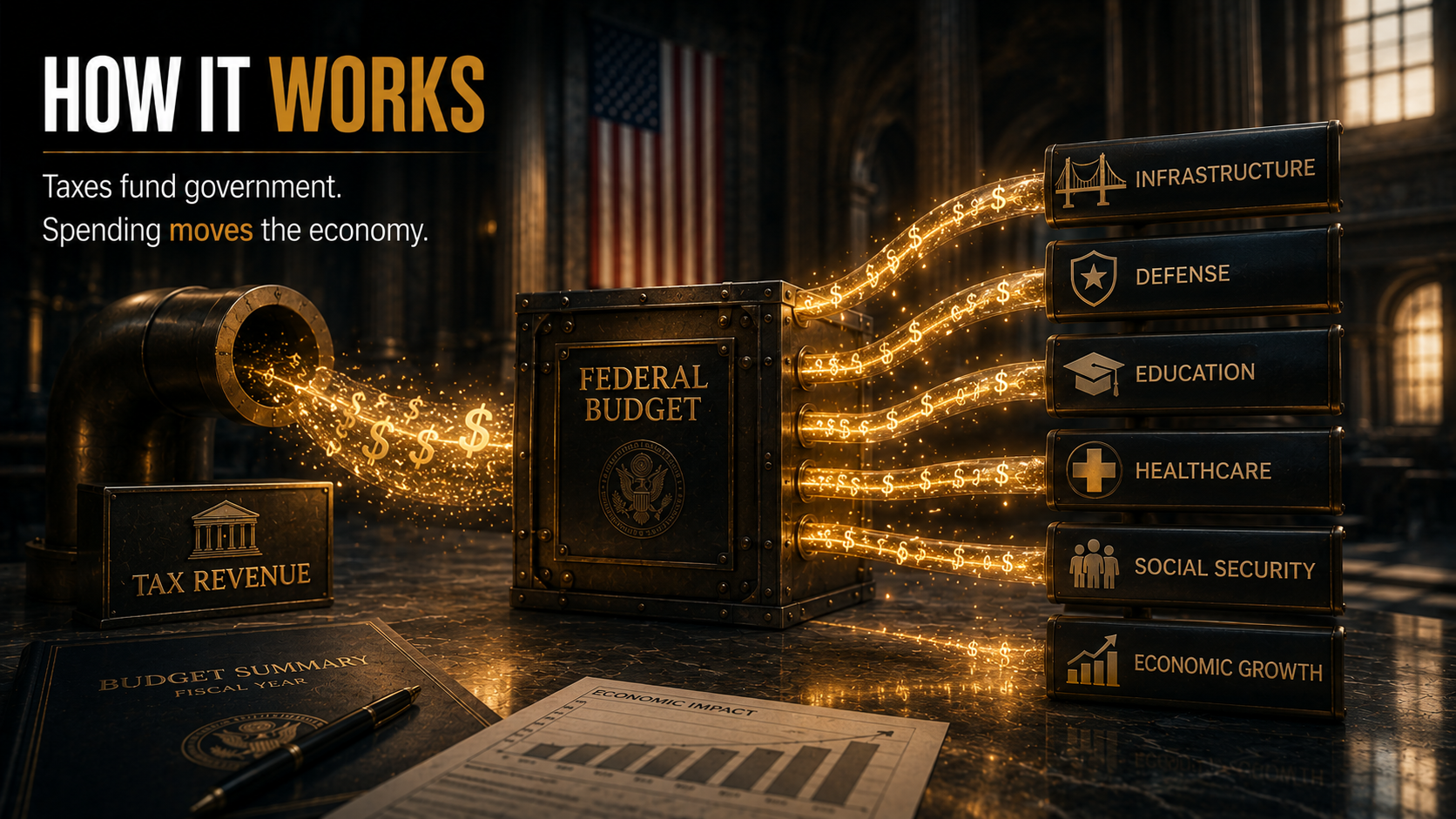
Fiscal policy refers to the actions governments take to manage economic conditions through taxation and public spending.
In the United States, fiscal policy is primarily implemented through Congress and the federal government.
Examples include
- Infrastructure spending
- Defense budgets
- Tax cuts
- Social Security and Medicare spending
- Education funding
- Industrial subsidies and economic stimulus programs
Unlike monetary policy, which influences borrowing costs indirectly through interest rates, fiscal policy injects or withdraws money directly from the economy.
Think of monetary policy as controlling the flow of water through a pipe.
Fiscal policy is the decision about where that water is actually directed.
The Two Types of Fiscal Policy
Expansionary Fiscal Policy
Expansionary fiscal policy is used when economic growth slows or unemployment rises.
Governments attempt to stimulate demand by
- Increasing public spending
- Cutting taxes
- Launching infrastructure projects
- Providing economic stimulus payments
The goal is simple: put more money into the hands of consumers and businesses so spending and investment increase.
This approach became highly visible during the COVID-19 pandemic when the U.S. government implemented several large stimulus programs.
Contractionary Fiscal Policy
Contractionary fiscal policy is used when inflation becomes excessive or the economy begins overheating.
Governments may
- Reduce spending
- Increase taxes
- Cut budget deficits
- Delay major projects
The objective is to slow economic activity and reduce inflationary pressure.
While expansionary policies often receive more attention, contractionary policies can be equally important in maintaining long-term economic stability.

How Fiscal Policy Works
The effectiveness of fiscal policy comes from what economists call the multiplier effect.
Imagine the government spends $100 billion on infrastructure.
Construction companies receive contracts.
Workers earn wages.
Those workers spend money at restaurants, stores, and service businesses.
Those businesses hire additional employees and invest in growth.
The original government spending creates multiple rounds of economic activity.
As a result, the total impact on GDP can be much larger than the initial expenditure itself.
This is why fiscal policy can be a powerful tool during recessions.
Fiscal Policy vs. Monetary Policy
Many investors confuse fiscal policy with monetary policy.
Although both influence the economy, they operate differently.
| Fiscal Policy | Monetary Policy |
| Controlled by government | Controlled by the Federal Reserve |
| Uses spending and taxation | Uses interest rates and liquidity |
| Direct economic impact | Indirect economic impact |
| Influences government deficits | Influences borrowing costs |
The most powerful economic environments often occur when fiscal and monetary policies move in the same direction.
When both are supportive, liquidity expands rapidly.
When they conflict, markets can become much more volatile.
Why Fiscal Policy Matters to Investors
For investors, fiscal policy is ultimately about liquidity.
Markets do not move solely because of earnings reports or headlines.
They move because capital flows from one place to another.
Government spending changes those flows.
A large infrastructure bill may direct capital toward construction companies, industrial firms, and materials producers.
Tax cuts can increase consumer spending and corporate profits.
Defense spending can create long-term demand for aerospace and military contractors.
Fiscal policy often determines where large amounts of money will be concentrated for years.
That makes it highly relevant for long-term investors.
How Fiscal Policy Affects Financial Markets

Stocks
Expansionary fiscal policy generally supports corporate earnings and economic growth.
Industries connected to government spending often benefit first.
Examples include
- Infrastructure
- Defense
- Industrial manufacturing
- Energy
- Semiconductor production
However, excessive spending can eventually increase inflation and pressure valuations.
Bonds
Bond investors pay close attention to fiscal deficits.
When government spending exceeds tax revenue, additional Treasury bonds are often issued to finance the gap.
More bond supply can place upward pressure on yields and downward pressure on bond prices.
This is one reason why large deficits remain a major topic in U.S. financial markets.
The U.S. Dollar
Fiscal policy can have mixed effects on the dollar.
In the short term, stronger economic growth may support the currency.
Over longer periods, persistent deficits and rising debt levels can create concerns about fiscal sustainability.
Gold
Gold often attracts attention when investors become concerned about inflation, government debt, or currency debasement.
Large-scale fiscal expansion can strengthen those concerns.
Bitcoin
Some investors view Bitcoin as an alternative store of value during periods of aggressive government spending and rising public debt.
While Bitcoin remains highly volatile, discussions about fiscal deficits frequently appear in long-term Bitcoin investment narratives.
Key Things Investors Should Watch
Follow Government Spending Priorities
Not all spending affects markets equally.
The destination of government money matters more than the headline number.
Investors should ask
- Which industries benefit?
- Which companies gain long-term revenue opportunities?
- Which sectors receive political support?
Monitor Deficits and Treasury Issuance
Government spending does not occur in isolation.
Deficits often require additional borrowing.
That borrowing can influence Treasury yields and financial conditions throughout the economy.
Watch Fiscal and Monetary Policy Together
The interaction between Congress and the Federal Reserve is often more important than either policy individually.
Markets react to the combination of liquidity, growth expectations, and inflation risks.
What Do Wealthy Investors See in Fiscal Policy?

Most investors focus on policy announcements.
Sophisticated investors focus on capital flows.
They ask questions such as
- Where is government money going?
- Which industries are receiving structural support?
- How will this affect future cash flows?
- What happens to interest rates?
- Which assets become stronger under this environment?
They understand a fundamental truth about markets
Money rarely disappears.
It simply moves.
Fiscal policy often determines the direction of that movement.
The challenge for investors is not predicting every economic outcome.
The challenge is identifying where capital is likely to flow next.
Ask yourself
When a major government spending package is announced, do you focus on the headline—or do you focus on where the money is actually going?
That distinction often separates short-term speculation from long-term investing.
Final Thoughts
Fiscal policy is one of the most important forces shaping economic growth, inflation, and financial markets.
Through taxation and government spending, policymakers influence liquidity, corporate earnings, employment, and investor expectations.
For long-term investors, the key lesson is not simply understanding whether the government is spending more or less money.
The real insight comes from understanding where that money is flowing and how those capital flows may reshape the investment landscape.
Markets constantly price the future.
Fiscal policy helps determine what that future may look like.
This was MasterMind.
'[Global] Success Blueprints' 카테고리의 다른 글