What Is an Index Fund? Benefits, Returns, and Why Long-Term Investors Use It


Hello, this is MasterMind.
If professional fund managers, analysts, and Wall Street institutions spend billions of dollars every year researching stocks, why do so many of them still fail to beat the market over the long run?
It's a question that challenges one of the biggest assumptions in investing.
Most people believe successful investing is about finding the next Apple, NVIDIA, or Amazon before everyone else does.
But many of the world's greatest investors argue that long-term wealth is often built in a much simpler way.
That is where index funds come in.
Today, we'll explore what index funds are, how they work, why investors pay attention to them, and why they have become one of the most powerful wealth-building tools in modern financial markets.
Key Takeaway
An index fund allows investors to own an entire market rather than trying to predict which individual stocks will outperform.
What Is an Index Fund?

An index fund is an investment fund designed to track the performance of a market index.
Popular examples include
- S&P 500
- Nasdaq-100
- Russell 2000
- Total Stock Market Index
- MSCI World Index
Instead of selecting a handful of stocks, an index fund buys every company within a specific index according to its weight.
For example, an S&P 500 index fund owns shares of hundreds of America's largest public companies.
When the U.S. economy grows and corporate profits expand, the index fund benefits from that growth.
In simple terms, an index fund is not a bet on one company.
It is a bet on the long-term growth of an economy.
How Does an Index Fund Work?
Index funds follow what is known as a passive investment strategy.
Unlike actively managed funds, there is no portfolio manager attempting to predict market winners and losers.
The fund simply follows predetermined rules.
Market Replication
If Apple represents 7% of the S&P 500, the fund allocates roughly 7% of its assets to Apple.
If Microsoft's weight increases, the fund automatically adjusts.
The goal is not to outperform the market.
The goal is to become the market.
Automatic Evolution
One of the most overlooked advantages of index investing is that the portfolio continuously updates itself.
Companies that decline eventually lose weight or leave the index.
New industry leaders replace them.
Decades ago, railroad companies dominated major indexes.
Today, technology firms lead the market.
Investors don't need to predict these transitions.
The index handles them automatically.
Why Are Index Funds Important?
1. Extremely Low Costs
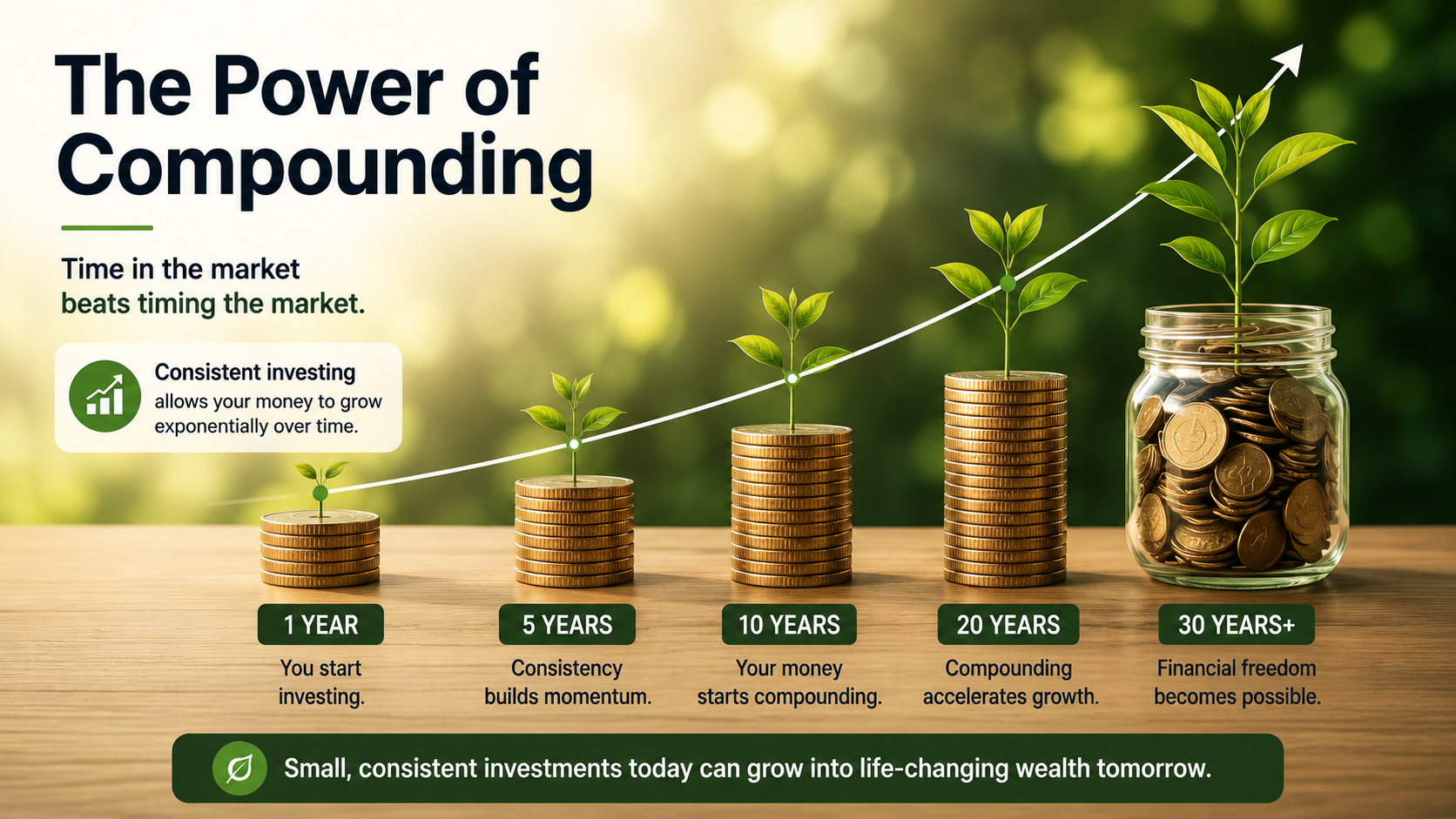
Investment costs may seem insignificant in the short term.
Over decades, however, costs compound just like returns.
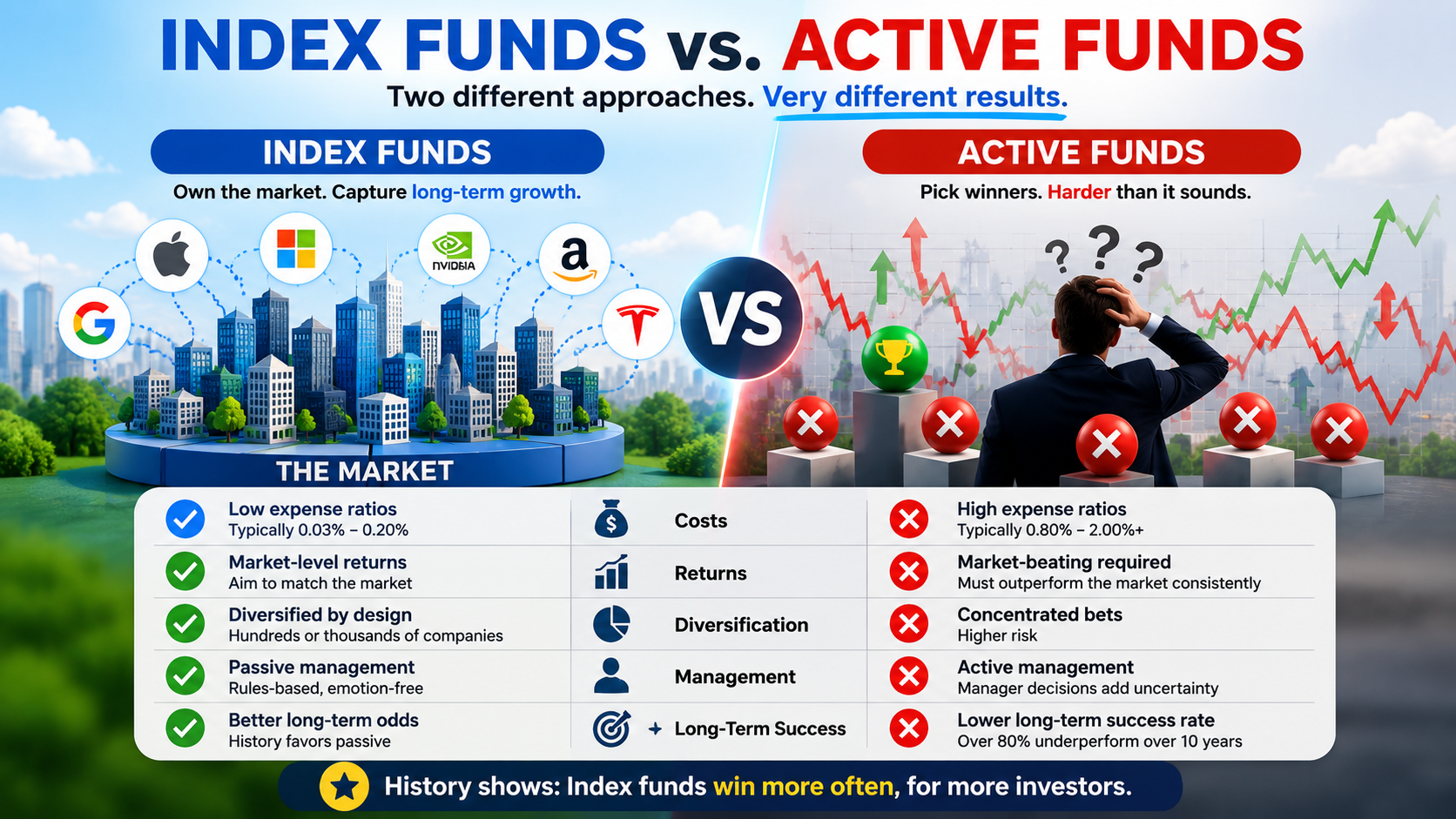
A fund charging 1% annually may not seem expensive.
But over a 30-year investing horizon, that difference can reduce final wealth by a substantial amount.
Index funds typically offer some of the lowest expense ratios available.
For long-term investors, lower costs often translate into higher net returns.
2. Built-In Diversification
Owning a single stock exposes investors to company-specific risks.
Management mistakes, competitive pressure, or industry disruption can severely impact returns.
An index fund spreads investments across hundreds or even thousands of companies.
The failure of one business rarely threatens the entire portfolio.
3. Reduced Emotional Decision-Making
One of the greatest challenges in investing is human psychology.
Investors often buy when prices are high and panic when prices fall.
They react to headlines, short-term volatility, and market noise.
Index investing removes much of this emotional pressure by focusing on a long-term process rather than short-term predictions.
4. Participation in Economic Growth
Markets are ultimately driven by innovation, productivity, and economic expansion.
Individual companies may fail.
Entire industries may disappear.
Yet throughout modern history, the broader economy has continued to evolve and grow.
Index funds allow investors to participate in that long-term growth rather than attempting to identify every future winner.
Why Does Warren Buffett Recommend Index Funds?
Few investors have a track record comparable to Warren Buffett.
Despite his extraordinary stock-picking ability, Buffett has repeatedly suggested that most investors would be better off owning a low-cost S&P 500 index fund.
His reasoning is straightforward.
Most investors do not have the time, resources, discipline, or expertise necessary to consistently outperform the market.
Rather than trying to beat the market, many investors achieve better outcomes by capturing the market's long-term return.
Buffett's message is not about avoiding investing.
It is about avoiding unnecessary complexity.
How Index Funds Impact Financial Markets
The rise of passive investing has fundamentally changed global markets.
Trillions of dollars now flow into index-based products every year.
As a result, index funds have become major drivers of capital allocation.
Asset ClassPotential Impact of Index Fund Flows
| Stocks | Increased demand for large-cap companies |
| Bonds | Improved liquidity in bond markets |
| U.S. Dollar | Continued demand for U.S. financial assets |
| Gold | May attract flows during periods of uncertainty |
| Bitcoin | Often benefits from broader liquidity expansion |
Understanding these capital flows helps investors see markets beyond daily headlines.
Key Things Investors Should Know
Pay Attention to Tracking Error
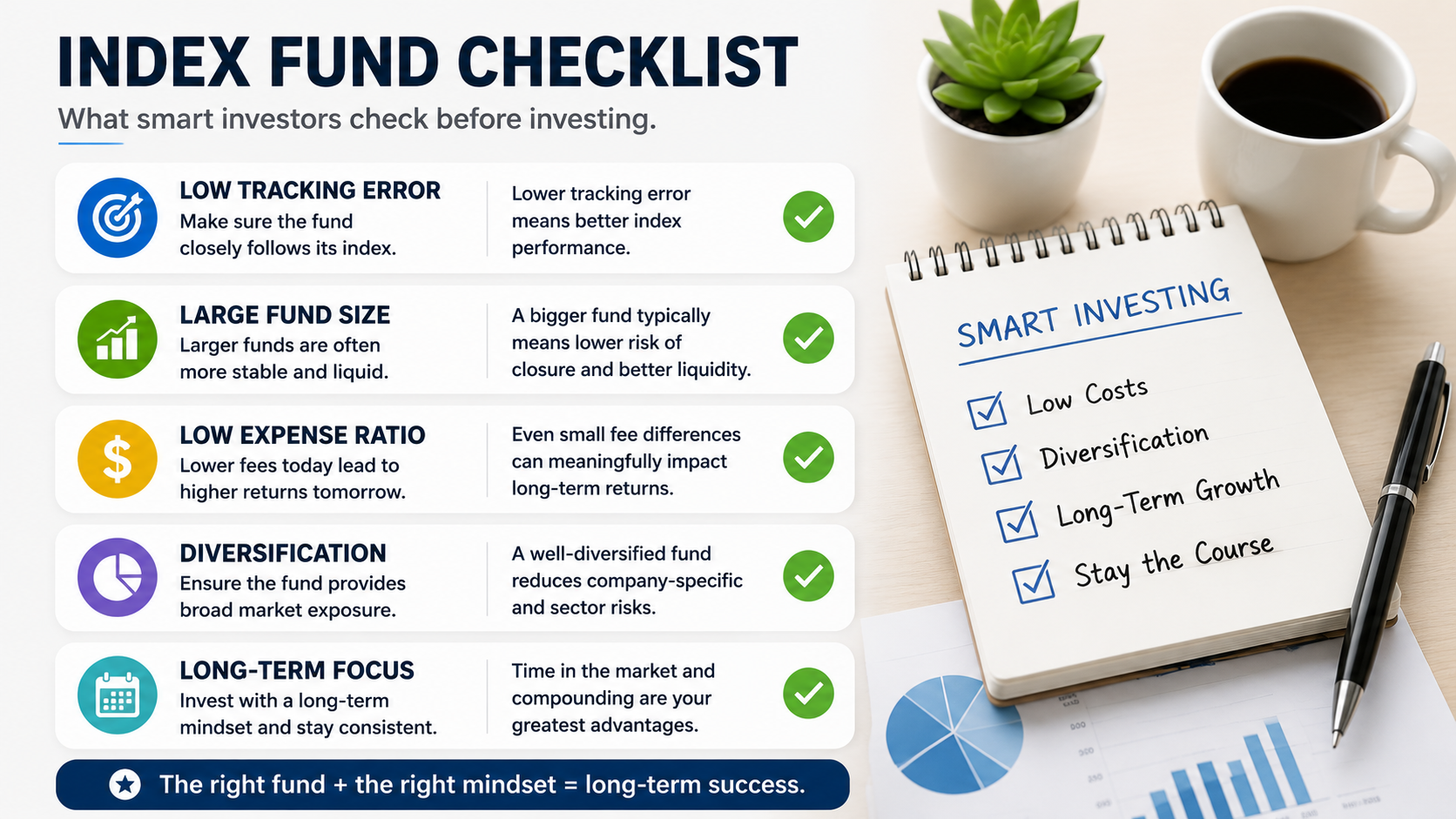
Tracking error measures how closely a fund follows its benchmark index.
Lower tracking error generally indicates a more efficient fund.
Consider Fund Size and Liquidity
Larger funds often provide better liquidity and lower operational risks.
For long-term investors, scale matters.
Focus on Time, Not Timing
Many investors spend years trying to predict market tops and bottoms.
Yet history suggests that time in the market is often more valuable than timing the market.
The longer the investment horizon, the greater the potential impact of compounding.
What Do Wealthy Investors See in This Trend?

Successful investors rarely focus solely on short-term returns.
Instead, they pay attention to capital flows, cash generation, and long-term survivability.
Where Is Money Moving?
Institutional investors, pension funds, and retirement accounts continue directing enormous amounts of capital into passive investment vehicles.
Understanding these flows can provide valuable perspective.
Are Businesses Generating Cash Flow?
Ultimately, stock prices are supported by earnings and cash generation.
Healthy businesses create long-term value.
Can the Asset Survive for Decades?
Great investors think in decades, not quarters.
They focus on assets capable of surviving economic cycles, technological disruption, and changing market conditions.
Are You Investing or Predicting?
This may be the most important question of all.
Many investors spend their time predicting.
The most successful investors often spend their time building systems.
Markets are unpredictable.
Processes are not.
Long-term investing is less about forecasting the future and more about creating a structure capable of surviving whatever future arrives.
Final Thoughts
Index funds are not exciting.
They rarely make headlines.
They do not promise overnight wealth.
What they offer instead is something far more valuable.
Low costs.
Broad diversification.
Exposure to economic growth.
And the power of compounding over time.
The true advantage of index investing is not that it beats the market.
It is that it allows investors to participate in the market's long-term success while avoiding many of the mistakes that destroy wealth.
Because in investing, survival matters more than prediction.
This was MasterMind.
'[Global] Success Blueprints' 카테고리의 다른 글