What Is an LLM (Large Language Model)? How Generative AI Works and Why It Matters


Hello, this is MasterMind.
Since the launch of ChatGPT, artificial intelligence has moved from a niche technology topic to one of the most important investment themes in the world.
NVIDIA became one of the most valuable companies in history. Big Tech firms are investing hundreds of billions of dollars into data centers, AI chips, and cloud infrastructure. Governments are racing to secure computing power and energy resources.
At the center of this transformation is a technology known as the LLM, or Large Language Model.
But what exactly is an LLM? Why are investors paying so much attention to it? And why do many analysts believe it could become the foundation of the next productivity revolution?
Let's break it down.
Key Takeaway
A Large Language Model (LLM) is the intelligence layer powering modern generative AI, and its widespread adoption could reshape productivity, corporate profitability, and global capital flows for years to come.
What Is a Large Language Model (LLM)?
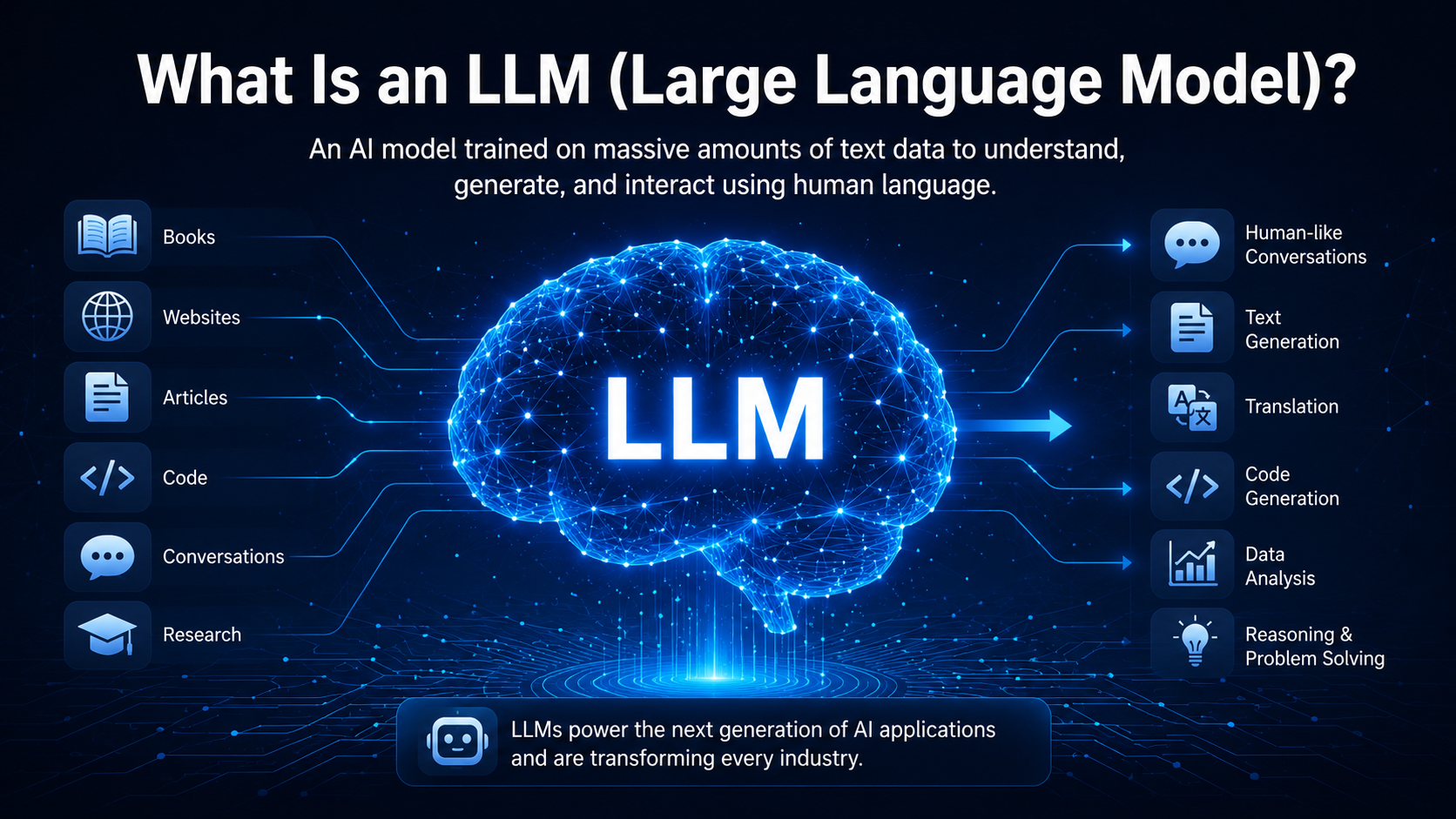
A Large Language Model, or LLM, is an artificial intelligence system trained on enormous amounts of text data to understand, generate, and interact using human language.
Think of it as a digital system that has analyzed a significant portion of humanity's written knowledge, including books, research papers, websites, technical documentation, and public conversations.
Popular examples include
| Product | LLM |
| ChatGPT | GPT Series |
| Gemini | Gemini |
| Claude | Claude |
| Copilot | GPT-based Models |
| Grok | Grok |
Many people assume these systems function like search engines.
They don't.
A search engine retrieves information.
An LLM generates responses by recognizing patterns it learned during training.
That distinction is one of the reasons generative AI has become so transformative.
How Do LLMs Work?
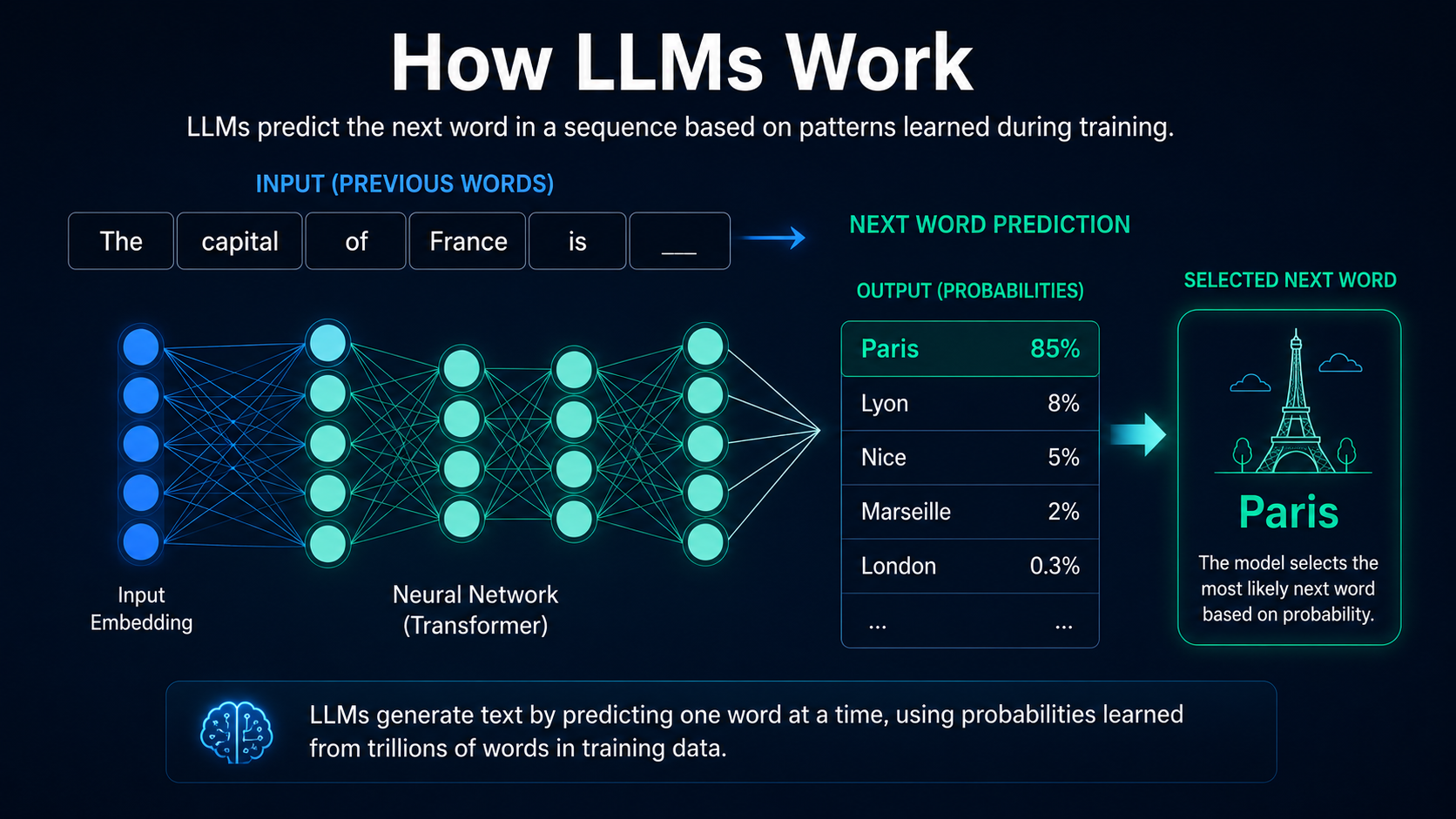
At a fundamental level, an LLM is a prediction engine.
Its primary task is surprisingly simple
Predict the most likely next word.
For example, if you read the sentence
"The capital of France is..."
You naturally expect the next word to be "Paris."
LLMs perform a similar process, but at an enormous scale.
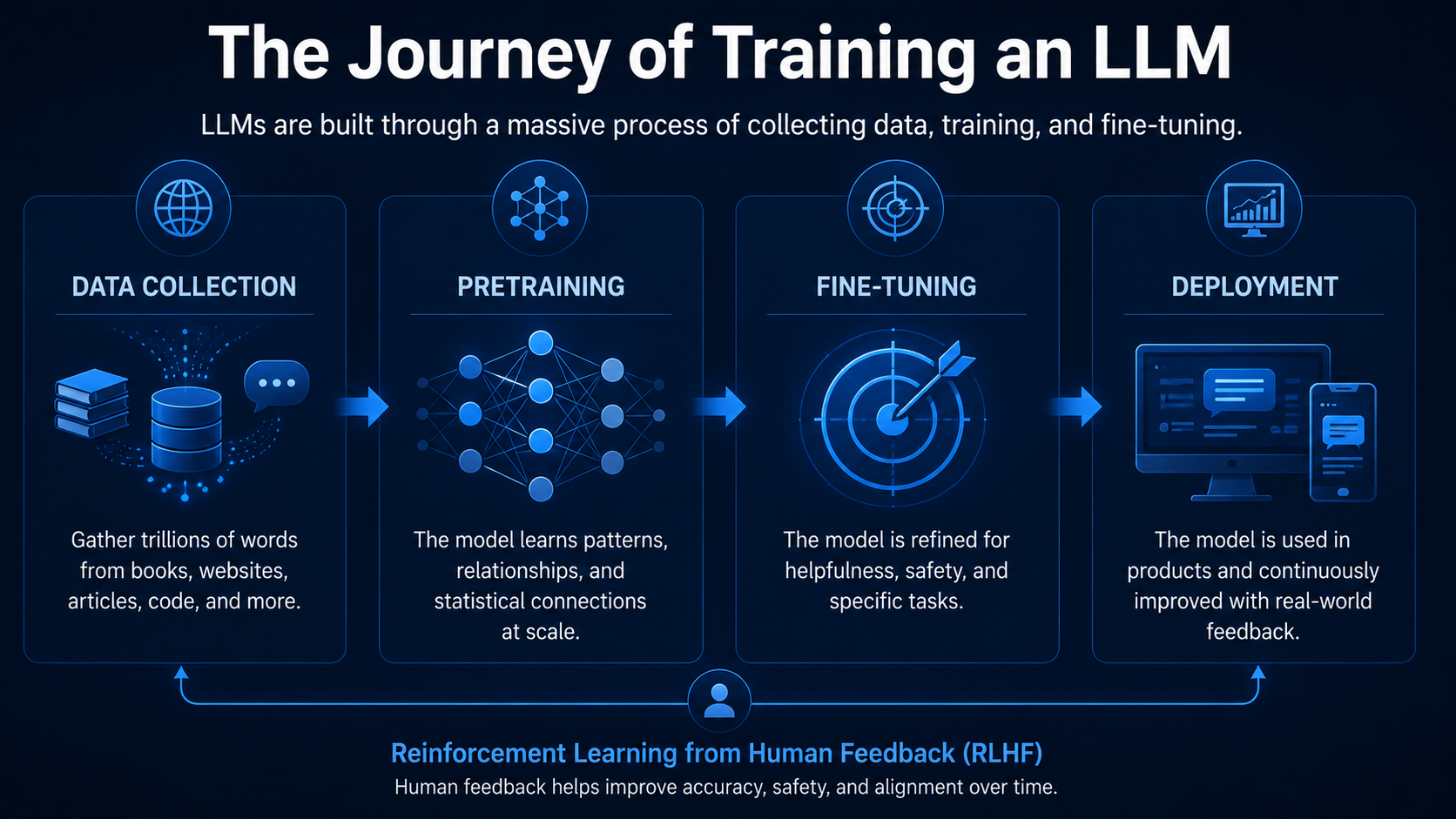
After training on trillions of words, the model learns statistical relationships between concepts, phrases, and ideas. It continuously predicts the next token, one step at a time, eventually generating paragraphs, articles, code, research summaries, and conversations.
While the process sounds simple, the scale is extraordinary.
Modern LLMs perform these predictions billions of times across massive neural networks.
The Transformer Breakthrough
The modern AI boom became possible because of a machine-learning architecture called the Transformer.
Transformers allow models to understand relationships between words and concepts across entire documents rather than processing language one word at a time.
This enables AI systems to
- Understand context
- Summarize information
- Translate languages
- Write software code
- Analyze documents
- Perform reasoning tasks
Without the Transformer architecture, ChatGPT and today's generative AI revolution would likely not exist.
The Scaling Law That Changed Everything
Another key concept behind the AI boom is the Scaling Law.
Researchers discovered that AI performance tends to improve as three things increase
- Model size
- Training data
- Computing power
This finding triggered what many investors now view as an AI infrastructure arms race.
The implication was straightforward
Bigger models plus more computing power generally lead to more capable AI systems.
As a result, technology companies began investing aggressively in
- AI chips
- Data centers
- Cloud infrastructure
- Networking equipment
- Energy capacity
The market is not simply funding software.
It is funding the infrastructure required to build increasingly powerful intelligence systems.
Why Are LLMs So Important?
The significance of LLMs extends far beyond chatbots.
Many economists view AI as a potential General Purpose Technology (GPT), a category that includes innovations such as
- The steam engine
- Electricity
- The internet
These technologies transformed entire economies because they improved productivity across many industries simultaneously.
LLMs may follow a similar path.
Instead of automating physical labor, they automate and augment knowledge work.
That distinction could have profound implications for economic growth.
Industries Being Transformed by LLMs
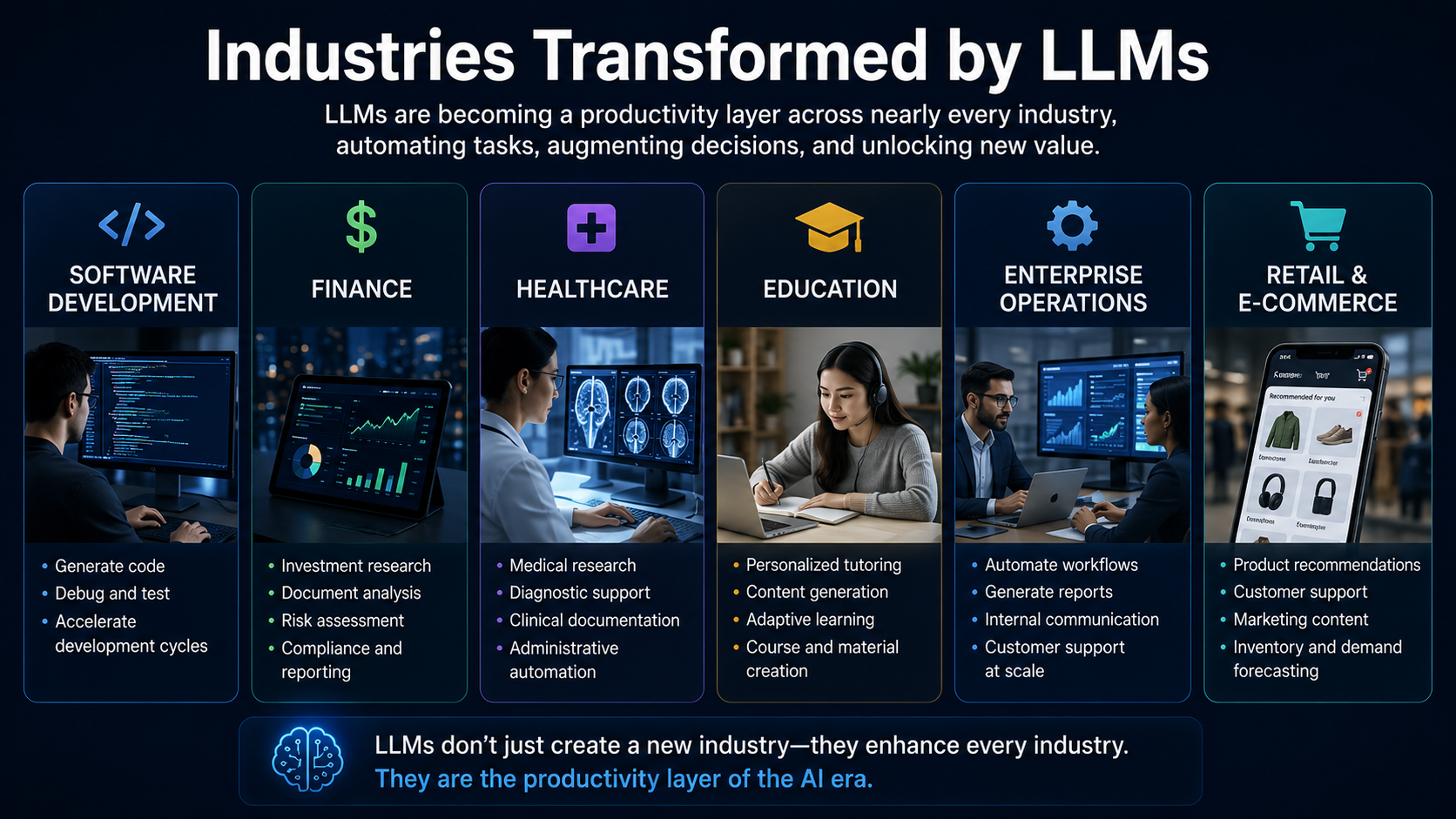
Software Development
AI can generate code, debug programs, and accelerate development cycles.
Finance
Investment research, document analysis, compliance reviews, and customer support are increasingly being enhanced by AI systems.
Healthcare
Medical research, diagnostics assistance, and administrative workflows are becoming more efficient through AI-powered tools.
Education
Personalized tutoring and adaptive learning systems are becoming increasingly accessible.
Enterprise Operations
Organizations are using AI to automate reporting, documentation, communication, and repetitive workflows.
The result is simple
LLMs are not creating a new industry.
They are becoming a productivity layer that can be applied across nearly every industry.
Why Investors Are Paying Attention
Investors ultimately care about two things
Revenue growth and profit margins.
LLMs have the potential to improve both.
Companies may be able to
- Reduce labor-intensive costs
- Increase operational efficiency
- Accelerate innovation
- Improve customer service
- Scale output without proportional increases in headcount
If successful, this could fundamentally change corporate economics.
That possibility explains why capital continues flowing toward AI-related businesses.
How LLMs Are Affecting Financial Markets
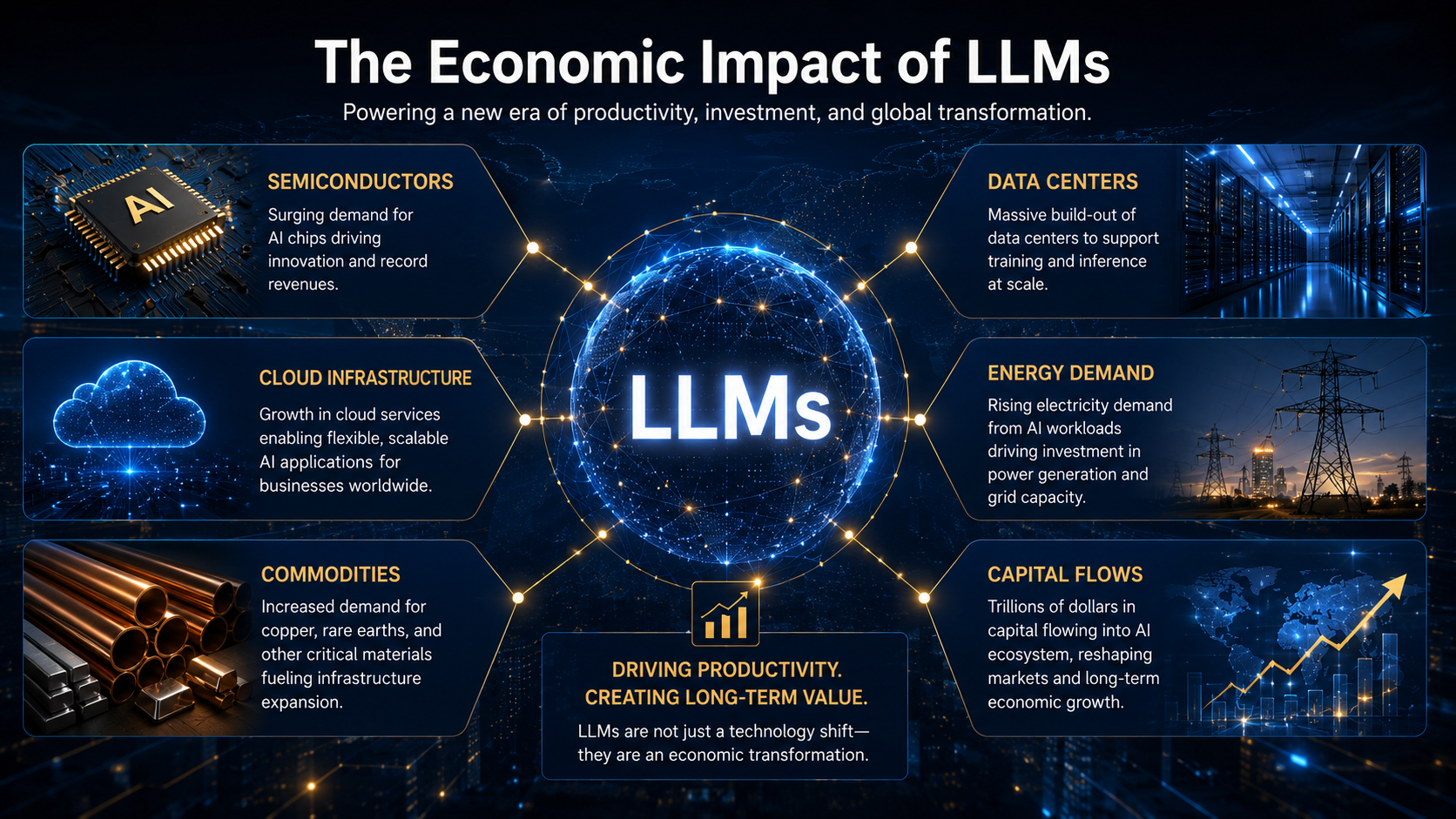
One of the most misunderstood aspects of the AI boom is where the money is actually flowing.
Many investors focus on AI applications.
However, much of the capital is moving toward infrastructure.
| Asset | ClassPotential Impact |
| Equities | Strong demand for AI, semiconductor, and cloud-related companies |
| Bonds | Massive capital expenditures may influence long-term financing needs |
| Energy | Rising electricity demand from AI data centers |
| Commodities | Increased demand for copper and infrastructure materials |
| Digital Assets | Growing discussions around AI verification, security, and decentralized systems |
A useful framework is to follow the flow of capital
AI Models → Data Centers → GPUs → Power Infrastructure → Energy Production
Markets often price these secondary effects long before they become obvious.
Key Takeaways for Investors
1. AI Success Does Not Guarantee Business Success
A powerful technology does not automatically create profitable companies.
Execution matters.
2. Return on Investment Matters
The market is increasingly shifting from AI excitement toward AI monetization.
Investors want evidence of sustainable returns.
3. Proprietary Data May Become a Competitive Advantage
As AI models become more accessible, exclusive data assets may become increasingly valuable.
4. Infrastructure Could Be as Important as Software
AI cannot operate without computing power, energy, networking, and physical infrastructure.
The winners may not always be the companies building the models.
What Are Wealthy Investors Watching?
Sophisticated investors often focus less on headlines and more on structural shifts.
Instead of asking
Which AI model is the smartest?
They ask
Where is capital flowing?
Which businesses generate durable cash flow?
Which assets become more valuable as AI adoption grows?
Many large investors are examining opportunities not only in software but also in
- Energy infrastructure
- Data centers
- Semiconductor supply chains
- Network infrastructure
- Industrial real estate
Technology changes quickly.
Infrastructure tends to endure.
Questions Investors Should Ask Themselves
- Which companies are actually generating profits from AI adoption?
- Who owns the infrastructure supporting AI growth?
- Are current valuations driven by fundamentals or expectations?
- Which businesses become stronger as AI adoption accelerates?
In investing, survival is often more important than prediction.
Understanding structural change matters more than forecasting short-term headlines.
Final Thoughts
Large Language Models are more than the technology behind ChatGPT.
They represent a new layer of digital infrastructure that could influence productivity, business models, and capital allocation across the global economy.
As with every major technological revolution, excitement will likely be followed by periods of disappointment, competition, and consolidation.
Some companies will thrive.
Many will not.
For long-term investors, the most important task is not predicting the next AI headline.
It is understanding how AI changes the flow of capital, the structure of industries, and the sources of future cash flow.
The real opportunity may not simply be in artificial intelligence itself, but in the economic ecosystem required to support it.
This was MasterMind.
Designing success.
'[Global] Success Blueprints' 카테고리의 다른 글