What Is Compound Interest? Why It Matters for Long-Term Investors


Hello, this is MasterMind.
Why do some investors build substantial wealth over time while others struggle to make meaningful progress, even when investing similar amounts of money?
Many people believe successful investing is about finding the next hot stock or predicting market movements. In reality, some of the greatest fortunes in history were built using a much simpler principle.
That principle is compound interest.
Compound interest is often described as “interest earning interest,” but that definition barely scratches the surface. It is one of the most powerful wealth-building mechanisms in capitalism, allowing money to grow exponentially when given enough time.
This is why legendary investors such as Warren Buffett consistently emphasize patience, discipline, and long-term investing.
In this article, we'll explore what compound interest is, how it works, why investors pay so much attention to it, and how it influences wealth creation across stocks, ETFs, bonds, and other assets.
Key Takeaway
Compound interest allows your returns to generate additional returns over time, creating exponential wealth growth for investors who stay invested long enough.
What Is Compound Interest?
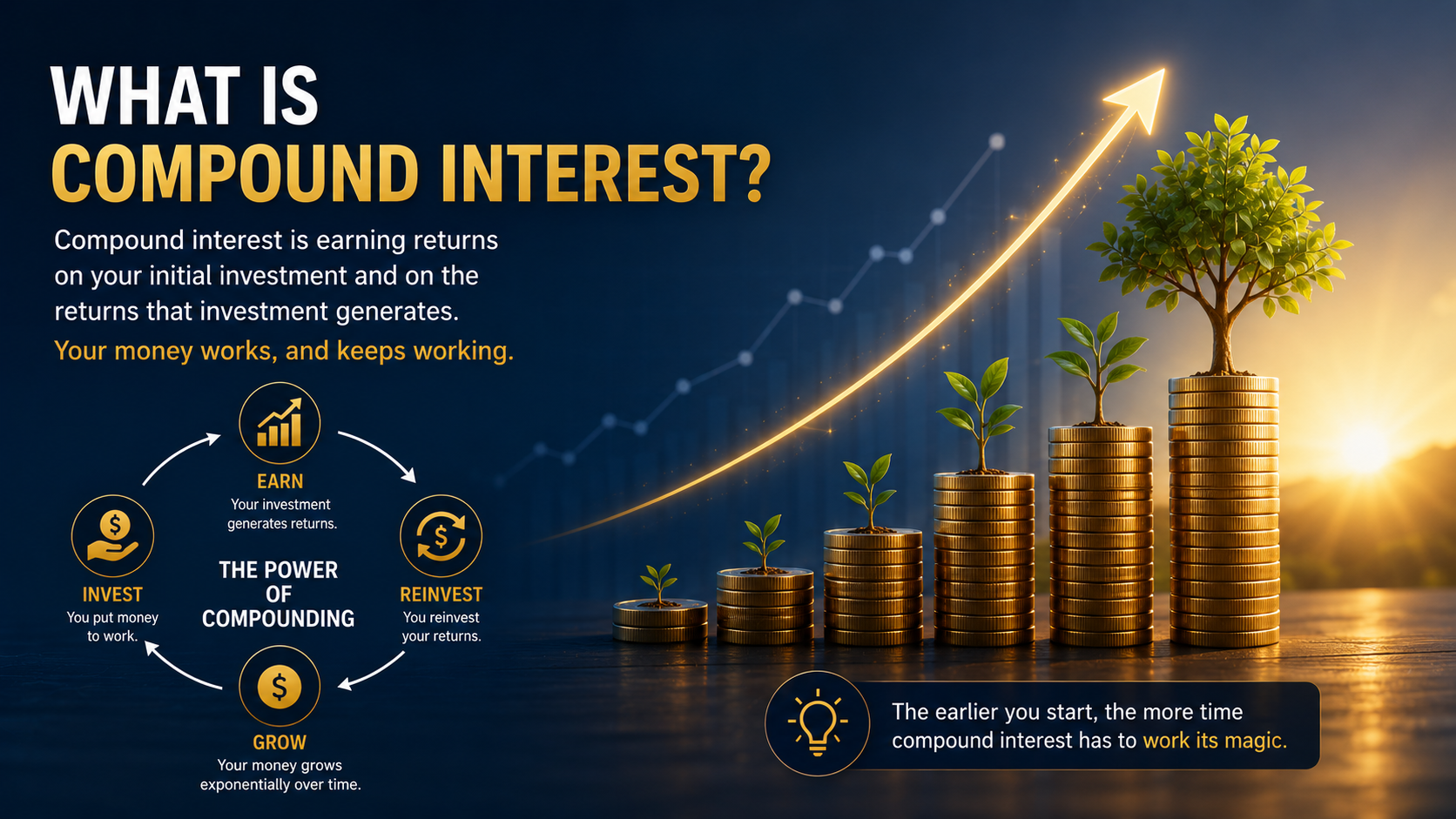
Compound interest is the process of earning returns not only on your original investment but also on the gains that investment has already generated.
In simple terms, your money starts working for itself.
This differs from simple interest, where returns are calculated only on the original principal.
Imagine investing $10,000 with an annual return of 10%.
Simple Interest
- Earn $1,000 per year
- Total profit after 10 years: $10,000
- Final value: $20,000
Compound Interest
- Year 1: $10,000 → $11,000
- Year 2: $11,000 → $12,100
- Year 3: $12,100 → $13,310
With compound interest, each year's gains become part of the principal, allowing future gains to be earned on a larger base.
At first, the difference appears small.
Over decades, the gap becomes enormous.
Compound Interest vs. Simple Interest

Many new investors understand the basic definition of compound interest but underestimate how dramatically it changes long-term outcomes.
| FeatureSimple | InterestCompound | Interest |
| Return Calculation | Principal Only | Principal + Previous Gains |
| Growth Pattern | Linear | Exponential |
| Impact of Time | Moderate | Extremely Powerful |
| Long-Term Effect | Limited | Significant |
| Wealth Creation | Steady | Accelerating |
This is why long-term investors focus so heavily on compounding.
How Compound Interest Works

One of the best ways to understand compound interest is through the snowball analogy.
Imagine rolling a small snowball down a hill.
At first, it barely changes in size.
As it continues rolling, it collects more snow.
The larger it becomes, the faster it grows.
Investing works in a similar way.
Stage 1: Accumulation
Growth feels slow because the portfolio is still relatively small.
This is often the most difficult phase psychologically.
Many investors quit before compounding has a chance to work.
Stage 2: Acceleration
Investment gains become meaningful enough to contribute significantly to future growth.
The compounding effect becomes more noticeable.
Stage 3: Exponential Growth
Portfolio size reaches a level where even average returns generate substantial dollar gains.
This is where compounding truly becomes powerful.
Why Compound Interest Matters
Time Is More Important Than Most Investors Realize
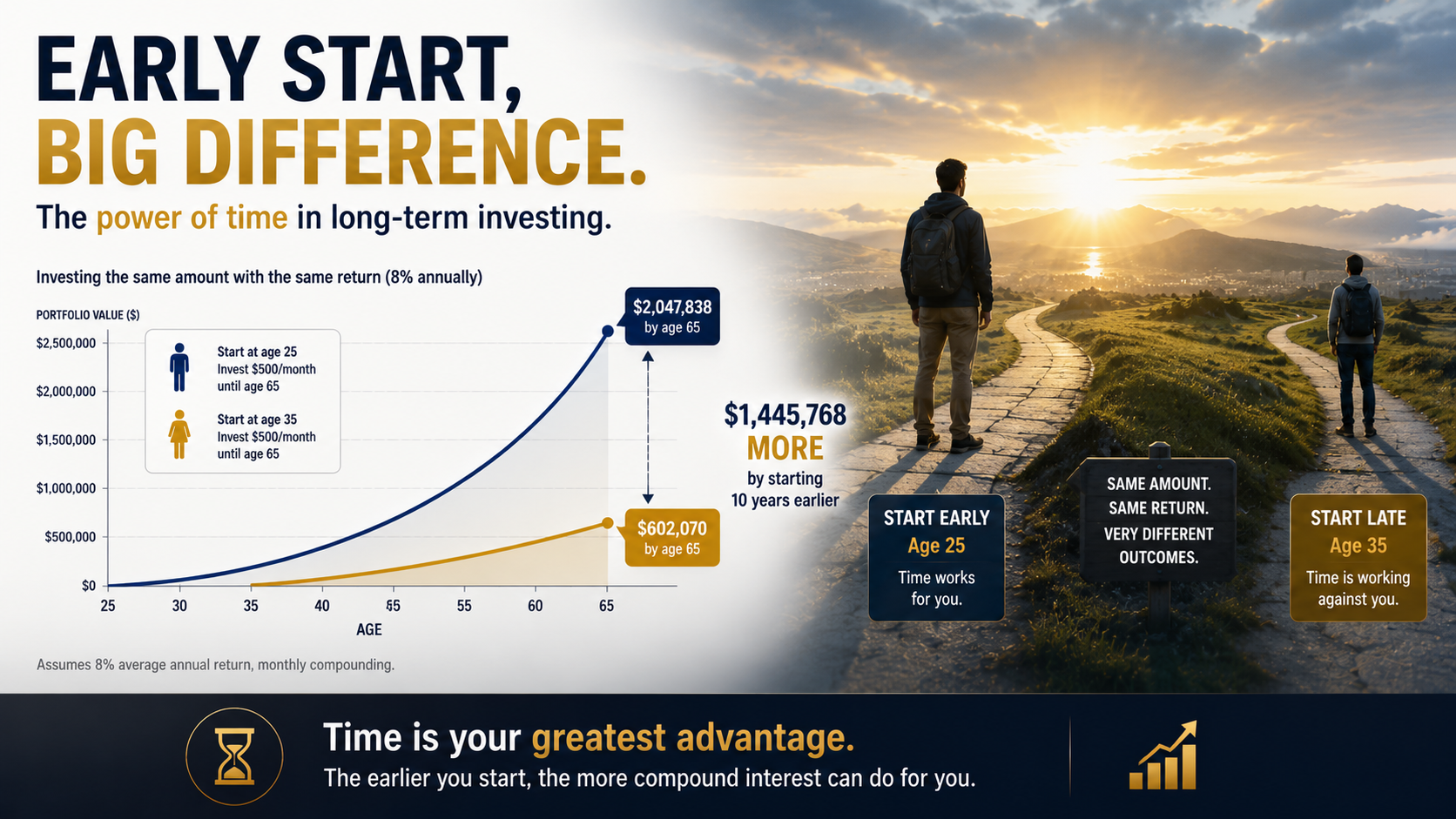
Many investors focus almost entirely on maximizing returns.
However, time is often the most important variable in the compounding equation.
A portfolio growing at 8% annually for 40 years can outperform a portfolio earning much higher returns for a shorter period.
Compound interest transforms time into one of the most valuable financial assets an investor can possess.
It Helps Investors Ignore Market Noise
Markets constantly fluctuate.
Stocks rise and fall.
News headlines create fear and excitement.
Investors who understand compounding tend to focus less on short-term volatility and more on staying invested.
They understand that temporary declines are often less important than maintaining long-term exposure to quality assets.
It Rewards Patience
Most wealth created through investing is generated in the later years of the compounding process.
This means patience is not simply a virtue in investing—it is a requirement.
How Compound Interest Impacts Different Asset Classes
Compound interest appears throughout the financial system in different ways.
| Asset | ClassHow Compounding Works |
| Stocks | Business earnings are reinvested to create future growth |
| ETFs | Long-term market appreciation compounds over time |
| Dividend Stocks | Reinvested dividends create additional returns |
| Bonds | Interest payments can be reinvested |
| Savings Accounts | Interest compounds automatically |
| Real Estate | Rental income can be reinvested |
| Gold | No internal compounding mechanism |
| Bitcoin | No cash flow or built-in compounding structure |
Dividend-paying stocks and broad-market ETFs are among the most common ways investors benefit from compounding in the United States.
Why Investors Pay Attention to Compound Interest
Compound interest is more than a mathematical formula.
It influences capital allocation, retirement planning, and long-term wealth creation.
Companies reinvest profits to grow earnings.
Investors reinvest dividends.
Retirement accounts such as 401(k)s and IRAs rely heavily on decades of compounding.
In many ways, modern wealth accumulation is built on the principle of compounding.
The market is not just about predicting prices.
It is about understanding how capital grows and where money flows over time.
Key Lessons Every Investor Should Remember
Avoid Large Losses
Compounding works both ways.
A portfolio that loses 50% must gain 100% just to break even.
Protecting capital is essential.
Reinvest Whenever Possible
Dividends, interest payments, and distributions become far more powerful when reinvested.
Reinvestment is the fuel that powers compounding.
Minimize Costs
High fees and excessive trading reduce long-term returns.
Even small expenses can significantly impact wealth over decades.
Stay Patient
Compounding often feels disappointing in the beginning.
Its greatest benefits appear much later.
What Do Wealthy Investors Look For?
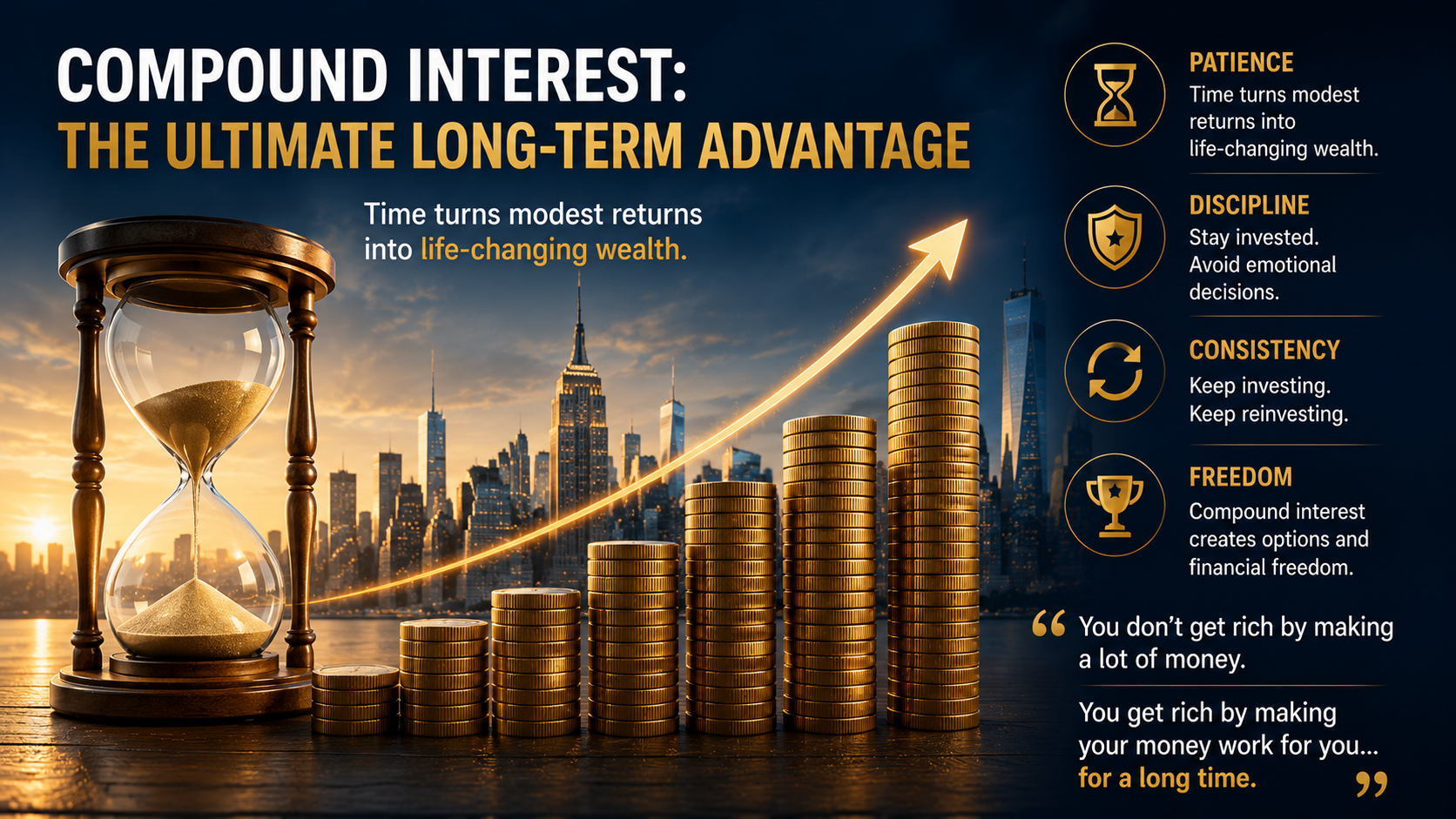
Successful investors do not simply chase high returns.
They look for systems that can compound wealth consistently for decades.
Capital Flows
They focus on assets capable of attracting and retaining capital over long periods.
Cash Flow
Businesses, dividend stocks, rental properties, and productive assets generate cash flow that can be reinvested.
Survivability
The best asset is not always the one that rises the fastest.
It is often the one that can survive and continue creating value through multiple economic cycles.
Long-Term Thinking
Wealthy investors often ask a different question than most market participants.
Instead of asking
"What will this asset do next month?"
They ask
"Will this asset still be creating value ten years from now?"
Ask yourself
- Am I focused only on short-term returns?
- Am I giving my investments enough time to compound?
- Am I reinvesting my gains?
- Are the assets I own likely to survive and thrive over the next decade?
Final Thoughts
Compound interest is not merely a financial concept.
It is one of the most powerful forces in investing.
Many investors spend years trying to predict markets.
Yet history shows that long-term wealth is often built not through perfect predictions, but through patience, discipline, and the ability to stay invested.
No one can consistently forecast every market move.
But the principles of compounding have remained unchanged for centuries.
If there is one lesson to remember, it is this
The most powerful force in investing is not an extraordinary return—it is giving compound interest enough time to work.
In the end, investing success is less about predicting the future and more about surviving long enough to benefit from compounding.
This was MasterMind.
'[Global] Success Blueprints' 카테고리의 다른 글