What Is an AI Agent? How AI Agents Work and Why They Matter



Hello, this is MasterMind.
For the past few years, artificial intelligence has been dominated by one question
How smart can AI become?
Now the conversation is changing.
The biggest technology companies in the world are no longer focused solely on building smarter chatbots. Instead, they are racing toward something potentially far more valuable: AI agents.
Imagine an AI that does more than answer questions.
An AI that researches information, writes reports, sends emails, schedules meetings, analyzes data, and completes tasks on your behalf.
That is the promise of AI agents.
Many investors believe this could become the next major phase of the AI revolution, potentially transforming productivity, labor markets, and corporate profitability over the coming decade.
So what exactly is an AI agent, and why are investors paying so much attention?
Key Takeaway
An AI agent is an autonomous AI system that can understand goals, create plans, use tools, and execute tasks with minimal human involvement.
What Is an AI Agent?

An AI agent is an artificial intelligence system designed to achieve objectives rather than simply generate responses.
Traditional generative AI systems such as ChatGPT are primarily reactive.
You ask a question.
The AI provides an answer.
The interaction ends.
AI agents work differently.
Instead of responding to a single prompt, they can break down a goal into multiple steps and execute those steps independently.
For example
A traditional chatbot might explain how to book a business trip.
An AI agent could
- Search for flights
- Compare hotel prices
- Check your calendar
- Schedule meetings
- Complete reservations
The difference is simple.
Generative AI provides information.
AI agents perform actions.
How AI Agents Work

Although implementations vary, most AI agents are built around four core components.
1. Large Language Models (LLMs)
The LLM serves as the agent's brain.
It interprets human instructions, understands context, and determines what actions should be taken.
Without LLMs, modern AI agents would not be possible.
2. Planning
Once a goal is received, the agent creates a step-by-step strategy.
For example, if asked to produce an investment research report, the agent might
- Gather market data
- Analyze financial information
- Review recent news
- Summarize key findings
- Generate a final report
This planning capability allows the system to handle complex tasks rather than isolated requests.
3. Memory
Effective AI agents need memory.
Short-term memory helps maintain context during an ongoing task.
Long-term memory allows the agent to remember user preferences, previous projects, and historical interactions.
Over time, this creates more personalized and efficient performance.
4. Tool Usage
This is where AI agents become truly powerful.
Instead of generating text alone, they can interact with external tools such as
- Web browsers
- Databases
- Email platforms
- Calendars
- Spreadsheets
- Enterprise software
- Payment systems
The ability to use tools transforms AI from a knowledge system into an execution system.
Why AI Agents Matter

The significance of AI agents extends far beyond technology.
At its core, this is a productivity story.
Previous technological revolutions helped humans perform work more efficiently.
AI agents aim to perform portions of the work itself.
This shift could fundamentally alter how companies operate.
Businesses spend enormous amounts of money on repetitive knowledge work
- Customer support
- Data entry
- Research
- Administrative tasks
- Reporting
- Scheduling
If AI agents can automate even a fraction of these activities, the economic impact could be enormous.
This is why many industry leaders view AI agents as the next major layer of the AI economy.
Why Big Tech Is Investing So Aggressively
The first phase of the AI race focused on building the most capable models.
The next phase focuses on delivering real-world outcomes.
Technology giants understand that users ultimately care less about how impressive an AI model sounds and more about what it can accomplish.
An AI that writes an email is useful.
An AI that manages an entire workflow is potentially transformative.
As a result, companies are investing heavily in agent frameworks, enterprise integrations, and autonomous software systems.
The winner may not simply be the company with the smartest AI.
It may be the company whose AI performs the most valuable work.
How AI Agents Could Impact Financial Markets
Like every major technological shift, AI agents may create both opportunities and risks across asset classes.
| Asset | ClassPotential Impact |
| Stocks | Increased productivity could support corporate earnings growth |
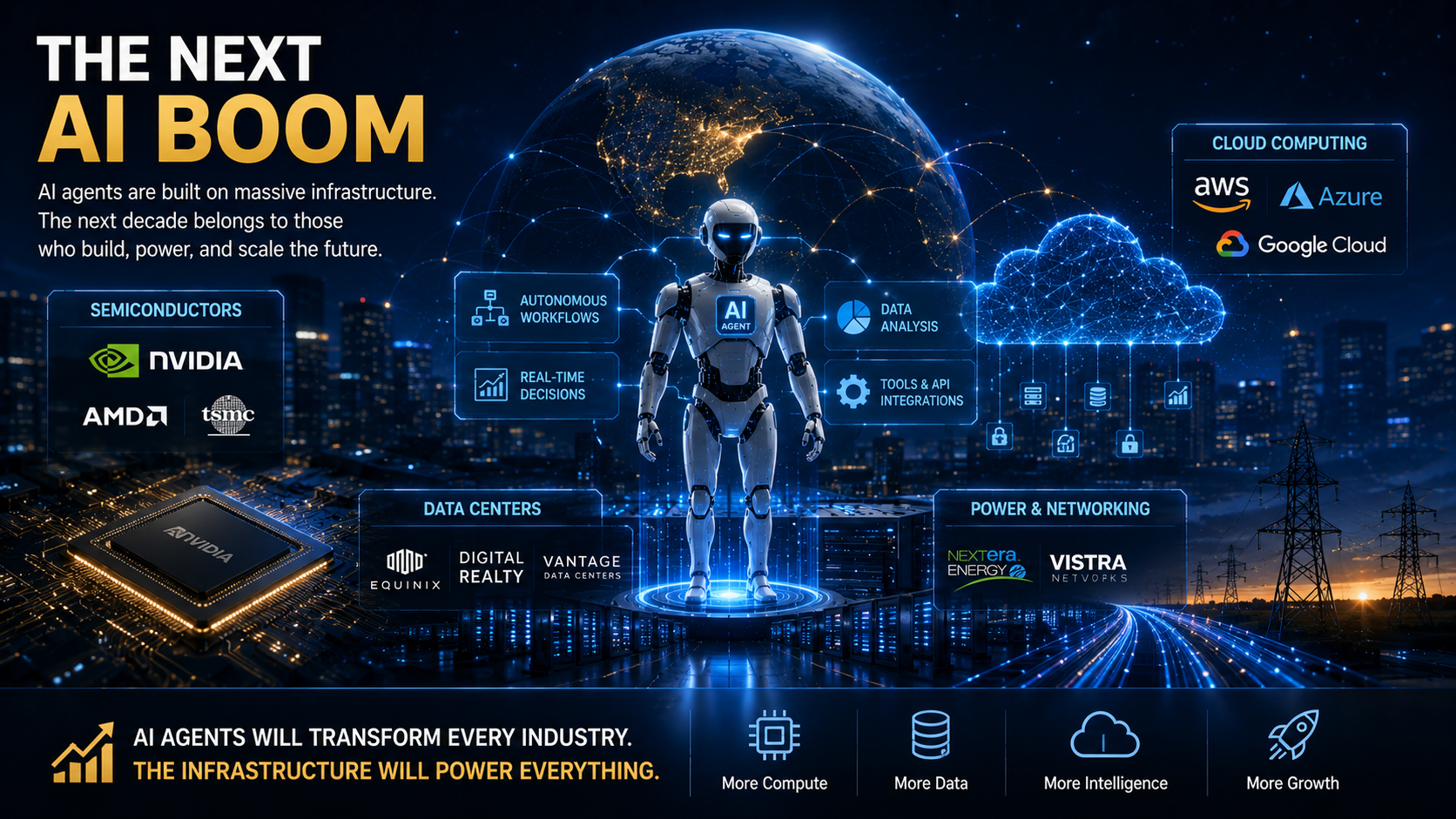
| Semiconductors | Demand for AI computing power may continue rising |
| Data Centers | Growing AI workloads require massive infrastructure investment |
| Cloud Computing | More autonomous systems increase cloud usage |
| Bonds | Productivity gains could help contain long-term inflation pressures |
| Bitcoin | Increased digital automation may strengthen interest in digital assets |
| U.S. Dollar | Continued U.S. leadership in AI could attract global capital |
Markets ultimately care about one thing
Future cash flows.
The long-term value of AI agents will depend on how much productivity and profitability they create.
Key Points Investors Should Understand
AI Models and AI Agents Are Not the Same
Many investors use these terms interchangeably.
However, AI models generate intelligence.
AI agents apply that intelligence to accomplish tasks.
This distinction may become increasingly important as the industry evolves.
Infrastructure Remains Critical
Every AI agent relies on computing power.
As adoption grows, demand for GPUs, data centers, networking equipment, and energy infrastructure may continue expanding.
Platforms Have a Competitive Advantage
Companies with access to user data, workflows, and ecosystems may hold significant advantages.
Operating systems, cloud platforms, and enterprise software providers could become key beneficiaries.
Productivity Is the Real Metric
The market will eventually focus less on AI demonstrations and more on measurable business results.
The companies that create genuine productivity gains are likely to capture the greatest value.
What Are Wealthy Investors Watching?
Experienced investors rarely focus on technology alone.
Instead, they follow the movement of capital.
When evaluating AI agents, they ask questions such as
- Where is money flowing?
- Which industries gain pricing power?
- Which businesses improve margins?
- Which companies become more resilient?
The biggest winners may not always be the most exciting AI startups.
They may be the companies that successfully use AI agents to improve cash flow, reduce costs, and strengthen competitive advantages.
Technology creates headlines.
Cash flow creates wealth.
That distinction matters.
Before investing in any AI-related company, consider
- Does this business benefit from AI adoption?
- Can AI improve its profitability?
- Does it possess durable competitive advantages?
- Can it generate sustainable long-term cash flow?
In investing, survival is often more important than prediction.
Final Thoughts
AI agents represent a major evolution in artificial intelligence.
Instead of simply generating information, they can understand objectives, create plans, use tools, and execute tasks.
This shift has the potential to reshape productivity, business operations, and the global economy over the coming decade.
For investors, the most important question is not how intelligent AI becomes.
The more important question is where the resulting productivity gains, cash flows, and capital flows ultimately lead.
Because markets do not reward technology alone.
They reward the businesses that successfully turn technology into economic value.
This was MasterMind.
Designing success.
'[Global] Success Blueprints' 카테고리의 다른 글