How Do Banks Create Money? Why Credit Creation Drives the Economy and Asset Prices


Hello, this is MasterMind.
When most people think about money, they imagine physical cash printed by the government. But what if I told you that most of the money circulating in the U.S. economy was never printed at all?
In fact, if every American tried to withdraw all the money shown in their bank accounts at the same time, the banking system would be unable to provide it.
That may sound alarming, but it is actually how modern finance is designed to work.
The reality is that most money today exists as digital bank deposits, and those deposits are largely created through lending.
Understanding how banks create money is one of the most important concepts in economics, investing, and financial markets. It explains why asset prices rise, why inflation occurs, and why central bank policy has such a powerful influence on the economy.
Today, we'll explore the mechanics of credit creation and why it matters for investors.
Key Takeaway
Most money in the modern economy is not created by printing cash. It is created by commercial banks when they issue loans.
What Is Credit Creation?
Many people assume banks simply take deposits from savers and lend them to borrowers.
While that description contains some truth, it misses the most important part of the story.
Modern banks do not merely move existing money from one person to another.
They create new money through lending.
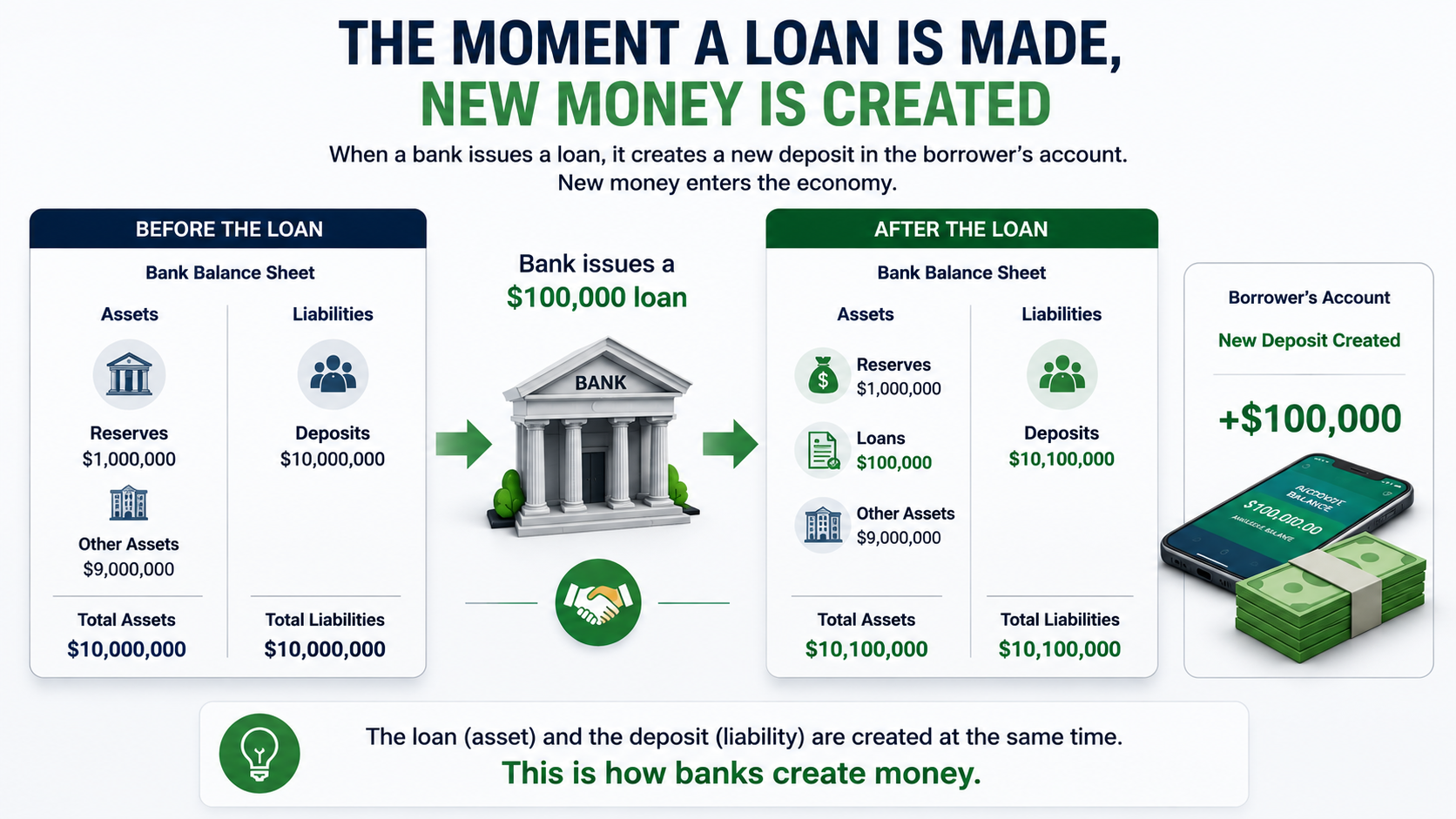
When a borrower receives a mortgage, business loan, or personal loan, the bank typically does not hand over existing cash from a vault. Instead, the bank credits the borrower's account with a new deposit.
At that moment, new money enters the financial system.
Consider a simple example.
Suppose a borrower takes out a $100,000 mortgage.
The bank's balance sheet changes as follows
| Bank Assets | Bank Liabilities |
| Loan Receivable: $100,000 | Customer Deposit: $100,000 |
The loan becomes an asset for the bank.
The newly created deposit becomes a liability.
Both appear simultaneously.
In other words, the bank creates a new deposit when it creates a new loan.
This process is known as credit creation.
How Credit Creation Expands the Money Supply

To understand the power of the banking system, imagine that a customer deposits $1,000 into a bank.
The bank keeps a portion of that deposit available for withdrawals and lends the rest to another borrower.
That borrower spends the money.
The recipient deposits the funds into another bank.
That bank then makes another loan.
The process continues throughout the economy.
As lending and redepositing repeat, the total amount of bank deposits grows far beyond the original amount of physical money.
The key insight is that the financial system is expanding credit, not necessarily expanding physical cash.
This is why economists often describe modern money as a system built on trust and credit rather than paper currency.
When you open your banking app and see a balance in your account, much of that money exists because somewhere in the system, someone has borrowed money.
Can Banks Create Unlimited Money?
No.
Banks operate under several important constraints.
Interest Rates
Interest rates represent the cost of borrowing money.
When rates rise, borrowing becomes more expensive.
Consumers buy fewer homes.
Businesses invest less aggressively.
Credit growth slows.
When rates fall, borrowing tends to increase and money creation accelerates.
Capital Requirements
Modern banking regulation requires banks to maintain sufficient capital relative to their assets.
This limits excessive lending and helps protect financial stability.
Loan Demand
Even if banks are willing to lend, money creation slows if consumers and businesses are unwilling to borrow.
Credit creation requires both lenders and borrowers.
Credit Risk
Banks must evaluate whether borrowers can repay their debts.
Poor lending decisions can lead to defaults and financial losses.
For this reason, banks cannot create money without considering risk.
Why Credit Creation Matters
Credit creation is not just a banking concept.
It is one of the primary engines of economic growth.
Businesses borrow to build factories, develop products, and hire workers.
Consumers borrow to purchase homes, cars, and other major assets.
In many ways, credit allows future economic activity to be brought into the present.
This is why financial markets pay close attention to lending activity and liquidity conditions.
Markets are not driven solely by earnings reports or economic headlines.
They are also driven by the availability of money and credit.
One of the most important realities investors eventually discover is that asset prices are heavily influenced by liquidity.
When credit expands, money has somewhere to go.
When credit contracts, liquidity becomes scarce.
Why the Value of Money Changes Over Time
The modern financial system is built on expanding credit.
As economies grow, the supply of money generally grows as well.
Over long periods, this tends to reduce the purchasing power of cash.
This does not mean money becomes worthless.
It means that the same dollar often buys less over time than it did decades earlier.
For investors, this creates an important challenge.
Holding cash provides stability, but preserving purchasing power often requires owning productive assets that can grow faster than inflation.
This is one reason stocks, real estate, and businesses have historically played such a significant role in long-term wealth creation.
How Credit Creation Affects Financial Markets
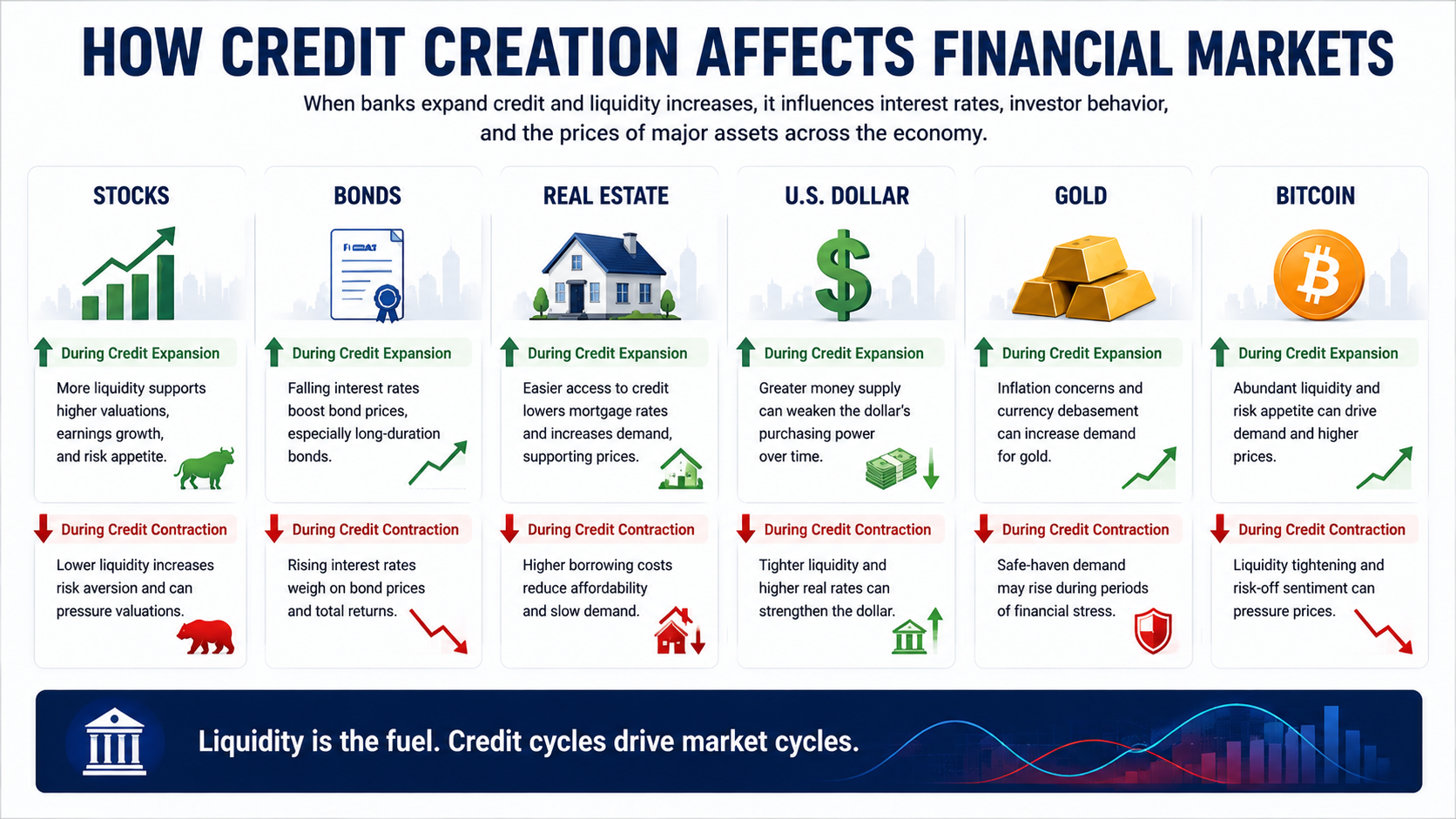
Credit Cycle Transmission: Asset Performance Matrix
| Asset Class | During Credit ExpansionDuring | During Credit Contraction |
| Stocks | Higher liquidity can support valuations and earnings growth | Lower liquidity can pressure valuations |
| Bonds | Falling rates often support bond prices | Rising rates can weigh on bond prices |
| Real Estate | Easier access to credit can increase demand | Higher borrowing costs can reduce demand |
| U.S. Dollar | Greater money supply may weaken purchasing power | Scarcer liquidity may strengthen the dollar |
| Gold | Often benefits from inflation concerns | Can benefit from risk-off sentiment |
| Bitcoin | May benefit from abundant liquidity and risk appetite | Can face pressure during liquidity tightening |
Every asset market is influenced by liquidity conditions.
Understanding credit cycles often provides valuable context for understanding market cycles.
Key Indicators Investors Should Watch
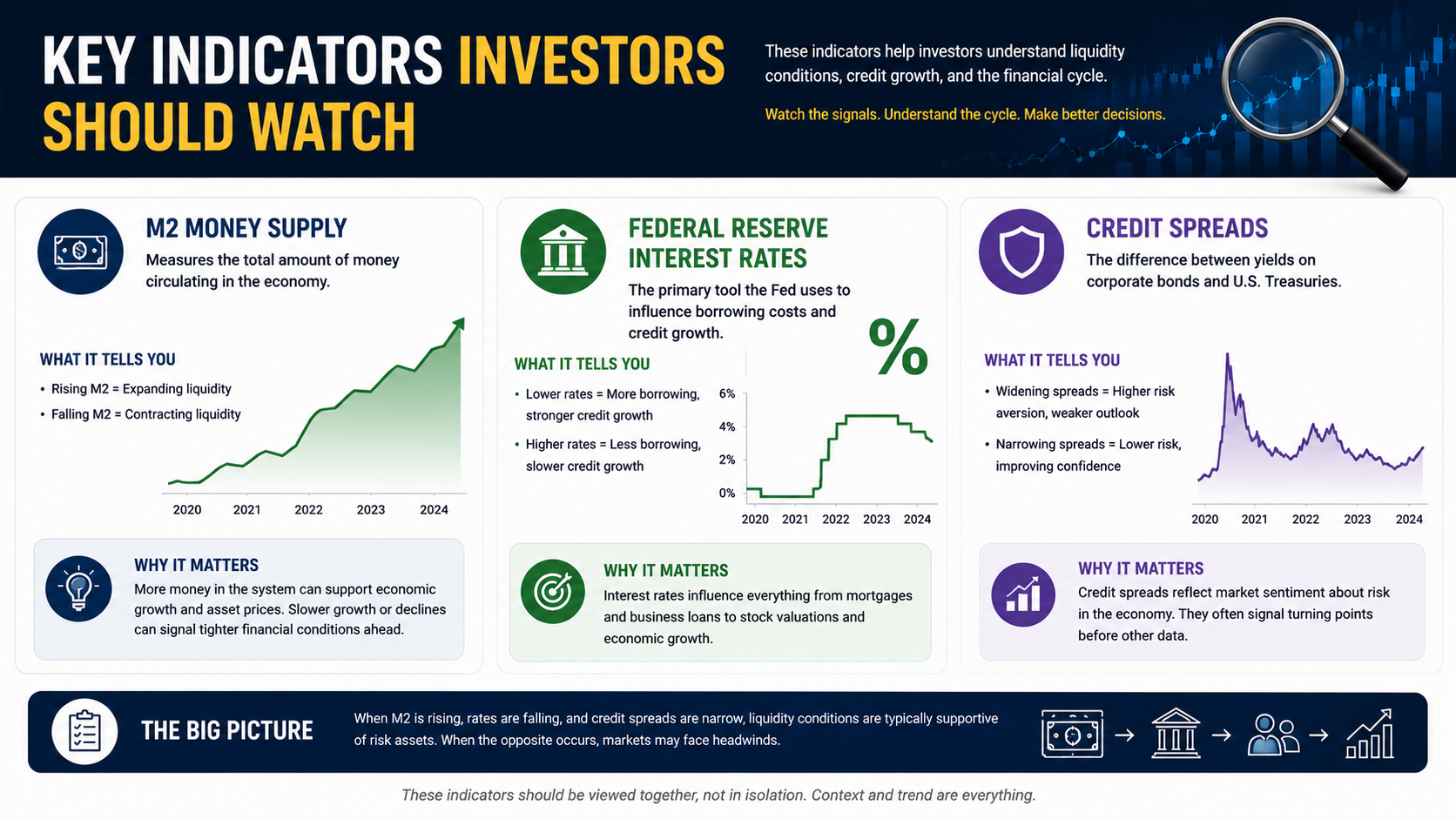
M2 Money Supply
M2 measures the amount of money circulating throughout the economy.
Rapid growth can indicate expanding liquidity conditions.
Federal Reserve Interest Rates
Interest rates directly influence borrowing costs and credit growth.
They are among the most important variables in financial markets.
Credit Spreads
Credit spreads measure the difference between yields on safer bonds and riskier bonds.
Widening spreads often indicate growing concerns about economic risk.
Narrowing spreads can suggest improving confidence and increasing risk appetite.
Together, these indicators help investors understand whether the financial system is expanding or contracting credit.
What Wealthy Investors Focus On
Sophisticated investors rarely ask only one question
"What should I buy next?"
Instead, they ask a deeper question
"Where is money flowing?"
Following Capital Flows
Newly created credit does not enter all sectors equally.
Some industries attract more capital than others.
Understanding where money is flowing can reveal emerging opportunities and risks.
Cash Flow Matters
In changing economic environments, businesses with strong and consistent cash flow often demonstrate greater resilience.
Asset Survivability
The goal is not merely maximizing returns.
The goal is surviving through multiple market cycles.
Highly leveraged assets often perform well during credit booms but can become vulnerable when liquidity tightens.
Thinking Long Term
Successful investors focus on preserving and growing purchasing power over decades, not weeks.
Ask yourself
- Is credit expanding or contracting today?
- What direction are interest rates moving?
- Where is liquidity flowing?
- Would my portfolio survive a period of tighter financial conditions?
In investing, survival often matters more than prediction.
Final Thoughts
Banks are far more than institutions that store money.
They are central participants in the creation of money itself.
Through lending and credit creation, banks influence economic growth, liquidity, inflation, and asset prices across the financial system.
Understanding how banks create money provides a deeper understanding of how markets function.
Once you understand where money comes from, it becomes much easier to understand where money is going.
And in investing, following the flow of money is often more valuable than following the headlines.
This was MasterMind.
'[Global] Success Blueprints' 카테고리의 다른 글