What Is Inflation? Causes, Market Impact, and Why Investors Should Care


Hello, this is MasterMind.
Why does it feel like everything gets more expensive over time?
You may notice that a grocery bill today buys less than it did a few years ago. The same paycheck that once covered your monthly expenses comfortably may no longer go as far. Most people call this rising prices, but from an economic perspective, something deeper is happening.
The value of money itself is changing.
So what exactly is inflation? Why does it happen? And why do investors, economists, and central banks pay so much attention to it?
Understanding inflation is one of the most important steps toward understanding how economies grow, how financial markets move, and how wealth is preserved over the long term.
Key Takeaway
Inflation is not simply the rise in prices. It is the decline in the purchasing power of money, and it plays a central role in shaping interest rates, asset prices, and capital flows throughout the global economy.
What Is Inflation?
Inflation is the sustained increase in the general price level of goods and services over time.
In simple terms, inflation means that the same amount of money buys fewer goods than it did in the past.
Imagine that a basket of groceries costs $100 today. If the same basket costs $105 next year, inflation has occurred.
While most people focus on the higher prices, investors often view inflation from the opposite perspective.
The products themselves may not have become significantly more valuable. Instead, the purchasing power of the currency has declined.
This is why inflation is often described as a hidden tax on savings.
If money loses value each year, holding cash alone may gradually reduce purchasing power over time.
What Causes Inflation?
Inflation does not emerge from a single source. Economists generally classify inflation into three major categories.

1. Demand-Pull Inflation
Demand-pull inflation occurs when demand for goods and services grows faster than supply.
As economies expand, consumers spend more and businesses invest more. If production cannot keep up with rising demand, prices naturally increase.
A simple example is a concert with 10,000 available seats and 100,000 people trying to buy tickets. Prices rise because demand exceeds supply.
In a healthy economy, moderate demand-pull inflation is often a sign of economic growth.
2. Cost-Push Inflation
Cost-push inflation occurs when production costs increase.
Businesses face higher expenses from
- Rising energy prices
- Higher wages
- Increased transportation costs
- More expensive raw materials
To protect profit margins, companies often pass these costs on to consumers through higher prices.
This type of inflation can be particularly challenging because it may occur even when economic growth is weak.
Supply chain disruptions and energy crises are common examples of cost-push inflation.
3. Monetary Inflation
Many investors pay the closest attention to monetary inflation.
This occurs when the money supply grows faster than the production of goods and services.
When central banks lower interest rates or inject liquidity into the financial system, more money becomes available throughout the economy.
If the quantity of goods remains relatively unchanged while the amount of money increases substantially, prices often rise.
In other words, the scarcity of money decreases, reducing its value.
This relationship between money supply and purchasing power has been one of the most important economic principles throughout history.
Why Is Inflation Important?
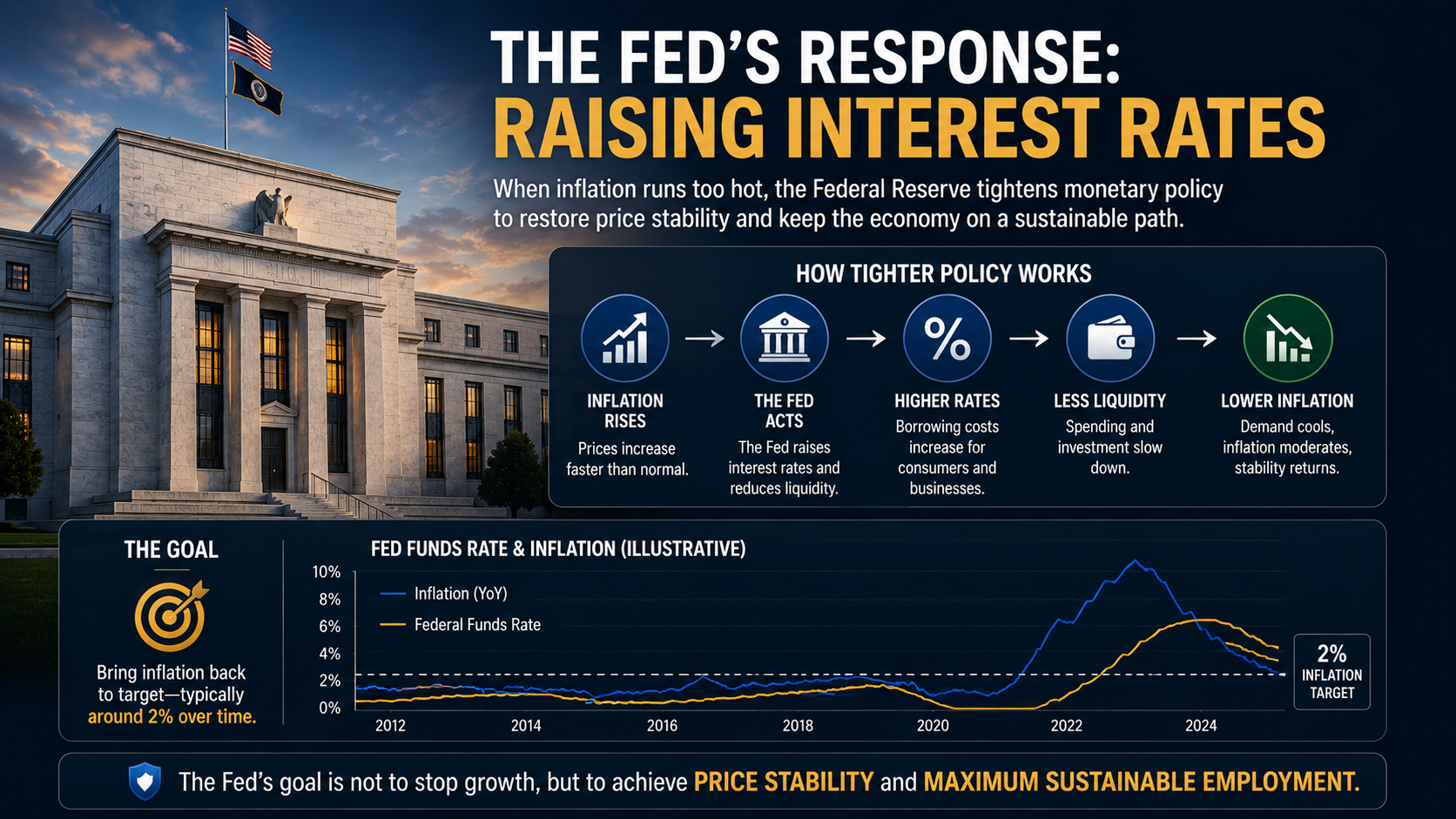
Inflation matters because it strongly influences central bank policy.
Most central banks have a mandate to maintain price stability.
When inflation rises too quickly, policymakers often respond by increasing interest rates.
Higher interest rates generally lead to
- Reduced borrowing
- Lower consumer spending
- Slower business investment
- Less liquidity in financial markets
When inflation falls toward target levels, central banks may eventually lower interest rates, supporting economic growth and market liquidity.
As a result, inflation is far more than a simple economic statistic.
It is one of the key drivers of global capital flows and financial market performance.
Markets are driven not only by earnings and growth, but by the movement of money. Inflation often determines where that money goes next.
How Inflation Affects Financial Markets

Inflation impacts nearly every major asset class.
However, the effects are rarely uniform.
| Asset Class | Typical Impact | Key Reason |
| Stocks | Mixed | Companies with strong pricing power often perform better than those facing margin pressure |
| Bonds | Negative | Rising inflation often leads to higher interest rates and lower bond prices |
| U.S. Dollar | Potentially Positive | Higher interest rates may attract global capital |
| Gold | Positive | Often viewed as a store of value during inflationary periods |
| Commodities | Positive | Physical assets tend to benefit from rising prices |
| Real Estate | Potentially Positive | Tangible assets may help preserve purchasing power |
| Bitcoin | Higher Volatility | Viewed by some as digital scarcity but still influenced by liquidity conditions |
One important lesson is that inflation itself does not determine market outcomes.
The response from central banks often matters even more.
The same inflation rate can produce very different market reactions depending on monetary policy expectations.
Why Markets Often Fear Interest Rates More Than Inflation
Investors frequently react more strongly to interest rate changes than to inflation itself.
The reason is simple.
Interest rates influence the valuation of nearly every financial asset.
Higher rates increase borrowing costs and reduce the present value of future cash flows.
This is especially important for growth stocks, whose valuations depend heavily on future earnings.
As a result, investors often focus less on the current inflation number and more on what that number implies for future monetary policy.
The key question becomes
How will central banks respond?
Key Lessons for Investors
Focus on Trends, Not Just Levels
Markets often react more to the direction of inflation than to the absolute number.
Is inflation accelerating?
Is it slowing down?
These trend changes frequently matter more than the headline figure itself.
Think in Real Returns
A portfolio that gains 5% during a year with 6% inflation has actually lost purchasing power.
Successful investing is not just about growing account balances.
It is about increasing wealth after adjusting for inflation.
Follow Capital Flows
Money constantly moves toward assets that investors believe can preserve value.
Understanding where capital is flowing can provide valuable insight into broader market trends.
What Do Wealthy Investors Look For During Inflation?
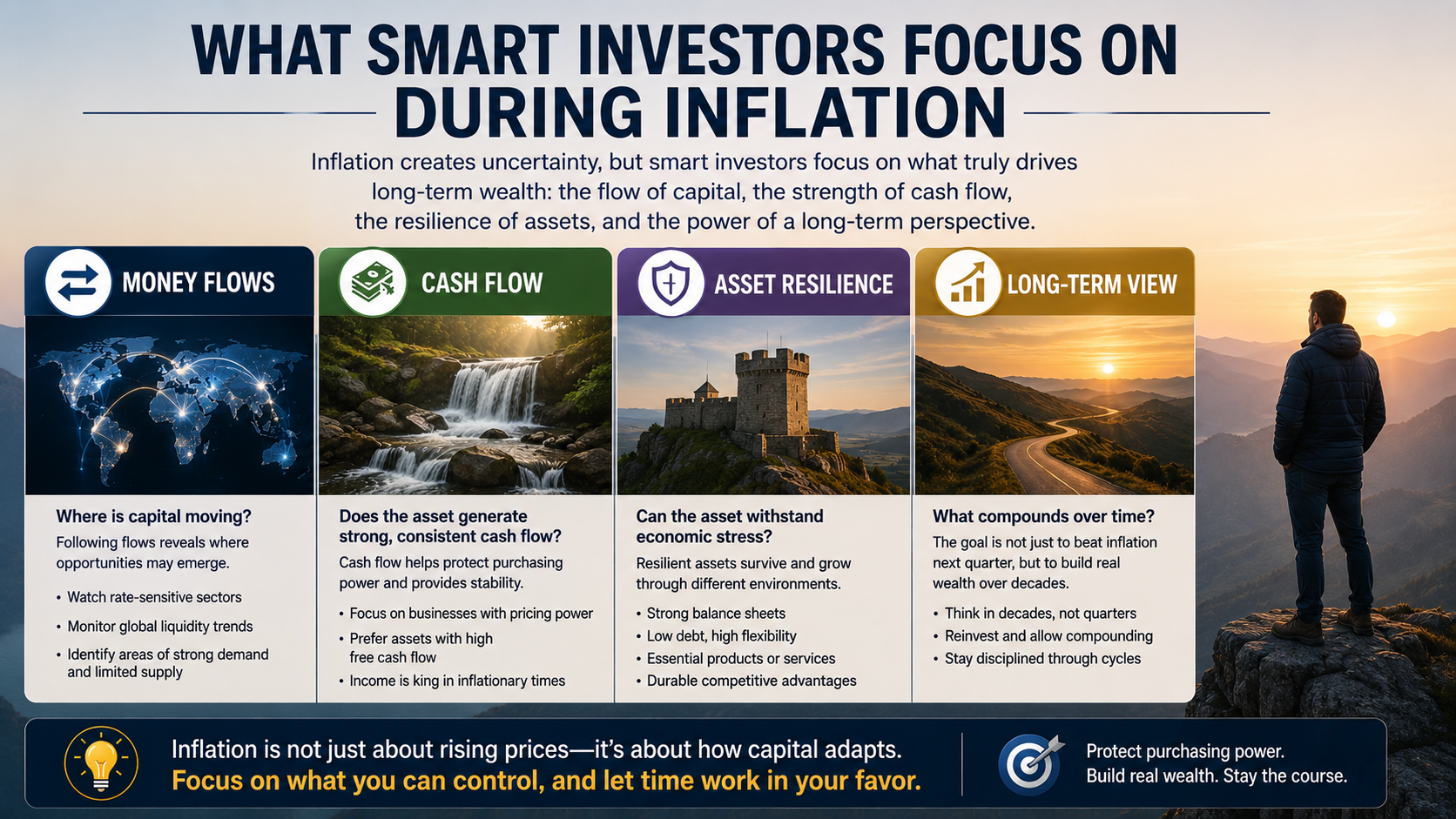
Experienced investors often focus on the movement of capital rather than the inflation headline itself.
Money Flows
Where is capital moving?
Is money flowing into equities, commodities, real estate, or defensive assets?
Understanding these shifts can reveal emerging opportunities.
Cash Flow
Assets that generate consistent cash flow often become more valuable during inflationary environments.
The ability to produce income can help offset rising costs and preserve purchasing power.
Asset Resilience
Not every asset survives periods of economic stress equally well.
Investors often evaluate which businesses and assets can withstand higher interest rates and slower economic growth.
Long-Term Purchasing Power
The ultimate goal is not merely to increase wealth on paper.
It is to maintain and expand purchasing power over decades.
This leads to an important question
Are your assets growing faster than inflation, or is inflation gradually eroding your wealth?
Final Thoughts
Inflation is one of the most powerful forces in the global economy.
It affects interest rates, financial markets, business decisions, and personal wealth.
While inflation is often viewed as a problem, moderate inflation is a natural part of modern economic systems. The real challenge for investors is understanding how inflation changes capital flows and asset valuations over time.
The most successful investors are not necessarily those who predict inflation perfectly.
They are the ones who build resilient portfolios capable of preserving purchasing power through different economic environments.
At its core, inflation is not simply about rising prices.
It is about the changing value of money and the long-term survival of wealth.
MasterMind.
'[Global] Success Blueprints' 카테고리의 다른 글