What Is the U.S. Dollar Index (DXY)? Why It Matters for Stocks, Gold, Bitcoin, and Global Markets


Hello, this is MasterMind.
When interest rates rise or financial markets become uncertain, one term appears repeatedly in market headlines - the U.S. dollar.
But how do professional investors measure the strength of the dollar beyond the USD exchange rate itself? Why do institutional investors, hedge funds, and global asset managers pay close attention to the U.S. Dollar Index (DXY)?
The answer is simple - the dollar sits at the center of the global financial system.
Understanding the DXY helps investors track capital flows, liquidity conditions, risk appetite, and even potential trends in stocks, commodities, gold, and cryptocurrencies.
In many ways, the Dollar Index acts as a real-time barometer of global money movement.
Key Takeaway
The U.S. Dollar Index (DXY) measures the strength of the U.S. dollar against major global currencies and serves as one of the most important indicators for understanding global liquidity and capital flows.
What Is the U.S. Dollar Index (DXY)?
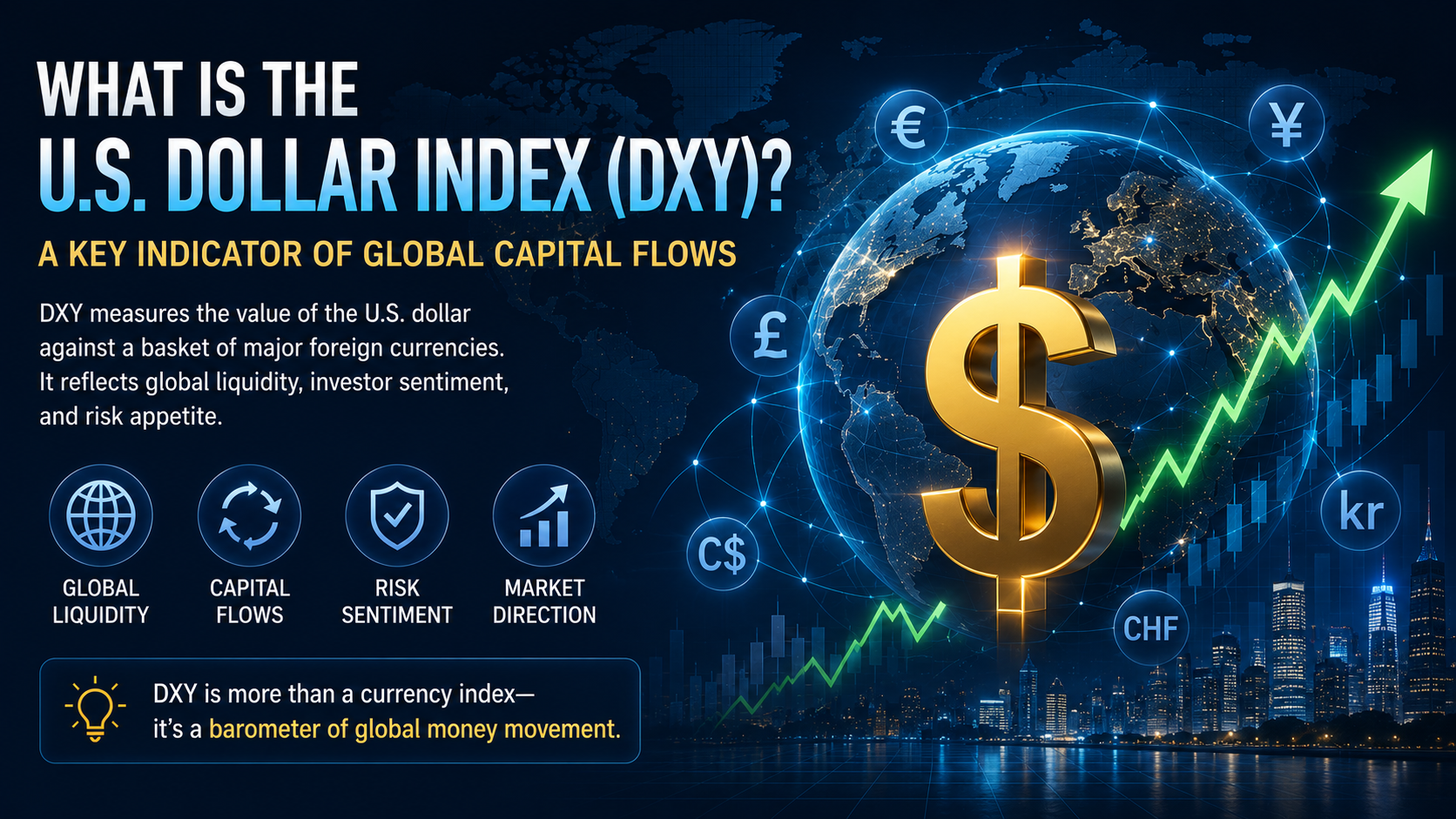
The U.S. Dollar Index, commonly known as DXY, measures the value of the U.S. dollar relative to a basket of major foreign currencies.
In simple terms, it answers one question
How strong is the U.S. dollar compared to other major currencies?
The index was introduced in 1973 after the collapse of the Bretton Woods system and has since become one of the most widely followed indicators in global financial markets.
The index uses a base value of 100.
For example
- DXY at 110 means the dollar has appreciated approximately 10% relative to the benchmark period.
- DXY at 90 means the dollar has weakened by approximately 10%.
Which Currencies Make Up the Dollar Index?

The DXY consists of six major currencies with fixed weightings.
| Currency | Weight |
| Euro (EUR) | 57.6% |
| Japanese Yen (JPY) | 13.6% |
| British Pound (GBP) | 11.9% |
| Canadian Dollar (CAD) | 9.1% |
| Swedish Krona (SEK) | 4.2% |
| Swiss Franc (CHF) | 3.6% |
Because the euro represents more than half of the index, movements in DXY often reflect not only U.S. economic strength but also the relative performance of the European economy.
MasterMind Insight
Many investors view DXY as merely a currency indicator.
In reality, it is often a liquidity indicator.
Markets are driven by capital flows, and capital flows are driven by expectations.
The Dollar Index frequently provides clues about where global capital may move before asset prices fully react.
How Does the Dollar Index Move?
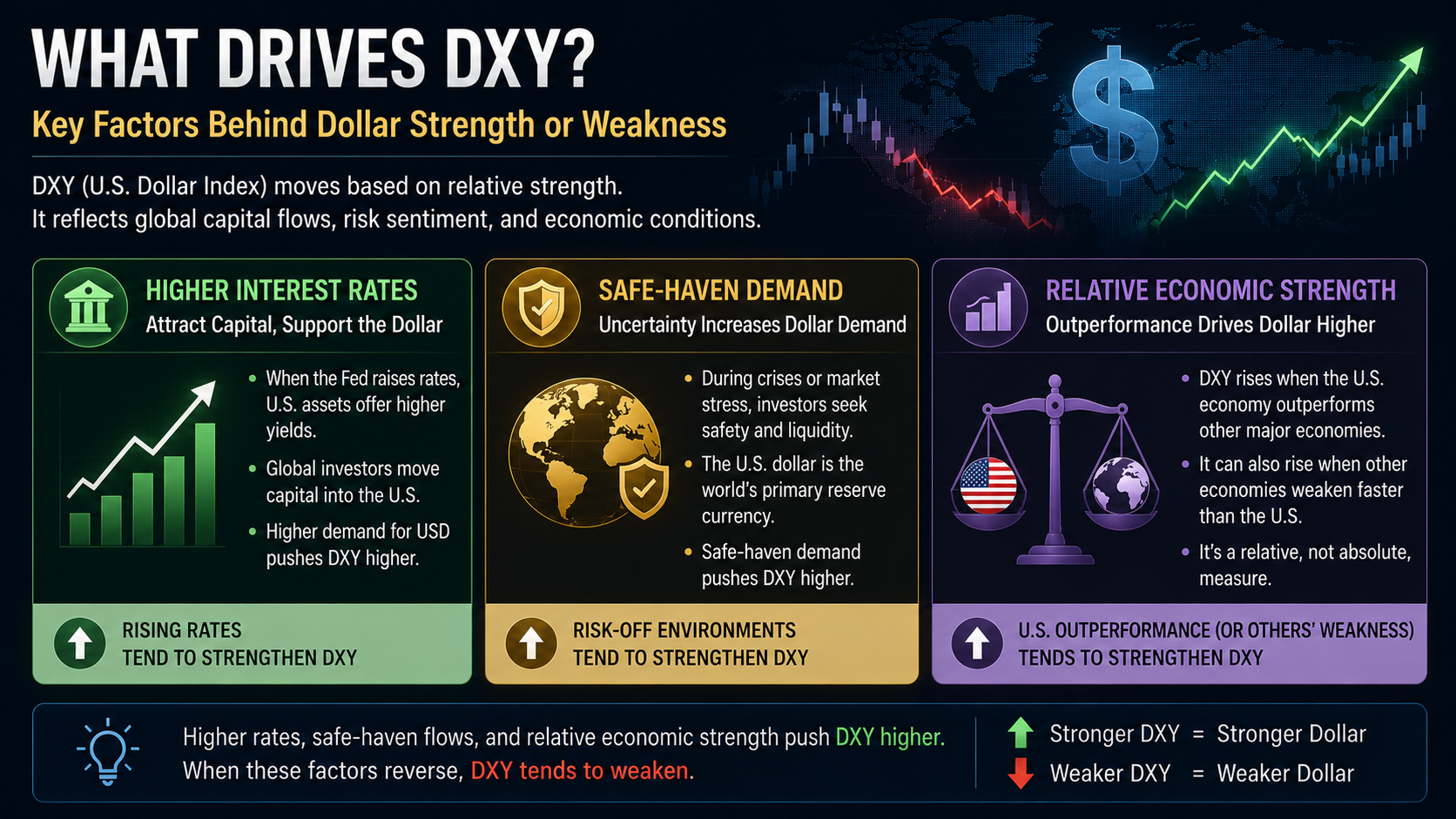
Interest Rates Matter Most
Interest rates are one of the primary drivers of DXY.
When the Federal Reserve raises rates, U.S. Treasury yields become more attractive to global investors.
As international capital flows into U.S. assets, demand for dollars increases, pushing the Dollar Index higher.
This is why periods of monetary tightening often coincide with dollar strength.
Global Uncertainty Creates Demand for Dollars
The U.S. dollar remains the world's dominant reserve currency.
During periods of uncertainty, investors often seek safety and liquidity.
Examples include
- Financial crises
- Recession fears
- Geopolitical conflicts
- Banking stress
- Global economic slowdowns
When investors prioritize capital preservation over growth, demand for dollars tends to increase.
Relative Economic Strength
DXY is a relative measure rather than an absolute one.
The index can rise because the U.S. economy is outperforming other regions.
However, it can also rise when Europe, Japan, or other major economies are weakening more rapidly than the United States.
This is why investors should view DXY through a global lens rather than focusing solely on U.S. economic data.
Why Is the Dollar Index So Important?
The dollar is more than just a currency.
It serves as the foundation of the global financial system.
Most international trade, commodity transactions, sovereign reserves, and cross-border payments are conducted in dollars.
As a result, movements in DXY often influence global liquidity conditions.
In many cases, asset prices follow capital flows.
And capital flows often follow the dollar.
This is one reason professional investors frequently monitor DXY before making broader asset allocation decisions.
How DXY Affects Major Asset Classes

U.S. Stocks
A stronger dollar can create headwinds for multinational corporations.
Companies that generate significant revenue overseas may see lower earnings when foreign revenues are converted back into dollars.
Conversely, a weaker dollar often supports earnings growth and can be favorable for large-cap U.S. equities.
Bonds
Dollar strength often accompanies rising interest rates.
When rates rise, existing bond prices generally face downward pressure.
However, during severe economic stress, both the dollar and U.S. Treasury bonds can rally simultaneously as investors seek safety.
Gold
Gold and the U.S. dollar often share an inverse relationship.
When the dollar strengthens, gold becomes more expensive for foreign buyers, reducing demand.
When the dollar weakens, gold often benefits as investors seek alternative stores of value.
Bitcoin and Cryptocurrencies
Bitcoin tends to be highly sensitive to global liquidity conditions.
Historically
- Rising DXY often creates pressure on Bitcoin and risk assets.
- Falling DXY often supports crypto markets.
While the relationship is not perfect, major crypto bull markets frequently coincide with periods of dollar weakness and expanding liquidity.
Emerging Markets
Emerging economies are often among the most sensitive to DXY movements.
Many countries and corporations carry dollar-denominated debt.
A stronger dollar increases debt-servicing costs and can trigger capital outflows from emerging markets.
This is why prolonged periods of dollar strength often coincide with weaker performance in emerging-market equities and currencies.
What Investors Should Watch
DXY Should Never Be Viewed in Isolation
While the Dollar Index is a powerful indicator, it is only one piece of the macroeconomic puzzle.
Investors should also monitor
- Treasury yields
- Inflation data (CPI and Core PCE)
- Federal Reserve policy
- Labor market conditions
- Global economic growth trends
Markets rarely move because of a single variable.

Trends Matter More Than Levels
The direction of DXY is often more important than the exact number.
A sustained uptrend in the dollar can signal tighter liquidity conditions and increased pressure on risk assets.
A prolonged decline may suggest improving liquidity and stronger demand for growth-oriented investments.
Rapid Dollar Strength Can Be a Warning Sign
Perhaps the most important factor is not how high DXY is, but how quickly it rises.
Sharp dollar rallies often indicate financial stress somewhere in the global system.
Historically, sudden dollar surges have frequently coincided with periods of elevated market volatility.
What Do Wealthy Investors See in This Trend?
Experienced investors focus on capital flows rather than headlines.
When analyzing DXY, they ask questions such as
- Where is global capital moving?
- Is liquidity expanding or contracting?
- Which assets are generating sustainable cash flow?
- Which markets are being unfairly discounted?
- What assets can survive multiple economic scenarios?
Most investors focus on prices.
Wealthy investors focus on cash flow, liquidity, and resilience.
Price fluctuations are temporary.
Capital preservation and cash-generating assets are what build long-term wealth.
A useful question to ask yourself is
If the Dollar Index suddenly rises 10% over the next year, how would my portfolio respond?
The answer may reveal more about your portfolio risk than any short-term market forecast.
Final Thoughts
The U.S. Dollar Index (DXY) is far more than a currency benchmark.
It is one of the clearest indicators of global capital flows, investor sentiment, and liquidity conditions.
A rising dollar often reflects risk aversion and tighter financial conditions.
A weakening dollar often supports risk assets and broader market participation.
While no single indicator can predict market outcomes, understanding DXY provides valuable insight into how money moves through the global financial system.
Successful investing is not about predicting every market move.
It is about understanding the forces that drive those moves and building a portfolio capable of surviving different economic environments.
And few indicators reveal those forces more clearly than the U.S. Dollar Index.
MasterMind.
'[Global] Success Blueprints' 카테고리의 다른 글