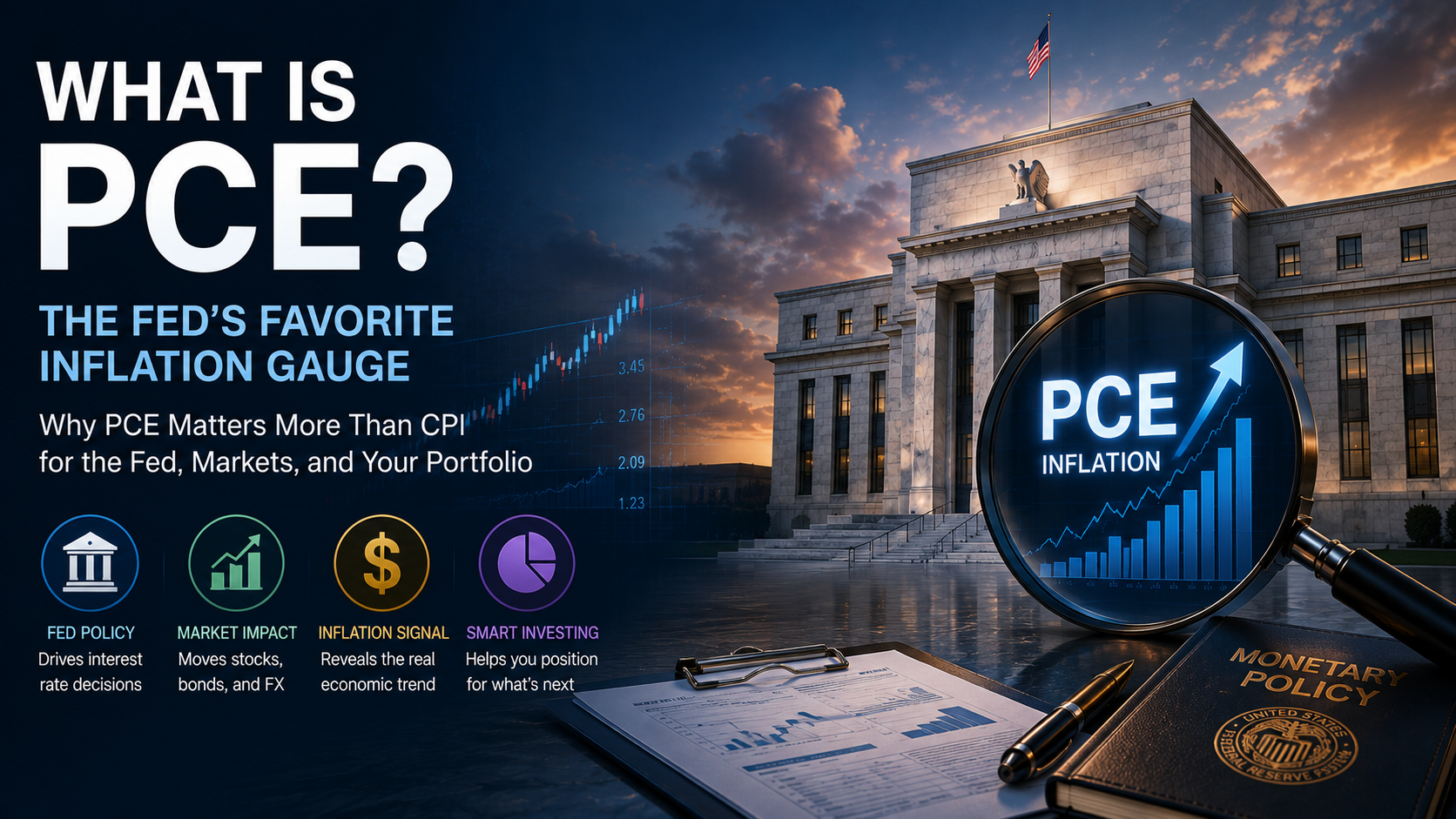
What Is PCE? Why the Fed’s Favorite Inflation Gauge Can Move the Entire Market


Hello, this is MasterMind.
When investors talk about inflation, most people immediately think of the Consumer Price Index (CPI). It’s the inflation number that dominates headlines and often drives short-term market reactions.
However, when it comes to setting interest rates, the Federal Reserve focuses on a different measure - the Personal Consumption Expenditures (PCE) Price Index.
Why does the Fed prefer PCE over CPI?
And why can a single PCE report influence stocks, bonds, the U.S. dollar, gold, and even Bitcoin?
Understanding the answer is crucial because PCE is not just an inflation report—it is one of the most important indicators shaping the future path of monetary policy and liquidity.
What Is the PCE Price Index?

The Personal Consumption Expenditures (PCE) Price Index measures changes in the prices that U.S. consumers pay for goods and services.
At first glance, it may seem similar to CPI. Both track inflation.
The key difference lies in how they measure consumer behavior.
CPI is based on a relatively fixed basket of goods and services.
PCE, on the other hand, adjusts as consumer spending patterns change.
For example, if beef prices rise significantly, consumers may switch to chicken. CPI tends to continue measuring the original basket, while PCE captures this substitution effect.
As a result, PCE often provides a more realistic picture of how consumers actually spend money in the real economy.
That is one of the main reasons why the Federal Reserve considers PCE to be its preferred inflation gauge.
In many ways, PCE is not just measuring inflation—it is measuring the flow of money throughout the economy.
Why Does the Federal Reserve Prefer PCE?
The Fed’s objective is not simply to lower inflation.
Its goal is to balance price stability and economic growth.
To achieve that balance, policymakers need an inflation measure that reflects real-world consumer behavior as accurately as possible.
This is where PCE becomes critical.
More importantly, the Fed pays close attention to Core PCE, which excludes food and energy prices.
Food and energy prices can fluctuate sharply due to seasonal factors, geopolitical events, or supply shocks.
Core PCE helps policymakers identify underlying inflation trends that are more likely to persist over time.
Because of this, investors carefully watch every monthly Core PCE report.
Markets are not focused on what inflation was.
They are focused on what the Fed might do next because of that inflation data.
And markets always price the future before it arrives.
The Three Ways PCE Can Move Financial Markets
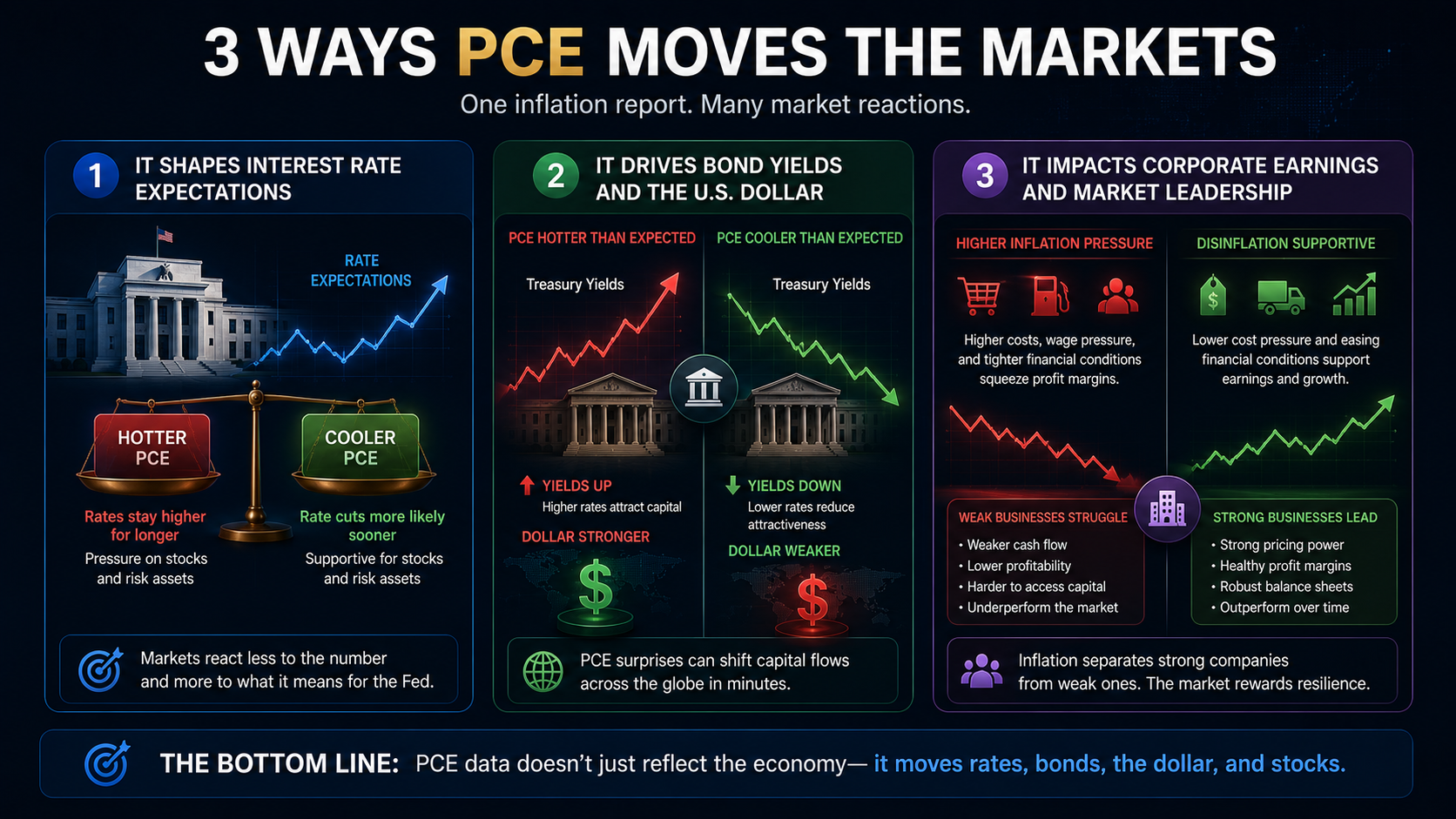
1. It Changes Expectations for Interest Rates
The market's reaction to PCE is often less about the number itself and more about how it compares to expectations.
If PCE comes in hotter than expected, investors may assume that the Fed will keep rates higher for longer.
If inflation cools faster than expected, rate-cut expectations tend to increase.
This shift in expectations can immediately affect stock valuations, bond yields, and investor sentiment.
The market is constantly trying to answer one question
"What will the Fed do next?"
2. It Influences Treasury Yields and the U.S. Dollar
Higher-than-expected PCE data often pushes Treasury yields upward.
Investors demand higher returns if they believe interest rates will remain elevated.
At the same time, the U.S. dollar frequently strengthens because higher rates attract global capital.
Conversely, lower inflation readings can lead to falling yields and a weaker dollar, creating a more favorable environment for risk assets.
This is why PCE has become one of the most important catalysts for global capital flows.
3. It Impacts Corporate Earnings and Market Leadership
Persistent inflation does not only affect consumers.
It also affects businesses.
Higher labor costs, rising rents, and increased operating expenses can pressure corporate profit margins.
Companies with weak cash flow often struggle the most during prolonged periods of elevated rates.
Meanwhile, firms with strong pricing power and durable competitive advantages tend to perform better.
Over time, inflation helps separate strong businesses from weak ones.
The market eventually rewards resilience.
Risks Investors Should Not Ignore

One of the biggest mistakes investors make is focusing too heavily on a single monthly report.
Inflation is a trend, not a one-month event.
A lower monthly reading does not automatically mean inflation has been defeated.
Prices may still remain significantly higher than they were a year ago.
Another risk is assuming that lower inflation guarantees a bullish market.
Financial markets are driven by expectations.
If investors were already expecting inflation to cool, even a favorable report may fail to generate a strong rally.
Successful investing requires understanding not only the data itself but also how that data compares to market expectations.
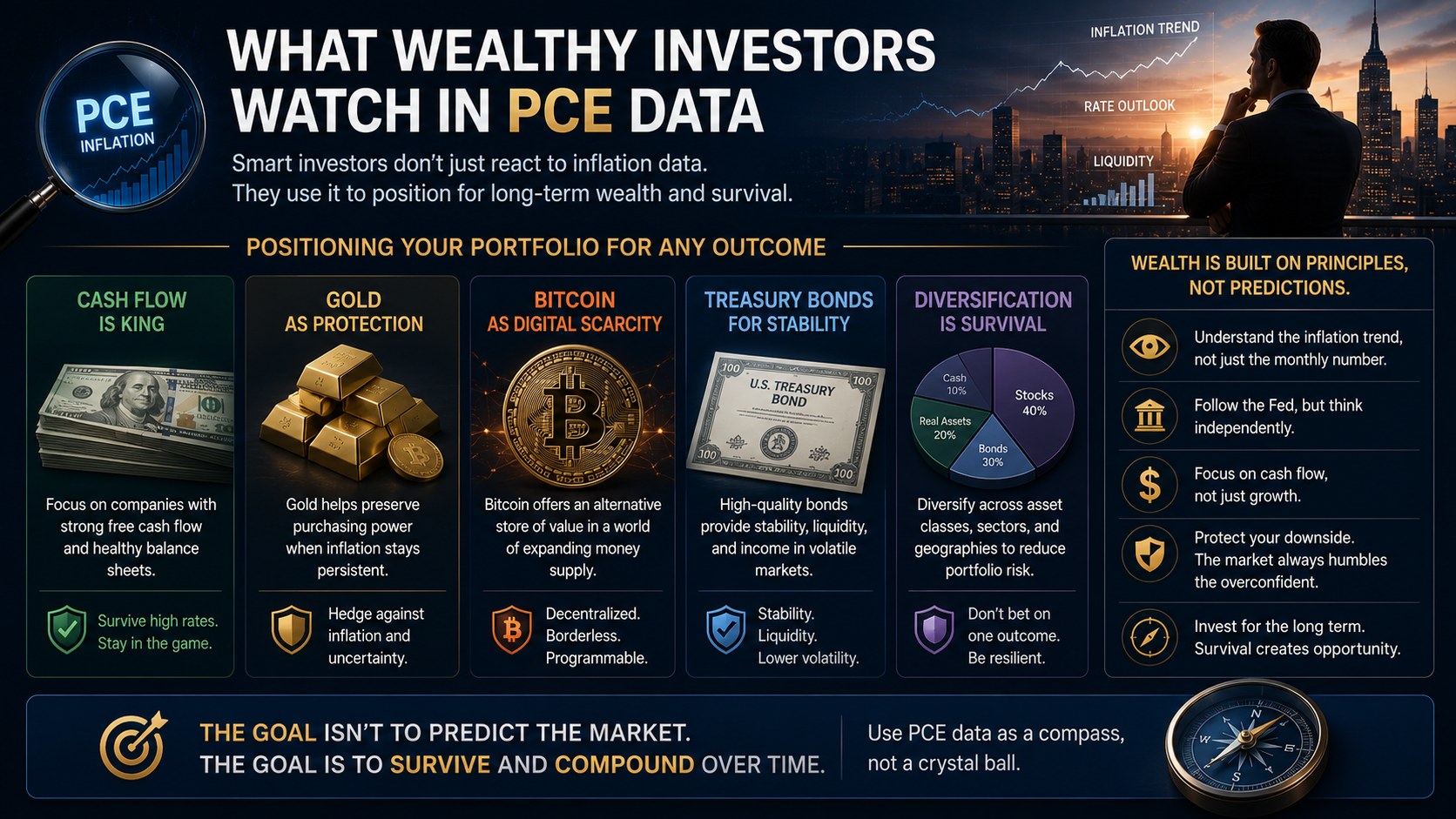
What Are Wealthy Investors Watching?
Large institutional investors rarely focus on a single headline number.
Instead, they analyze where capital is flowing and which assets are most likely to survive different economic environments.
The first priority is resilience.
Which companies can continue generating profits even if interest rates remain elevated?
Businesses with strong cash flow, dominant market positions, and sustainable competitive advantages tend to attract capital during uncertain periods.
The second priority is asset protection.
If inflation remains persistent, investors may increase exposure to assets that can potentially preserve purchasing power, including gold, Treasury securities, and alternative stores of value.
Ultimately, sophisticated investors focus less on predictions and more on survivability.
Ask yourself the following questions
- Can my portfolio withstand higher interest rates for longer than expected?
- Do the companies I own generate strong and consistent cash flow?
- Can these businesses pass higher costs on to customers?
- Am I investing based on reality, or simply on market optimism?
These questions often matter more than the next inflation report.
Final Thoughts
The PCE Price Index is far more than another economic statistic.
It is one of the Federal Reserve’s most important tools for evaluating inflation and shaping monetary policy.
For investors, the real value of PCE lies not in the headline number itself, but in what it signals about future interest rates, liquidity conditions, and capital flows.
Markets are forward-looking.
The critical question is not where inflation stands today.
The critical question is how inflation will influence the decisions of the Federal Reserve tomorrow.
MasterMind’s Take
Markets care less about what they expect and more about what they fear. As long as inflation remains a concern, capital will continue flowing toward businesses and assets with strong cash flow, pricing power, and long-term resilience.
In investing, survival matters more than prediction.
MasterMind.
'[Global] Success Blueprints' 카테고리의 다른 글