[Resource Dominance #1] Why Economists Watch Copper Prices Instead of Stock Charts - Dr. Copper and the Coming AI Shortage


The Hidden Prophet of the Global Economy - Dr. Copper
Hello, this is Mastermind.
When world-renowned economists, hedge fund managers, and macro investors try to predict the future direction of the economy, many of them look beyond stock market indexes.
Instead, they closely watch a humble industrial metal.
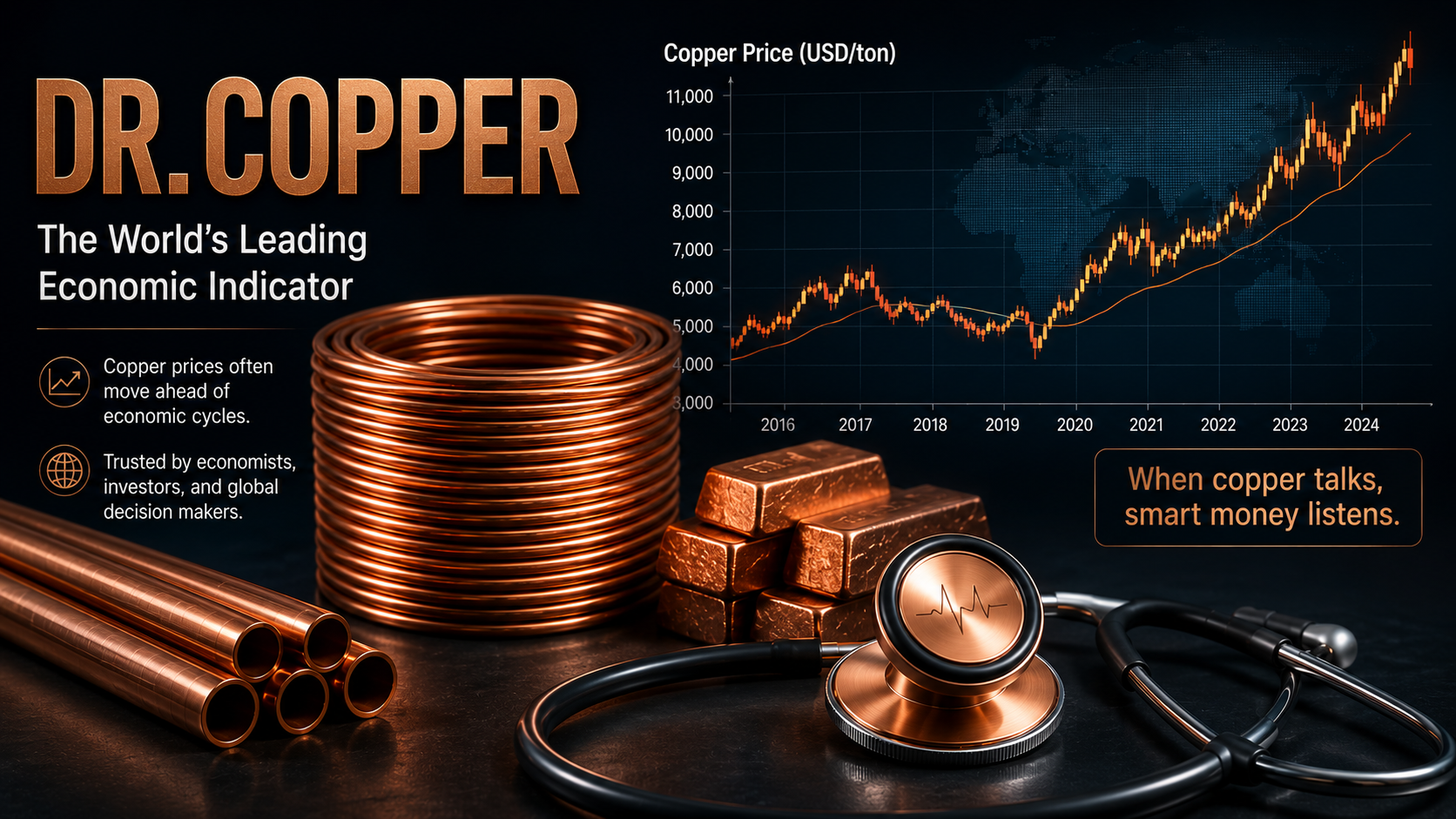
In financial markets, copper has earned a unique nickname
"Dr. Copper."
Unlike economists, copper holds no academic degree and offers no forecasts. Yet for decades, it has developed a reputation for accurately signaling economic trends before they appear in official data.
So why has a common metal found inside electrical wires become one of the most respected indicators in global finance?
Today, we'll explore the secret behind copper prices, the rise of AI infrastructure, and why copper may become one of the most important strategic resources of the 21st century.
Why Is Copper Called "Dr. Copper"?
Copper occupies a unique position in the global economy because of its extraordinary versatility.
Almost every modern industry depends on it.
Copper is used in
- Electrical grids
- Buildings and infrastructure
- Consumer electronics
- Automobiles
- Renewable energy systems
- AI data centers
If electricity is involved, copper is likely involved as well.
This makes copper one of the most direct reflections of real-world economic activity.
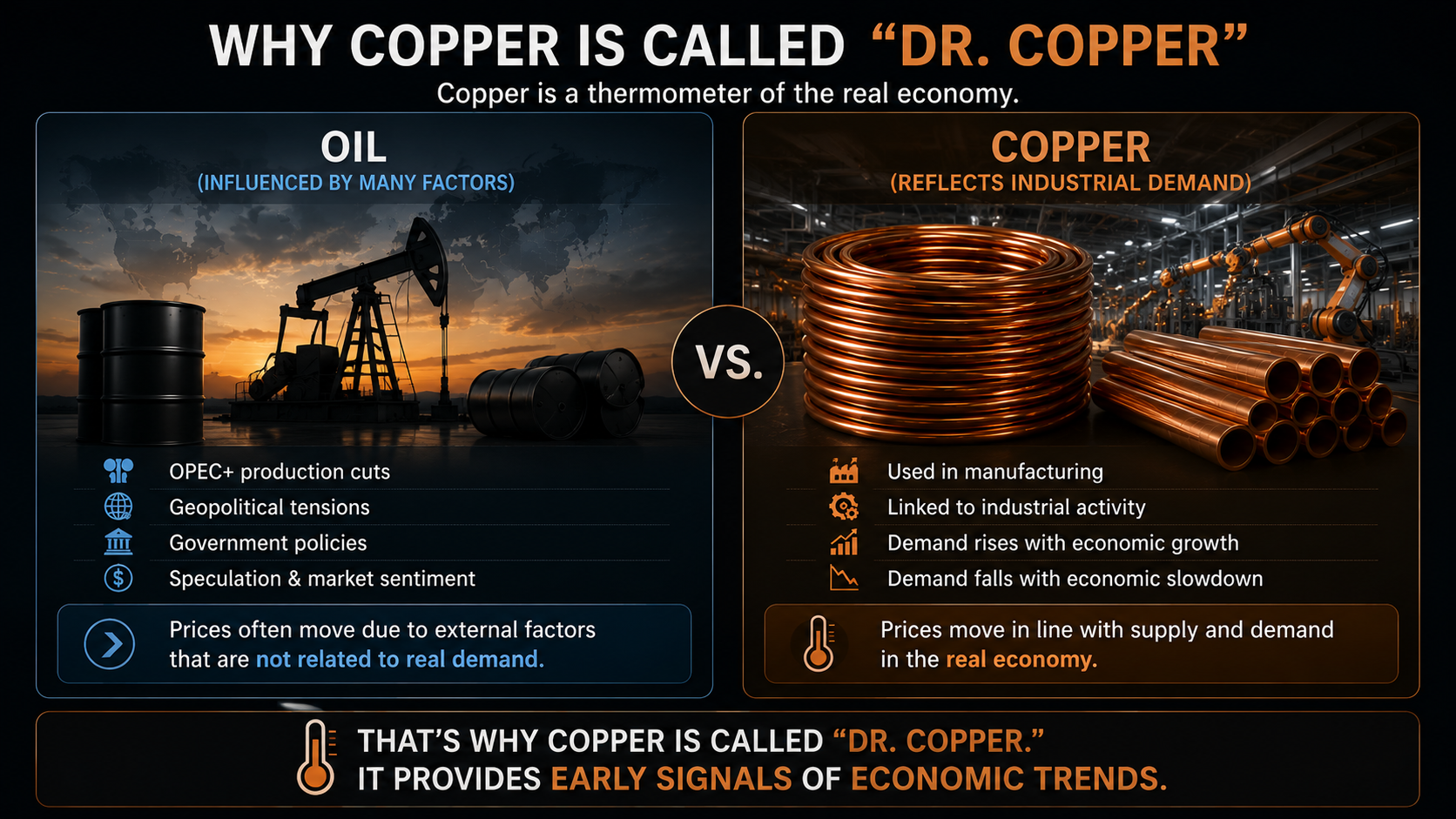
Oil vs. Copper
Oil prices are often influenced by factors beyond simple supply and demand.
Production cuts by OPEC+, geopolitical conflicts, and government policies can significantly affect prices.
Copper, on the other hand, is generally viewed as a purer reflection of industrial demand.
When factories expand production, copper demand rises.
When economic activity slows, copper demand falls.
For this reason, economists often describe copper prices as a thermometer for the global economy.
A Leading Indicator That Moves Before Stocks
Businesses tend to react quickly to changing economic conditions.
When companies expect a slowdown, they often reduce orders for raw materials before cutting production.
Copper is usually one of the first purchases to be reduced.
Conversely, when businesses anticipate growth, they begin securing copper supplies before expanding operations.
As a result, copper prices frequently change direction months before economic reports or corporate earnings reflect those shifts.
This predictive quality is why financial professionals have long referred to copper as "Dr. Copper."
The Real Bottleneck of the AI Era - Not Chips, but Copper

Today, Dr. Copper is signaling something bigger than a normal economic cycle.
Copper is becoming a strategic resource at the center of the AI revolution.
Most investors focus on AI chips, software breakthroughs, and companies like Nvidia.
However, AI systems require enormous physical infrastructure to operate.
Data centers consume vast amounts of electricity.
That electricity must travel through transmission lines, substations, transformers, cooling systems, and server networks.
At the core of all these systems is one critical material
Copper.
Behind every AI breakthrough lies a massive physical infrastructure built upon copper.
This is why major investment banks have begun referring to copper as "The New Oil."
As AI adoption accelerates, demand for copper is expected to increase dramatically.
Structural Shortage - Rising Demand Meets Limited Supply
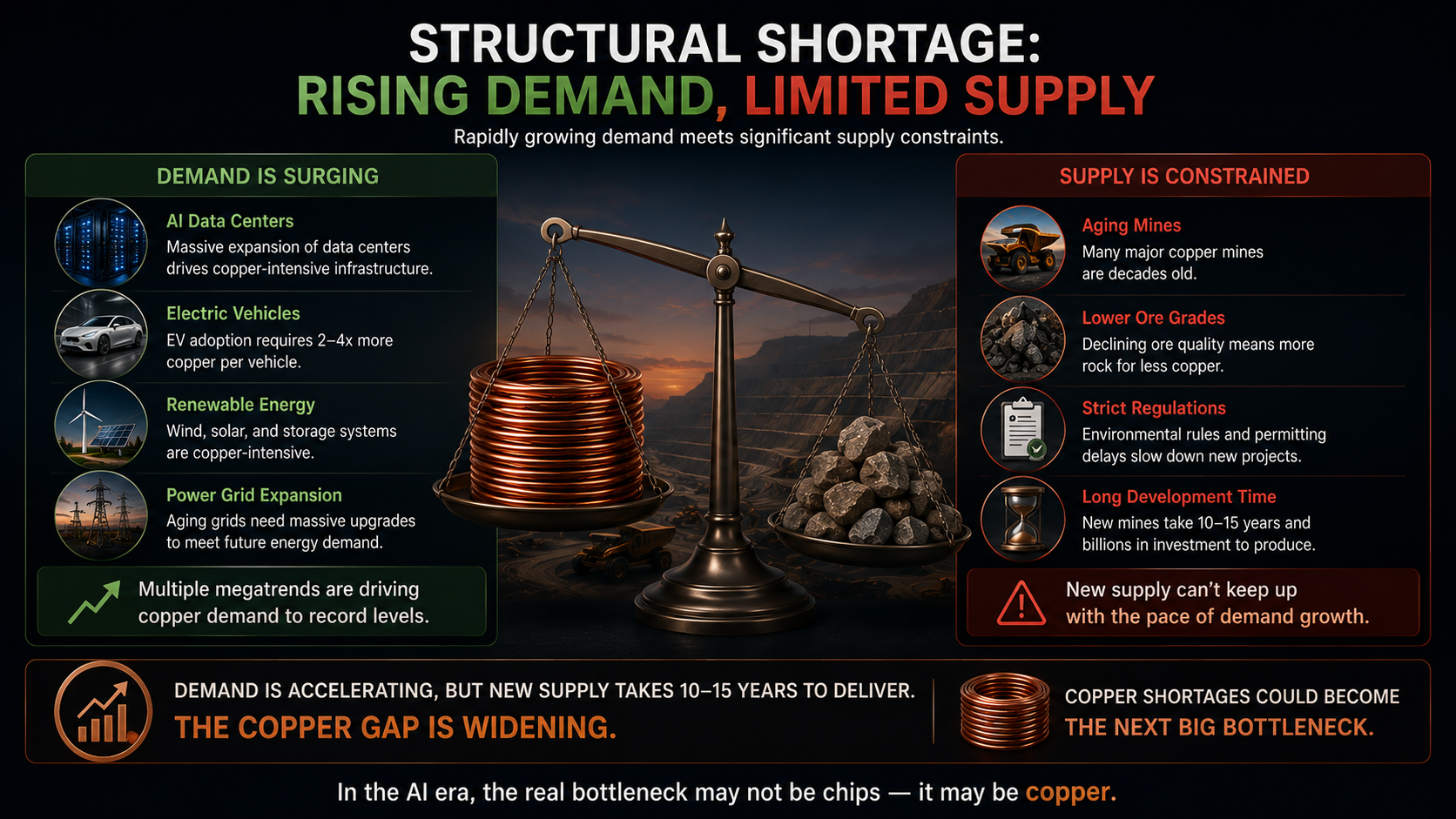
The copper market is currently facing a powerful imbalance.
Demand Is Exploding
Several major trends are increasing copper consumption simultaneously
- AI data center expansion
- Electric vehicle adoption
- Renewable energy development
- Power grid modernization projects
Each of these sectors requires significant amounts of copper.
Supply Growth Is Limited
Unfortunately, copper supply cannot be expanded quickly.
Many of the world's largest copper mines are aging.
Ore grades are declining, meaning more rock must be processed to produce the same amount of copper.
Environmental regulations and permitting requirements have also become more complex.
New Mines Take Time
Developing a large copper mine is not a quick process.
From discovery to full-scale production, new projects often require
- 10 to 15 years of development
- Billions of dollars in investment
- Extensive regulatory approvals
Simply put
Copper demand is growing rapidly, but new supply is extremely difficult to bring online.
This is why many analysts warn that future economies may face copper shortages that are even more disruptive than semiconductor shortages.
The real bottleneck of the AI era may not be silicon chips.
It may be copper.
The Future of Resource Dominance

During the 19th and 20th centuries, oil shaped global power.
Countries and corporations that controlled oil resources gained enormous economic and geopolitical advantages.
The question today is
What resource will define power in the AI era?
The answer may be copper.
Artificial intelligence depends on electricity.
Electricity depends on infrastructure.
Infrastructure depends on copper.
As a result, securing copper supply chains is becoming a strategic priority for governments, mining companies, and technology giants alike.
Major mining firms are pursuing multi-billion-dollar acquisitions to secure copper assets.
At the same time, technology leaders are paying increasing attention to energy infrastructure and resource security.
Copper is no longer just an industrial metal.
It is rapidly becoming a strategic asset.
Final Thoughts - Following the Flow of Capital
Most investors spend their days watching stock prices and market headlines.
The world's largest pools of capital often focus on something deeper.
They watch the movement of resources.
A change in copper prices is not simply a commodities story.
It can signal shifts in economic activity, industrial development, and capital allocation long before those changes become obvious.
Markets usually send signals before the public notices them.
And surprisingly often, those signals begin with copper.
If oil defined the last century, copper may help define the next.
The race for AI dominance may ultimately become a race for energy infrastructure, resource security, and copper supply chains.
And that may be the clearest sign yet that a new era of resource dominance has already begun.
Mastermind
'[Global] Success Blueprints' 카테고리의 다른 글