What Happens When U.S. Treasury Yields Fall? (Why the 10-Year Treasury Matters)


Why Investors Pay Close Attention to U.S. Treasury Yields
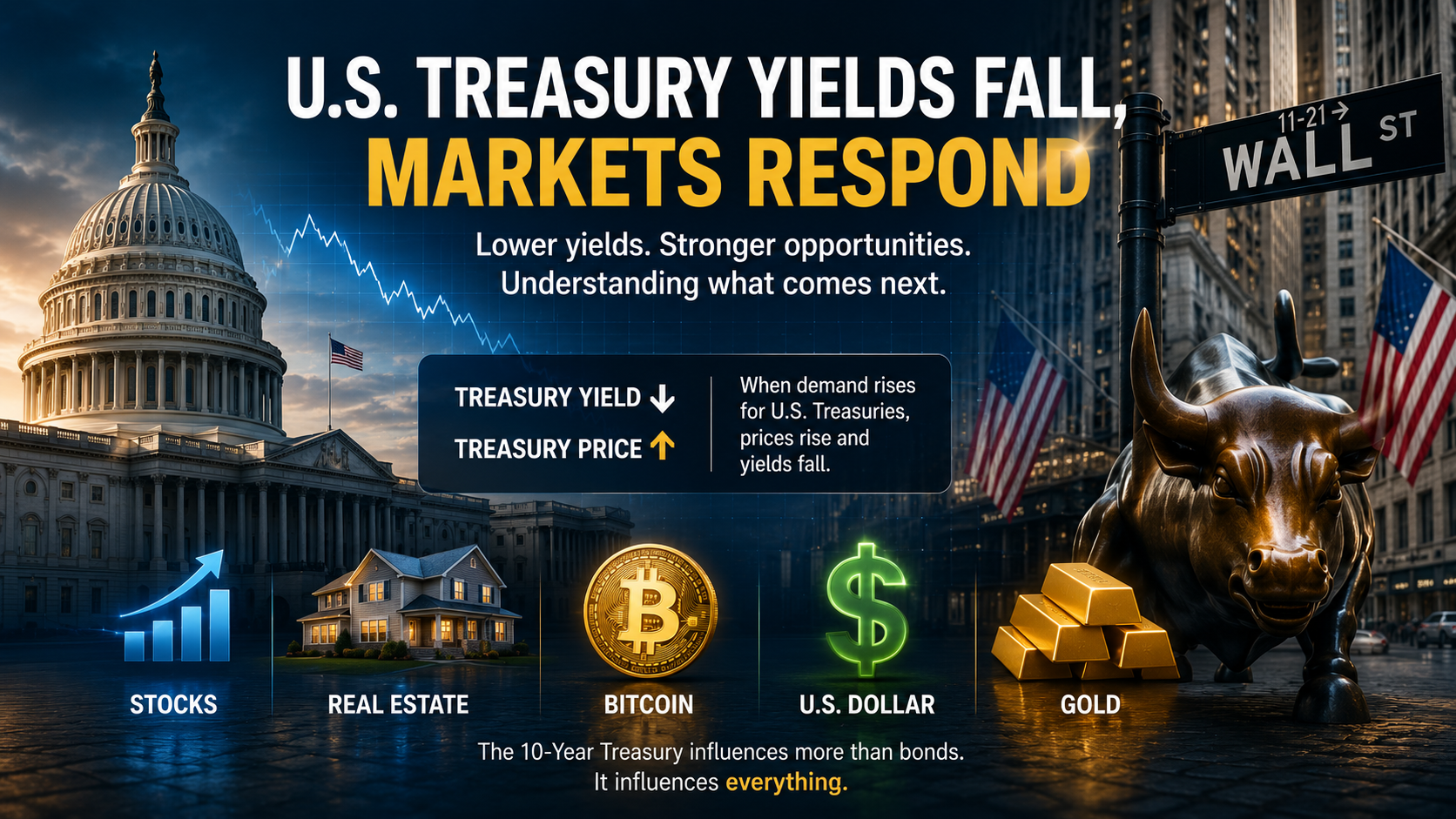
If you follow financial news, you've probably seen headlines about falling U.S. Treasury yields or growing expectations for Federal Reserve rate cuts.
When these shifts occur, investors immediately start asking important questions
- How will this affect my stock portfolio?
- Is this bullish for Bitcoin?
- Will mortgage rates finally come down?
- Does this create new investment opportunities?
The reality is that U.S. Treasury yields are far more than just another market statistic.
They serve as one of the foundational benchmarks of the global financial system.
When Treasury yields move lower, the effects ripple through stocks, real estate, cryptocurrencies, commodities, currencies, and consumer borrowing costs.
Before diving deeper, it is important to understand one fundamental principle.
Quick Take
Treasury Yield ↓ = Treasury Price ↑
When investors buy large amounts of U.S. Treasuries, bond prices rise and yields fall.
This inverse relationship is one of the cornerstones of modern financial markets.
So what exactly happens when Treasury yields begin moving lower?
Let's take a closer look.
1. What Are U.S. Treasuries?
U.S. Treasuries are debt securities issued by the U.S. government to finance federal spending.
These funds support infrastructure projects, defense programs, healthcare initiatives, and other government obligations.
In return, investors receive interest payments over a specified period.
Because the United States has historically been viewed as one of the most creditworthy borrowers in the world, Treasury securities are widely considered among the safest and most liquid investments available.
As a result, central banks, pension funds, insurance companies, asset managers, hedge funds, and individual investors all hold Treasuries as part of their portfolios.
2. Why Do Treasury Yields Fall?
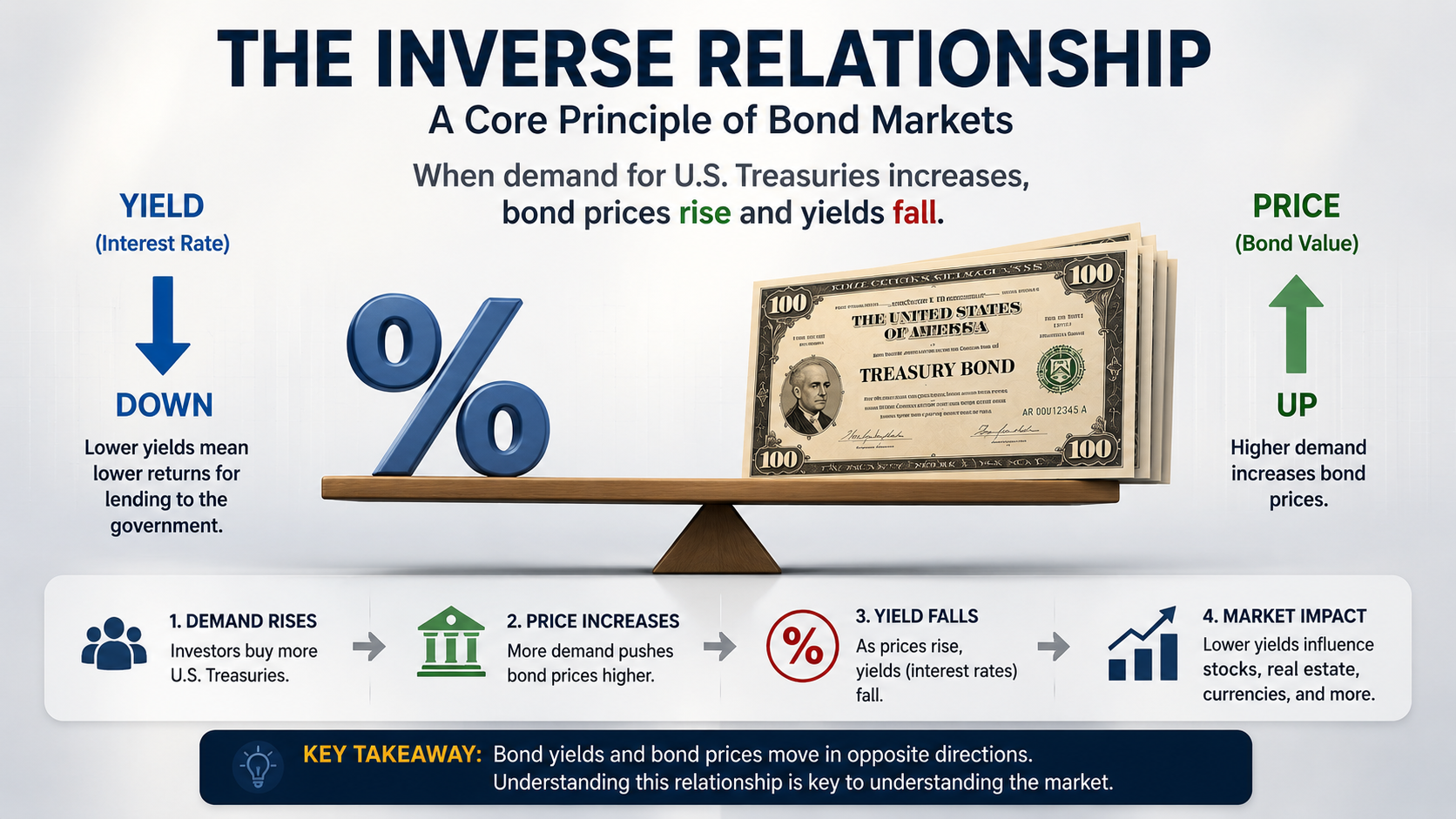
Treasury yields generally decline when demand for government bonds increases.
Several macroeconomic forces can drive this demand.
Cooling Inflation
When inflation begins to moderate, investors often expect the Federal Reserve to lower interest rates in the future.
Lower expected rates tend to increase demand for existing bonds, pushing yields lower.
Slowing Economic Growth
During periods of economic uncertainty, investors often move money out of riskier assets and into safer investments such as U.S. Treasuries.
This process is commonly known as a "flight to safety."
Expectations of Federal Reserve Rate Cuts
If investors believe future interest rates will be lower, existing bonds with higher yields become more attractive.
Demand rises, bond prices increase, and yields fall.
3. Five Things That Often Happen When U.S. Treasury Yields Fall

Stocks Often Benefit
Lower Treasury yields are frequently supportive for equities.
Growth-oriented sectors such as technology, artificial intelligence, software, and innovative industries tend to benefit the most.
Lower borrowing costs can improve corporate profitability, while reduced yields on safe assets make stocks more attractive by comparison.
This is one reason why falling Treasury yields often support growth stocks and the broader equity market.
Borrowing Costs May Decline
Treasury yields influence many interest rates throughout the economy.
When yields move lower, borrowing costs for consumers and businesses often follow.
This can affect
- Mortgage rates
- Corporate loans
- Consumer credit
- Business financing
Lower borrowing costs can stimulate spending, investment, and economic activity.
Bitcoin and Other Risk Assets May Gain Momentum

Bitcoin has increasingly become part of the broader risk-asset landscape.
Historically, environments characterized by lower interest rates and greater liquidity have provided a supportive backdrop for cryptocurrencies.
When Treasury yields decline, investors may become more willing to allocate capital toward higher-risk assets in pursuit of stronger returns.
As a result, falling yields can create favorable conditions for Bitcoin and other digital assets.
The U.S. Dollar May Weaken
Higher interest rates generally make dollar-denominated assets more attractive.
The reverse can also be true.
When Treasury yields decline, the yield advantage of holding U.S. assets may decrease.
This can reduce demand for the dollar and encourage capital flows into international markets.
Emerging markets, in particular, often benefit when global financial conditions become more accommodative.
Gold May Become More Attractive
Gold does not generate interest income.
As a result, it often faces stronger competition from bonds during periods of high interest rates.
However, when Treasury yields fall, the opportunity cost of holding gold decreases.
Investors seeking diversification or protection against uncertainty may increase their allocation to gold, potentially supporting higher prices.
4. Is Falling Treasury Yield Always Good News?

Not necessarily.
The reason behind declining yields matters just as much as the decline itself.
If yields are falling because inflation is easing while the economy remains healthy, financial markets often respond positively.
However, yields can also decline because investors are becoming increasingly concerned about recession risks.
In that scenario, investors may rush into safe-haven assets such as Treasuries, causing yields to fall while stock markets struggle.
Understanding why yields are declining is often more important than focusing on the decline alone.
5. Why Does the Market Watch the 10-Year Treasury So Closely?
Among all Treasury securities, the U.S. 10-Year Treasury receives the most attention.
It is widely viewed as one of the best indicators of long-term economic expectations.
The 10-year yield influences
- Mortgage rates
- Corporate borrowing costs
- Equity valuations
- Investor sentiment
- Economic growth expectations
For this reason, many market participants view the 10-Year Treasury as a real-time gauge of economic conditions.
When it moves, investors pay attention.
6. What Do Experienced Investors Focus On?
Successful investors do not simply react to headlines about rising or falling yields.
Instead, they focus on where capital is moving next.
They ask questions such as
- Which sectors are attracting new investment?
- Which assets are benefiting from changing financial conditions?
- How is investor behavior evolving?
In many cases, major market trends begin in the bond market long before they become visible elsewhere.
Following those shifts can provide valuable insight into future opportunities.
Final Thoughts
U.S. Treasury yields are much more than a bond-market statistic.
They remain one of the most important signals in global finance.
A seemingly small move in Treasury yields can influence investment decisions across stocks, real estate, currencies, commodities, and digital assets around the world.
Financial markets often send signals before major trends become obvious.
Investors who understand those signals are often better positioned to navigate changing market conditions.
The key is not simply watching where yields move—but understanding why they are moving in the first place.
Success belongs to those who understand the flow before the crowd does.
— MasterMind
'[Global] Success Blueprints' 카테고리의 다른 글