Nasdaq Market Close – August 26, 2026: PCE Lifts Treasury Yields, Nvidia Earnings Put AI Stocks in Focus


U.S. stocks finished slightly lower on August 26, 2026, as investors digested persistent inflation, rising Treasury yields, and positioned portfolios ahead of Nvidia’s highly anticipated earnings report after the closing bell.
The Nasdaq Composite slipped 0.08% to 26,130.20, while the S&P 500 declined 0.02% and the Dow Jones Industrial Average fell 0.21%.
At first glance, this looked like an uneventful session.
Underneath the indexes, however, the market was far more selective.
Declining stocks outnumbered advancing stocks on the Nasdaq, overall trading activity remained below its recent average, and investors rewarded companies that delivered convincing earnings and forward guidance while punishing those that failed to clear increasingly high expectations.
That distinction matters more than the Nasdaq’s modest daily move.
The key question for investors is not simply why the market moved, but where capital actually went.
The Bottom Line
Hotter-than-expected PCE inflation pushed the 10-year Treasury yield back toward 4.66%, creating another valuation headwind for growth stocks, while investors selectively rotated toward companies delivering credible earnings and guidance across AI infrastructure, cybersecurity, and consumer sectors.
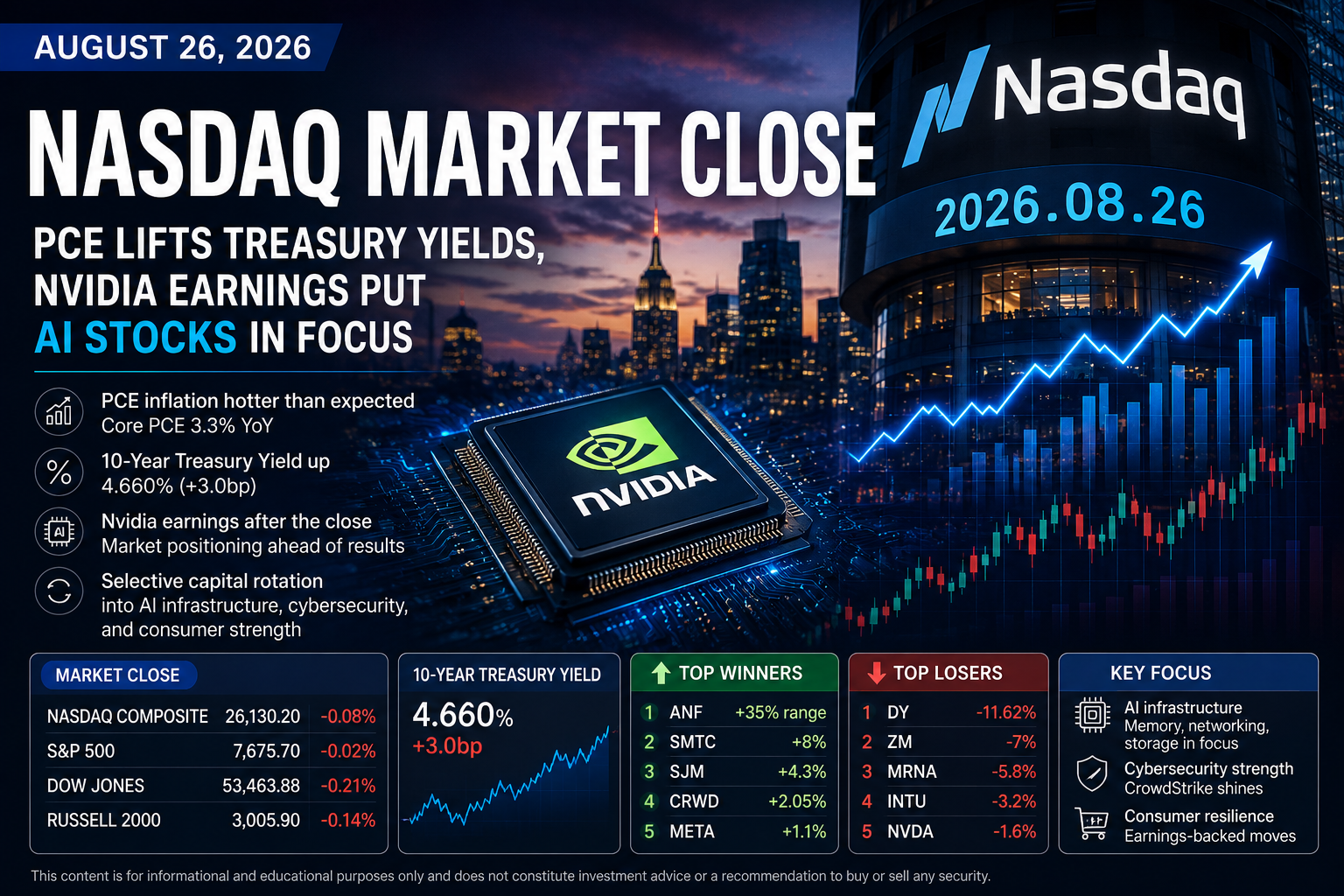
1. U.S. Stock Market Close
| Index Index | Close | Change |
| Nasdaq Composite | 26,130.20 | -0.08% |
| S&P 500 | 7,675.70 | -0.02% |
| Dow Jones Industrial Average | 53,463.88 | -0.21% |
| Russell 2000 | 3,005.90 | -0.14% |
The headline indexes barely moved, but market breadth painted a weaker picture.
On the Nasdaq, 1,983 stocks advanced while 2,745 declined. There were also 68 new 52-week highs compared with 75 new lows.
Total U.S. equity volume came in around 14.2 billion shares, below the roughly 16.2 billion-share average over the previous 20 trading sessions.
In other words, this was not a broad risk-on session.
Major indexes held relatively close to record territory, but participation underneath them was considerably weaker.
That matters because a market can appear stable at the index level while individual stocks quietly lose momentum.
Nvidia’s earnings report after the closing bell also discouraged investors from making aggressive bets across the semiconductor and AI complex.
2. What Moved the Nasdaq Today?
Three forces dominated the session.
First: Inflation Remains Sticky
The July headline PCE price index increased 3.7% year over year, slightly above the 3.6% consensus estimate.
Core PCE, which excludes food and energy and is closely watched by the Federal Reserve, rose 3.3% year over year.
For U.S. investors, the important point is not simply that inflation remains above the Fed’s 2% target.
It is what persistent inflation does to the expected path of monetary policy.
The transmission mechanism looks like this
Hotter inflation
↓
Less confidence in rapid disinflation
↓
Higher-for-longer Fed expectations
↓
Higher Treasury yields
↓
Higher discount rates
↓
Greater valuation pressure on long-duration growth stocks
That final step is especially important for the Nasdaq.
The more of a company's valuation that depends on profits expected many years into the future, the more sensitive that valuation becomes to changes in interest rates.
Second: The U.S. Economy Is Still Growing
Second-quarter real GDP was confirmed at an annualized 1.5% growth rate.
That creates an interesting problem for markets.
Economic growth is strong enough to reduce immediate recession concerns, but the economy is also holding up well enough that the Fed has less reason to rush toward easier monetary policy.
The combination investors are confronting is therefore
Resilient economy + persistent inflation = less urgency for monetary easing.
For growth stocks, that can be a more difficult combination than weaker economic data accompanied by rapidly falling bond yields.
Third: Nvidia Became a Market-Wide Risk Event
Nvidia (NVDA) fell approximately 1.6% during regular trading ahead of its earnings report.
The decline was less about a new deterioration in Nvidia's business and more about expectations.
Investors no longer expect Nvidia merely to beat Wall Street estimates.
The company is increasingly expected to deliver something close to a triple beat
Revenue beat + earnings beat + guidance beat.
After the close, Nvidia projected approximately $108 billion in next-quarter revenue, above Wall Street expectations of roughly $104.2 billion.
Yet the stock initially traded lower after hours.
That reaction highlights one of the most important characteristics of the current AI trade
Good results are no longer enough when great results are already priced in.
3. The 10-Year Treasury Yield Matters More Than the Nasdaq's -0.08%
U.S. 10-Year Treasury yield: approximately 4.656% / +1.7 basis points
The 10-year Treasury yield climbed from roughly 4.639% to 4.656%.
For growth investors, this may have been the most important market move of the session.
Why?
Consider a company whose largest profits are expected five or ten years from now.
Investors must discount those future cash flows back into today's dollars.
When the risk-free rate rises, the discount rate used in valuation models generally rises as well.
The result is straightforward
Higher rates reduce the present value of distant future earnings.
That is why high-multiple technology, semiconductor, and software stocks tend to be especially sensitive to movements in long-term Treasury yields.
So rather than focusing only on the Nasdaq's 0.08% decline, investors should watch whether the 10-year Treasury yield can stabilize around the mid-4.6% range or continues moving toward 4.7%.
4. Five Meaningful Winners With Heavy Market Attention
These are not simply the five stocks with the largest percentage gains.
The selection emphasizes trading activity, company size, market relevance, identifiable catalysts, and broader industry implications.
| Company | Business | Change | Trading Activity | Main Catalyst |
| Abercrombie & Fitch (ANF) | Apparel retail | +35% range | Volume surged | Earnings beat and higher full-year outlook |
| Semtech (SMTC) | AI/data-center connectivity semiconductors | about +8% | Strong increase | Earnings and guidance |
| J.M. Smucker (SJM) | Food and coffee | +4.3% | Increased | Strong results and improved outlook |
| CrowdStrike (CRWD) | Cybersecurity | +2.05% | 12.1M shares | Cybersecurity relative strength ahead of earnings |
| Meta Platforms (META) | Social media and digital advertising | about +1.1% | Heavy large-cap trading | Reduced legal uncertainty |
Abercrombie & Fitch (ANF): +35% Range
Abercrombie delivered one of the clearest examples of what this market is willing to reward.
The apparel retailer reported quarterly EPS of $4.17, dramatically above Wall Street expectations of roughly $1.99.
Revenue also exceeded expectations.
More importantly, management raised its full-year EPS outlook from $10.20-$11.00 to approximately $13.10-$13.60.
That combination matters.
This was not simply an earnings beat.
It was
Strong current results + stronger future expectations.
The stock's explosive reaction demonstrates that investors are still willing to pay aggressively for upside surprises when forward guidance confirms the underlying momentum.
Semtech (SMTC): About +8%
Semtech provides semiconductor and connectivity technologies used across data centers, networking, IoT, and communications infrastructure.
The stock rallied roughly 8% following better-than-expected results and guidance.
The broader implication is particularly relevant for AI investors.
Building an AI data center requires much more than GPUs.
Once thousands of accelerators are installed, enormous amounts of data must move between chips, servers, racks, and storage systems.
That increases the strategic importance of
Networking → optical connectivity → high-speed interconnects → data-center semiconductors.
Semtech's move therefore supports the idea that AI capital spending is generating revenue opportunities beyond the accelerator itself.
J.M. Smucker (SJM): +4.3%
J.M. Smucker represents an entirely different part of the market.
The food and coffee company advanced 4.3% following better-than-expected results and an improved outlook.
Its strength is important precisely because it is not an AI stock.
When Treasury yields are rising and major technology stocks face event risk, companies offering relatively visible earnings can attract incremental capital.
This suggests investors were not simply moving toward or away from risk.
They were becoming more selective about earnings visibility.
CrowdStrike (CRWD): +2.05%
CrowdStrike closed at $189.18, gaining 2.05%, on approximately 12.1 million shares.
That volume exceeded its recent average.
The stock's strength stood out because software was far from universally strong.
Zoom and Intuit struggled while CrowdStrike gained.
After the close, CrowdStrike then delivered results and guidance above expectations, sending shares sharply higher in after-hours trading.
The divergence reinforces an increasingly important theme
Investors are separating software companies that merely talk about AI from businesses demonstrating durable demand and monetization.
Cybersecurity remains particularly well positioned because greater AI adoption and cloud infrastructure expansion can increase the number and complexity of digital assets that enterprises must protect.
Meta Platforms (META): About +1.1%
Meta gained approximately 1.1% as investors digested a major settlement related to youth social-media litigation.
The significance here was not AI infrastructure.
It was uncertainty reduction.
Long-running legal disputes can create valuation discounts because investors cannot easily estimate their ultimate financial impact.
Resolving a major portion of that uncertainty can therefore support the stock even when the settlement itself carries a substantial cost.
5. Five Meaningful Decliners
| Company | Business | Change | Trading Activity | Main Catalyst |
| Dycom Industries (DY) | Telecom and fiber infrastructure | -11.62% | about 2.79M shares | Forward outlook disappointed investors |
| Zoom Communications (ZM) | Collaboration software | about -7% | Increased | Forward revenue outlook disappointed |
| Moderna (MRNA) | mRNA biotechnology | -5.8% | Increased | Profit-taking following recent volatility |
| Intuit (INTU) | Tax and accounting software | -3.2% | Increased | Slower forward revenue growth expectations |
| Nvidia (NVDA) | AI accelerators | -1.6% | Among the most heavily traded | Pre-earnings positioning |
Dycom Industries (DY): -11.62%
Dycom provides telecommunications and fiber infrastructure services.
The company reported strong current-quarter numbers, including approximately $2 billion in revenue, but the market focused on the outlook.
Shares fell 11.62%, with approximately 2.79 million shares changing hands.
The lesson is straightforward
Backward-looking earnings strength does not protect a stock when forward expectations disappoint.
That is especially true after a stock has already priced in substantial growth.
Zoom Communications (ZM): About -7%
Zoom reported adjusted EPS of approximately $1.55 and revenue of roughly $1.277 billion, both modestly above expectations.
Enterprise revenue also continued to improve.
Yet shares fell roughly 7%.
Why?
Forward revenue guidance failed to clear Wall Street's expectations.
This is a textbook example of the market shifting its attention from
What did the company earn?
to
How fast will the company grow next?
That distinction is becoming increasingly important across high-multiple software.
Moderna (MRNA): -5.8%
Moderna fell 5.8% following a period of extreme volatility.
The move should not automatically be interpreted as broad biotechnology weakness.
Moderna had already experienced significant price swings surrounding recent clinical developments, making profit-taking and position adjustments a major factor.
For sector analysis, this distinction matters.
A single volatile biotech stock falling sharply is not enough evidence to conclude that institutional capital is leaving biotechnology broadly.
Intuit (INTU): -3.2%
Intuit, the company behind TurboTax and QuickBooks, declined 3.2%.
The company projected fiscal-year revenue growth of approximately 9%-10%, representing a slowdown from the previous year's 14% pace.
That is precisely the type of change investors are scrutinizing.
The question for software companies is increasingly not whether they have introduced AI functionality.
It is
Is AI actually helping sustain or accelerate revenue growth?
If the answer is not visible in the numbers, investors are becoming less willing to pay premium multiples.
Nvidia (NVDA): -1.6%
Nvidia fell 1.6% during regular trading ahead of its earnings announcement.
The decline did not signal collapsing AI demand.
Instead, it reflected the enormous expectations embedded in Nvidia's valuation.
That distinction became even clearer after the close.
Nvidia issued next-quarter revenue guidance above Wall Street expectations, yet shares initially declined after hours.
The takeaway is not that Nvidia's business suddenly weakened.
It is that the market's hurdle rate for Nvidia has become extraordinarily high.
6. Where Did the Money Actually Go?
This was the most important part of the session.
The evidence does not support a simple conclusion such as
"Investors sold technology and bought defensive stocks."
Nor does it support saying that capital decisively abandoned GPUs for memory and storage.
The actual picture was more nuanced.
AI Capital Is Becoming More Selective
Nvidia declined ahead of earnings while Semtech rallied on its results.
Some other AI infrastructure names also showed relative strength.
That suggests investors continue to look beyond the GPU itself toward the infrastructure required to operate increasingly large AI clusters.
The AI investment chain increasingly looks like
Accelerators
↓
HBM and DRAM
↓
Networking and optical interconnects
↓
Storage
↓
Power and cooling
↓
Cybersecurity
But investors should be careful not to call every rising infrastructure stock evidence of a major institutional rotation.
For example, Seagate (STX) rose 3.01%, but its roughly 2.1 million-share volume remained well below its 50-day average of approximately 5.2 million shares.
Price strength without volume confirmation is weaker evidence of sustained capital rotation.
Guidance Was the Real Dividing Line
The strongest cross-sector pattern was not simply AI versus software.
It was guidance strength versus guidance disappointment.
Consider the contrast
Abercrombie
Earnings beat + guidance raised
→ stock surged more than 30%
J.M. Smucker
Solid earnings + improved outlook
→ +4.3%
Now compare that with
Zoom
Earnings beat + disappointing forward outlook
→ about -7%
Intuit
Slower forward growth
→ -3.2%
That tells us something important about the current market regime.
Investors are willing to pay for growth.
But they increasingly want forward evidence, not yesterday's results.
Software Is Splitting Into Winners and Losers
Software itself is no longer trading as a single group.
Intuit fell.
Zoom fell.
CrowdStrike rose.
CrowdStrike then rallied further after hours following its earnings report.
This suggests capital is differentiating between general SaaS exposure and software categories where demand remains structurally strong.
Cybersecurity is one of those areas.
As AI increases enterprise computing capacity and expands cloud infrastructure, the attack surface that companies must secure can grow as well.
That creates a more tangible spending case than simply attaching an "AI-powered" label to an existing software product.
7. MasterMind's Insight
First: Market Breadth Matters More Than the Nasdaq's -0.08%
The Nasdaq barely declined.
Yet 2,745 Nasdaq-listed stocks fell compared with only 1,983 that advanced.
That is a meaningful divergence.
The index remained stable while weakness underneath the surface was considerably broader.
If this pattern continues, investors should watch whether mega-cap stocks are masking deterioration across the broader market.
Second: 4.65% on the 10-Year Is a Critical Variable
The 10-year Treasury yield is back near 4.656%.
That matters because today's market is carrying high expectations for future corporate earnings, particularly across AI and technology.
The key question is no longer simply whether the Fed cuts or raises rates at the next meeting.
It is whether growth companies can produce enough earnings growth to justify premium valuations while long-term discount rates remain elevated.
Nvidia's initial after-hours decline despite better-than-expected revenue guidance illustrates how high that bar has become.
Third: "AI Stocks" Are No Longer One Trade
Investors increasingly need to stop treating AI as a single sector.
The infrastructure stack includes
GPUs → memory → networking → optical connectivity → storage → power → cooling → security.
Different parts of that chain can outperform at different points in the capital-spending cycle.
The next phase of the AI trade may therefore be less about simply asking whether AI spending is growing and more about determining
Which bottleneck is receiving the next incremental dollar of capital spending?
Price performance alone is not enough.
The strongest evidence comes when rising prices, expanding volume, and strength across related companies occur simultaneously.
8. What to Watch Next
The next U.S. trading session will provide several important tests.
Nvidia's Regular-Session Reaction
Nvidia guided next-quarter revenue to approximately $108 billion, above Wall Street expectations of roughly $104.2 billion.
Yet the stock initially traded lower after hours.
The important question is therefore not just whether Nvidia rises or falls.
Watch whether the reaction spreads through
Nvidia → AMD → Broadcom → Micron → networking and storage
If Nvidia struggles while other AI infrastructure names remain strong, that would strengthen the case for rotation within the AI value chain rather than a broad exit from AI.
Weekly Initial Jobless Claims
Weekly initial unemployment claims will provide another read on labor-market conditions.
The important market reaction may again come from Treasuries.
A stronger-than-expected labor market could reinforce the idea that the Fed has little urgency to ease policy, potentially putting renewed upward pressure on yields.
Marvell Technology (MRVL) Earnings
Marvell's upcoming report is particularly relevant for investors tracking AI infrastructure beyond GPUs.
The company has exposure to data-center networking, custom compute, and storage infrastructure.
Its outlook can therefore provide another useful signal about whether hyperscaler AI capital spending is spreading through the broader infrastructure stack.
The 10-Year Treasury Yield
The 4.7% area remains a key level to watch.
If yields continue moving higher, even strong corporate earnings could face valuation headwinds.
If yields stabilize while AI companies deliver strong results, the environment becomes considerably more supportive for growth stocks.
Follow the Second Day of Volume
Finally, watch the stocks that made large moves today.
Do Abercrombie and Semtech continue attracting heavy volume?
Do Zoom, Intuit, and Dycom experience another wave of selling?
A one-day price move can reflect short-term positioning.
Persistent volume over multiple sessions provides stronger evidence that institutional capital is actually reallocating.
Five-Day Capital Flow Trend
Looking across the most recent five trading sessions, there is not yet enough evidence to declare one sector the dominant market leader.
AI and semiconductor stocks have alternated between strong rallies and profit-taking, while capital has periodically rotated toward energy, healthcare, biotechnology, financials, and commodity-linked stocks.
The more interesting pattern is occurring inside sectors.
Large AI stocks are no longer automatically moving together.
Software companies are separating based on forward growth.
Infrastructure companies are being rewarded when AI demand translates into actual revenue and guidance.
The emerging pattern is therefore
Less indiscriminate concentration in mega-cap AI and more rapid rotation toward companies that can demonstrate real earnings, orders, and forward growth.
The next question is whether volume confirms a broader progression through the AI infrastructure chain
GPU → memory → networking → storage → cybersecurity.
There are early signs of this broadening, but not enough evidence yet to call it a confirmed trend.
Today's Bottom Line
Hotter PCE inflation pushed the 10-year Treasury yield toward 4.66% and kept the Nasdaq under pressure ahead of Nvidia earnings, while capital increasingly favored companies able to validate growth through earnings and guidance across AI infrastructure, cybersecurity, and selected consumer names.
Final Thoughts
A 0.08% Nasdaq decline makes August 26 look like a quiet trading day.
It wasn't.
Inflation came in hotter than expected.
The 10-year Treasury yield climbed back toward 4.66%.
Nasdaq breadth weakened, with substantially more stocks declining than advancing.
And beneath the indexes, investors aggressively separated companies that delivered credible forward growth from those that failed to meet increasingly demanding expectations.
That is why looking only at the major indexes is rarely enough.
A more useful framework is
Index → Treasury yields → trading volume → sectors → individual stocks.
The most important question each day is not simply what happened in the news.
It is how real money responded to that news.
Why did the market move?
Where did trading volume concentrate?
Which industries attracted capital?
And which parts of the market started losing it?
Following that chain can reveal far more about the market's underlying direction than the headline index move alone.
This was MasterMind, designing the path to success.
Disclaimer: This article is for market information and educational purposes only and does not constitute a recommendation to buy or sell any security.
'[Global] Success Blueprints' 카테고리의 다른 글