Nvidia Earnings August 27, 2026: Revenue Beats Estimates, $108B Guidance Signals Strong AI Demand


Hello, this is MasterMind.
Nvidia just delivered another quarter that would be extraordinary for almost any company on the planet.
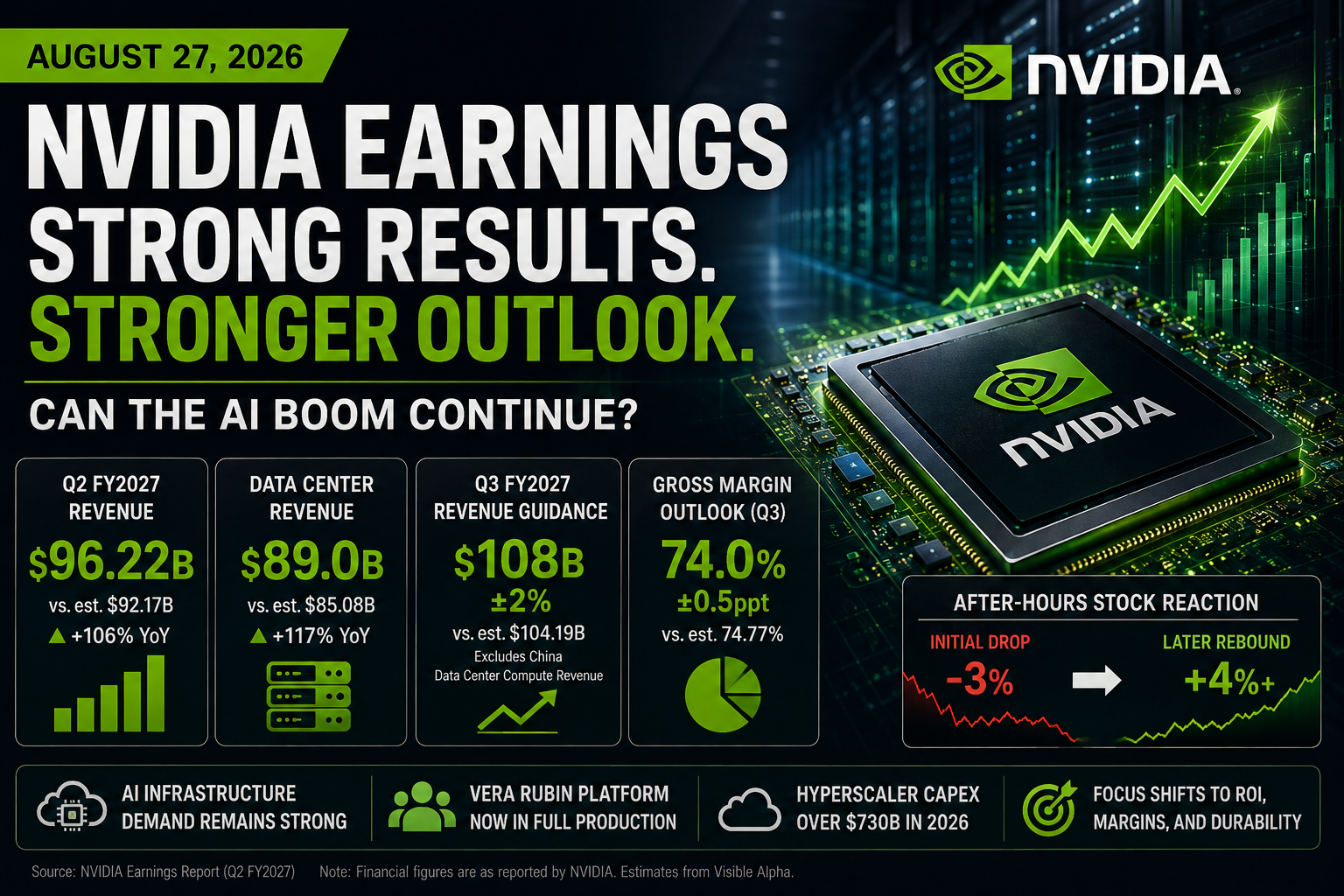
Quarterly revenue reached $96.22 billion, more than doubling from a year earlier. Data center revenue climbed to $89 billion, up 117% year over year. And management guided for approximately $108 billion in revenue next quarter, comfortably above Wall Street expectations.
The initial after-hours reaction was volatile. Nvidia shares briefly fell as investors focused on the gross-margin outlook, before reversing course and climbing more than 4% as the earnings call reinforced confidence in long-term AI infrastructure demand.
But for U.S. investors, the most important question is no longer whether Nvidia can beat earnings estimates.
It is this
Can hyperscalers continue spending hundreds of billions of dollars on AI infrastructure at a pace that supports Nvidia's extraordinary growth — and can Nvidia maintain its exceptional profitability as the AI buildout enters its next phase?
That is the real story behind this earnings report.
The Bottom Line
Nvidia's latest results provide little evidence that the AI infrastructure cycle is collapsing.
If anything, the numbers suggest the opposite.
Data center revenue is still growing at triple-digit rates, next-quarter guidance exceeded Wall Street expectations, and Nvidia produced that outlook without assuming any China data center compute revenue.
However, the investment debate is changing.
Wall Street is moving beyond the question of whether AI demand is strong. Investors increasingly want to know whether hyperscaler capital spending can generate sufficient returns, whether Nvidia can defend gross margins in the mid-70% range, and whether the transition from Blackwell to Vera Rubin can extend the current growth cycle.
In other words
The AI story is shifting from proving demand to proving durability and returns.
Nvidia Earnings: What Actually Happened?
Nvidia reported fiscal 2027 second-quarter revenue of $96.221 billion, an increase of 18% sequentially and 106% from a year earlier.
The company's Data Center business generated $89 billion, rising 117% year over year.
Adjusted earnings per share came in at $2.22.
The numbers were strong across the board.
| Metric | Nvidia Reported/Guided | Wall Street Estimate | Takeaway |
| Quarterly Revenue | $96.22B | ~$92.17B | Beat |
| Data Center Revenue | $89.0B | ~$85.08B | AI demand remains strong |
| Adjusted EPS | $2.22 | ~$2.10 | Beat |
| Q3 Revenue Guidance | $108B ±2% | ~$104.19B | Above consensus |
| Q2 Gross Margin | 75.0% | — | Exceptional profitability |
| Q3 Gross Margin Outlook | 74.0% ±0.5 ppt | ~74.77% | Slightly below expectations |
The next-quarter guidance deserves particular attention.
Nvidia expects approximately $108 billion in revenue, plus or minus 2%, compared with Wall Street expectations of roughly $104.19 billion.
But one detail makes that number even more interesting.
Nvidia's $108 Billion Guidance Assumes No China Data Center Compute Revenue
Nvidia explicitly stated that its third-quarter outlook assumes no Data Center compute revenue from China.
That matters.
China remains a major source of uncertainty because of U.S. export restrictions, geopolitical risk and Beijing's push to develop a domestic semiconductor ecosystem.
Yet Nvidia is still forecasting quarterly revenue above Wall Street consensus without depending on China Data Center compute sales.
That tells investors something important about the underlying demand environment.
For now, AI infrastructure spending outside China appears powerful enough to keep Nvidia's growth engine running at an extraordinary pace.
Why Did Nvidia Initially Fall — Then Rally After Hours?
The after-hours price action provided a useful window into what investors actually care about.
Nvidia initially fell by roughly 3% following the earnings release.
The problem wasn't revenue.
It wasn't EPS.
And it wasn't the top-line guidance.
The market's attention quickly turned toward gross margins.
Nvidia reported a second-quarter gross margin of 75.0%, while management expects approximately 74.0% ±0.5 percentage points next quarter.
That was slightly below Wall Street's roughly 74.77% expectation.
For an ordinary semiconductor company, a gross margin around 74% would be remarkable.
For Nvidia, investors are asking a different question
Has profitability reached a peak?
That concern contributed to the initial weakness.
But sentiment shifted during the conference call.
CEO Jensen Huang emphasized that the AI infrastructure buildout remains powerful, while Nvidia confirmed that its next-generation Vera Rubin platform has entered full production.
The shares subsequently reversed course and gained more than 4% in after-hours trading.
The sequence matters.
It suggests the market initially focused on near-term profitability risks but ultimately placed greater weight on the durability of the long-term AI infrastructure cycle.
Still, this is only the after-hours reaction.
The next U.S. regular trading session will provide a much better test of how Nvidia, semiconductor stocks and the Nasdaq collectively digest the report.
Nvidia Has a New Problem: Expectations
Nvidia's biggest challenge may no longer be competition.
It may be expectations.
The company has trained Wall Street to expect extraordinary results.
Nvidia has now beaten Wall Street revenue expectations for 15 consecutive quarters, but the size of those beats has generally become less dramatic.
That creates an unusual situation.
A company can report
- triple-digit revenue growth,
- triple-digit Data Center growth,
- better-than-expected earnings,
- and better-than-expected forward guidance,
and investors can still debate whether the results were strong enough.
This is a fundamental principle of markets
Stocks don't trade on whether the news is good or bad. They trade on the difference between reality and expectations.
For Nvidia, merely beating consensus has increasingly become the baseline.
The question is whether the company can continue beating the expectations embedded not just in analysts' spreadsheets, but also in its valuation.
The Real Question Is No Longer Nvidia — It's Big Tech
The most important number in Nvidia's future may not appear on Nvidia's own income statement.
It may appear in the capital expenditure budgets of Microsoft, Amazon, Alphabet and Meta.
These companies are spending enormous amounts of money building AI infrastructure.
Major technology companies are expected to spend more than $730 billion on AI infrastructure this year, up substantially from roughly $400 billion previously.
For Nvidia, that is obviously bullish.
Every new AI data center requires accelerators, networking equipment and increasingly sophisticated computing infrastructure.
But Wall Street's question is evolving from
“How much will Big Tech spend on AI?”
to
“How much money will Big Tech make from that spending?”
That distinction could eventually determine the length of the current AI investment cycle.
AI CAPEX vs. AI ROI: The Next Major Market Debate
Imagine Microsoft, Meta, Alphabet and Amazon collectively spend hundreds of billions of dollars building AI infrastructure.
As long as AI-related cloud revenue, advertising productivity, enterprise software revenue and other monetization opportunities grow fast enough, those investments can continue.
But if capital expenditures rise dramatically faster than the cash flows generated by AI, shareholders may eventually demand more discipline.
That would matter enormously for Nvidia.
Nvidia sells the infrastructure.
But Nvidia's customers ultimately need to generate an acceptable return on investment, or ROI, from that infrastructure.
There are already encouraging signals.
Microsoft's recent results showed Azure growth exceeding market expectations, providing evidence that heavy AI investment is translating into actual business growth.
But one quarter does not settle the debate.
For long-term investors, hyperscaler AI monetization may eventually become a more useful leading indicator for Nvidia than Nvidia's own quarterly GPU shipments.
Is This an AI Bubble?
Nvidia's latest earnings do not provide strong evidence that the AI boom is collapsing.
Quite the opposite.
Data Center revenue increased 117% year over year.
Total revenue increased 106%.
Third-quarter revenue is expected to reach approximately $108 billion.
And that outlook excludes China Data Center compute revenue.
Those are not numbers associated with collapsing demand.
But the phrase “AI bubble” is often misunderstood.
The real question isn't whether artificial intelligence has economic value.
It clearly does.
The more sophisticated question is whether capital investment and asset prices are moving faster than the economic returns ultimately generated by AI.
History provides many examples of transformative technologies where the technology itself succeeded while investors still overpaid during certain stages of the cycle.
The internet was real.
Railroads were real.
Telecommunications infrastructure was real.
But real technological revolutions can still produce periods of excessive capital investment and excessive valuations.
That is the distinction investors should keep in mind when analyzing AI today.
The Gross Margin Signal Investors Should Watch
Nvidia's gross margin deserves more attention going forward.
The company delivered a 75.0% gross margin in the second quarter but expects approximately 74.0% ±0.5 percentage points in Q3.
A one-percentage-point decline is hardly a crisis.
A 74% gross margin remains extraordinarily high.
The important issue is the direction.
Nvidia is navigating the transition toward Vera Rubin while dealing with the economics of increasingly complex AI systems, including higher memory costs and production expenses.
If gross margins stabilize after the production ramp, the market may conclude that Nvidia retains extraordinary pricing power.
If margins continue declining across several quarters while revenue growth also slows, the interpretation could change.
Investors might begin questioning whether competition, system complexity and input costs are gradually eroding Nvidia's economics.
One quarter doesn't establish that trend.
But it gives investors another metric to monitor.
Blackwell Is Not the Endgame — Vera Rubin Is Next
One of the biggest mistakes investors can make is thinking of Nvidia simply as a GPU manufacturer.
The company is increasingly positioning itself as an AI infrastructure platform.
Its ecosystem now includes GPUs, CPUs, networking, switches, software and rack-scale computing systems.
That matters because Nvidia's competitive advantage is no longer based entirely on producing the fastest individual accelerator.
Nvidia said its next-generation Vera Rubin platform is now in full production, with systems being built by major cloud and infrastructure partners including Google Cloud, Microsoft Azure, Oracle Cloud Infrastructure and CoreWeave.
That creates the next major test for the Nvidia story.
Can Nvidia move customers from Blackwell into Rubin without disrupting the extraordinary pace of AI infrastructure spending?
If it can, the AI hardware cycle could extend much further than skeptics currently expect.
Nvidia's Biggest Competitor May Not Be AMD
AMD remains an obvious competitor in AI accelerators.
But the longer-term competitive threat may come from Nvidia's own customers.
Alphabet, Meta and other hyperscalers are increasingly developing custom AI chips and ASICs designed for specific workloads.
The economics become particularly interesting as AI workloads shift from training toward inference.
Training frontier models often requires enormous computational power.
Inference can place greater emphasis on cost efficiency, power efficiency and workload optimization.
That creates more room for custom silicon.
Nvidia's defense is therefore much larger than GPU performance.
Its moat increasingly depends on the entire stack
CUDA + networking + CPUs + GPUs + rack-scale architecture + software + rapid product cycles.
The harder Nvidia makes it for customers to replace the entire ecosystem, the stronger its competitive position becomes.
Where Is the Money Moving?
Investors should be careful about interpreting Nvidia's earnings as evidence that money is suddenly abandoning AI.
There is a more subtle possibility.
The U.S. equity rally may simply be broadening.
Healthcare and financial stocks have recently shown relative strength, while the equal-weighted S&P 500 has at times outperformed the traditional market-cap-weighted index — a sign that market participation may be expanding beyond a small group of mega-cap technology companies.
That would not necessarily be bearish for Nvidia.
A healthy bull market does not require Nvidia, Microsoft, Apple, Amazon, Meta and Alphabet to generate nearly all of the index's returns.
Broader participation can actually reduce concentration risk.
The important distinction is between rotation and risk-off.
If investors take profits in AI hardware and move capital toward financials, industrials, healthcare or other equities, that is sector rotation.
If stocks, cryptocurrencies and other risk assets weaken together while capital moves toward cash, Treasuries and the U.S. dollar, that would represent a broader decline in risk appetite.
Those are very different market environments.
What U.S. Investors Should Watch Next
1. Hyperscaler CAPEX
Watch Microsoft, Amazon, Alphabet and Meta.
If their AI capital spending plans continue rising, Nvidia's demand environment remains structurally supportive.
A slowdown in customer CAPEX could appear before a meaningful slowdown becomes visible in Nvidia's revenue.
2. AI Monetization
Spending alone isn't enough.
Investors need evidence that AI is generating revenue and cash flow.
Watch Azure, AWS, Google Cloud, Meta's advertising economics, enterprise AI software and other monetization channels.
The stronger the economic returns from AI, the longer hyperscalers can justify aggressive infrastructure investment.
3. Nvidia's Gross Margin
The 74%-75% range is now a critical indicator.
Stable margins combined with strong revenue growth would signal continued pricing power.
Falling growth and falling margins at the same time would deserve much closer attention.
4. Treasury Yields
Nvidia may be an AI company, but its stock still lives inside the global financial system.
High-growth stocks derive a significant portion of their valuation from future earnings.
When long-term Treasury yields rise, those future cash flows are discounted more heavily.
That means the AI industry can continue growing even while AI stocks experience valuation compression.
A great industry does not automatically mean rising stock prices at every valuation.
5. Inflation and the Federal Reserve
Macro conditions remain important.
Stronger inflation can push Treasury yields higher and reduce expectations for easier Federal Reserve policy.
That can pressure technology multiples even when corporate fundamentals remain strong.
Nvidia's earnings should therefore be analyzed alongside rates, inflation, the dollar and liquidity — not in isolation.
What Would Wealthy Investors Look For?
For long-term capital, the question isn't simply
“Should I buy Nvidia tomorrow?”
A more useful question is
“Where does the next dollar go if the AI infrastructure cycle continues?”
AI data centers require far more than GPUs.
They require high-bandwidth memory.
They require high-speed networking.
They require enormous amounts of electricity.
They require cooling equipment, transformers, data center capacity and physical infrastructure.
And once that infrastructure exists, companies need software and applications capable of turning all that computing power into revenue.
The capital flow could therefore broaden across the AI value chain
GPUs → Memory → Networking → Power & Cooling → Data Centers → AI Software & Services
That doesn't mean every company connected to AI will succeed.
It means the investment opportunity is broader than one semiconductor stock.
Sophisticated investors also pay attention to price.
A great company can still be a poor investment if too much future growth is already embedded in its valuation.
That is why cash can remain strategically valuable.
Cash isn't necessarily a prediction that markets will fall.
It provides optionality when expectations reset and prices become more attractive.
Investors should ask themselves
Am I trying to predict Nvidia's next daily move, or am I investing around a multi-year transformation in global capital spending driven by AI infrastructure?
And there is an equally important second question
How much of that extraordinary future is already reflected in today's price?
Great companies and great investments are not always the same thing.
In investing, survival matters more than perfect prediction.
Final Thoughts
Nvidia's latest earnings did not invalidate the AI growth story.
Quarterly revenue increased 106% year over year.
Data Center revenue increased 117%.
And management expects approximately $108 billion in next-quarter revenue without assuming China Data Center compute sales.
The initial after-hours decline reflected concerns about the gross-margin outlook, but shares subsequently reversed higher by more than 4% as investors absorbed Nvidia's message about continued AI demand and the next phase of its product roadmap.
But expectations are becoming harder to beat.
Wall Street is no longer asking only whether AI is growing.
Investors increasingly want to know how long this extraordinary growth can continue, whether hyperscalers can earn acceptable returns on massive AI investments, and whether Nvidia can preserve its exceptional margins as competition and system complexity increase.
The Nvidia story can now be summarized in one sentence
Nvidia has once again demonstrated that the AI infrastructure cycle remains powerful, but the market's next question is shifting from “Will AI grow?” to “How long can this level of growth and profitability actually last?”
This has been MasterMind.
'[Global] Success Blueprints' 카테고리의 다른 글