Nvidia AI Server Prices Rise 15%: How the Memory Shortage Could Reshape the AI Chip Market


Hello, this is MasterMind.
If Nvidia has been one of the biggest beneficiaries of the AI boom, what does it mean when even Nvidia can no longer fully absorb rising memory costs?
That question is becoming increasingly important for U.S. investors.
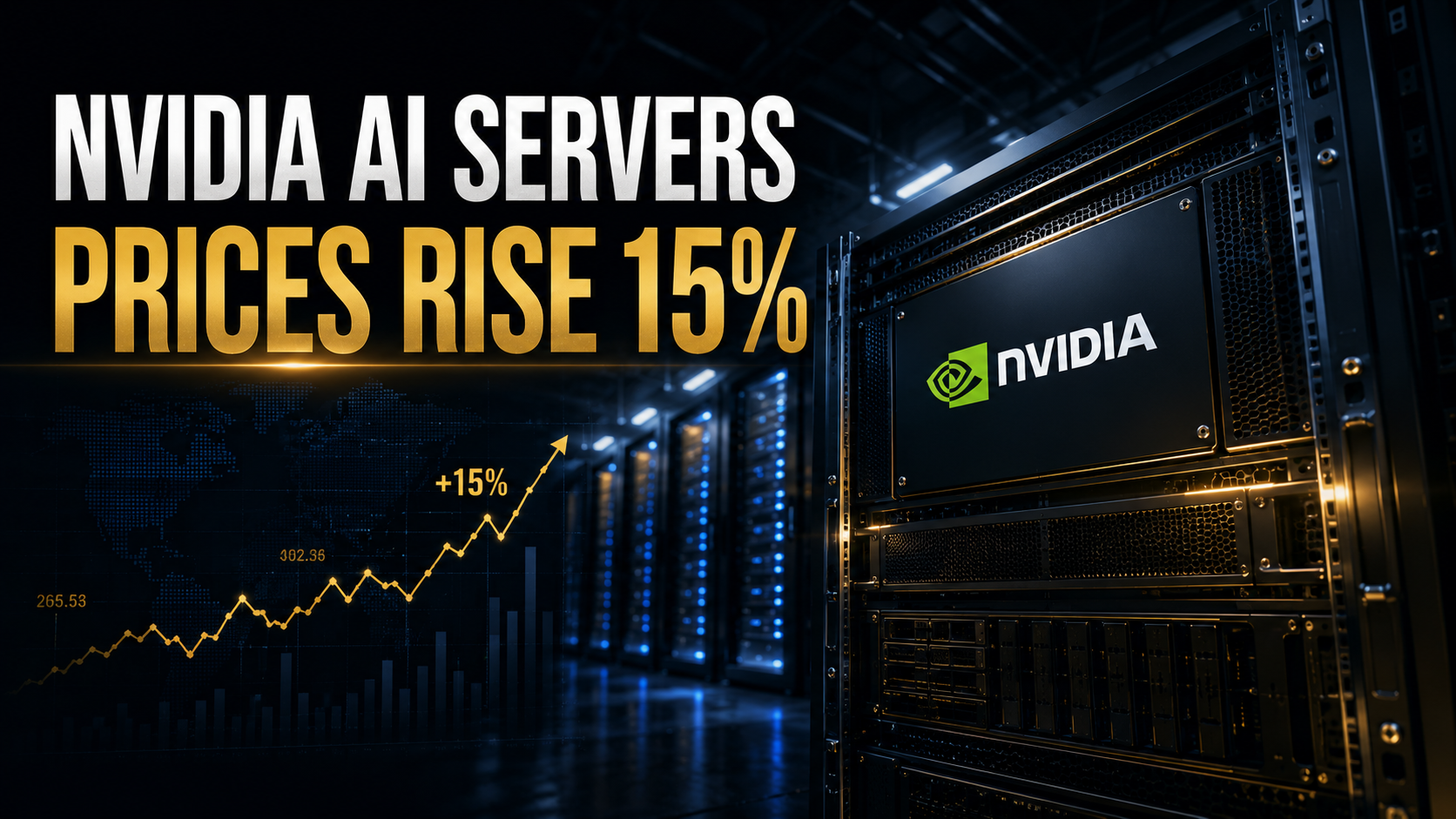
Some of Nvidia’s largest customers have reportedly been told that prices for servers containing Nvidia AI chips could rise by more than 15% in many cases, largely because of soaring memory costs. The increases are expected to affect systems shipping in early 2027, including platforms based on Grace Blackwell and the next-generation Vera Rubin architecture.
At first glance, this looks like another Nvidia pricing story.
But the more important development may be happening elsewhere in the AI supply chain.
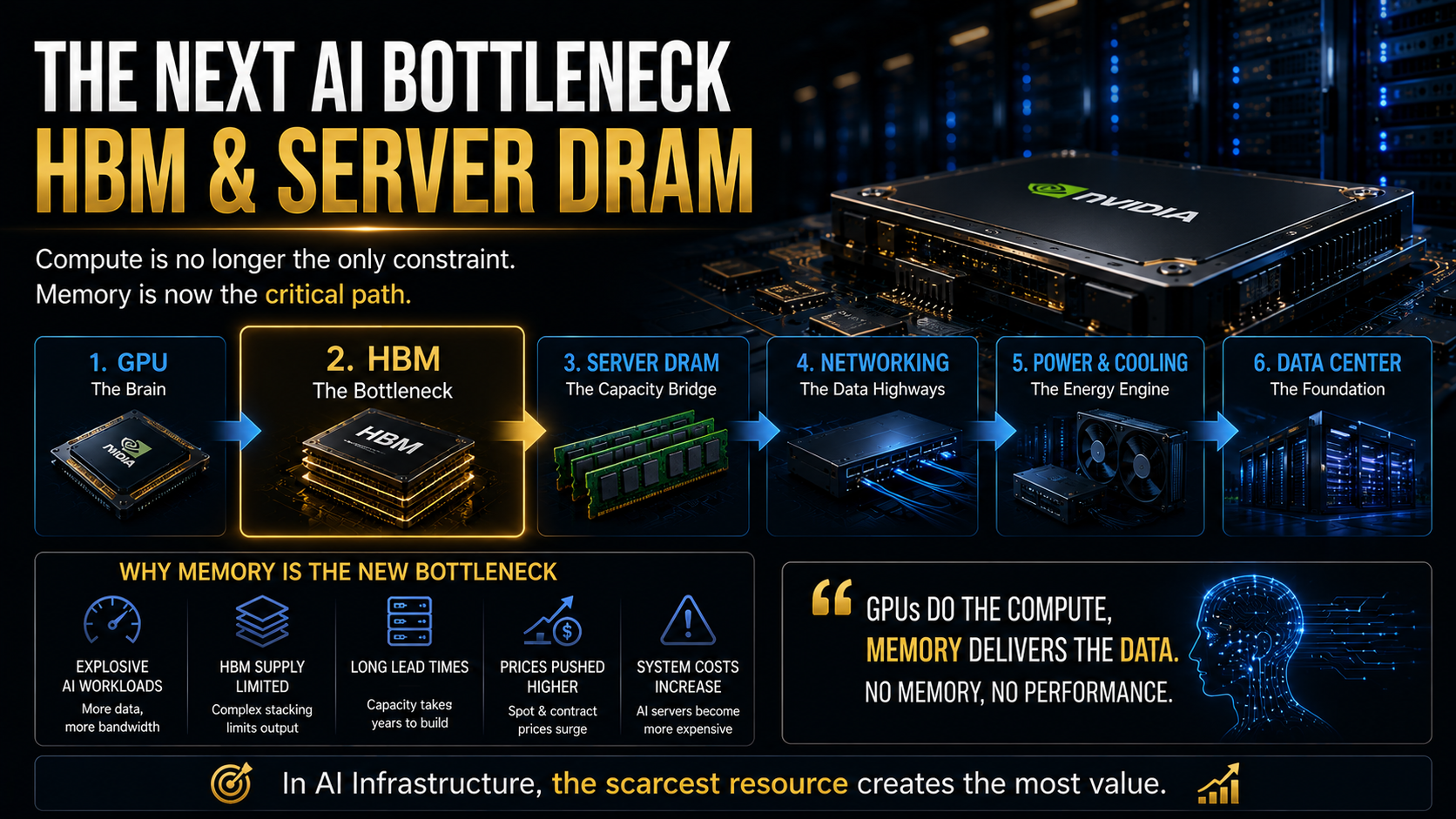
As artificial intelligence infrastructure expands, the industry's bottleneck is broadening from GPUs into high-bandwidth memory, server DRAM, advanced packaging, networking, power and cooling infrastructure.
For investors, that raises a much bigger question
Where is pricing power moving next in the AI economy?
The Bottom Line
Nvidia’s reported AI server price increases suggest that rising HBM and server memory costs are becoming significant enough to move through the supply chain. The bigger investment story is that AI pricing power is no longer concentrated in GPUs alone—it is spreading toward memory and other scarce infrastructure.
For U.S. investors, this puts not only Nvidia in focus, but also Micron, the hyperscalers, custom AI chip developers and the broader data center infrastructure ecosystem.
Why Are Nvidia AI Server Prices Rising?
For most of the AI boom, investors have focused primarily on GPUs.
That makes sense.
GPUs perform the enormous number of calculations required to train and run modern AI models.
But computing power alone does not determine AI performance.
A GPU needs enormous amounts of data delivered quickly enough to keep its processing cores working.
That is where HBM, or high-bandwidth memory, becomes critical.
Think of a GPU as a massive factory.
The factory may contain the fastest machines in the world, but those machines cannot operate efficiently if raw materials arrive too slowly.
HBM is essentially the high-speed logistics system feeding that factory.
As AI models become larger and inference workloads become more complex, memory bandwidth and capacity become increasingly important.
Micron, for example, says its HBM4 technology can provide more than 2.8 terabytes per second of bandwidth per stack—more than twice the bandwidth of its previous HBM generation.
That illustrates how quickly the memory requirements surrounding AI accelerators are increasing.
Why Is AI Creating a Memory Shortage?
The memory story is not simply about selling more chips.
Several structural forces are occurring simultaneously.
AI Servers Need More Memory
Traditional servers already consume large amounts of DRAM.
AI servers require even more sophisticated memory architectures because accelerators must continuously process enormous datasets.
As AI workloads expand from training toward large-scale inference, reasoning and agentic applications, the demand for memory capacity and bandwidth increases.
Micron has said memory content per server has doubled over the past three years while AI workloads continue to increase memory requirements across the computing stack.
That means memory demand can rise even faster than the number of servers being deployed.
HBM Is More Difficult to Produce
HBM is not simply conventional DRAM sold at a higher price.
Multiple DRAM dies must be stacked vertically and connected through advanced packaging technologies.
Manufacturing yields, packaging capacity and customer qualification therefore matter.
Increasing supply is more complicated than simply producing additional conventional memory chips.
HBM Consumes Manufacturing Capacity
There is another important consequence.
When memory manufacturers allocate more production capacity toward high-value HBM products, the available supply environment for conventional DRAM can tighten as well.
Micron has previously said growing HBM demand creates significant pressure on industry supply because HBM consumes substantially more wafer capacity than standard DDR5 memory.
The result can become a reinforcing cycle
AI data center expansion → more accelerators → more HBM → tighter DRAM capacity → higher memory prices
Eventually, those higher costs reach the companies assembling AI systems.

What Is Cost Pass-Through?
One of the most important concepts for investors in this story is cost pass-through.
When a company's input costs rise, management essentially has two choices.
It can absorb those higher costs and accept lower margins.
Or it can increase prices and transfer some of those costs to customers.
The second option is cost pass-through.
This matters because it reveals pricing power.
If Nvidia can raise system prices while customers continue buying, Nvidia preserves part of its economics.
But there is another side to the transaction.
If memory suppliers can charge Nvidia and other AI system manufacturers higher prices because supply is scarce, they also possess pricing power.
This creates a chain
Higher memory prices → higher AI system costs → higher server prices → higher hyperscaler capital expenditures
The key investment question becomes
Who can pass costs forward, and who ultimately has to absorb them?
Is AI Pricing Power Shifting Away From Nvidia?
Not exactly.
It would be too aggressive to say pricing power has simply moved from Nvidia to memory manufacturers.
Nvidia remains one of the most strategically important companies in the AI ecosystem, with an extensive hardware and software platform surrounding its accelerators.
A better way to understand the change is this
Pricing power is spreading across the AI infrastructure stack.
During the first stage of the generative AI boom, the obvious bottleneck was GPU availability.
Now the infrastructure chain looks increasingly complex
GPU → HBM → Advanced Packaging → Server Memory → Networking → Power → Cooling → Data Centers
Every component must scale.
If one cannot, that component can become the next bottleneck.
And bottlenecks matter because scarcity creates economic value.
One of the most important principles investors can take from the AI buildout is this
Capital does not only follow the most exciting technology. It eventually flows toward the scarce resources required to make that technology work.
Why Micron Matters More to U.S. Investors Now
For American investors, the most direct publicly traded U.S. memory company in this story is Micron Technology.
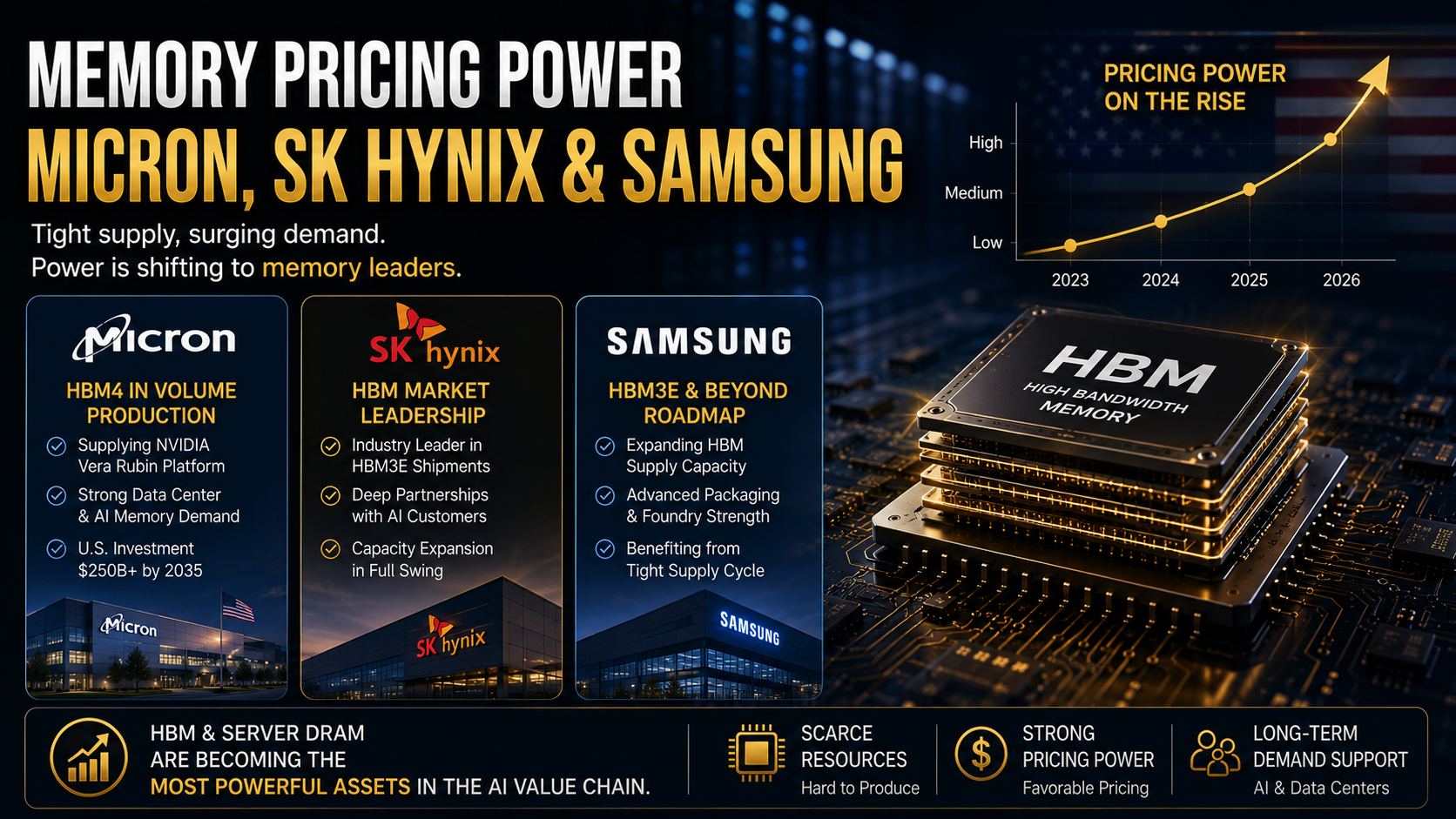
Micron is competing in HBM alongside South Korea's SK hynix and Samsung Electronics while also maintaining significant exposure to conventional DRAM and data center memory.
More importantly, Micron has already entered volume production of HBM4 designed for Nvidia’s Vera Rubin platform.
That changes how investors should think about the company.
Historically, Micron has often been viewed primarily through the lens of the highly cyclical DRAM and NAND markets.
AI introduces another dimension.
If HBM becomes an increasingly important portion of the memory market, memory companies could benefit from
- Higher memory content per AI server
- More advanced products
- Greater manufacturing complexity
- Stronger pricing environments during periods of constrained supply
- Long-term demand from hyperscale data center operators
Micron has also announced plans to increase its total planned U.S. investment to more than $250 billion through 2035, reflecting expectations for continued long-term memory demand.
But that last point also introduces an important risk.
Today's shortage eventually encourages tomorrow's capacity expansion.
What About SK Hynix and Samsung?
Even for U.S. investors who do not directly own Korean semiconductor stocks, SK hynix and Samsung remain critical to understanding Nvidia, Micron and the entire AI infrastructure market.
The global DRAM industry is concentrated among a small number of major producers.
That means supply decisions by Samsung, SK hynix and Micron can have consequences across the global technology sector.
Samsung is also exposed to several other areas of the AI semiconductor chain, including foundry manufacturing and advanced semiconductor production.
In August 2026, Samsung reportedly raised prices for some advanced contract chipmaking services by as much as 15% as demand increased and industry capacity tightened.
That broader pattern matters.
Scarcity is appearing in more than one layer of the semiconductor manufacturing ecosystem.
For investors, the question is therefore bigger than which memory company sells the most HBM.
The real question is
How much pricing power can semiconductor manufacturers retain as AI infrastructure demand expands?
Higher Memory Prices Are Not Automatically Bullish
This distinction is crucial.
Higher memory prices can initially be very positive for memory manufacturers.
If selling prices rise while production volumes remain strong, revenue and margins can improve quickly.
But prices cannot rise indefinitely without consequences.
Imagine the following sequence
Memory prices rise
↓
AI server prices rise
↓
Data center construction becomes more expensive
↓
Hyperscaler AI capital expenditures increase
↓
AI return-on-investment requirements rise
At some point, customers may begin asking whether the economics still make sense.
That means the ideal environment for memory companies is not necessarily exploding memory prices.
It is
High memory pricing + strong AI demand + disciplined supply growth
That combination matters far more than price increases alone.
What Nvidia’s Price Increase Means for Microsoft, Google, Amazon and Meta
The ultimate buyers of much of the world's AI infrastructure are hyperscalers.
Companies such as Microsoft, Alphabet, Amazon and Meta are investing enormous amounts of capital in AI data centers.
Higher AI server prices therefore affect their economics directly.
If infrastructure costs increase while AI revenue grows even faster, there may be little reason to slow investment.
But if infrastructure costs continue climbing while monetization disappoints, investors may become much more demanding about capital efficiency.
That leads to one of the most important questions for the next stage of the AI cycle
Can Big Tech convert AI CAPEX into sustainable free cash flow?
The AI investment debate is gradually shifting from simply measuring how much companies spend to measuring what they receive in return.
There is already evidence that the scale of AI financing is becoming relevant to capital markets beyond equities. U.S. corporate borrowing to fund AI infrastructure has increased enough that some bond investors are demanding higher yields and questioning how much additional issuance the market can absorb.
That is an important macro signal.
The AI boom is becoming large enough to influence not just semiconductor earnings, but corporate financing decisions.
Could Higher Nvidia Prices Accelerate Custom AI Chips?
There is another potential consequence.
The more expensive Nvidia-based AI infrastructure becomes, the stronger the economic incentive for hyperscalers to develop their own accelerators.
Google already has its TPU ecosystem, while other large technology companies are investing in custom silicon and ASICs.
Custom chips can reduce dependence on general-purpose merchant accelerators for certain workloads.
But there is an important catch.
Replacing an Nvidia GPU does not eliminate the need for memory.
A custom AI accelerator still requires high-speed memory, advanced packaging, networking and enormous amounts of electrical power.
This creates an interesting possibility.
Nvidia could face greater competition from custom silicon while the broader memory market continues benefiting from AI accelerator proliferation.
In other words
The winner of the accelerator battle and the winner of the memory demand cycle do not necessarily have to be the same company.
How Could the Memory Shortage Affect Major Asset Classes?
| Market / Sector | Potential Impact | What Investors Should Watch |
| Micron / Memory | Potentially positive | HBM shipments, DRAM pricing, margins |
| Nvidia | Mixed but potentially manageable | Gross margin, demand elasticity, pricing |
| Hyperscalers | Higher near-term costs | CAPEX, AI revenue, free cash flow |
| Custom AI Chips | Stronger economic incentive | TPU/ASIC adoption |
| Foundries & Packaging | Potential demand support | Capacity utilization |
| Networking | Structural demand growth | AI cluster expansion |
| Power & Cooling | Higher infrastructure demand | Data center construction |
| Bonds | Financing pressure possible | Corporate issuance, credit spreads |
| U.S. Dollar / Treasuries | Limited direct effect | Inflation, growth and Fed policy remain dominant |
The broader lesson is that the AI trade is evolving.
It is no longer simply
Buy more GPUs.
It increasingly involves an entire physical infrastructure stack.
Is This Really a New Memory Supercycle?
Possibly—but investors should be careful with the word "supercycle."
The memory industry has historically followed a simple pattern
Demand growth → higher prices → higher profits → higher CAPEX → more supply → lower prices
AI does not repeal this cycle.
But it may change its characteristics.
AI servers consume far more sophisticated memory.
HBM is harder to manufacture.
Hyperscalers have significantly greater purchasing power than traditional consumer electronics buyers.
And AI infrastructure requires multiple scarce resources to expand simultaneously.
These factors could potentially keep memory conditions tighter for longer than in some previous cycles.
But there is a dangerous phrase investors should avoid
"This time the cycle is gone."
High profitability attracts capital.
Capital creates factories.
Factories create supply.
Eventually, supply can catch demand.
Technology changes.
Economics does not.
Seven Things Investors Should Watch
1. HBM Volume and Pricing
Do not focus only on AI headlines.
Watch actual HBM shipments, product generations and average selling prices.
2. Conventional Server DRAM
If pricing strength spreads from HBM into conventional server DRAM, the memory upcycle becomes much broader.
3. Micron, Samsung and SK Hynix CAPEX
Today's investment decisions determine tomorrow's supply.
Aggressive simultaneous expansion could eventually weaken pricing.
4. Hyperscaler AI Spending
Microsoft, Alphabet, Amazon and Meta remain crucial demand indicators.
Watch whether AI infrastructure spending continues growing.
5. AI Monetization
Revenue matters more than demonstrations.
Eventually, companies must convert AI usage into economic returns.
6. Nvidia Margins and Demand Elasticity
If Nvidia raises prices and demand remains strong, that demonstrates extraordinary pricing power.
If customers begin delaying purchases, the interpretation changes.
7. The Next Bottleneck
HBM may not remain the only constraint.
Advanced packaging, networking, transformers, electricity generation, grid connections and cooling could all become critical.
Investors should continuously ask
Where is the next shortage forming?
What Would Long-Term Capital Watch?
Long-term investors should look beyond Nvidia’s next earnings report or Micron’s next quarterly memory price.
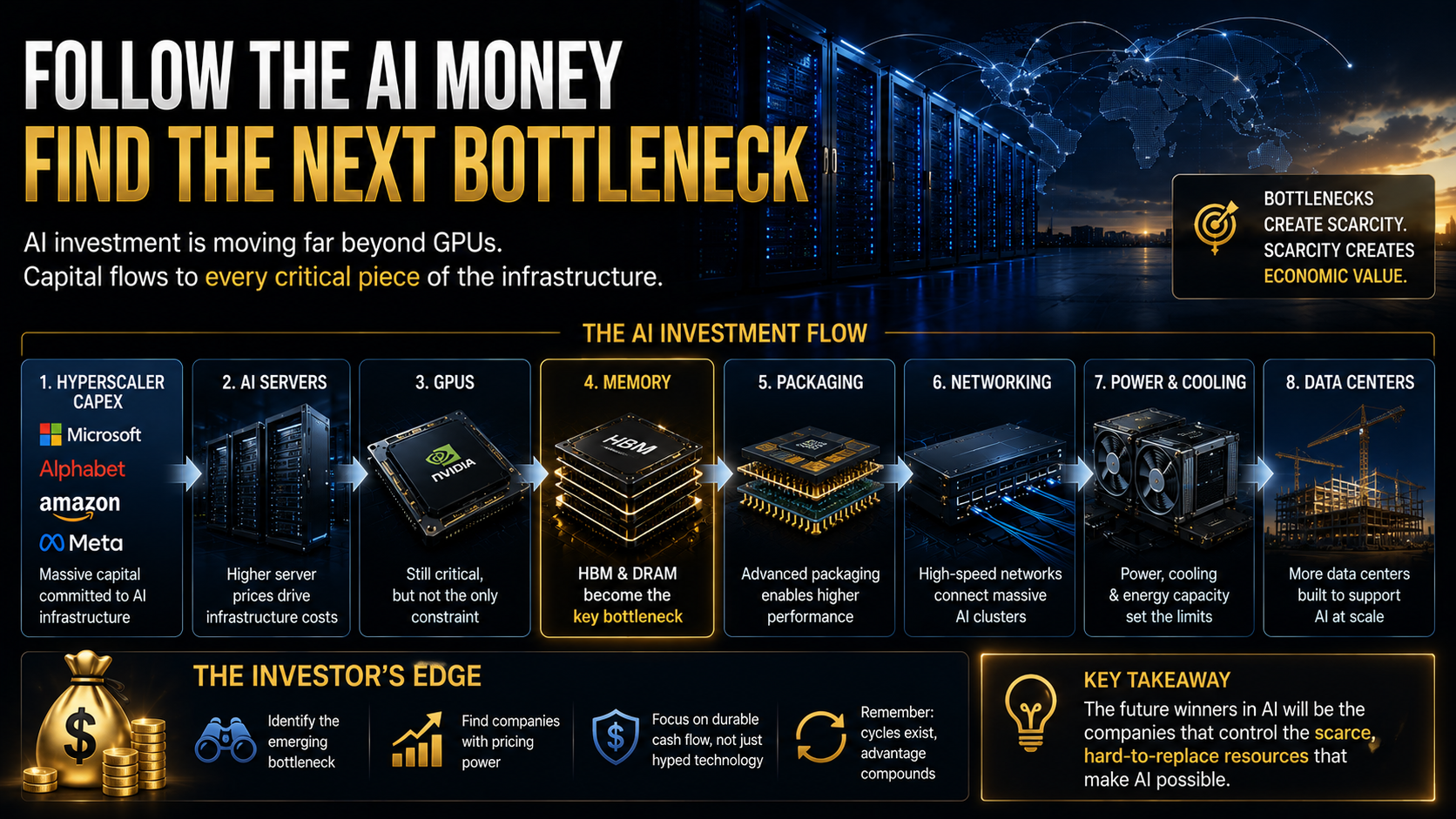
The bigger story is the movement of capital inside the AI ecosystem.
During the first stage of the AI boom, enormous economic value accumulated around GPUs.
As infrastructure scales, money spreads outward
Hyperscaler CAPEX → AI Servers → GPUs → Memory → Packaging → Networking → Power → Cooling → Data Centers
Where bottlenecks appear, pricing power can follow.
Where pricing power appears, margins and cash flow can follow.
But those profits attract new investment.
And new investment eventually creates supply.
That is why investors should ask several questions
Which companies can pass higher costs to customers—and which companies must absorb them?
Which businesses generate real free cash flow from the AI boom rather than simply reporting higher revenue?
Would the business remain financially strong if memory prices normalized?
Is today's cash flow funding durable competitive advantages or tomorrow's excess capacity?
Which part of the AI infrastructure stack is likely to become the next bottleneck?
These questions are more useful than trying to predict exactly where Nvidia, Micron or any other semiconductor stock will trade next quarter.
Because long-term investing is not primarily about predicting every turn in the cycle.
It is about owning assets capable of surviving when the prediction is wrong.
Final Thoughts
Nvidia’s reported AI server price increases of more than 15% should not be viewed simply as another Nvidia pricing story.
They highlight a much larger transformation inside the AI economy.
The first major constraint was compute.
Now the bottlenecks are spreading across HBM, server DRAM, advanced packaging, networking, power, cooling and data center infrastructure.
For Nvidia, higher prices may help protect economics against rising component costs.
For Micron, Samsung and SK hynix, tight memory supply could strengthen pricing and cash generation.
For Microsoft, Alphabet, Amazon, Meta and other hyperscalers, however, higher infrastructure costs raise the hurdle for AI monetization.
And eventually the entire cycle comes back to one fundamental relationship
AI demand → higher memory prices → higher semiconductor profits → more CAPEX → more supply → the next memory cycle
The technology may be revolutionary, but supply and demand still matter.
The key message for investors is therefore simple
In a technology revolution, some of the greatest economic value can accrue not to the most visible technology, but to the companies controlling the scarce, difficult-to-replace bottlenecks that make the entire system possible.
Instead of focusing only on who builds the fastest AI chip, investors should watch where scarcity, pricing power and free cash flow are moving next.
This was MasterMind.
'[Global] Success Blueprints' 카테고리의 다른 글