What Is Operating Cash Flow (OCF)? How to Analyze a Company’s Real Cash Generation


Hello, this is MasterMind.
A company reports record revenue. Net income jumps. Management raises its growth outlook, and the stock looks fundamentally strong.
But then something strange happens.
The company starts borrowing more money, liquidity becomes tighter, and investors suddenly begin questioning whether the business can fund its own operations.
How can a profitable company run into a cash problem?
The answer is simple but important
Accounting profit and actual cash generation are not the same thing.
A company can record revenue before collecting cash from customers. It can report rising earnings while inventory piles up. It can even appear profitable while increasingly depending on debt or equity financing to keep the business running.
That is why investors should understand Operating Cash Flow (OCF).
The income statement tells us how much profit a company reported. The cash flow statement helps us understand where the actual money went.
For long-term investors, that distinction can be critical.
The One-Sentence Takeaway
Operating Cash Flow (OCF) measures how much cash a company's core business actually generates, making it one of the most useful indicators for evaluating earnings quality, financial resilience, and long-term business strength.
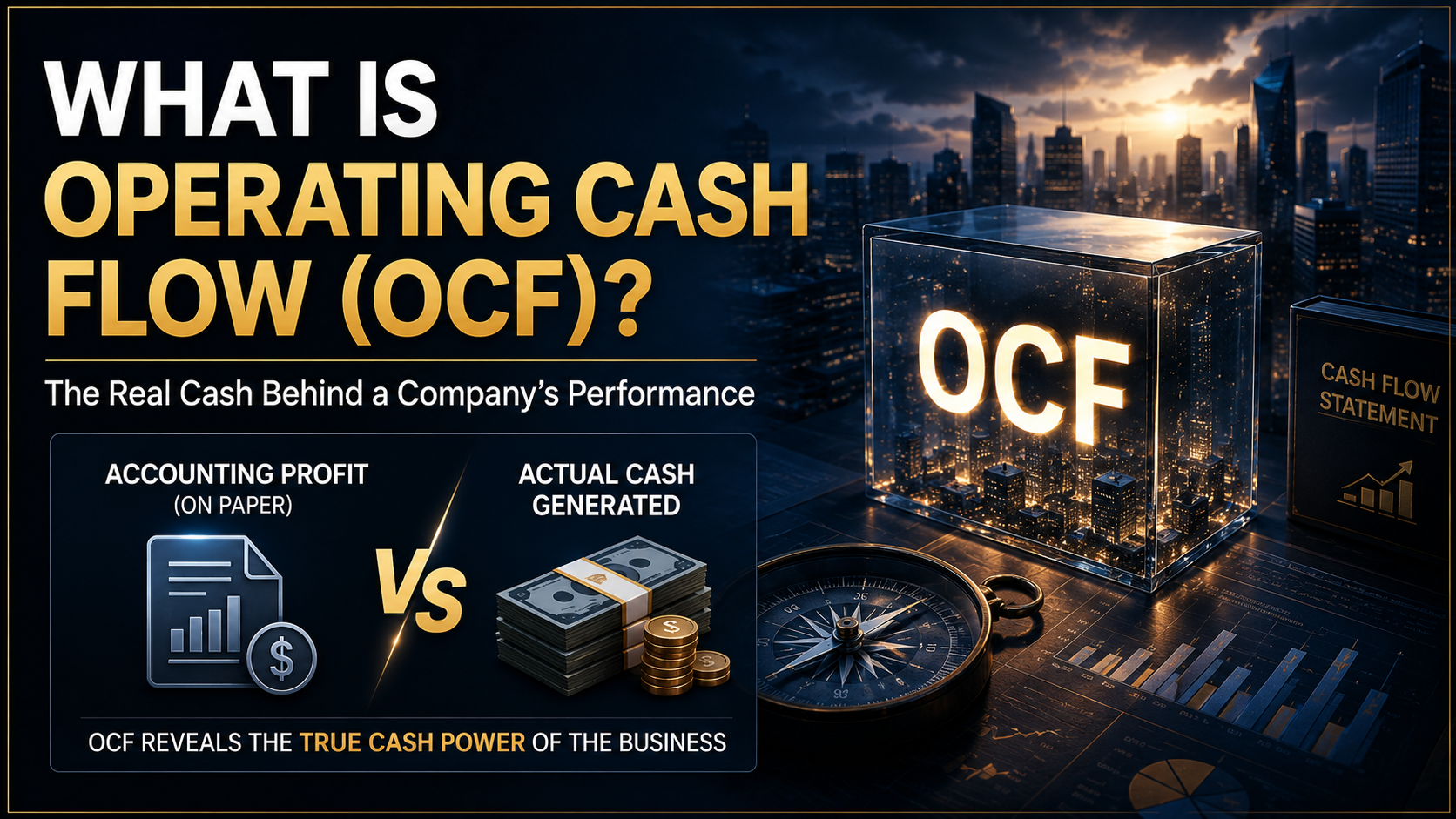
What Is Operating Cash Flow (OCF)?
Operating Cash Flow, usually abbreviated as OCF, represents the cash generated or consumed by a company's normal business operations.
Think about a retailer selling products, a software company collecting subscription payments, or an industrial company selling machinery.
Those core activities generate cash inflows and require cash outflows.
OCF attempts to capture the net cash effect of those operating activities.
A company's cash flow statement is generally divided into three major categories
| Cash Flow Category | What It Represents | Common Examples |
| Operating Cash Flow | Cash generated by core operations | Customer payments, operating expenses |
| Investing Cash Flow | Cash used for or generated from investments | Property, equipment, acquisitions, asset sales |
| Financing Cash Flow | Cash related to funding and capital returns | Debt issuance, stock issuance, dividends, share repurchases |
Why does operating cash flow receive so much attention?
Because over the long run, a sustainable business eventually needs to generate cash from its operations.
A company can borrow money.
It can issue bonds.
It can sell additional shares.
It can sell assets.
But none of those actions represents the underlying economic engine of the business.
Eventually, the core business needs to produce cash.
Why Are Net Income and Operating Cash Flow Different?
This is one of the most important concepts for investors learning financial statement analysis.
If a company earns a profit, shouldn't it receive the cash?
Not necessarily.
Financial statements generally use accrual accounting, meaning revenue and expenses can be recognized when economic activity occurs rather than only when cash physically changes hands.
A Simple Example: $100 Million in Sales
Suppose a U.S. industrial company sells $100 million worth of equipment to customers.
The sale qualifies for revenue recognition, so the company may report $100 million in revenue.
But imagine its customers have 90 days to pay.
The company has recorded the sale, but it has not yet collected the cash.
The unpaid amount appears as accounts receivable.
This creates an important distinction
Revenue has been recorded, but the cash has not arrived yet.
If revenue and net income are rising rapidly while accounts receivable is growing even faster, investors may want to understand why.
The company could simply be expanding quickly.
But it could also be taking longer to collect from customers or offering more generous payment terms to support sales.
This is one reason OCF can reveal information that net income alone cannot.

How Does Operating Cash Flow Work?
There are different presentation methods for operating cash flow, but investors commonly encounter the indirect method.
Conceptually, the process looks something like this
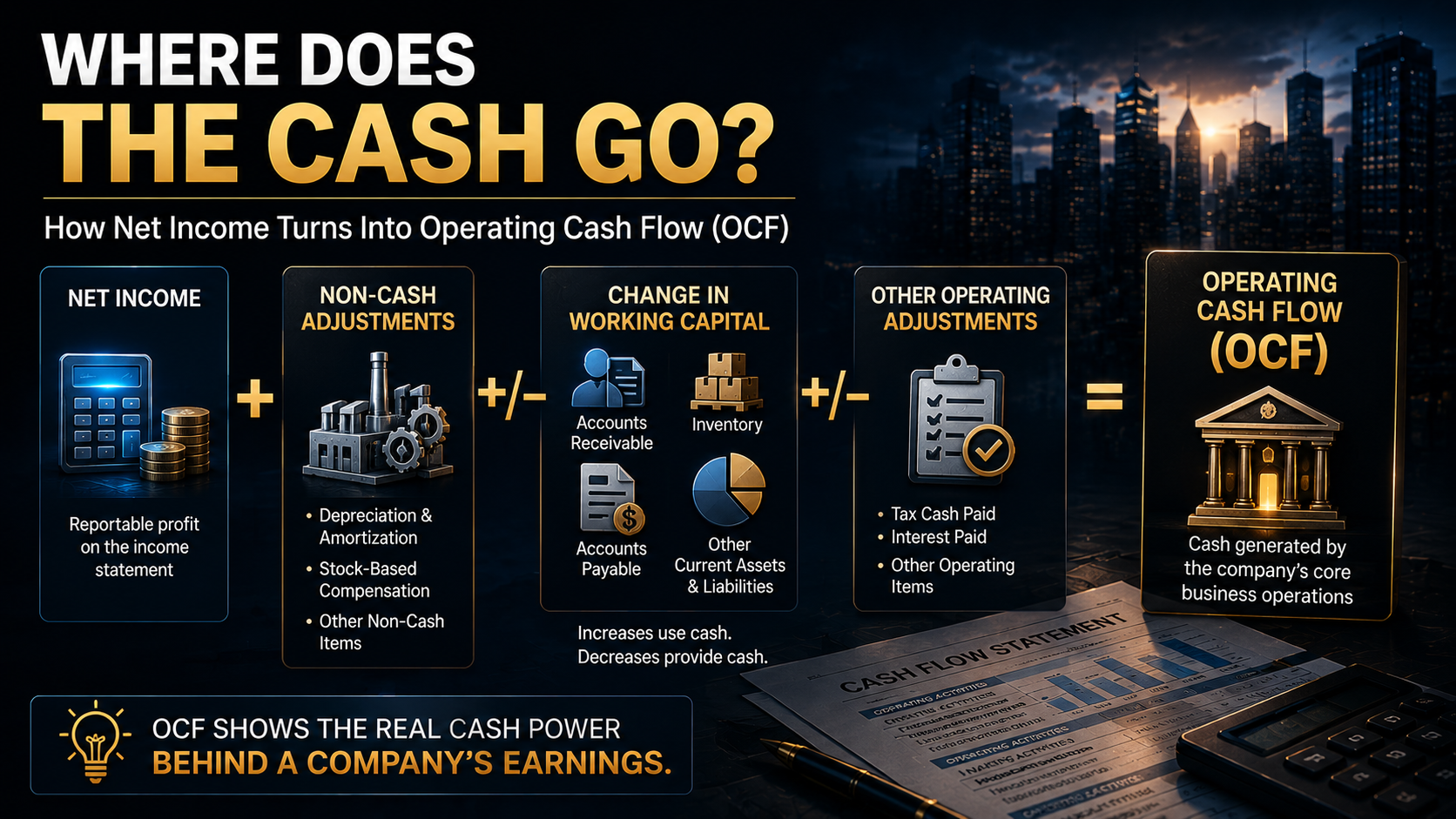
Operating Cash Flow = Net Income + Non-Cash Adjustments ± Changes in Working Capital ± Other Operating Adjustments
The key idea is that OCF begins with accounting earnings and then adjusts them to better reflect actual cash movements.
Depreciation and Other Non-Cash Expenses
Consider a semiconductor manufacturer that spends billions of dollars building fabrication facilities and purchasing equipment.
The cash used to acquire those assets does not necessarily appear as an expense on the income statement all at once.
Instead, the cost is generally recognized over time through depreciation.
Depreciation reduces accounting earnings, but the depreciation expense itself does not represent a new cash payment during that reporting period.
That is why depreciation is typically added back when reconciling net income to operating cash flow.
Accounts Receivable
When accounts receivable increases, it can mean the company has recognized sales for which it has not yet collected the cash.
All else equal, that can reduce operating cash flow.
Inventory
Inventory can also absorb cash.
A retailer preparing for the holiday season or a hardware company expecting stronger demand may deliberately increase inventory.
That is not automatically a negative signal.
But if inventory consistently grows much faster than sales, investors should ask whether products are taking longer to sell.
Accounts Payable
Accounts payable works in the opposite direction.
If a company receives goods or services but delays payment to suppliers, it temporarily keeps more cash inside the business.
That can boost operating cash flow.
This leads to an important lesson
The size of OCF matters, but understanding why OCF changed matters even more.
Why Is Operating Cash Flow So Important?
OCF Helps Investors Evaluate Earnings Quality
Imagine a company whose net income rises every year.
At first glance, the trend looks attractive.
But suppose operating cash flow steadily declines during the same period.
That divergence deserves attention.
Perhaps accounts receivable is increasing rapidly.
Perhaps inventory is building.
Perhaps working-capital movements are consuming cash.
Or perhaps unusual accounting items are contributing to reported earnings.
None of these possibilities automatically means something is wrong.
But the divergence tells investors where to investigate.
Conversely, when revenue, earnings, and operating cash flow grow together over a long period, it can provide stronger evidence that reported business growth is translating into actual cash generation.
OCF Can Reveal Financial Stress
Cash flow statements are not immune to distortions, and investors should avoid treating OCF as an infallible number.
However, persistent differences between earnings and cash generation can reveal issues that may not be obvious from the income statement alone.
That makes OCF particularly useful as a financial-analysis filter.
Cash Generation Supports Corporate Survival
Businesses need cash for nearly everything.
They need cash to
- invest in new facilities and technology,
- fund research and development,
- repay debt,
- pay interest,
- make acquisitions,
- repurchase shares,
- and distribute dividends.
If operations cannot provide enough cash, the company may need outside capital.
When interest rates are low and credit is abundant, raising money may be relatively easy.
When financial conditions tighten, that equation changes.
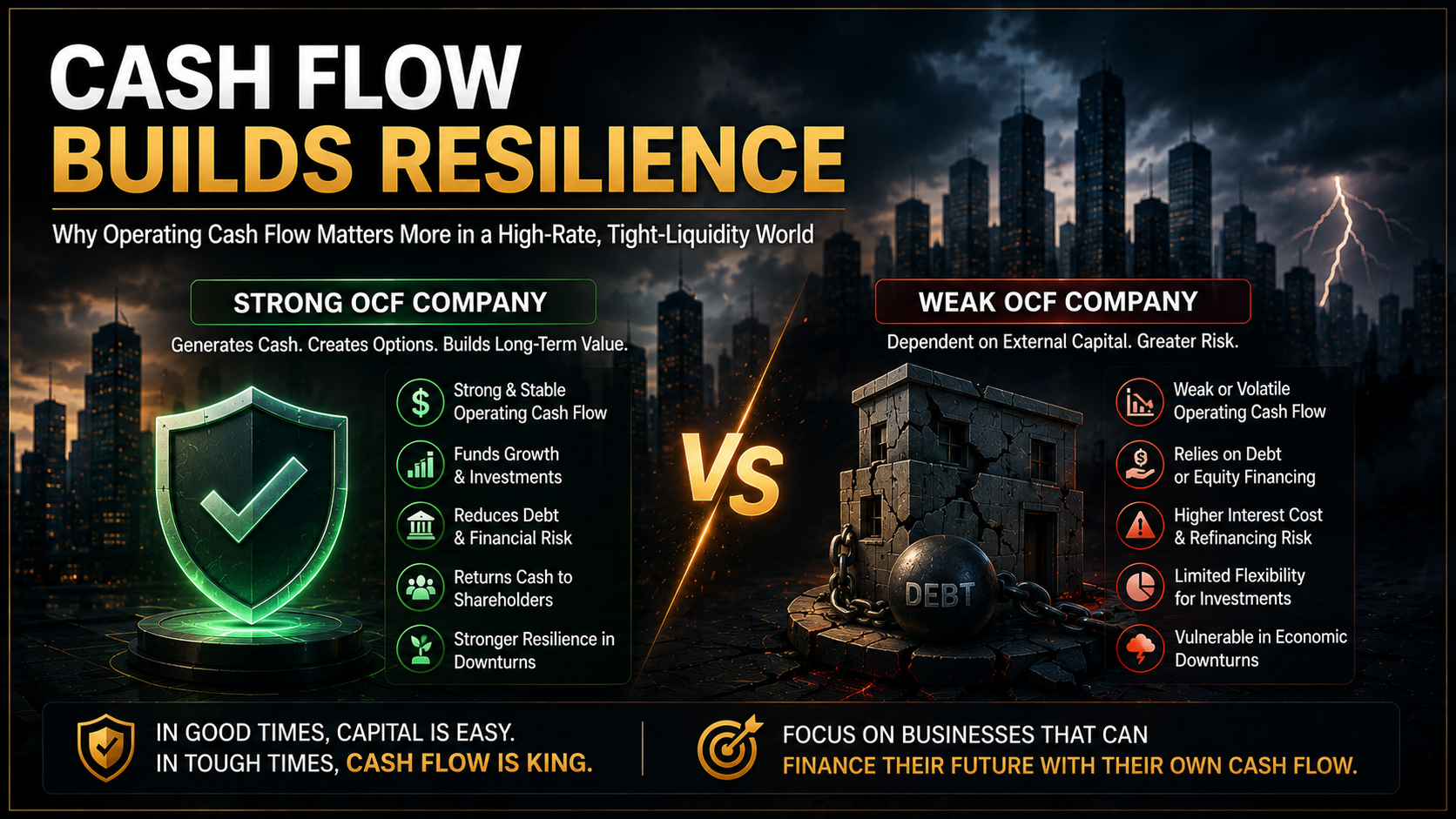
When capital becomes expensive, internally generated cash becomes more valuable.
Operating Cash Flow vs. Free Cash Flow
Once investors understand OCF, the next logical concept is Free Cash Flow (FCF).
The two measures are related but answer different questions.
A simplified version of free cash flow is
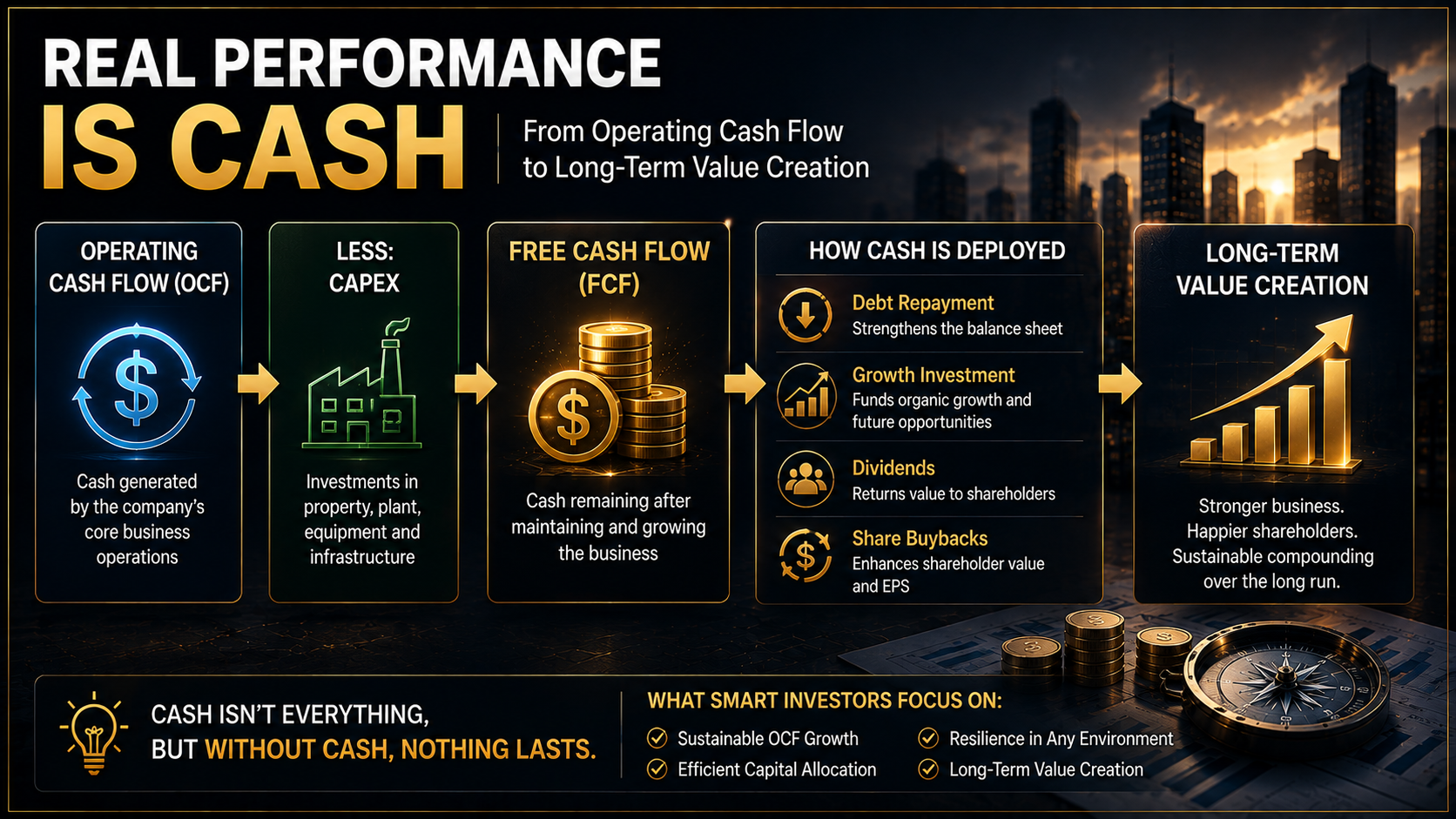
FCF ≈ Operating Cash Flow − Capital Expenditures
Suppose a company generates $10 billion in operating cash flow.
That sounds impressive.
But imagine it needs to spend $8 billion on data centers, manufacturing facilities, equipment, and infrastructure.
Its simplified free cash flow would be approximately $2 billion.
That distinction matters.
| Metric | Key Investor Question |
| Operating Income | How profitable are core operations on an accounting basis? |
| Net Income | How much accounting profit did the company ultimately report? |
| Operating Cash Flow | How much cash did operations generate? |
| Capital Expenditures | How much cash is being invested in long-term assets? |
| Free Cash Flow | How much cash remains after capital investment? |
This becomes especially important when analyzing capital-intensive industries.
Semiconductors, telecommunications, utilities, energy infrastructure, cloud computing, and AI data centers can require enormous capital expenditures.
A business can therefore generate substantial OCF while producing much less FCF.
Why Operating Cash Flow Matters More When Interest Rates Rise
Operating cash flow is a company-specific financial metric, but its importance can change with the macroeconomic environment.
When interest rates are low and liquidity is abundant, investors may be willing to finance companies that generate little current cash but promise significant future growth.
Companies can often raise capital more easily as well.
Higher interest rates change the calculation.
Debt becomes more expensive.
Refinancing becomes more difficult.
Investors apply higher discount rates to future cash flows.
And companies that constantly require external capital can become more vulnerable.
Businesses capable of financing operations and investment internally may therefore become relatively more attractive.
This reflects a broader market principle
When liquidity is abundant, markets can afford to focus on the size of the dream. When liquidity tightens, investors start asking who actually generates cash.
How Operating Cash Flow Can Affect Stocks and Bonds
OCF does not directly determine the price of every asset, but it plays an important role in company valuation and credit analysis.
| Market | Strong and Sustainable OCF | Persistently Weak OCF |
| Stocks | Greater flexibility for investment and shareholder returns | Questions about growth quality and financial resilience |
| Corporate Bonds | Stronger capacity to service interest and principal | Potential increase in credit risk |
| Corporate Financing | Less dependence on external funding | Greater reliance on debt or equity markets |
| Business Investment | More ability to fund CAPEX and R&D internally | Potential investment cuts or additional financing needs |
Stocks
For equity investors, growing operating cash flow can support multiple uses of capital.
Management may reinvest it in growth, reduce debt, make acquisitions, pay dividends, or repurchase shares.
That flexibility can be valuable.
Corporate Bonds
Bondholders care less about exciting growth narratives than shareholders often do.
Their fundamental question is straightforward
Can the company pay its interest and repay its debt?
Reliable operating cash flow can help answer that question.
Gold, the U.S. Dollar, and Bitcoin
Operating cash flow does not directly drive gold, the dollar, or Bitcoin.
Those assets respond to much broader variables such as real interest rates, monetary policy, inflation expectations, liquidity, and risk sentiment.
However, there is an indirect connection.
When financial conditions tighten across the U.S. economy, investors often become more sensitive to balance-sheet strength and cash generation.
In that environment, the difference between a company funded by its own operations and one dependent on continuous access to capital markets can become much more important.
What Investors Should Look for in Operating Cash Flow
Look at the Trend, Not Just One Quarter
A single quarter can be misleading.
Working-capital movements, seasonality, customer payment schedules, and inventory preparation can create significant fluctuations.
Looking across several years often provides a better picture.
Compare Net Income With OCF
Net income and operating cash flow do not need to match.
But if earnings keep rising while operating cash flow consistently deteriorates, investors should understand the reason.
Watch Accounts Receivable
If receivables grow significantly faster than sales, ask whether customers are taking longer to pay.
Watch Inventory
Inventory growth is not inherently bad.
A company expecting strong future demand may deliberately build inventory.
But persistent inventory growth well above revenue growth can signal weaker-than-expected demand or operational inefficiency.
Examine Accounts Payable
A temporary increase in OCF may come from delaying payments to suppliers.
That is very different from generating additional cash through stronger sales.
Compare OCF With CAPEX
This is particularly important for companies such as semiconductor manufacturers, utilities, telecom operators, cloud providers, and other infrastructure-heavy businesses.
Strong OCF does not necessarily mean strong free cash flow.
Compare Companies Within the Same Industry
A software company, retailer, biotechnology company, and industrial manufacturer can have dramatically different working-capital and investment structures.
OCF should therefore be analyzed relative to the company's own history and comparable businesses.
Does Positive Operating Cash Flow Always Mean a Good Business?
No.
This is an important limitation.
A company can temporarily increase OCF by reducing inventory.
It can collect more customer payments in advance.
It can delay payments to suppliers.
Changes in working capital can significantly affect cash flow without representing a permanent improvement in the underlying business.
The opposite can also happen.
A fast-growing company may consume cash because it is building inventory or extending credit to support legitimate expansion.
Therefore
Positive OCF does not automatically mean a great company, and negative OCF does not automatically mean a bad company.
The more useful question is
Where did the cash come from, and is that source sustainable?
That question moves investors beyond simple financial ratios and toward understanding the economics of the business itself.
What Do Wealthy Investors Look for in This Trend?
Sophisticated investors and long-term capital allocators tend to look beyond headline earnings.
They want to understand where the money is actually moving.
Follow the Money
If a company reports $1 billion in profit, where did that economic value go?
Did it become cash?
Is it sitting in accounts receivable?
Is it trapped in unsold inventory?
Or is the business converting its reported earnings into cash that management can redeploy?
This is the first question.
Cash Flow Creates Optionality
Strong cash generation gives management choices.
A company can invest in new capacity.
It can develop new products.
It can acquire competitors.
It can reduce leverage.
It can repurchase shares.
It can return capital through dividends.
Strong cash flow creates strategic optionality.
Cash Flow Supports Survival
During economic expansions, many businesses can look healthy.
Credit is available, investors are willing to take risk, and refinancing is easier.
The real test often arrives during recessions, credit shocks, or periods of sharply higher interest rates.
Companies that can finance their operations internally may have more flexibility to survive.
Some may even emerge stronger by taking market share or acquiring assets from weaker competitors.
Think Like a Long-Term Owner
Stock prices can move dramatically in the short run because of expectations, liquidity, narratives, positioning, and investor psychology.
Over longer periods, however, business value is closely connected to the cash a company can generate for its capital providers.
Instead of trying to predict every market move, investors can ask
- Is operating cash flow growing over time?
- Are rising earnings translating into cash?
- Are receivables growing faster than revenue?
- Is inventory building faster than sales?
- Is stronger OCF coming from business growth or working-capital timing?
- Can operating cash flow fund required capital expenditures?
- Can the company service its debt without constantly raising new capital?
- Could the business survive a recession or credit contraction?
- Is today's cash-generating engine likely to remain relevant five or ten years from now?
And perhaps the most important question
Am I investing in a company that reports profits, or a business that actually generates cash?
Final Thoughts
Operating Cash Flow is one of the most useful tools for understanding the financial reality behind a company's reported earnings.
Revenue tells us how much business a company generated.
Operating income tells us about the profitability of its core operations.
Net income tells us the accounting profit left after expenses.
But OCF helps answer another question
Did those earnings actually turn into cash?
No single financial metric should be used in isolation.
OCF becomes much more powerful when analyzed alongside net income, accounts receivable, inventory, accounts payable, debt, capital expenditures, and free cash flow.
The key lesson is straightforward
A company that reports profits and a company that generates cash are not necessarily the same thing.
Markets can reward expectations for a long time. But businesses ultimately need real cash to invest, repay debt, survive downturns, and create long-term value.
In investing, predicting every market turn is impossible. Understanding which businesses can continue generating cash when conditions become difficult is often far more valuable.
This was MasterMind.
'[Global] Success Blueprints' 카테고리의 다른 글