What Is a Treasury Buyback? Why Gold and Bitcoin Surged as Bond Yields Fell


Hello, this is MasterMind.
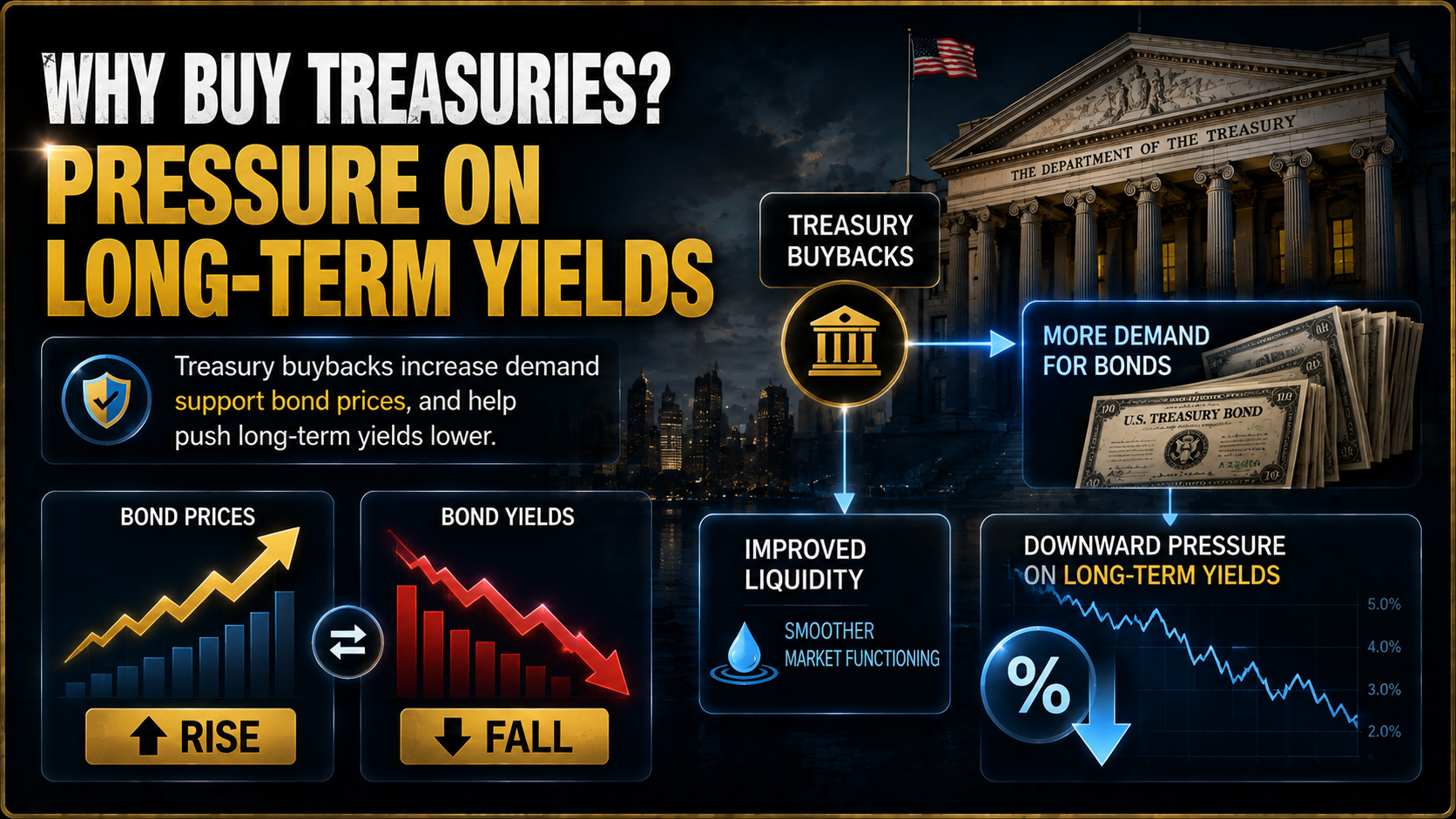
When the U.S. Treasury buys back its own government bonds, the first reaction seems straightforward: Treasury prices should receive support, market liquidity should improve, and long-term yields should face downward pressure.
But recent market behavior produced a much more interesting outcome.
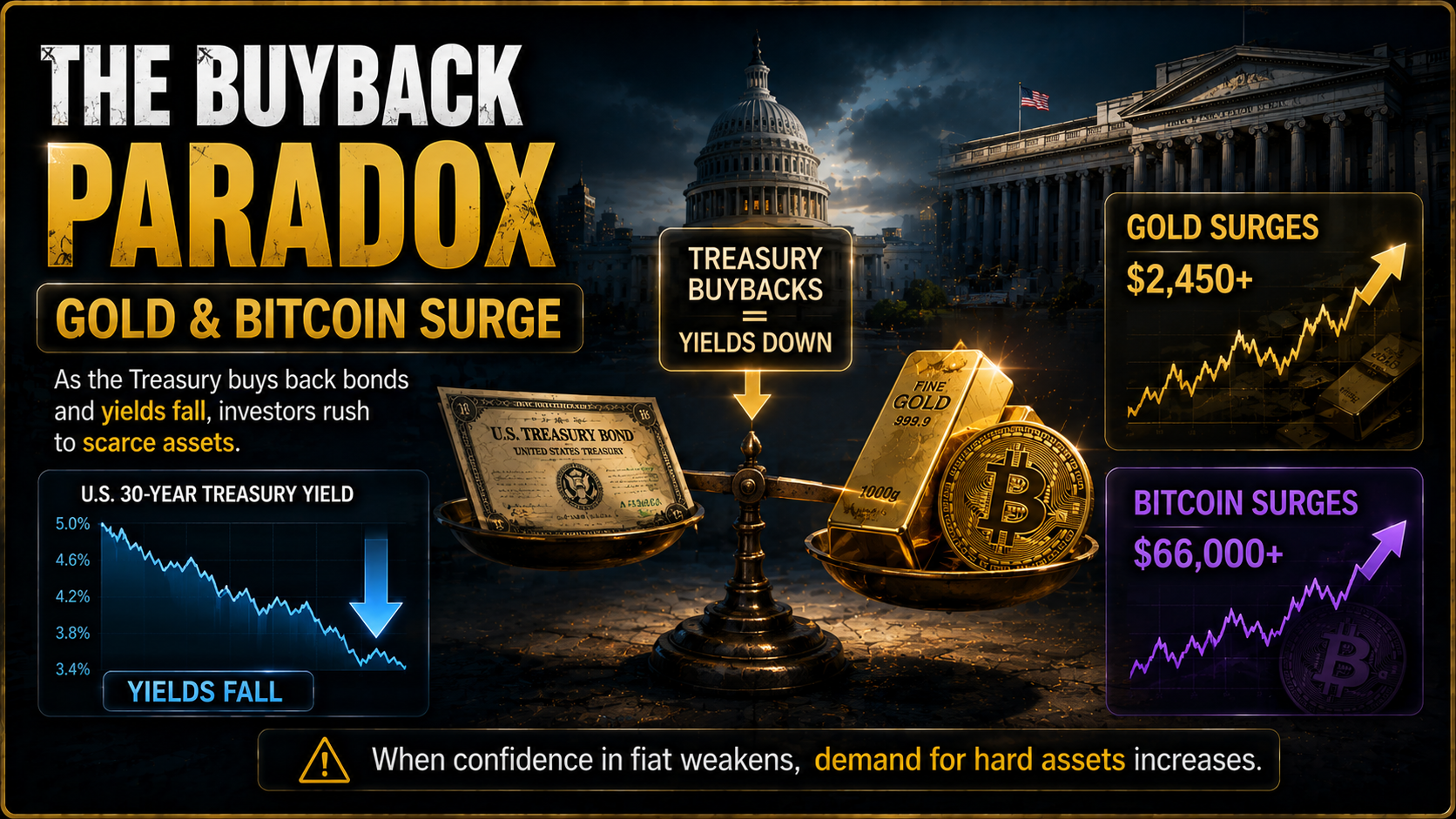
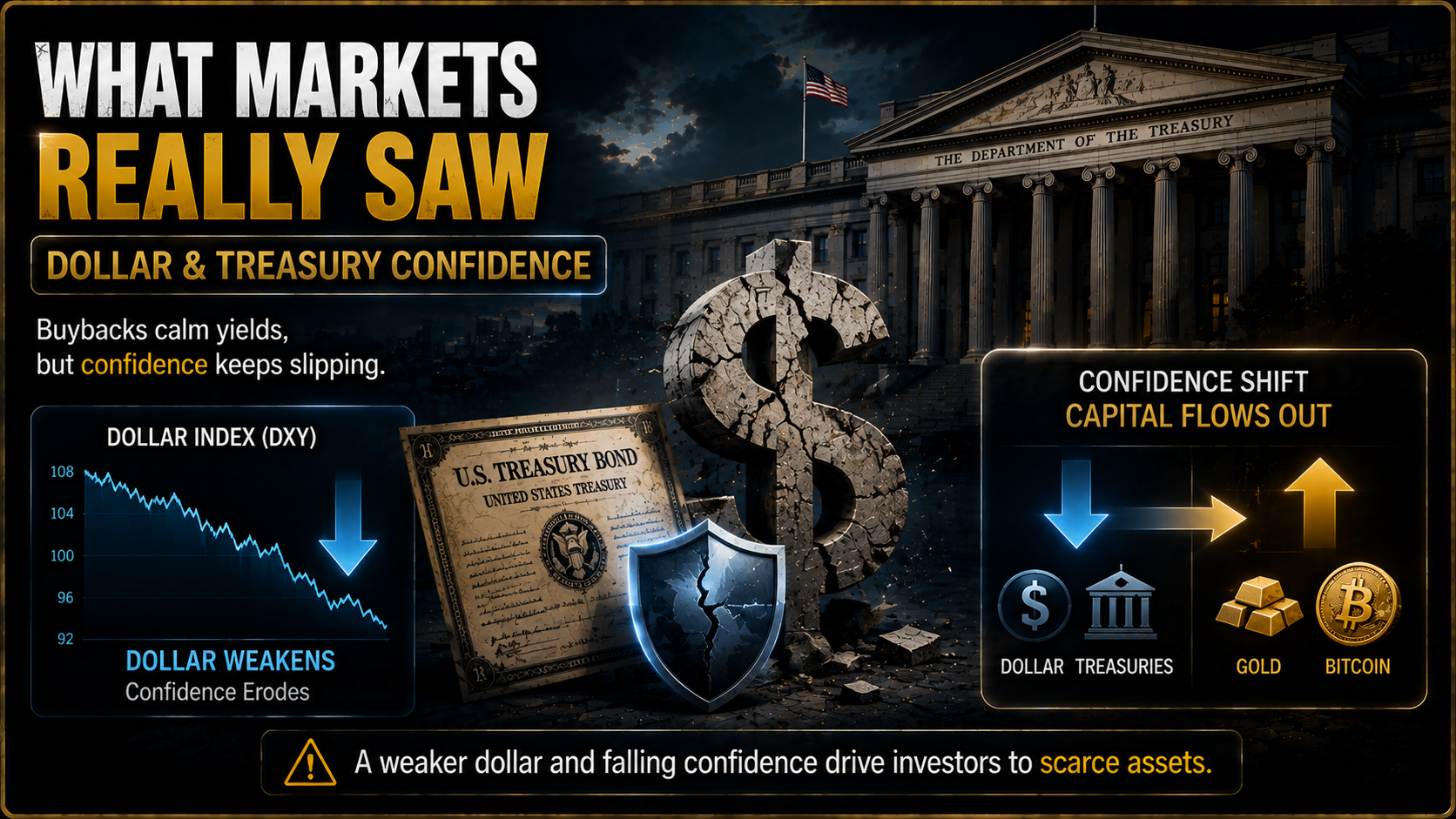
As the Treasury expanded support for the long end of the bond market, yields initially moved lower. At the same time, however, the U.S. dollar weakened while gold and Bitcoin rallied sharply.
Why would a policy designed to stabilize the Treasury market send investors toward assets that sit outside the traditional government-debt system?
For U.S. investors, this is a much bigger question than whether gold or Bitcoin will rise next week.
It goes directly to the relationship between Treasury supply, fiscal deficits, long-term interest rates, the dollar, and the growing “debasement trade.”
The Bottom Line
A Treasury buyback is a debt-management operation in which the U.S. Treasury repurchases previously issued government securities from the market. While buybacks can improve liquidity and temporarily reduce pressure on long-term yields, investors may interpret an expansion of buybacks as a sign that rising yields and heavy Treasury supply are becoming increasingly difficult to manage. When that interpretation coincides with a weaker dollar, capital can rotate toward scarce assets such as gold and Bitcoin.
That does not mean Treasury buybacks automatically cause gold or Bitcoin to rise.
It means investors need to understand why the buyback is happening and how the rest of the market reacts to it.

What Is a U.S. Treasury Buyback?
A Treasury buyback occurs when the U.S. Department of the Treasury repurchases Treasury securities that it previously issued and that are currently trading in the secondary market.
The term may sound similar to a corporate share buyback, but the objectives are very different.
A corporation may repurchase shares to return capital to shareholders, reduce its share count, or improve per-share financial metrics.
The Treasury is not trying to increase the "value" of the U.S. government.
Treasury buybacks are primarily a debt-management and market-liquidity tool.
One important target can be older, less frequently traded Treasury securities known as off-the-run Treasuries.
The newest Treasury issue of a particular maturity generally trades more actively. Older securities can become less liquid over time.
By buying back selected older securities, the Treasury can help improve the functioning and liquidity of the broader Treasury market.
Does a Treasury Buyback Reduce the National Debt?
Not necessarily.
This is one of the most important distinctions for beginners.
If the Treasury repurchases $10 billion of existing bonds but issues new securities elsewhere to finance government borrowing needs, the operation does not automatically reduce total federal debt by $10 billion.
A useful way to think about it is
A Treasury buyback changes the composition and liquidity of government debt. It is not necessarily a program to eliminate government debt.
This distinction becomes particularly important when federal deficits remain large and the government continues issuing substantial amounts of new debt.
How Can Treasury Buybacks Affect Bond Yields?
Understanding Treasury buybacks requires understanding one of the most important relationships in fixed-income investing
Bond prices and bond yields move in opposite directions.
Imagine a Treasury bond pays $4 per year.
If the bond trades for $100, its simplified current yield is 4%.
But suppose investors become eager to own that bond and bid its price up to $110.
The bond still pays $4.
A new investor is therefore paying more money for the same income stream, meaning the effective yield is lower.
The opposite happens when investors sell bonds.
| Treasury Market Move | Bond Price | Bond Yield |
| Stronger buying demand | Higher | Lower |
| Heavy selling | Lower | Higher |
| Treasury buyback | Upward pressure | Downward pressure |
| Treasury supply pressure | Downward pressure | Upward pressure |
This gives us the basic transmission mechanism
Treasury purchases bonds → demand receives support → bond prices rise → yields face downward pressure.
But that is only the first-order effect.
Markets rarely stop at the first-order effect.
Why Does Washington Care About Long-Term Treasury Yields?
The 10-year and 30-year Treasury yields matter far beyond the government bond market.
They influence financial conditions across the U.S. economy.
Higher long-term rates can contribute to higher mortgage rates, increase corporate borrowing costs, raise the federal government's interest expense, and affect the discount rates investors use to value stocks.
That last point matters especially for growth stocks.
A company whose valuation depends heavily on profits expected many years into the future can become less valuable today when the discount rate applied to those future earnings rises.
That is one reason technology, semiconductor, AI infrastructure, and other long-duration growth stocks can become particularly sensitive to sharp moves in Treasury yields.
The Treasury market is therefore not an isolated corner of finance.
It sits near the center of the global asset-pricing system.
Is a Treasury Buyback Just QE Under Another Name?
No.
This distinction is essential.
Treasury buybacks and quantitative easing are not the same policy.
| Treasury Buyback | Quantitative Easing | |
| Institution | U.S. Treasury | Federal Reserve |
| Type of policy | Debt management | Monetary policy |
| Main objective | Liquidity and debt management | Ease financial conditions |
| Purchases Treasuries? | Yes | Yes |
| Creates central-bank reserves? | Not in the QE sense | Yes |
| Automatically reduces federal debt? | No | No |
Quantitative easing is conducted by the Federal Reserve.
Treasury buybacks are conducted by the U.S. Treasury Department.
So saying that the Treasury is simply "printing money to buy its own debt" is misleading.
However, investors can still connect the two psychologically because both can affect Treasury demand and yields.
That is where market interpretation becomes important.
Is the Treasury Swapping Long-Term Debt for T-Bills?
This is another area where oversimplification can create confusion.
The basic narrative sometimes looks like this
More T-bill issuance
→ Treasury raises cash
→ Treasury buys longer-duration bonds
→ pressure on long-term yields falls
This can be a useful way of thinking about the broader effect when increased short-term issuance coincides with long-duration buybacks.
But it does not mean every dollar of Treasury buybacks is literally financed by issuing an equivalent dollar of T-bills.
Treasury borrowing, cash management, debt maturities, and buyback operations are part of a much larger financing program.
What investors should watch instead is the overall maturity composition of Treasury issuance.
If the government relies increasingly on short-term debt while reducing some pressure on longer maturities, investors may perceive the effective debt structure as becoming shorter.
That matters because shorter-term borrowing must be refinanced more frequently.
Why Did Gold and Bitcoin Rally?
This is where the story becomes much more interesting.
The simple interpretation of a Treasury buyback is bullish for bonds
Buybacks → bond demand → lower yields
But markets ask another question
Why does the Treasury need to provide more support to the long end of the market in the first place?
That question can completely change the market reaction.
The Market Watches Why a Policy Became Necessary
From the Treasury's perspective, a buyback can be a routine debt-management tool designed to improve liquidity.
Investors, however, may look at the broader environment and see something else.
If long-term yields are rising while fiscal deficits remain large and Treasury issuance remains heavy, an expansion of buybacks can lead some investors to wonder
Is the government becoming increasingly uncomfortable with the level of long-term interest rates?
That does not make the policy a bailout of the Treasury market.
But it can change investor psychology.
This is one of the most important principles in macro investing
Markets do not only price what policymakers do. They also price why policymakers felt they needed to do it.
Why Can Gold Rise Even When Bond Yields Are High?
For decades, investors have often relied on a familiar relationship.
Gold pays no interest.
Treasuries do.
When real interest rates rise, holding a non-yielding asset such as gold becomes relatively more expensive.
That often creates the following relationship
Higher real yields → pressure on gold
Lower real yields → support for gold
But this relationship is not a law of physics.
There are periods when Treasury yields and gold can rise together.
Why?
Because investors may start caring about something more important than the nominal interest payment
the future purchasing power of the money in which that interest is paid.
Imagine a Treasury offers an attractive nominal yield, but investors become increasingly concerned about persistent inflation, large fiscal deficits, currency depreciation, or the long-term purchasing power of the dollar.
The question changes from
"How much interest can I earn?"
to
"What will that interest actually buy in the future?"
That distinction helps explain why gold can perform well even in an environment of relatively high interest rates.
Does the U.S. Government Want Gold Prices to Fall?
This question requires some nuance.
It is too simplistic to say that the U.S. government dislikes rising gold prices.
Gold can rise for many reasons: geopolitical risk, central-bank purchases, falling real yields, inflation expectations, currency movements, or simple investment demand.
A higher gold price by itself is therefore not necessarily a problem for Washington.
What matters is why gold is rising.
Consider this sequence
Fiscal concerns rise
→ investors demand higher compensation for holding long-term Treasuries
→ confidence in dollar-denominated assets weakens
→ capital moves toward gold
In that scenario, the uncomfortable development for the United States is not that gold rose by 5% or 10%.
It is that the gold rally may be reflecting declining confidence in Treasury debt or the dollar's long-term purchasing power.
Gold has no issuer.
It is not the liability of the U.S. government, a bank, or a corporation.
That characteristic becomes more valuable when investors become concerned about sovereign debt or currency risk.
So the more accurate conclusion is
Rising gold prices are not inherently a threat to the United States. A gold rally driven by declining confidence in Treasuries or the dollar would be much more significant.
Does This Mean the Dollar's Reserve-Currency Status Is Collapsing?
No.
That conclusion goes too far.
The U.S. dollar remains the central currency of global finance, and the Treasury market remains one of the world's deepest and most liquid pools of financial assets.
A rally in gold does not mean the dollar system is suddenly collapsing.
However, there is a longer-term development worth watching.
Foreign governments and central banks have increasingly reconsidered what constitutes a truly neutral reserve asset.
The freezing of Russian foreign reserves after the invasion of Ukraine intensified that debate in some countries.
Gold has one unusual advantage in this context
It is nobody else's liability.
A Treasury security is an asset to its owner, but it is also a liability of the U.S. government.
A bank deposit is an asset to the depositor but a liability of a bank.
Physical gold does not have the same counterparty structure.
That does not mean central banks will abandon Treasuries.
It means the relative appeal of holding some reserves in gold can increase when geopolitical, fiscal, or currency risks become more important.
Why Did Bitcoin Join the Trade?
Bitcoin is not the same asset as gold.
Gold has thousands of years of history as a store of value and is held by central banks around the world.
Bitcoin is much younger and dramatically more volatile.
Calling Bitcoin a traditional safe-haven asset would therefore be misleading.
But Bitcoin and gold share one important investment narrative
Neither asset's supply can be expanded at the discretion of a government responding to fiscal pressure.
That is why both assets can attract attention during periods when investors worry about currency debasement.
This is often called the debasement trade.
The basic thesis is simple
If government debt continues to expand and the long-term purchasing power of fiat currencies declines, scarce assets may become more valuable relative to money.
Gold represents the traditional version of that trade.
Bitcoin represents a newer, much more speculative version.
Because Bitcoin's market is smaller and more sensitive to liquidity and risk appetite, its moves can be dramatically larger in either direction.
A stronger Bitcoin rally therefore does not necessarily mean investors consider Bitcoin "safer" than gold.
U.S. Crypto Policy Adds Another Layer
American investors also need to consider a factor that is less relevant to traditional gold markets: regulatory policy.
A more supportive regulatory environment for digital assets can increase institutional participation and improve sentiment toward Bitcoin.
Stablecoins are particularly interesting because they create a connection between digital assets and the Treasury market.
Dollar-backed stablecoin issuers commonly hold reserves in cash and short-term Treasury instruments.
In simplified form
Stablecoin adoption grows
→ reserve assets grow
→ demand for short-term Treasury securities can increase
This means the growth of dollar-based stablecoins does not necessarily represent an escape from the dollar system.
In some respects, stablecoins can actually extend dollar usage into digital financial markets while creating another source of demand for Treasury bills.
That is a much more interesting structural story for U.S. investors than the claim that Washington is deliberately pushing investors from gold into Bitcoin.
There is insufficient evidence to conclude that the U.S. government is intentionally engineering Bitcoin prices higher to suppress demand for gold.
The more defensible interpretation is that crypto-friendly regulation can strengthen digital-asset demand while stablecoin growth can simultaneously support demand for short-term U.S. government debt.
Can Treasury Buybacks Solve America's Debt Problem?
No.
And this may be the most important distinction in the entire discussion.
Treasury buybacks can improve liquidity.
They can alter the composition of outstanding debt.
They can reduce localized market dislocations.
They can influence supply and demand in specific parts of the yield curve.
But they do not eliminate the underlying fiscal deficit.
If the federal government continues spending substantially more than it collects in revenue, it must continue financing that gap.
That means continued Treasury issuance.
Long-term yields therefore depend on much more than buybacks.
Investors must consider
- inflation expectations,
- Federal Reserve policy,
- economic growth,
- Treasury issuance,
- foreign demand,
- fiscal deficits,
- term premiums,
- and investor confidence.
This is why a buyback can push yields lower initially without permanently reversing a structural rise in long-term borrowing costs.
Policy can move prices in the short run. It cannot permanently force investors to believe something they no longer believe.
How Treasury Buybacks Can Affect Major Assets
The most useful way to analyze a Treasury buyback is not to isolate the bond market.
Watch the entire cross-asset system.
| Asset | Potential Initial Reaction | What Matters Longer Term |
| Long-term Treasuries | Prices supported | Issuance, deficits, inflation |
| Treasury yields | Downward pressure | Term premium, Fed policy, supply |
| U.S. dollar | Could weaken | Relative rates, capital flows, Fed |
| Gold | Could benefit | Real yields, dollar, central-bank demand |
| Bitcoin | Could benefit | Liquidity, regulation, risk appetite |
| Growth stocks | Benefit from lower yields | Earnings, valuation, economic outlook |
These are relationships, not mechanical rules.
For example, falling Treasury yields caused by lower inflation can be positive for growth stocks.
Falling yields caused by a severe recession scare may not be.
Likewise, a rising gold price driven by lower real yields tells a different story from a rising gold price accompanied by a weaker dollar and increasing fiscal concerns.
The reason behind the price move matters more than the direction alone.
What Should Investors Watch?
The first mistake is treating a Treasury buyback as QE. The Treasury and the Federal Reserve are different institutions performing different functions.
The second mistake is watching only the 10-year Treasury yield. Investors should also watch the 30-year yield and the shape of the yield curve, particularly when concerns center on long-term fiscal sustainability.
The third mistake is ignoring the dollar.
Consider two different scenarios
Treasury yields rise + dollar strengthens
This can indicate that higher U.S. yields are attracting global capital.
Now consider
Long-term yields remain elevated + dollar weakens + gold rises
That combination can carry a different message. Investors may be demanding more compensation for holding long-duration dollar assets while simultaneously seeking protection elsewhere.
Neither configuration guarantees what happens next.
But cross-asset relationships can reveal information that one chart cannot.
What Would Wealthy Investors Look for in This Environment?
Long-term investors are less interested in guessing whether gold will rise another 10% next month.
They are interested in where capital is moving, what generates durable cash flow, and which assets can survive multiple economic regimes.
Follow the Money
A gold rally by itself tells us relatively little.
Where did the money come from?
Did investors sell Treasuries?
Did capital leave the dollar?
Are central banks buying?
Or is gold simply rising alongside equities and Bitcoin because global liquidity is improving?
The same price movement can have very different implications depending on the source of demand.
Focus on Real Purchasing Power
Treasuries generate income.
Gold and Bitcoin do not generate contractual cash flows.
That creates an important trade-off.
An investor choosing between them is effectively comparing the certainty of nominal income against the possibility of preserving purchasing power under different monetary and fiscal environments.
The question is not simply
"Which asset has the highest yield?"
It is
"What will my capital be able to buy after inflation and currency changes?"
Think About Asset Survival
There is no asset that wins in every macroeconomic regime.
A liquidity crisis can temporarily push gold lower.
Bitcoin can experience enormous drawdowns.
Long-duration Treasuries can suffer when inflation and term premiums rise.
Cash can lose purchasing power over time.
Stocks can experience deep recessional bear markets.
This is why long-term investing should not depend entirely on predicting one macro scenario correctly.
Investing is not only about predicting the future. It is also about surviving when the future looks different from what you expected.
Investors should ask themselves
What happens to my portfolio if long-term Treasury yields continue rising?
What happens if yields suddenly collapse?
Which assets protect me if the dollar strengthens?
Which assets could help if the dollar weakens?
How much of my portfolio actually produces cash flow?
Am I making one enormous bet on a single macroeconomic outcome?
Those questions are more durable than attempting to forecast the next move in gold or Bitcoin.
Final Thoughts
A U.S. Treasury buyback sounds complicated, but the basic idea is straightforward.
The Treasury repurchases government securities that are already trading in the market.
Those purchases can improve liquidity, support bond prices, and place downward pressure on yields.
But the market reaction can extend far beyond bonds.
When buybacks occur against a backdrop of large fiscal deficits, heavy Treasury issuance, elevated long-term rates, and concerns about the dollar's purchasing power, investors may ask a more important question
Why has additional support for the Treasury market become necessary?
That question can help explain why lower bond yields can sometimes coincide with a weaker dollar and stronger gold and Bitcoin.
None of this proves that the dollar is losing its reserve-currency status, that Treasuries are no longer safe assets, or that gold and Bitcoin will continue rising.
The structural lesson is more useful than those predictions.
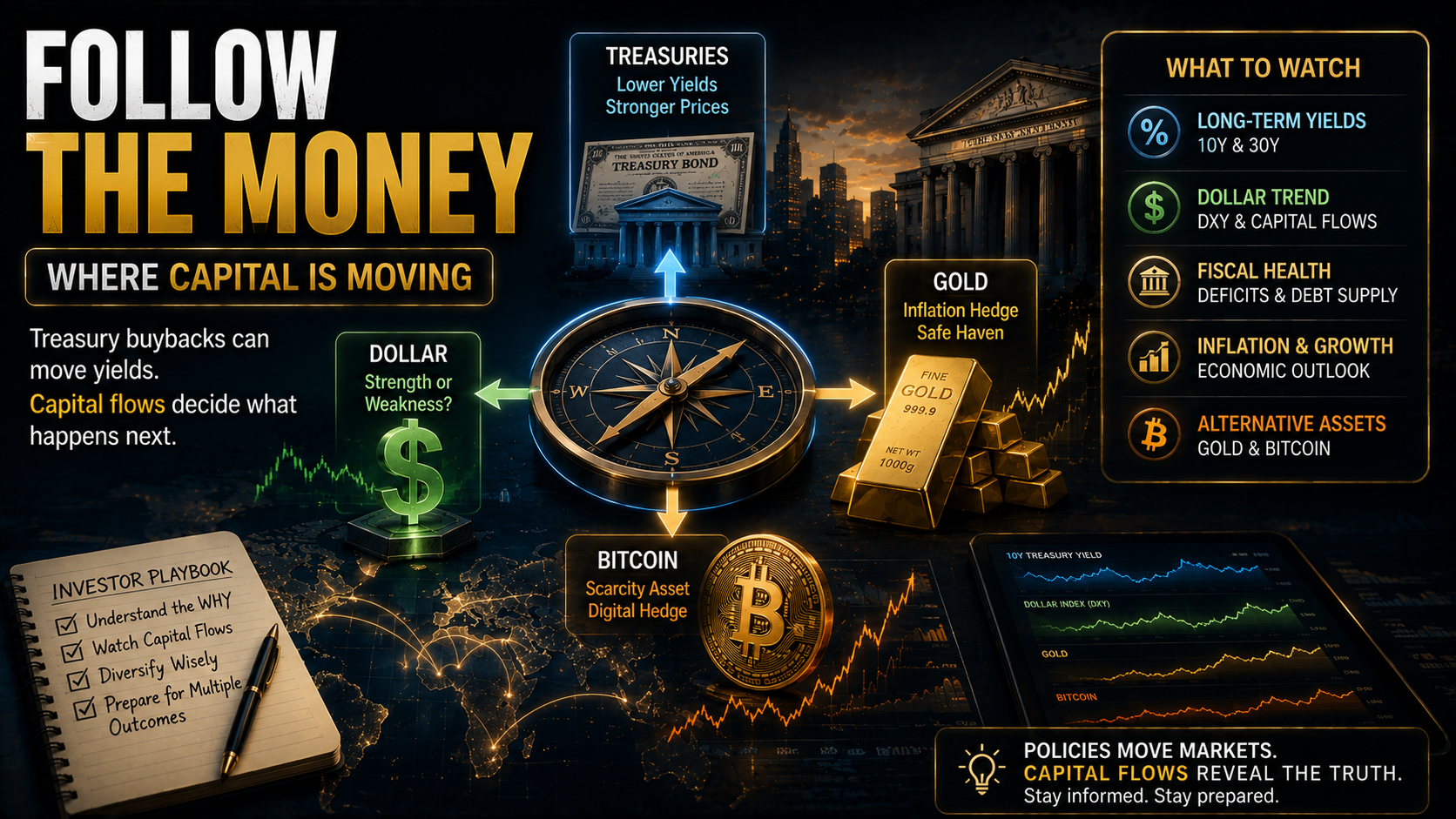
Do not watch Treasury yields in isolation.
Watch the 10-year yield, the 30-year yield, the dollar, gold, Bitcoin, and equity valuations together.
If Treasury yields rise while the dollar strengthens, markets may be rewarding higher U.S. rates.
If long-term yields remain elevated while the dollar weakens and gold rises, the market may be telling a very different story.
One price tells you what is moving.
Following capital across several markets can help you understand what investors are worried about.
For long-term investors, understanding that flow—and building a portfolio capable of surviving multiple outcomes—is far more valuable than predicting the next headline.
This has been MasterMind.
'[Global] Success Blueprints' 카테고리의 다른 글