What Is a Power Purchase Agreement (PPA)? Why It Matters for AI Data Centers and Energy Infrastructure


Hello, this is MasterMind.
Why are some of the world's largest technology companies signing electricity contracts that can stretch for a decade or longer instead of simply buying power from the grid at prevailing rates?
The answer goes far beyond sustainability.
As artificial intelligence drives a new wave of data center construction across the United States, access to electricity is becoming a strategic constraint. Companies can buy GPUs, build server campuses, and invest billions of dollars in computing infrastructure, but none of those assets can operate without reliable power.
At the same time, utilities and energy developers need enormous amounts of capital to build new generation capacity and supporting infrastructure.
This is where the Power Purchase Agreement, or PPA, becomes important.
A PPA connects long-term electricity demand with long-term investment capital. For corporate buyers, it can provide greater visibility into future power costs and support renewable energy procurement. For developers, it can create predictable revenue that helps make multibillion-dollar energy projects financeable.
For U.S. investors, understanding PPAs therefore means understanding much more than renewable energy.
It means understanding the increasingly important connection between AI data centers, electricity generation, transmission grids, utilities, project finance, and the next stage of infrastructure investment.
Key Takeaway
A Power Purchase Agreement is a long-term contract between an electricity buyer and a power producer. In the AI era, PPAs are becoming increasingly important because they can help corporations secure power, manage electricity-price risk, support clean-energy procurement, and provide developers with the predictable cash flows needed to finance new generation capacity.
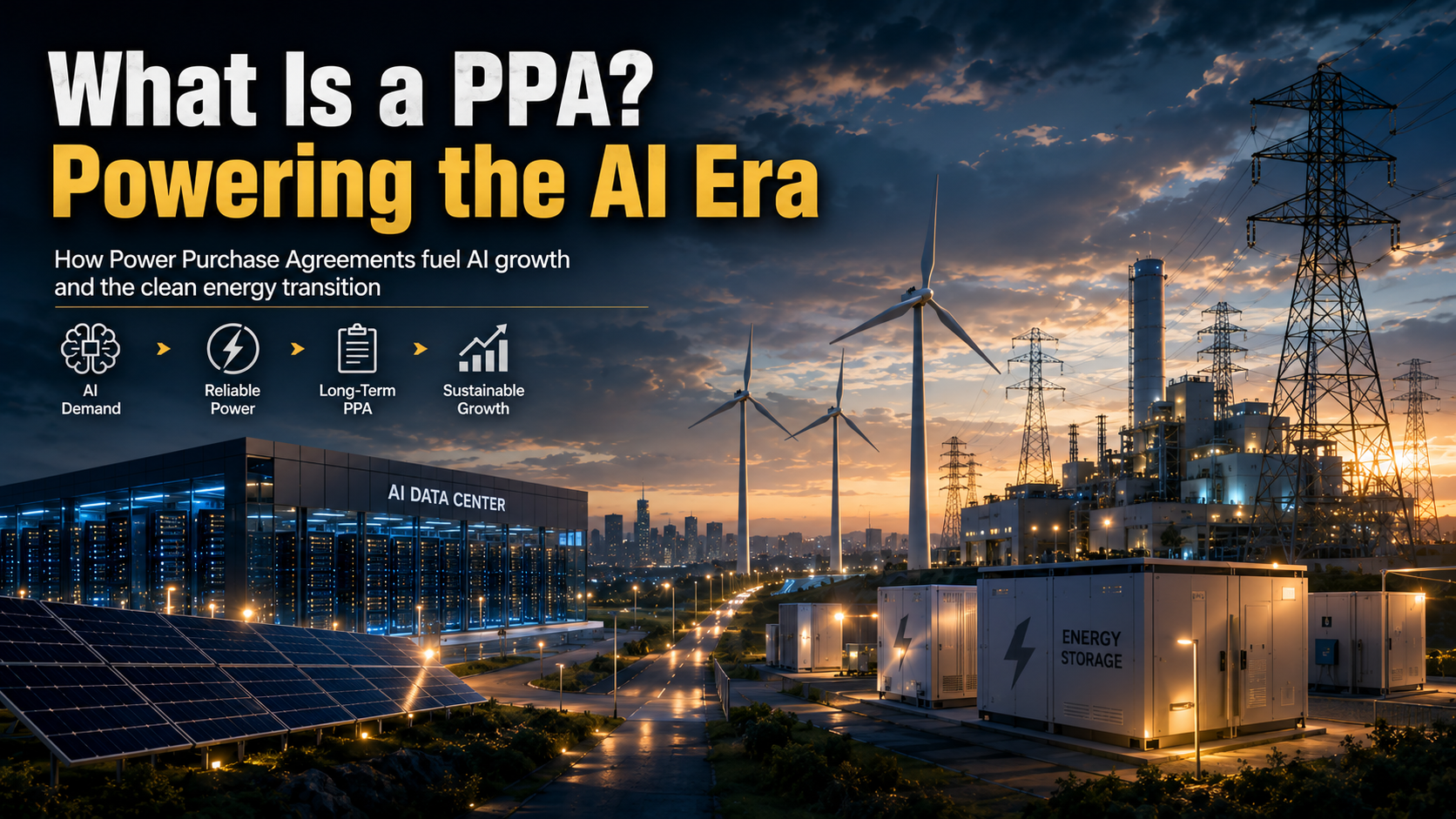
What Is a Power Purchase Agreement (PPA)?
A Power Purchase Agreement, commonly known as a PPA, is a contract under which an electricity buyer agrees to purchase power from a producer according to predetermined terms over an extended period.
Imagine that a company planning a large data center signs an agreement with a solar or wind developer.
The basic arrangement might look something like this
The company agrees to purchase a specified amount of electricity for 15 years according to an agreed pricing formula.
The actual contracts can be far more complicated, but this captures the basic economic relationship.
Without such an agreement, a power producer may have greater exposure to future wholesale electricity prices.
The buyer faces the opposite problem.
If electricity prices rise substantially, operating expenses can increase, particularly for energy-intensive businesses such as data centers, semiconductor fabs, manufacturing plants, and industrial facilities.
A PPA can transfer or redistribute some of those risks between the two parties.
The underlying economic exchange is straightforward
The buyer wants reliable power and greater cost visibility. The developer wants predictable revenue and cash flow.
The PPA connects those two objectives.
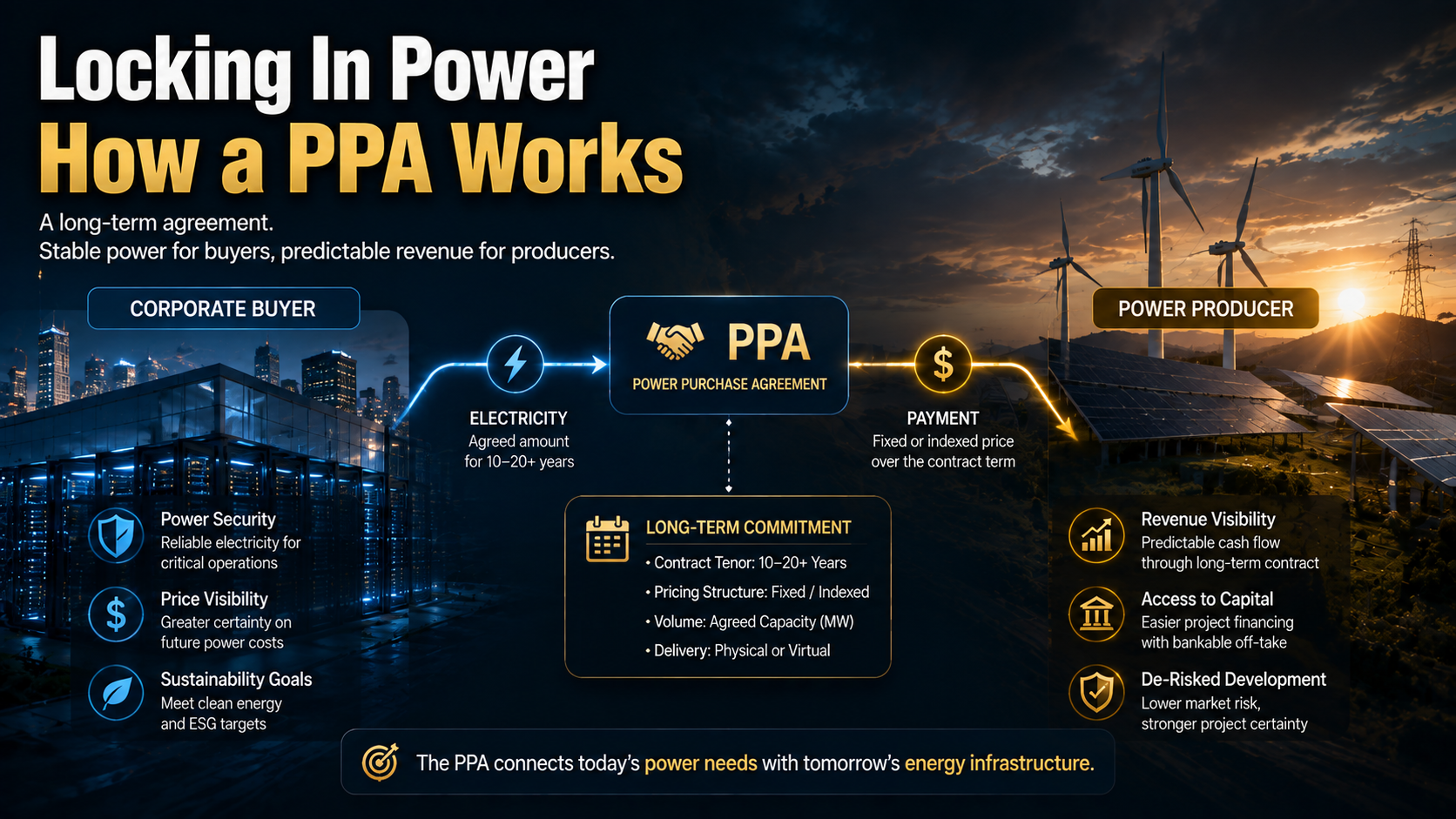
How Do PPAs Work?
PPAs sit at the intersection of the electricity market and the financial system.
That financial dimension is especially important for investors.
Step 1: The Buyer and Developer Sign a Long-Term Agreement
The parties negotiate terms that can include electricity volume, contract duration, pricing, settlement mechanisms, delivery arrangements, and the ownership of environmental attributes.
Depending on the project and market, these agreements can last many years.
For the corporate buyer, this can improve visibility into future electricity procurement.
For the developer, the agreement creates a potential long-term customer for the electricity generated by the project.
Step 2: The Developer Gains Revenue Visibility
Building a utility-scale solar farm, wind project, or other large generation asset requires substantial upfront capital.
Lenders and investors therefore need to answer a basic question
Who will buy the electricity once this project is built?
A long-term agreement with a creditworthy buyer can make future project revenue more predictable.
That revenue visibility can become important when the developer seeks debt or equity financing.
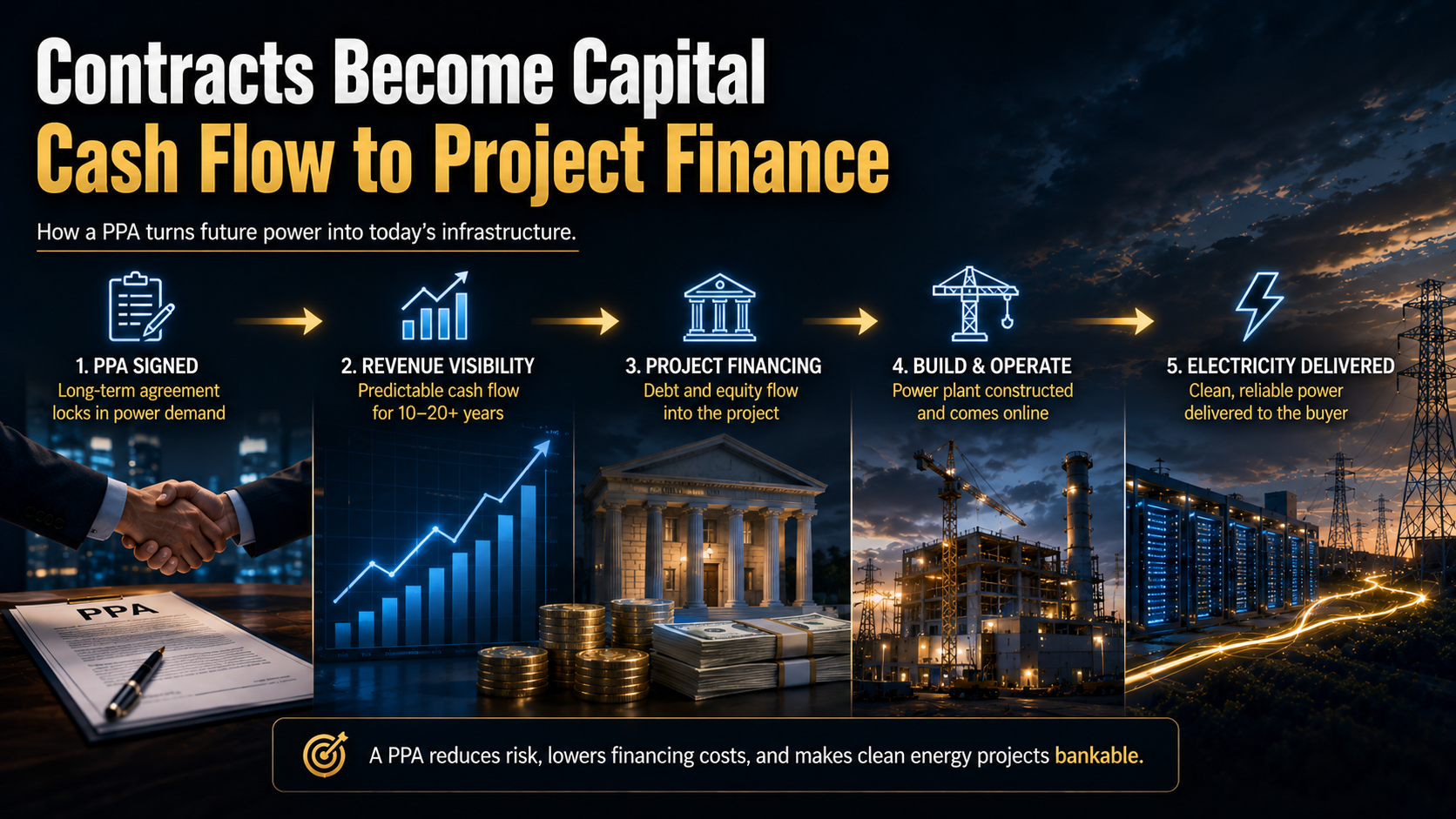
The simplified chain looks like this
PPA → Greater Revenue Visibility → More Predictable Cash Flow → Improved Financing Potential → New Generation Capacity
This is why PPAs should not be viewed merely as electricity-purchasing agreements.
They can also function as part of the financial foundation that allows new energy infrastructure to be built.
Step 3: The Corporate Buyer Manages Electricity Risk
For a large corporate power consumer, electricity is an operating expense.
For an AI data center, however, it can become a strategic input.
A long-term PPA can potentially reduce some exposure to volatile electricity prices, depending on how the agreement is structured.
In this sense, a PPA can perform a function similar to a hedging mechanism.
But there is an important distinction.
A PPA does not guarantee that a company will always receive the cheapest electricity available.
If market prices fall significantly below the contracted economics, a long-term agreement could become less attractive.
The real value of a PPA is therefore often not simply obtaining "cheap electricity."
It is obtaining greater predictability in an inherently uncertain market.
Physical PPA vs. Virtual PPA
Not every Power Purchase Agreement works the same way.
Two concepts are particularly important for U.S. investors.
Physical PPA
A physical PPA is tied to the actual delivery or procurement of electricity.
The power producer generates electricity, and contractual arrangements allow the buyer to procure that power through the relevant electricity-market and grid structure.
The exact mechanics depend heavily on the regional power market and utility regulations.
Virtual Power Purchase Agreement (VPPA)
A Virtual Power Purchase Agreement, or VPPA, is different.
Rather than requiring electricity from a particular project to physically flow directly into the corporate buyer's facility, the parties typically use a financial settlement based on an agreed contract price and the relevant wholesale electricity price.
This can resemble a contract-for-differences structure.
The corporate buyer may also receive contractual rights to associated renewable-energy attributes, depending on the agreement.
| Feature | Physical PPA | Virtual PPA |
| Primary structure | Electricity procurement and delivery | Financial settlement |
| Physical delivery | Connected to physical power procurement | Not necessarily delivered directly to buyer |
| Main purpose | Long-term electricity supply | Price risk management and clean-energy procurement |
| Key risks | Delivery, pricing, grid conditions | Market-price basis and settlement risk |
| Financial characteristics | Primarily electricity contract | Stronger financial-contract characteristics |
Investors should therefore avoid treating every announced PPA as economically identical.
The details matter.
Why Are PPAs Becoming More Important?
Three structural trends are increasing their relevance: AI power demand, corporate clean-energy procurement, and electricity-price uncertainty.
AI Data Centers Are Turning Electricity Into a Strategic Resource
For years, the AI investment story was dominated by semiconductors.
Investors focused on GPUs, high-bandwidth memory, advanced packaging, networking equipment, and cloud computing.
But the AI infrastructure story does not end with the chip.
Large clusters of high-performance computing equipment require substantial electricity. Cooling systems, networking infrastructure, backup systems, and other supporting equipment add to the power requirement.
That creates an important physical constraint.
A company may have the capital to purchase computing hardware and the land to build a data center, but the project cannot reach its full potential without sufficient electricity.
A useful way to think about the AI economy is
GPUs provide the computing capacity. Electricity keeps that capacity running.
This means the AI infrastructure race can gradually expand from
Chips → Data Centers → Power Generation → Grid Infrastructure
PPAs can become part of this transition by helping large electricity consumers establish long-term relationships with energy suppliers and developers.
Renewable Energy Procurement and Corporate Supply Chains
The second driver is corporate decarbonization.
Large U.S. corporations have increasingly sought renewable electricity through a combination of PPAs, utility programs, renewable energy certificates, and other procurement structures.
For multinational corporations, energy sourcing can also influence corporate emissions targets and supply-chain requirements.
This matters because sustainability is gradually becoming intertwined with capital allocation and operational planning.
However, investors should avoid oversimplifying the relationship.
Corporate renewable-energy goals, renewable energy certificates, PPAs, emissions accounting, and government carbon regulations are not interchangeable concepts.
They operate under different rules and accounting frameworks.
The investment implication is broader
Energy procurement is increasingly becoming part of corporate strategy rather than merely a utility expense.
PPAs as an Electricity-Price Hedge
Electricity prices can be affected by natural gas prices, weather, generation availability, transmission congestion, regional demand, regulation, and geopolitical events.
For a conventional office, fluctuations in electricity prices may represent a relatively modest cost issue.
For a massive data center operating around the clock, the consequences can be much larger.
This changes the economic calculation.
Companies do not always need the lowest possible electricity price at every moment.
Sometimes they value something else
the ability to predict their costs years into the future.
That distinction is central to understanding the economics of PPAs.
How PPAs Can Affect Financial Markets
A PPA does not move the S&P 500, Treasury yields, or the U.S. dollar in the way an inflation report or Federal Reserve decision might.
Its importance is more structural.
Widespread PPA activity can influence where long-term capital is deployed across the energy and infrastructure ecosystem.
| Industry / Asset | Potential Impact of PPA Growth | What Investors Should Watch |
| Power developers | Greater long-term revenue visibility | Contract economics and counterparties |
| Renewable energy | Support for new project development | Financing costs and project returns |
| AI data centers | Greater focus on securing electricity | Power availability and operating costs |
| Utilities and grids | Need for additional infrastructure | Transmission capacity and regulation |
| Electrical equipment | Potential demand for transformers and grid hardware | Supply constraints and manufacturing capacity |
| Infrastructure finance | More project-financing opportunities | Interest rates and credit quality |
| Energy storage | Growing need to manage intermittency and grid balance | Storage economics and utilization |
The Stock Market Impact: Look Beyond Renewable Energy
One of the easiest mistakes investors can make is assuming that more PPAs automatically mean higher valuations for solar and wind companies.
The electricity system is a chain.
Generating more power does little good if that electricity cannot reach the customer.
New generation may require additional transmission lines.
Transmission expansion requires substations, transformers, switchgear, and other electrical equipment.
Growing intermittent generation may increase the need for storage and sophisticated grid-management systems.
And new data centers can require substantial upgrades to local power infrastructure.
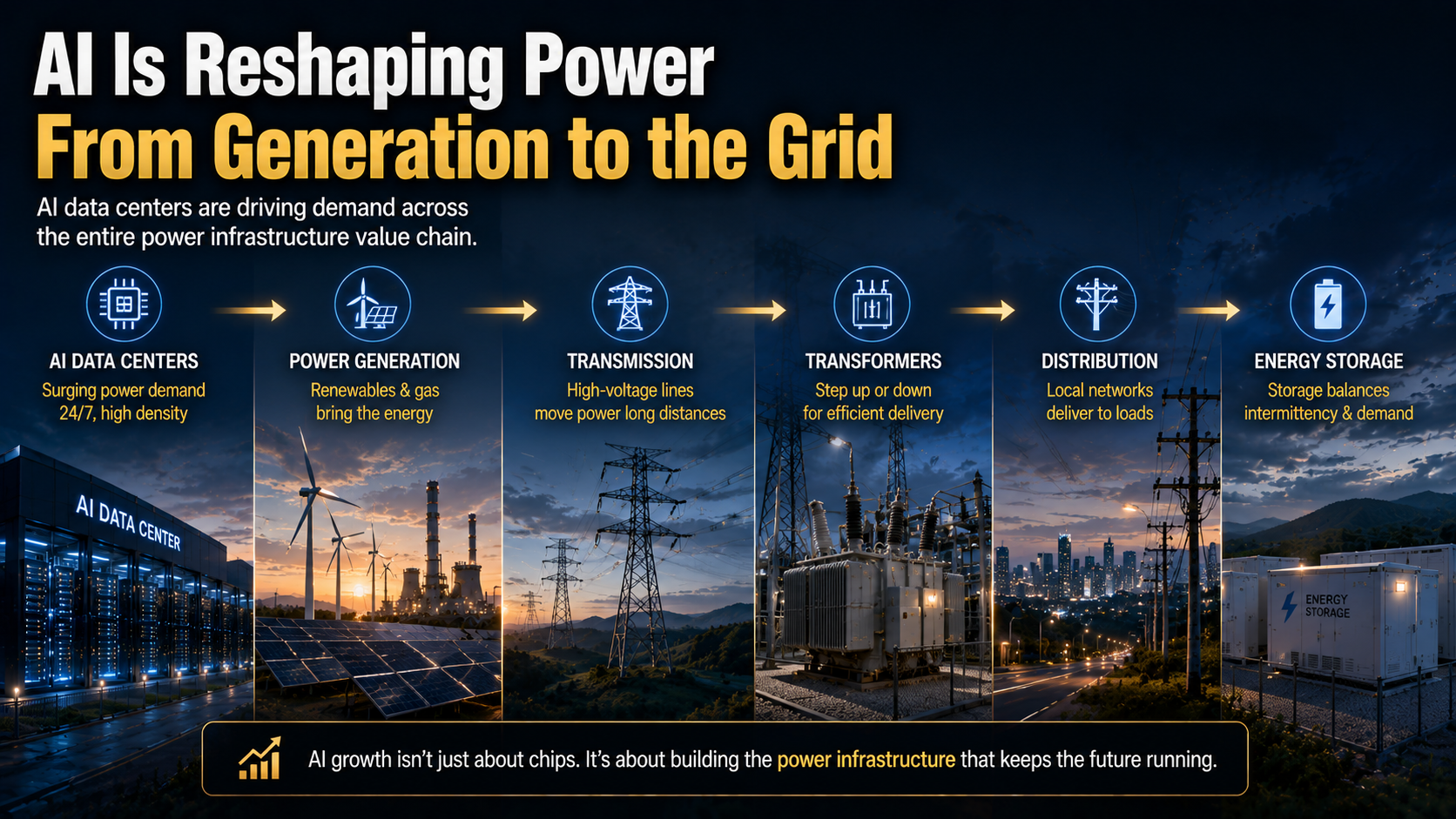
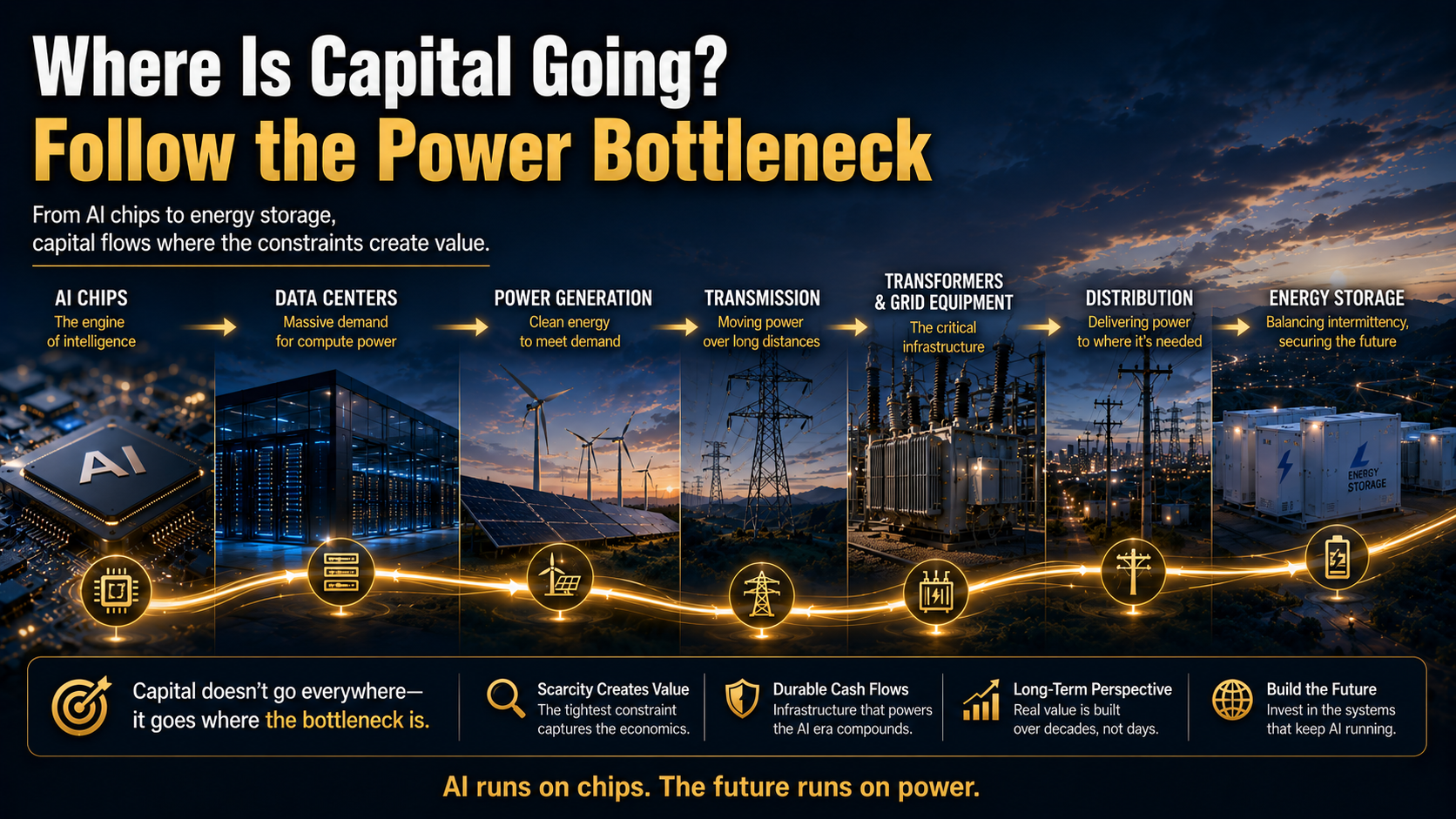
The investment opportunity can therefore migrate through the value chain
Generation → Transmission → Transformers → Distribution → Storage → Power Management
This leads to one of the most important principles for infrastructure investors
Capital often moves toward the bottleneck.
The fastest-growing part of an industry is not always the most valuable part.
Sometimes the scarce component captures more economic value.
PPAs, Bonds, and Infrastructure Finance
Power projects are capital intensive.
Developers often need large amounts of debt and equity before a project generates its first dollar of revenue.
A long-term PPA with a financially strong counterparty can improve revenue visibility and potentially make financing easier.
This is one reason PPAs are relevant to infrastructure funds, banks, private credit, project finance, and fixed-income investors.
But investors should not confuse contractual revenue with guaranteed profitability.
A project can have an impressive long-term contract and still produce disappointing returns if construction costs surge, interest rates remain high, generation underperforms, or operating expenses exceed expectations.
The economics ultimately depend on the entire equation
Contract Price + Construction Cost + Financing Cost + Operating Cost + Counterparty Quality + Actual Power Generation
A large PPA is therefore not automatically a good investment.
What Investors Should Check When Evaluating a PPA
Contract Duration and Pricing
How long is the contract?
Is the electricity price fixed, indexed to inflation, or linked to market conditions?
Different structures transfer different risks between buyers and sellers.
The words "long-term contract" alone reveal very little about profitability.
Counterparty Risk
A 20-year agreement is valuable only if the counterparty remains capable of honoring it.
This is known as counterparty risk.
The financial strength of the electricity buyer can therefore influence the financing terms and economic value of the underlying project.
Project Economics
Investors should compare contracted revenue against the total cost of building and operating the project.
Falling technology costs can improve economics, but higher interest rates, equipment prices, labor expenses, and grid interconnection costs can work in the opposite direction.
Grid Interconnection
This may be one of the most important issues in the next phase of the energy investment cycle.
A power plant can exist on paper.
A data center can exist on paper.
But neither matters much if the necessary grid connection cannot be built on time.
Transmission capacity, interconnection queues, transformers, substations, and local grid capacity can therefore become critical bottlenecks.
This is where the investment story may shift from electricity generation toward the infrastructure required to deliver that electricity.
Cash Flow, Not Headlines
Large PPA announcements attract attention because the numbers can be enormous.
But investors should focus less on headline contract size and more on the cash flow generated after financing and operating costs.
Revenue size matters. Cash-flow quality matters more.
Where Could the Money Flow in the AI Power Boom?
The first phase of the AI investment cycle was dominated by computing hardware.
But as AI infrastructure expands, capital requirements can spread deeper into the physical economy.
One possible chain is
AI Semiconductors → Data Centers → Power Generation → PPAs → Transmission → Transformers → Distribution → Energy Storage → Grid Management
This does not mean every company in these industries will benefit.
Nor does it mean every electricity-related stock deserves a higher valuation.
The more useful question is
Where is supply failing to keep pace with demand?
If generation capacity becomes abundant but transformers remain scarce, the bottleneck may move to electrical equipment.
If equipment supply improves but transmission projects remain delayed, the bottleneck may move to the grid.
If power becomes available but data-center interconnections remain constrained, value may migrate again.
Markets reward growth, but they can place an even greater premium on scarcity.
What Do Wealthy Investors Look for in This Trend?
Large pools of capital usually look beyond the question, "Which renewable energy stock should I buy?"
They focus on something more fundamental
Where is capital moving, what cash flows will it create, and how resilient are those cash flows?
Follow the Money
AI infrastructure investment initially directs capital toward chips and servers.
But expanding computing capacity requires additional physical infrastructure.
That can redirect capital toward data centers, utilities, generation projects, transmission networks, electrical equipment, storage, and other parts of the power ecosystem.
The opportunity may therefore expand well beyond traditional technology stocks.
Focus on Cash Flow
Infrastructure investors tend to care deeply about predictable cash generation.
A long-term PPA can potentially increase the visibility of future revenue.
But predictable revenue is not the same as predictable profit.
Investors still need to examine leverage, interest rates, operating costs, project execution, generation performance, and counterparty quality.
Look for Asset Resilience
The most important question is not necessarily which technology is fashionable today.
It is which assets can survive multiple economic environments.
Can the project remain viable if interest rates stay higher for longer?
Can it compete if government incentives change?
Will the infrastructure still be necessary if AI capital spending grows more slowly?
Can it generate adequate cash flow if electricity prices behave differently than expected?
These questions reveal something more important than short-term market momentum: asset resilience.
Think Long Term
Investing is not about perfectly predicting every change in electricity demand, interest rates, or AI spending.
It is about understanding which businesses can survive when those predictions are wrong.
A useful question for long-term investors is
Does the company I own have access to the electricity, infrastructure, financing, and durable cash flows required to remain competitive as AI reshapes the power market?
That question applies not only to PPAs, but to the entire AI energy infrastructure investment cycle.
Final Thoughts
A Power Purchase Agreement (PPA) is a long-term contractual arrangement between an electricity buyer and a power producer.
But viewing it simply as a renewable-energy purchasing tool misses the larger investment story.
For corporate buyers, PPAs can provide greater visibility into electricity procurement and help manage certain energy-price risks.
For power developers, long-term contracts can provide revenue visibility that supports the financing of new generation capacity.
And for investors, the expansion of PPAs can reveal where capital may need to flow as AI infrastructure places increasing pressure on the physical electricity system.
The full chain matters
Power Generation → PPA → Transmission → Transformers → Distribution → Storage → Data Centers
The key message to remember is simple
The AI race is no longer only a competition for computing power. It is increasingly a competition for the electricity and infrastructure required to keep that computing power running. PPAs are one of the mechanisms connecting that demand with long-term energy investment.
Rather than trying to predict every short-term market move, investors may gain more by watching where capital is flowing, where infrastructure bottlenecks are emerging, and where durable cash flows are being created.
This was MasterMind.
'[Global] Success Blueprints' 카테고리의 다른 글