What Is WACC? How Weighted Average Cost of Capital Affects DCF Valuation


Hello, this is MasterMind.
Suppose a company generates $100 million in operating profit every year. Does that automatically make it a great business or an attractive investment?
Not necessarily.
The more important question is how much capital the company needed to generate that profit—and how much that capital costs.
Companies need money to build factories, expand data centers, develop new products, acquire competitors, and fund everyday operations. That capital usually comes from two primary sources: debt and equity.
Neither is free.
Lenders demand interest. Bondholders demand compensation for credit risk. Shareholders expect returns for taking equity risk.
So how much does a company effectively pay for all of its capital?
That is the question behind WACC, or Weighted Average Cost of Capital.
For U.S. investors, understanding WACC is especially useful because it connects several concepts that often appear separately in financial analysis: Treasury yields, corporate borrowing costs, DCF valuation, growth-stock multiples, ROIC, and capital allocation.
Once you understand WACC, you can begin to see why a change in interest rates can affect the valuation of a technology company even when its revenue outlook has barely changed.
The Bottom Line
WACC represents the average return required by a company's debt and equity investors. It is also a key hurdle rate a business must exceed if it wants to create economic value over time.
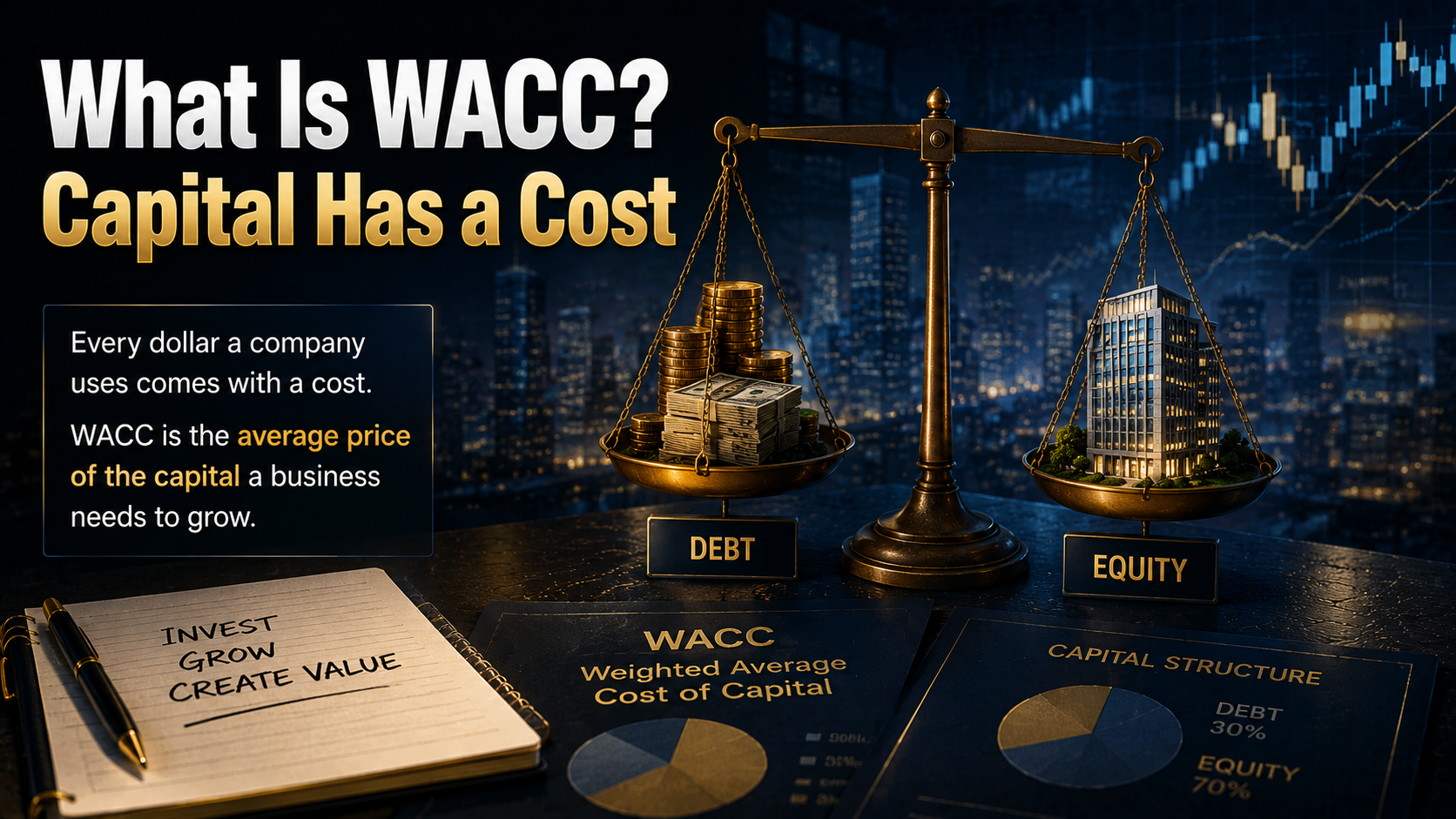
What Is WACC?
WACC stands for Weighted Average Cost of Capital.
Despite the technical name, the underlying idea is straightforward
Capital has a price.
A corporation generally finances its operations through two major sources.
Debt
Debt includes bank loans, corporate bonds, and other borrowed capital.
Companies pay interest to use this money.
Equity
Equity represents capital provided by shareholders.
Unlike debt, equity does not come with a contractual interest payment. But that does not make it free.
An investor could buy U.S. Treasury securities, investment-grade bonds, an S&P 500 index fund, or shares of another company instead.
If investors choose to own a particular stock, they generally expect compensation for the risk they are taking.
That expected return represents the company's cost of equity.
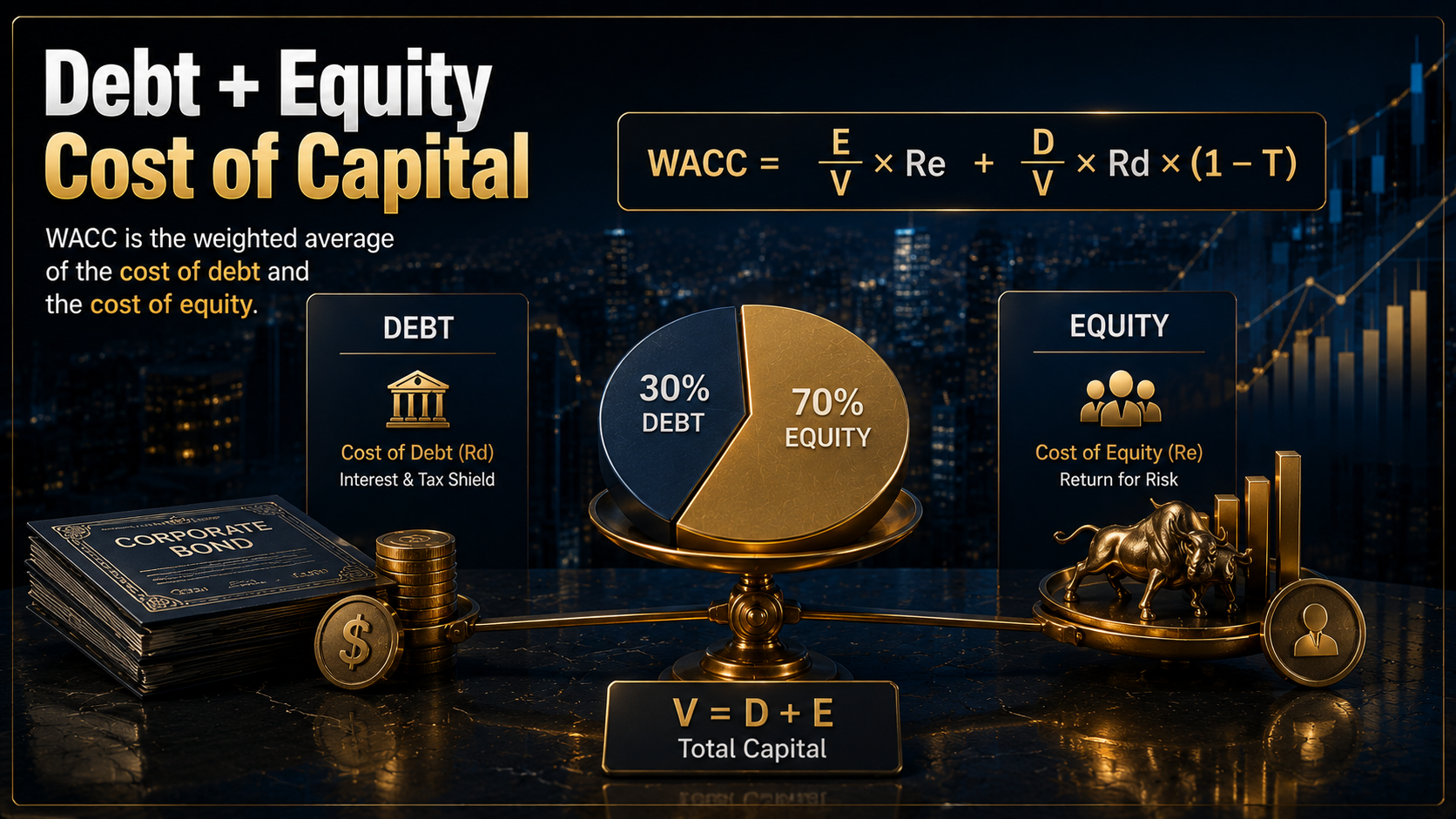
WACC combines the cost of debt and the cost of equity according to their respective weights in the company's capital structure.
In simple terms, WACC attempts to answer
What is the average price this company pays for the capital it uses?
How Is WACC Calculated?
The standard WACC formula is
WACC = (E / V × Re) + (D / V × Rd × (1 − T))
Where
| Variable | Meaning |
| E | Market value of equity |
| D | Market value of debt |
| V | Total capital, or debt plus equity |
| Re | Cost of equity |
| Rd | Cost of debt |
| T | Corporate tax rate |
Consider a simplified example.
Suppose a U.S. company finances itself with
- 70% equity
- 30% debt
- 10% cost of equity
- 4% after-tax cost of debt
Its approximate WACC would be
(70% × 10%) + (30% × 4%) = 8.2%
In simplified terms, an 8.2% WACC means the company needs to generate returns around or above that level on its invested capital to compensate the providers of that capital and create economic value beyond their required return.
The real calculation is more complicated because analysts must estimate the cost of equity, borrowing costs, tax effects, and an appropriate capital structure.
That introduces an important point
WACC is an estimate, not an observable market price with one universally correct value.
Why Does Equity Have a Cost?
This is one of the most important concepts for investors learning corporate finance.
Debt obviously costs money because borrowers pay interest.
But why should equity have a cost?
Because of opportunity cost and risk.
Imagine that a U.S. investor can earn a relatively attractive yield on Treasury securities. To justify taking substantially more risk in an individual stock, that investor will generally demand a higher expected return.
The greater the perceived risk, the greater that required return may become.
A common framework for estimating the cost of equity is the Capital Asset Pricing Model, or CAPM:
Cost of Equity = Risk-Free Rate + Beta × Equity Risk Premium
In U.S. valuation models, Treasury yields are commonly used as a reference point for the risk-free rate.
This creates an important connection between monetary conditions and stock valuations.
If Treasury yields rise while other assumptions remain unchanged, the required return on equity can also face upward pressure.
That gives us a simplified chain
Higher Treasury yields → higher required returns → higher discount rates → pressure on valuations
This is one reason bond-market movements matter even to investors who own no bonds.
Why Is the Cost of Debt Adjusted for Taxes?
The debt portion of the WACC formula contains (1 − T).
That reflects the potential tax benefit associated with interest expense.
Under applicable tax rules, interest expense may reduce taxable income, meaning the effective after-tax cost of debt can be lower than the stated interest rate.
This is commonly described as the interest tax shield.
Does that mean companies should simply borrow as much as possible?
No.
As leverage increases, financial risk also increases.
Creditors may demand higher interest rates. Credit ratings can deteriorate. Refinancing can become more expensive. Equity investors may also require higher expected returns because shareholders bear greater financial risk.
Eventually, excessive leverage can increase rather than reduce the company's overall cost of capital.
The objective is therefore not maximum debt.
It is an efficient balance between capital cost and financial resilience.
What Causes WACC to Rise or Fall?
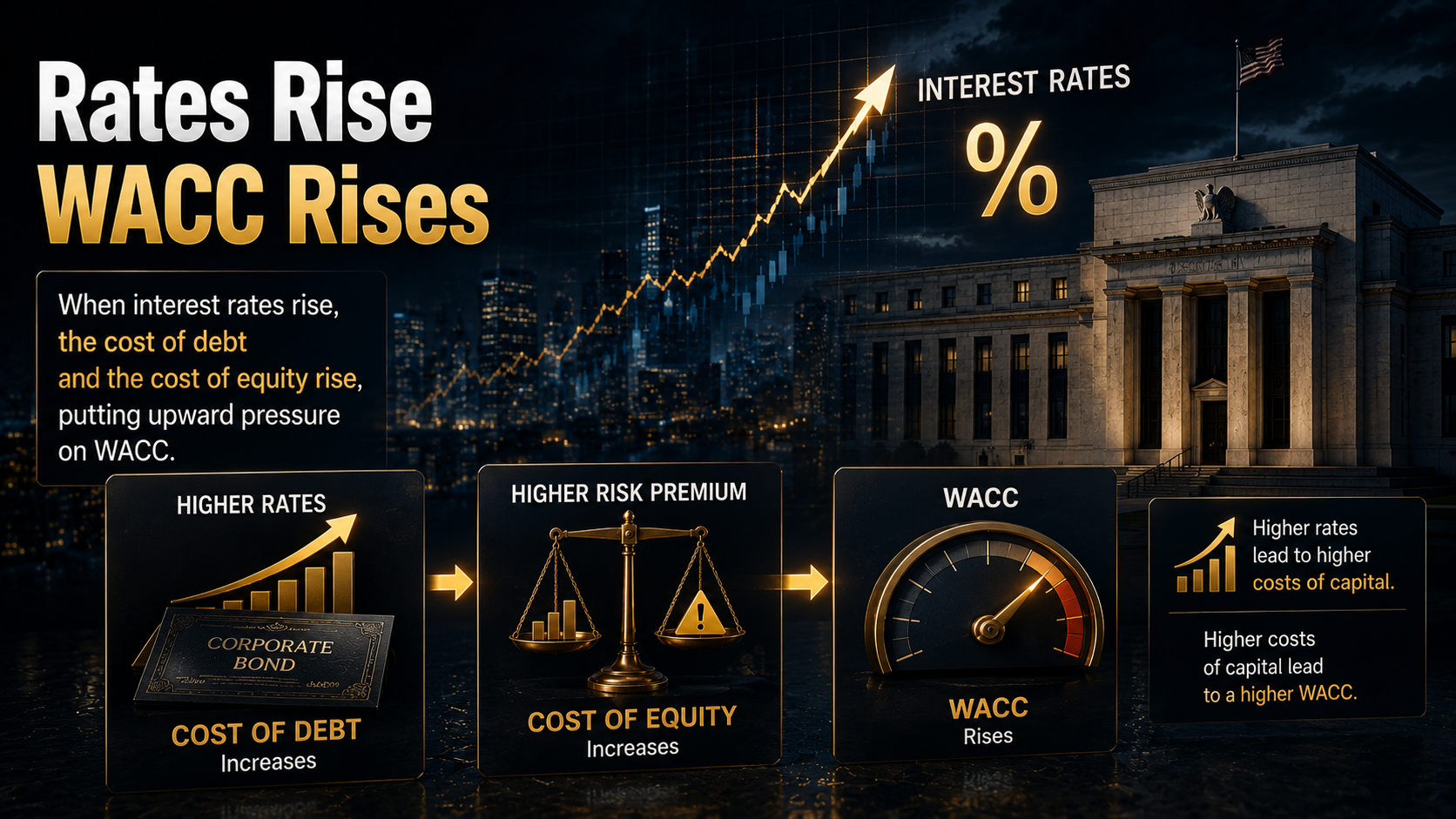
WACC is not static.
It can change with interest rates, credit conditions, market volatility, investor risk appetite, and the company's own balance sheet.
Consider a tightening financial environment.
Treasury yields rise
→ risk-free rates increase
→ required equity returns may increase
→ corporate borrowing costs may increase
→ WACC faces upward pressure
A loosening financial environment can produce the opposite effect.
But investors should avoid assuming that falling Federal Reserve policy rates automatically mean a lower WACC for every company.
Suppose Treasury yields fall because investors suddenly fear a severe recession.
At the same time, corporate credit spreads could widen dramatically and equity risk premiums could rise.
The risk-free rate might be falling while the compensation investors demand for taking corporate risk is increasing.
This is why sophisticated valuation analysis looks beyond the federal funds rate.
Investors should consider Treasury yields, credit spreads, equity risk premiums, leverage, and refinancing conditions together.
Why Does WACC Matter?
WACC matters because it can serve as a company's hurdle rate for capital allocation.
Suppose a corporation is considering building a new manufacturing facility.
The project is expected to generate a 6% return, while the company's WACC is 8%.
The project may still generate accounting profits, but economically it may fail to earn enough to compensate the providers of capital.
Now suppose another project is expected to generate a 13% return against the same 8% WACC.
That investment has much greater potential to create economic value.
This is why corporate executives use cost-of-capital concepts when evaluating
- Capital expenditures
- New factories
- Data centers
- Research and development
- Acquisitions
- International expansion
- Other long-term investments
Growth by itself is not enough.
The return generated by that growth relative to the cost of funding it matters.
ROIC vs. WACC: One of the Most Important Relationships in Investing
This brings us to ROIC, or Return on Invested Capital.
ROIC measures how effectively a company generates operating returns from the capital invested in its business.
Looking at ROIC and WACC together can tell investors much more than looking at revenue growth alone.
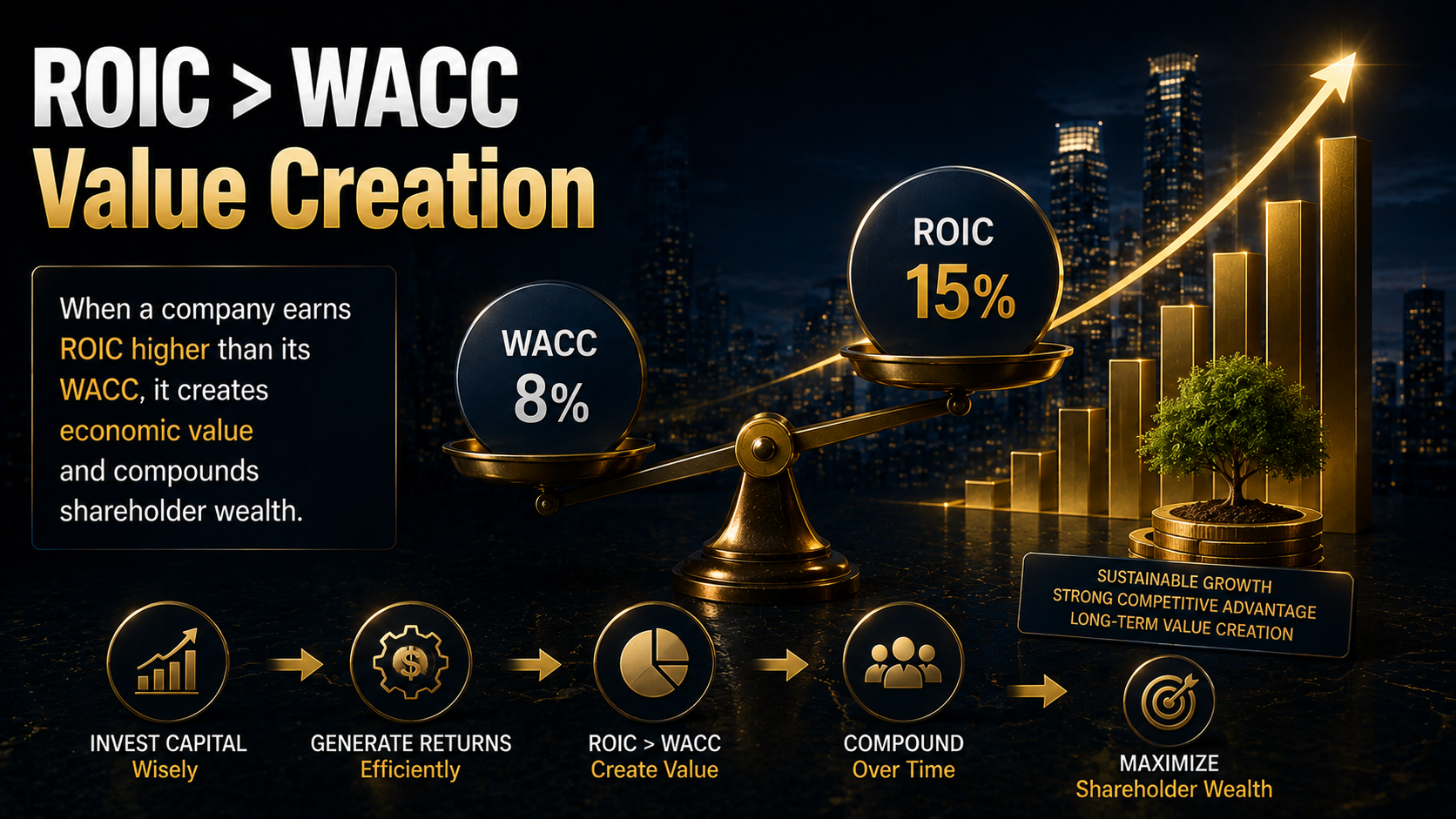
ROIC > WACC
The business is generating returns above its estimated cost of capital.
If this spread can be sustained over long periods, it can be a powerful indicator of economic value creation.
ROIC < WACC
The business may be expanding while failing to generate sufficient returns on the capital required to finance that expansion.
This leads to an important principle
Revenue growth and value creation are not the same thing.
A company could double revenue by continuously issuing shares, borrowing money, and investing enormous amounts of capital.
But if the incremental return on that capital remains below its cost, bigger does not necessarily mean more valuable.
For long-term investors, one of the more useful questions is therefore
How large and sustainable is the spread between ROIC and WACC?
Companies capable of maintaining high returns on incremental capital for long periods may possess valuable competitive advantages, strong brands, network effects, pricing power, switching costs, intellectual property, or other structural strengths.
How Does WACC Affect DCF Valuation?
WACC is also fundamental to Discounted Cash Flow analysis, or DCF.
The basic idea behind DCF valuation is simple
A company is worth the present value of the cash it can generate in the future.
But $100 received ten years from now is not worth the same as $100 today.
There is a time value of money, and there is uncertainty surrounding future cash flows.
That means analysts need a discount rate.
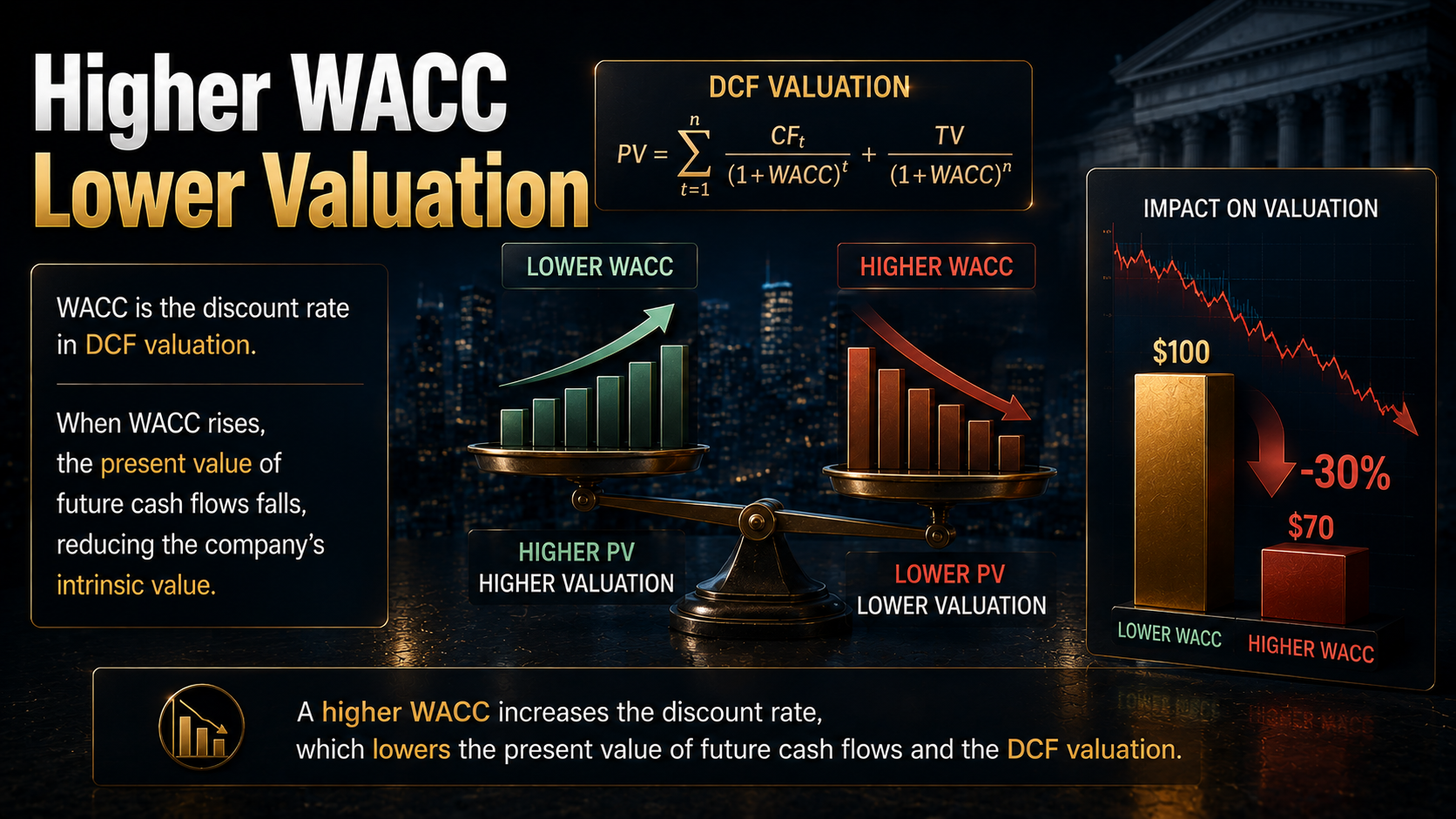
When valuing the entire enterprise using Free Cash Flow to the Firm (FCFF), WACC is commonly used as that discount rate.
The relationship works roughly like this
Higher WACC
→ higher discount rate
→ lower present value of future cash flows
→ lower estimated enterprise value
Conversely
Lower WACC
→ lower discount rate
→ higher present value of future cash flows
→ higher estimated enterprise value
This is why relatively small changes in WACC assumptions can produce substantial changes in DCF valuations.
The effect can be particularly significant when a large portion of estimated enterprise value comes from cash flows expected far into the future or from terminal value.
Markets do not simply price today's earnings.
They continuously decide what future dollars are worth today.
WACC is one of the key mechanisms connecting those two points in time.
Why Are Growth Stocks So Sensitive to Interest Rates?
WACC also helps explain why high-growth technology stocks can react sharply to changes in Treasury yields.
Many growth companies are valued primarily on earnings and cash flows expected years into the future.
When discount rates rise, those distant cash flows lose more present value than cash flows expected in the near term.
This concept is similar to duration in fixed income.
A company whose valuation depends heavily on distant future cash flows effectively has greater sensitivity to changes in discount rates.
That is why high-multiple software, semiconductor, AI infrastructure, biotechnology, and other growth-oriented stocks can sometimes experience significant multiple compression when real yields and required returns rise.
But investors should avoid oversimplifying this relationship.
Higher rates do not automatically mean lower technology stocks.
If earnings and free cash flow grow rapidly enough, improving fundamentals can outweigh the negative impact of a higher discount rate.
Stock valuation is ultimately a competition between two forces
the cash flows investors expect and the discount rate applied to those cash flows.
How WACC Connects to Financial Markets
WACC itself is a corporate finance concept and should not be used to directly value assets such as gold or Bitcoin.
However, many of the variables that influence WACC—interest rates, liquidity, credit conditions, and risk premiums—also influence broader asset allocation.
| Asset Class | Higher Cost-of-Capital Environment | Lower Cost-of-Capital Environment |
| Growth Stocks | Higher discount rates may pressure valuations | Lower discount rates can support valuations |
| Value Stocks | Strong current cash flow may provide relative resilience | Performance depends more heavily on growth and economic conditions |
| Bonds | Rising yields generally pressure existing bond prices | Falling yields generally support existing bond prices |
| U.S. Dollar | Higher U.S. yields or risk aversion can provide support | Improving global risk appetite can change relative demand |
| Gold | Higher real yields can increase opportunity cost | Lower real yields can become more supportive |
| Bitcoin and Risk Assets | Tighter liquidity can pressure risk appetite | Easier liquidity can support risk-taking |
The important distinction is that WACC is not directly determining the price of every asset in this table.
Instead, the financial conditions influencing corporate capital costs are also influencing where global capital wants to go.
What Investors Should Know About WACC
WACC Is an Estimate, Not a Fact
There is no single objectively correct WACC for most companies.
Analysts make assumptions about Treasury yields, beta, equity risk premiums, borrowing costs, tax rates, and capital structure.
Two reasonable analysts can therefore produce different WACC estimates for the same company.
This is why professional valuation work frequently uses sensitivity analysis rather than relying on one precise number.
Small Changes Can Have Large Valuation Effects
Moving a DCF discount rate from 8% to 9% may not sound dramatic.
But when decades of expected cash flows and terminal value are being discounted, the impact can be significant.
The longer the duration of the expected cash flows, the more important the discount-rate assumption becomes.
Watch Refinancing Risk
A company may still be benefiting from debt issued years ago at extremely low rates.
That does not mean today's borrowing environment is irrelevant.
If large amounts of that debt mature and must be refinanced at significantly higher yields, interest expense can rise gradually as the old financing rolls off.
For leveraged companies, the debt maturity schedule can therefore matter almost as much as the headline debt balance.
Focus on the ROIC-WACC Spread
A high ROIC is useful.
But what matters economically is how that return compares with the company's cost of capital.
An enduring positive spread between ROIC and WACC can indicate that the company is consistently creating value with each dollar of capital it deploys.
A Low WACC Is Not Automatically Bullish
Low interest rates and abundant liquidity can reduce capital costs and boost theoretical valuations.
But those same conditions can also push market multiples to unsustainable levels.
A great business and a great investment price are not necessarily the same thing.
Common Misconceptions About WACC
“Equity Is Free Capital”
It is not.
There may be no mandatory coupon payment, but shareholders still require compensation for risk.
That required return represents a real economic cost.
“A Low-WACC Company Is Automatically a Great Company”
Not necessarily.
If the company cannot generate returns above that low cost of capital, it can still destroy economic value.
“Falling Interest Rates Mean All Stocks Should Rise”
Not necessarily.
Lower rates may reduce discount rates, but if they are falling because economic conditions are deteriorating rapidly, expected corporate cash flows can fall even faster.
“More Debt Always Means a Higher WACC”
Not necessarily.
Moderate leverage can sometimes lower the overall cost of capital because debt is often cheaper than equity and may provide tax benefits.
The problem begins when leverage raises financial risk enough to increase both borrowing costs and required equity returns.
What Do Wealthy Long-Term Investors Look for?
Investors managing capital over decades tend to care about something deeper than next quarter's revenue growth.
They need to understand the price of money.
Capital Flows
When Treasury yields, credit spreads, and equity risk premiums rise, capital becomes more expensive.
Investors may begin shifting attention away from speculative long-duration growth and toward companies producing substantial current cash flow.
When capital becomes cheaper and liquidity improves, investors may become more willing to fund businesses whose value depends on growth far into the future.
Understanding WACC therefore helps investors understand not only individual companies but also why money rotates between different parts of the market.
Cash Flow
Cheap capital can hide weak business models.
When money is readily available, companies can repeatedly issue stock or debt to finance expansion.
The difference between businesses becomes clearer when financing becomes expensive.
Companies capable of funding growth from internally generated cash flow gain strategic flexibility that capital-dependent competitors may lack.
Financial Survivability
The best business during a boom is not necessarily the business best positioned for the next decade.
What happens if borrowing costs remain elevated longer than expected?
What happens if credit markets temporarily close?
What happens if earnings fall while debt still needs to be refinanced?
Companies with strong balance sheets, durable free cash flow, manageable leverage, and high capital efficiency can retain strategic options during difficult periods.
That matters because downturns can allow financially strong businesses to invest while weaker competitors are forced to retreat.
The Long-Term Perspective
Long-term investors do not need to predict the exact level of Treasury yields next year.
A more useful question is whether a business can continue creating value under several different capital-cost environments.
Ask yourself
Does this company consistently generate ROIC above its cost of capital?
Could it remain financially healthy if interest rates stayed higher for longer?
Can it refinance its debt without damaging free cash flow?
Does growth depend on continuous external financing?
Is today's stock price assuming an unrealistically low discount rate or unusually optimistic future cash flows?
These questions are not designed to predict next month's stock price.
They are designed to identify businesses capable of surviving unexpected economic environments long enough for compounding to work.
In investing, prediction receives most of the attention.
Survival is what keeps capital in the game.
Final Thoughts
WACC may look like another complicated corporate finance formula.
It is much more useful to think of it as the price of corporate capital.
Once that concept is understood, several seemingly separate financial ideas begin to connect.
At the macro level
Treasury yields → required returns → capital costs → discount rates → valuations
At the company level
Capital raised → capital invested → cash flow generated → ROIC compared with WACC → value creation or destruction
That is why investors should not stop at revenue growth, earnings growth, or exciting new markets.
The deeper questions are
How much capital did the company need to generate that growth?
What did that capital cost?
And can the business consistently earn a return above that cost?
The key idea to remember is simple
A great business does not merely generate profits. It can repeatedly invest capital at returns above its cost of capital.
Once you understand WACC, DCF valuation, ROIC, Treasury yields, growth-stock multiples, and corporate capital allocation begin to look less like separate financial concepts and more like different parts of the same system.
This was MasterMind.
'[Global] Success Blueprints' 카테고리의 다른 글