What Is a Credit Default Swap (CDS)? How It Works and Why It Matters to Investors


Hello, this is MasterMind.
When financial markets become volatile or concerns emerge about a company's or country's financial health, one indicator tends to appear repeatedly in headlines: the Credit Default Swap (CDS).
You may have seen reports such as "CDS spreads surged" or "A country's CDS premium jumped." While these headlines often signal growing market anxiety, many investors still don't fully understand what a CDS actually is—or why Wall Street pays so much attention to it.
Is a CDS simply another complicated derivative? Or is it something much more important?
The answer is that a Credit Default Swap is more than just a financial contract. It serves as one of the market's fastest and most reliable gauges of credit risk, often reacting long before credit rating agencies update their assessments.
Understanding how CDS works can help investors better interpret market stress, capital flows, and shifts in risk sentiment.

Key Takeaway
A Credit Default Swap (CDS) is a financial contract that transfers default risk from one party to another, making it one of the financial market's most important real-time indicators of credit risk.
What Is a Credit Default Swap (CDS)?
A Credit Default Swap (CDS) is a financial derivative that allows investors to transfer the risk that a borrower—such as a corporation or a government—fails to repay its debt.
The easiest way to understand a CDS is to think of it as insurance for a bond.
Imagine you own corporate bonds issued by a large company.
As long as the company continues making interest payments and eventually repays its principal, your investment performs as expected.
But what happens if the company goes bankrupt?
Instead of selling the bonds, an investor can purchase a CDS contract.
In exchange for paying an annual premium, the investor receives financial protection if the issuer defaults on its debt.
Although CDS contracts are not legally insurance policies, they function in a very similar way.
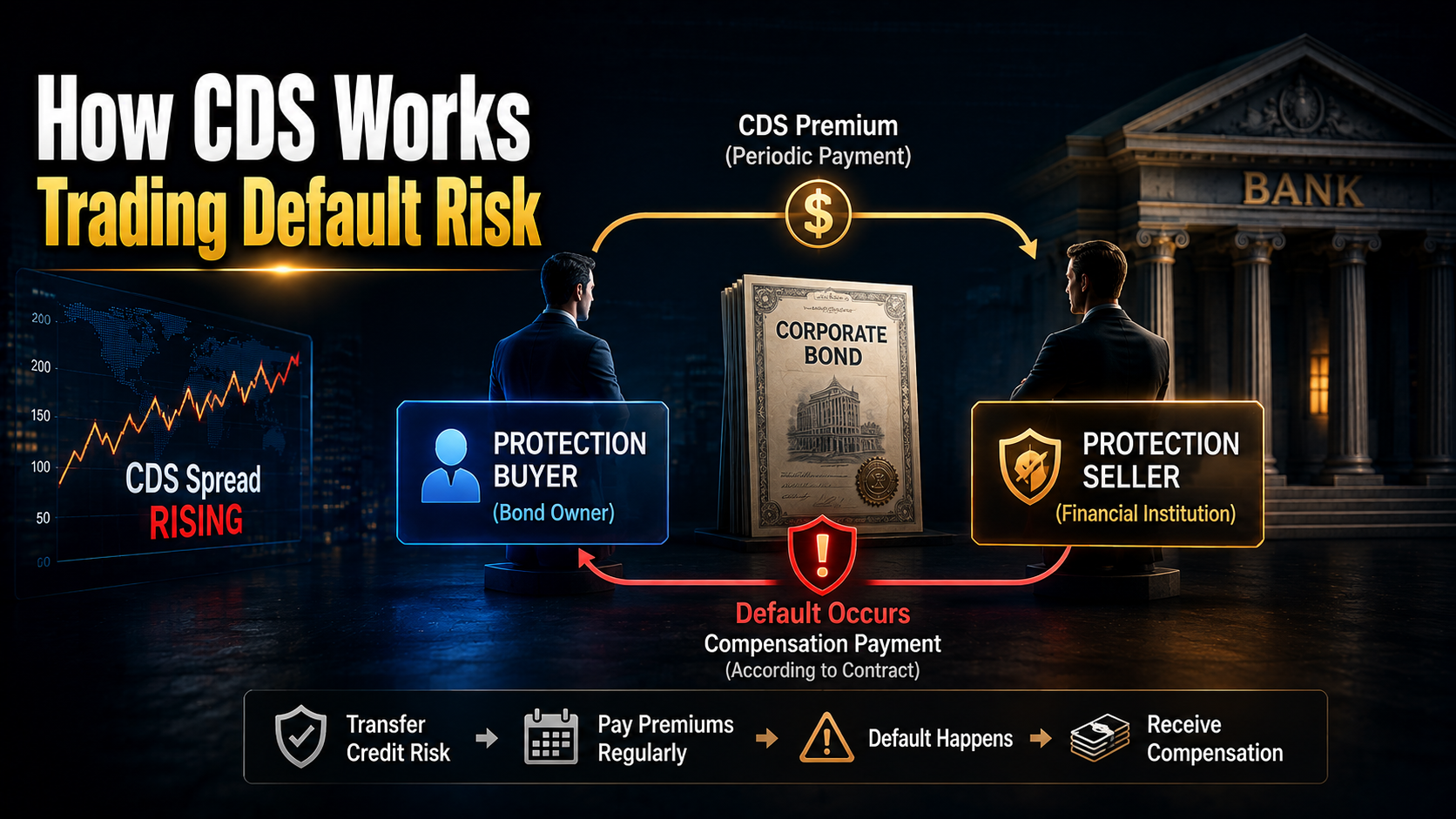
- The bond owner pays a recurring premium.
- Another financial institution agrees to absorb the credit risk.
- If a default occurs, the protection seller compensates the buyer for the agreed loss.
This mechanism allows investors to separate credit risk from the bond itself.
Why Were Credit Default Swaps Created?
Modern financial markets needed a more efficient way to manage credit risk.
During the 1990s, major investment banks—most notably JPMorgan—developed CDS contracts so banks could reduce the credit exposure on loans and bonds without selling the underlying assets.
Instead of removing bonds from their portfolios, financial institutions could simply transfer the default risk to another party.
This innovation fundamentally changed credit markets.
Today, CDS contracts are widely used by
- Commercial banks
- Investment banks
- Pension funds
- Insurance companies
- Hedge funds
- Institutional asset managers
While CDS began as a hedging tool, it eventually became one of the most closely watched indicators of financial stability around the world.
How Does a CDS Work?
The structure is relatively straightforward.
Step 1
An investor owns bonds issued by a corporation or government.
↓
Step 2
The investor purchases CDS protection by paying an annual premium.
↓
Step 3
If no default occurs, the protection seller simply keeps the premiums until the contract expires.
↓
Step 4
If a credit event—such as bankruptcy or debt restructuring—occurs, the protection seller compensates the buyer according to the contract.
In other words, the higher the perceived probability of default, the more expensive the CDS premium becomes.
This is why CDS prices often move before stock prices or credit ratings change.
Understanding CDS Premiums
The cost of CDS protection is called the CDS premium and is typically quoted in basis points (bps).
- 1 basis point = 0.01%
- 100 basis points = 1%
For example
If a company's five-year CDS trades at 150 basis points, an investor would pay approximately 1.5% of the insured amount per year for protection against default.
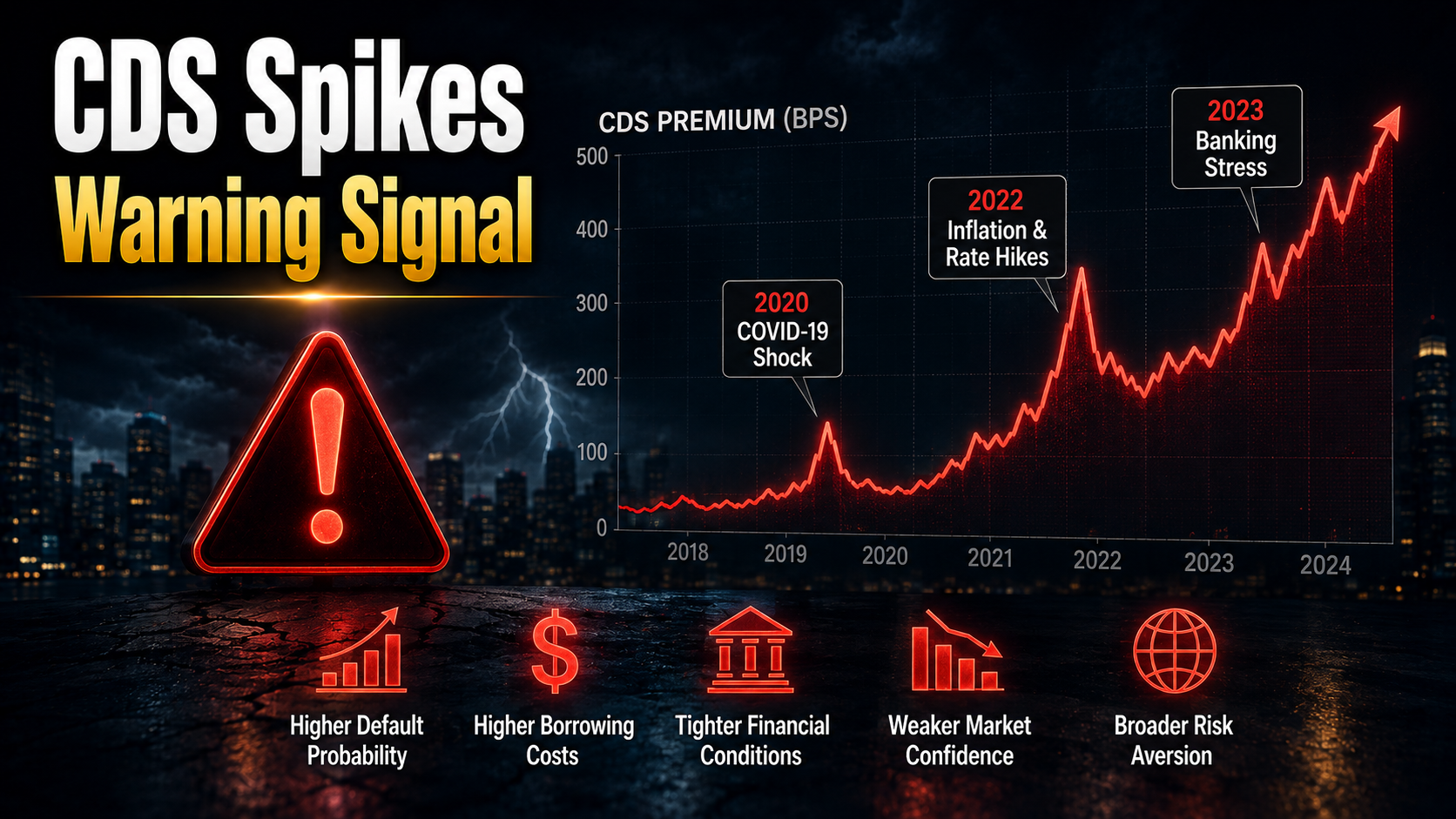
A rising CDS premium generally indicates that investors believe the borrower's financial condition is deteriorating.
Conversely, falling CDS premiums suggest improving confidence and lower perceived credit risk.
For this reason, many institutional investors monitor CDS movements every day as an early warning signal for broader financial markets.
Why Do Investors Watch CDS So Closely?
Credit Default Swaps are more than hedging instruments. They also function as real-time market prices for credit risk.
When investors become concerned about a company’s ability to service its debt, demand for CDS protection increases. As more investors seek protection, the CDS premium rises.
This makes CDS useful as an early warning system.
A company may still report positive earnings, maintain an investment-grade credit rating, and see its stock price remain relatively stable. Yet its CDS spread may already be widening because bond investors are worried about declining cash flow, refinancing pressure, or excessive leverage.
That distinction matters because equity investors and credit investors often focus on different questions.
Stock investors tend to ask
How much can this company grow?
Credit investors tend to ask
Can this company continue paying its interest and repay its debt?
When financial conditions tighten, the second question often becomes more important than the first.
1. CDS Can React Faster Than Credit Ratings
Credit ratings issued by agencies such as Moody’s, S&P Global Ratings, and Fitch provide an important assessment of a borrower’s creditworthiness.
However, ratings usually change gradually.
Credit rating agencies must review financial statements, debt structures, industry conditions, liquidity, and management plans before upgrading or downgrading an issuer.
CDS markets respond much faster because prices change continuously as investors buy and sell protection.
This creates an important difference
| Category | CDS Market | Credit Rating |
| Main driver | Market transactions | Rating agency analysis |
| Speed of adjustment | Fast | Relatively slow |
| Frequency of change | Continuous | Periodic |
| Main meaning | Market-implied credit risk | Formal credit assessment |
| Sensitivity to sentiment | High | Lower |
A credit rating tells investors how an agency currently evaluates the issuer.
A CDS spread shows how the market is pricing the issuer’s risk at that moment.
The two indicators often move in the same direction, but not always at the same speed.
2. CDS Reflects Liquidity and Risk Sentiment
A rise in CDS premiums does not always mean default is imminent.
CDS spreads can also increase because of
- Weak market liquidity
- Heavy demand for hedging
- Rising interest rates
- Recession concerns
- Political uncertainty
- Sector-specific stress
- Large speculative positions
- A broad decline in risk appetite
This is why CDS should not be interpreted in isolation.
A widening spread may represent a genuine deterioration in the borrower’s financial condition. It may also reflect a temporary rush for protection during a market panic.
The most useful question is not simply whether CDS is rising.
The better question is
Is the increase being confirmed by weaker cash flow, falling bond prices, wider credit spreads, or difficulty accessing funding?
When several warning signals move together, the probability of a deeper credit problem increases.
CDS and Bond Yields: What Is the Connection?
CDS premiums and bond yields are closely connected because both reflect compensation for credit risk.
Investors who lend money to a financially strong company may accept a relatively low yield because they expect to receive their interest and principal on time.
Investors lending to a weaker company demand a higher yield because they face a greater possibility of loss.
When perceived default risk rises, two things usually happen
- The cost of CDS protection increases.
- Investors demand a higher yield on the company’s bonds.
This can be summarized as
Higher credit risk → Wider CDS spread → Higher required bond yield → Lower bond price
Bond prices and yields move in opposite directions. Therefore, when investors demand a higher yield, the market price of existing bonds generally falls.
Why Rising CDS Costs Matter to Companies
A rising CDS premium can eventually affect the real economy.
If investors become more concerned about a company’s creditworthiness, the company may have to offer higher interest rates when issuing new debt.
That increases its cost of capital.
Higher borrowing costs can reduce the amount of money available for
- Business investment
- Research and development
- Acquisitions
- Share repurchases
- Dividends
- Hiring
- Debt refinancing
The effect can be especially severe for heavily indebted companies that must refinance large amounts of debt during a period of high interest rates.
A company does not need to default for shareholders to be affected. A sustained rise in financing costs can weaken earnings, restrict growth, and reduce equity value long before an actual credit event occurs.
CDS and Credit Spreads
Investors should examine CDS together with the credit spread in the cash bond market.
A credit spread is the additional yield that a corporate bond offers over a comparable U.S. Treasury security.
For example, suppose a five-year corporate bond yields 6%, while a five-year Treasury yields 4%.
The corporate bond’s credit spread is approximately 2 percentage points, or 200 basis points.
That additional yield compensates the investor for risks such as
- Default risk
- Liquidity risk
- Economic uncertainty
- Company-specific financial weakness
CDS and bond credit spreads often move in the same direction because both represent the market price of credit risk.
| Market signal | Typical interpretation |
| CDS rising, bond spreads widening | Credit concerns are becoming more serious |
| CDS rising, bond spreads stable | Hedging demand or technical factors may be driving CDS |
| CDS stable, bond spreads widening | Bond liquidity or cash-market selling may be the main issue |
| CDS falling, bond spreads narrowing | Credit confidence may be improving |
When CDS premiums and bond spreads rise together, the warning is generally more meaningful than a move in either indicator alone.
What Is Sovereign CDS?
CDS contracts are not limited to corporations.
Investors can also trade CDS on sovereign debt issued by national governments.
A sovereign CDS reflects the market’s perception of the probability that a government may fail to meet its debt obligations, restructure its bonds, or experience severe financial stress.
Investors may watch sovereign CDS when evaluating
- Government debt levels
- Fiscal deficits
- Political stability
- Foreign-exchange reserves
- Inflation
- External debt
- Banking-system exposure
- Ability to borrow in international markets
Sovereign CDS is especially important in emerging markets, where governments may depend heavily on foreign capital or debt denominated in U.S. dollars.
Why Dollar-Denominated Debt Matters
A country that borrows in its own currency has more flexibility than a country that owes large amounts in a foreign currency.
When the U.S. dollar strengthens, the burden of dollar-denominated debt can increase for foreign governments and companies whose revenues are earned in weaker local currencies.
This can create the following cycle
- The local currency declines.
- Dollar-denominated debt becomes more expensive to service.
- Investors demand greater compensation for risk.
- Sovereign CDS premiums rise.
- Capital outflows put further pressure on the currency and bond market.
For U.S. investors, sovereign CDS can therefore provide insight into risks facing emerging-market bonds, multinational companies, global banks, and international equity funds.
Naked CDS: Protection Without Owning the Bond
One of the most controversial characteristics of the CDS market is that an investor does not always need to own the underlying bond.
A CDS purchased without owning the referenced debt is commonly called a naked CDS.
An investor may buy naked CDS protection because they expect the borrower’s credit condition to deteriorate. If the CDS spread rises, the position may gain value even if no default occurs.
This makes it possible to express a negative view on a borrower’s creditworthiness without short-selling its bonds.
Supporters argue that naked CDS improves price discovery and market liquidity.
Critics argue that it can amplify fear, speculation, and market stress.
The key point is that CDS demand does not come only from investors protecting bond portfolios. It can also come from traders positioning for a deterioration in credit conditions.
As a result, CDS premiums may sometimes move more sharply than the underlying fundamentals appear to justify.
Lessons from Major Financial Crises
The 2008 Global Financial Crisis
Credit Default Swaps became widely known during the 2008 financial crisis.
Before the crisis, financial institutions used CDS contracts to transfer risks connected to mortgage-backed securities and other structured credit products.
The problem was not simply that CDS existed.
The deeper problem was that many institutions sold enormous amounts of credit protection without maintaining enough capital or liquidity to absorb losses under a severe scenario.
When mortgage defaults increased and the value of structured securities collapsed, CDS sellers faced massive payment obligations.
American International Group, better known as AIG, became one of the most important examples. Its exposure to credit protection contracts created systemic concerns because its failure could have transmitted losses across numerous financial institutions.
The crisis demonstrated a critical lesson
Risk does not disappear when it is transferred. It moves to another balance sheet.
If the institution accepting the risk lacks the capital to survive a major shock, the financial system may become more fragile rather than safer.
Lehman Brothers and Counterparty Risk
The collapse of Lehman Brothers also showed why CDS is linked to counterparty risk.
A CDS buyer depends on the protection seller remaining financially capable of paying compensation after a credit event.
If the seller itself becomes insolvent, the protection may fail precisely when it is needed most.
This means a CDS contract contains two major risks
- The credit risk of the referenced borrower
- The counterparty risk of the institution selling protection
For investors, the quality of the contract is only as strong as the ability of the protection seller to honor it.
The European Sovereign Debt Crisis
During the European sovereign debt crisis, CDS premiums on several highly indebted countries rose sharply.
Investors became concerned that governments might be unable to manage rising debt burdens without restructuring, external assistance, or severe fiscal adjustments.
The widening of sovereign CDS spreads affected more than government bonds.
It also placed pressure on European banks because many banks held large amounts of domestic sovereign debt. As sovereign credit risk increased, confidence in bank balance sheets weakened as well.
This demonstrated how government risk and banking-system risk can reinforce each other.
The 2023 Banking Stress
The U.S. regional banking turmoil of 2023 reminded investors that rapid changes in interest rates can create credit and liquidity stress even when traditional loan defaults remain limited.
As concerns spread across the banking sector, investors reassessed the value of bank bond portfolios, deposit stability, funding costs, and unrealized losses.
Credit spreads and CDS premiums on several financial institutions widened as markets attempted to identify which balance sheets were most exposed.
The episode reinforced an important principle
Financial stress often begins as a liquidity problem and becomes a credit problem when confidence disappears.
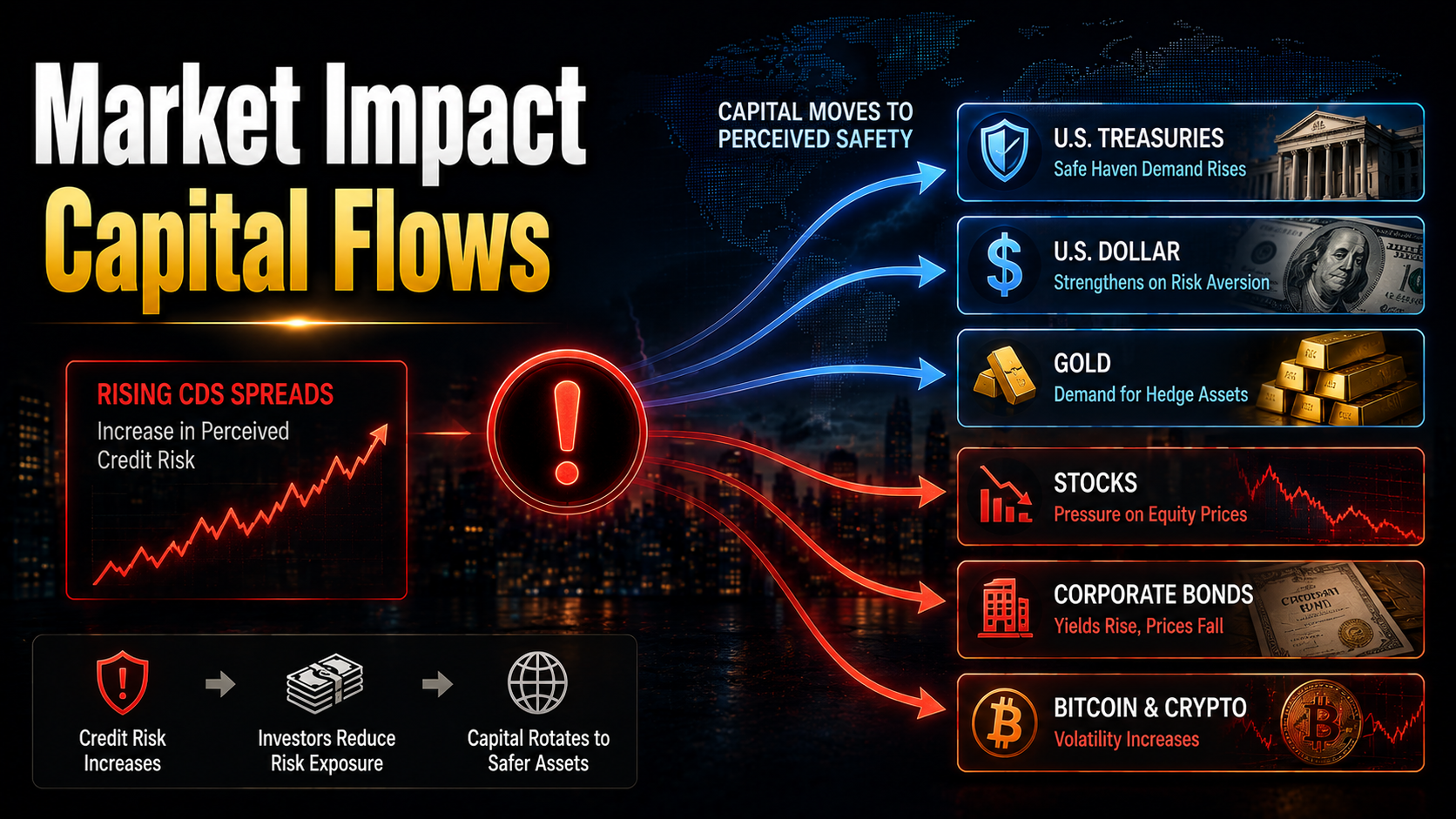
How Rising CDS Premiums Affect Major Asset Classes
A sharp rise in CDS spreads can influence stocks, bonds, currencies, commodities, and digital assets.
The reaction depends on whether the risk is isolated to one company, concentrated in one sector, or spreading across the financial system.
| Asset class | Typical response to rising CDS spreads | Main mechanism |
| Stocks | Downward pressure | Lower earnings expectations and higher financing costs |
| Corporate bonds | Prices fall, yields rise | Investors demand more compensation for credit risk |
| U.S. Treasuries | May rise | Capital moves toward perceived safety |
| U.S. dollar | Often strengthens | Global demand for liquidity and safe assets increases |
| Gold | May benefit | Demand for defensive assets can increase |
| Bitcoin | Volatility may rise | Liquidity and risk appetite often dominate in the short term |
These are general tendencies rather than fixed rules.
The cause of the CDS increase matters as much as the increase itself.
Impact on Stocks
Equity investors sometimes underestimate changes in credit markets because stocks receive more attention in financial media.
However, bond and CDS markets can reveal stress before it becomes visible in earnings.
A rising CDS premium can signal
- Higher refinancing expenses
- Reduced access to capital markets
- Greater probability of a credit downgrade
- Pressure on profit margins
- Risk of dividend reductions
- Reduced share repurchases
- Potential dilution from new equity issuance
Highly leveraged companies are generally more sensitive because a larger share of their cash flow must be used to service debt.
Impact on Corporate Bonds
Corporate bonds are the most directly affected asset class.
As CDS premiums rise, investors usually demand higher yields to hold the issuer’s debt. Existing bond prices may fall as a result.
The impact can be particularly strong in the high-yield market, where borrowers already have weaker balance sheets or lower credit ratings.
A broad increase in high-yield CDS or credit spreads may indicate that investors are becoming more concerned about economic growth, defaults, or market liquidity.
Impact on U.S. Treasuries
When credit concerns become systemic, investors often move capital toward U.S. Treasury securities.
This safe-haven demand may push Treasury prices higher and yields lower.
However, the relationship is not always simple.
If CDS spreads rise because inflation is accelerating or fiscal concerns are increasing, Treasury yields may remain elevated.
Investors therefore need to distinguish between
- A growth or credit shock that increases demand for Treasuries
- An inflation or fiscal shock that reduces demand for long-duration bonds
Impact on the U.S. Dollar
The dollar often benefits during periods of global credit stress because it plays a central role in international funding, trade, and debt repayment.
When investors reduce risk, they may sell foreign assets and increase their holdings of dollar cash or short-term Treasury securities.
Companies and governments with dollar-denominated liabilities may also need to acquire dollars to meet debt obligations.
This demand can strengthen the dollar, especially against emerging-market currencies.
Impact on Gold
Gold may benefit when CDS spreads rise because investors seek assets that are not directly dependent on the solvency of a corporation or government.
However, gold can also fall during the early phase of a liquidity crisis if investors sell assets to raise cash or meet margin calls.
Its longer-term response often depends on
- Real interest rates
- The Federal Reserve’s policy response
- Dollar strength
- Inflation expectations
- Confidence in the financial system
Impact on Bitcoin
Bitcoin is sometimes described as an alternative monetary asset, but its short-term behavior during credit stress is inconsistent.
During a sharp liquidity contraction, Bitcoin may trade like a risk asset because investors reduce leverage and seek cash.
In other periods, concerns about banks, currencies, or financial institutions may increase interest in decentralized assets.
For that reason, rising CDS spreads do not automatically imply that Bitcoin will rise or fall.
The more important variables are global liquidity, real interest rates, dollar funding conditions, and overall risk appetite.
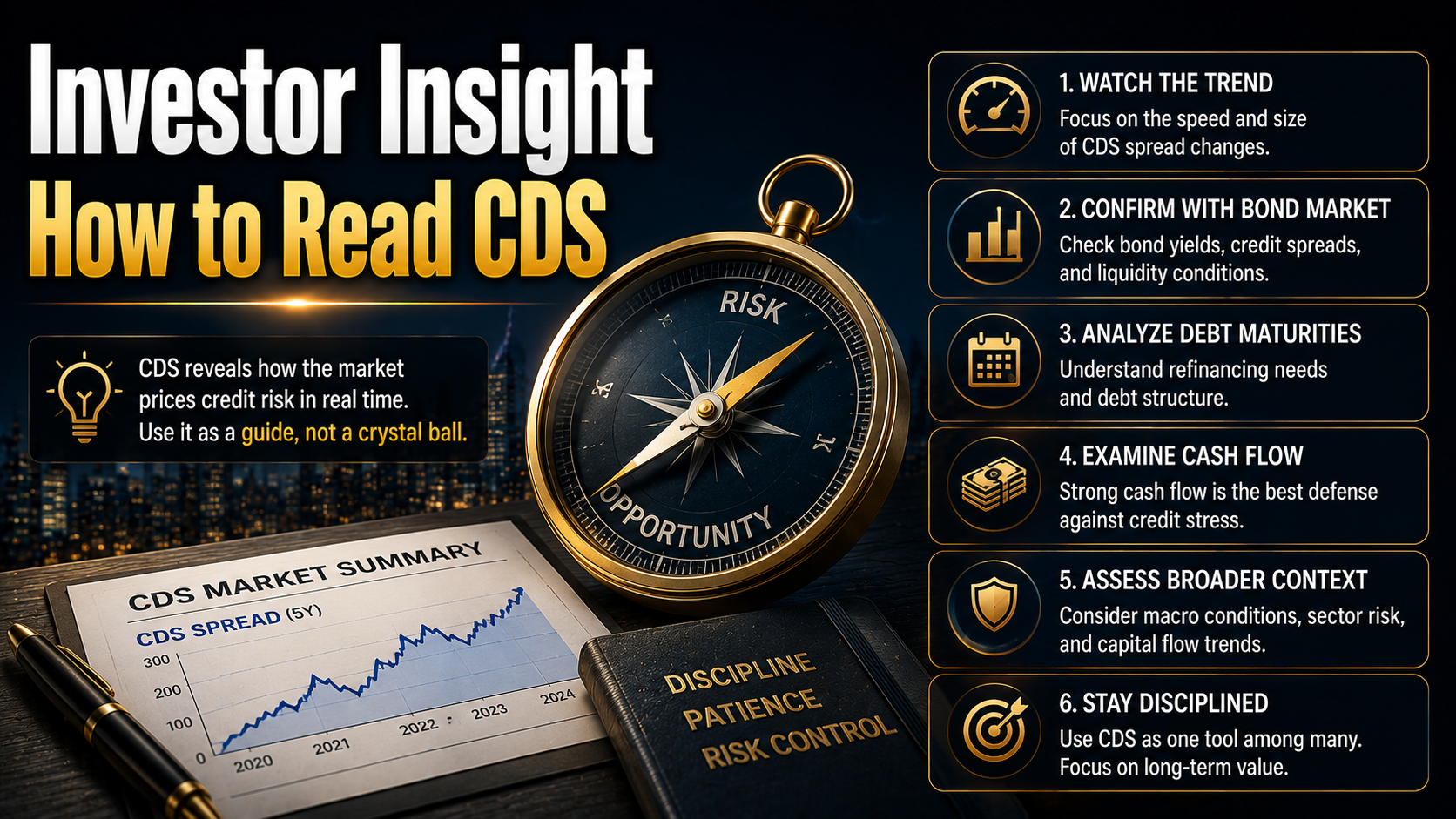
What Should Investors Look For?
1. Focus on the Speed of Change
The absolute level of a CDS spread matters, but the rate of change can be even more informative.
A company with a structurally risky business may trade with a high CDS premium for years.
That does not necessarily mean a crisis is imminent.
A more serious warning may occur when an issuer’s CDS premium rises from 80 basis points to 250 basis points within a short period.
Such a move suggests that investors are rapidly reassessing the borrower’s ability to service its debt.
Investors should ask
- Did the spread rise gradually or suddenly?
- Is the move specific to one issuer?
- Are competitors experiencing the same pressure?
- Is the broader credit market also weakening?
2. Compare Corporate, Sector, and Sovereign CDS
A rise in one company’s CDS may indicate an issuer-specific problem.
A simultaneous increase across an entire industry may signal sector-wide stress.
A broad rise in sovereign CDS and bank CDS may suggest a deeper macroeconomic or financial-system problem.
The wider the stress spreads, the more important the signal becomes.
3. Watch the Cash Bond Market
CDS is most useful when confirmed by actual bond prices and yields.
Investors should monitor whether
- Corporate bond yields are rising
- Credit spreads are widening
- New bond issuance is being delayed
- Companies are paying unusually high rates to refinance
- Bond trading liquidity is deteriorating
If CDS prices rise but cash bonds remain stable, the move may be driven by technical hedging demand.
If both markets weaken together, the deterioration is more likely to be fundamental.
4. Examine the Debt Maturity Schedule
A company with large amounts of debt maturing soon is more vulnerable to rising credit costs than a company with long-term fixed-rate debt.
Investors should consider
- How much debt matures in the next one to three years?
- Is the debt fixed-rate or floating-rate?
- Does the company have enough cash to repay maturities?
- Can it refinance without severely reducing profits?
- Are its bonds secured or unsecured?
- Does it depend on short-term funding?
The same CDS spread can carry very different implications depending on the issuer’s debt structure.
5. Follow Cash Flow, Not Just Earnings
Accounting earnings do not always reveal whether a borrower can meet its obligations.
A company may report positive net income while generating weak free cash flow.
Credit investors focus heavily on
- Operating cash flow
- Free cash flow
- Interest coverage
- Net debt
- Debt-to-EBITDA
- Cash reserves
- Refinancing needs
A strong business model with durable cash flow has a better chance of surviving temporary credit-market stress.
What Do Wealthy Investors Look for in This Trend?
Experienced investors do not treat every increase in CDS premiums as a signal to sell everything.
They use credit-market stress to understand where capital is leaving, where it is moving, and which assets are likely to survive.
1. The Direction of Capital Flows
When CDS spreads rise, money may leave leveraged stocks, lower-quality bonds, emerging markets, or vulnerable financial institutions.
That capital does not simply disappear.
It may move into
- Treasury bills
- Money market funds
- High-quality corporate bonds
- The U.S. dollar
- Gold
- Cash-rich companies
- Defensive sectors
Understanding where money is moving can be more valuable than reacting to the initial decline.
Market prices are the visible result. Capital flows are often the underlying cause.
2. Cash Flow and Asset Survivability
During easy financial conditions, weak companies can often refinance debt and continue operating.
When CDS premiums and borrowing costs rise, access to capital becomes more selective.
Businesses with recurring revenue, high margins, strong balance sheets, and limited refinancing needs may continue operating without depending on favorable market conditions.
Companies with unstable cash flow and heavy debt may be forced to issue shares, sell assets, cut investment, or restructure liabilities.
Long-term investors should ask
Can this business survive without cheap money?
That question becomes increasingly important when the credit cycle turns.
3. The Difference Between Insolvency and Illiquidity
A temporary liquidity problem is not always the same as insolvency.
An illiquid borrower may own valuable assets but lack immediate access to cash.
An insolvent borrower has liabilities that may exceed the realistic value of its assets or lacks the long-term cash flow needed to repay debt.
Markets can sometimes confuse the two during periods of panic.
This can create opportunities—but only for investors who carefully analyze the balance sheet, debt maturity schedule, collateral, and cash-generating capacity.
4. Excessive Fear Versus Fundamental Deterioration
CDS markets can overreact because they incorporate hedging demand, speculation, and thin liquidity.
A dramatic spike does not always lead to default.
However, assuming every spike is an overreaction can be equally dangerous.
Investors need to distinguish between
- Temporary market panic
- A short-lived liquidity problem
- A deteriorating business model
- Unsustainable leverage
- A genuine solvency crisis
The opportunity is not created by falling prices alone.
It is created when market fear becomes greater than the long-term deterioration in the asset’s fundamental value.
Questions Investors Should Ask Themselves
- Is the CDS increase isolated or spreading across the market?
- Are bond prices confirming the warning?
- Does the borrower generate enough cash to cover interest payments?
- How much debt must be refinanced soon?
- Is the market facing a liquidity shock or a solvency crisis?
- Where is capital moving as investors reduce risk?
- Can the asset survive without access to cheap financing?
- Is fear creating a discount, or is the underlying value permanently impaired?
The goal is not to predict every default.
The goal is to recognize when the market’s tolerance for risk is changing and adjust the margin of safety accordingly.
CDS at a Glance
| Key concept | Meaning |
| Credit Default Swap | A contract that transfers credit risk |
| CDS buyer | Pays premiums to receive default protection |
| CDS seller | Receives premiums and assumes default risk |
| Rising CDS premium | The market perceives higher credit risk |
| Falling CDS premium | Credit confidence may be improving |
| Corporate CDS | Measures risk related to a company’s debt |
| Sovereign CDS | Measures risk related to a government’s debt |
| Key confirmation indicators | Bond yields, credit spreads, liquidity, and cash flow |
| Main investor lesson | Watch where capital moves and which assets can survive tighter credit |
Final Thoughts
A Credit Default Swap is not merely a complicated Wall Street derivative.
It is one of the clearest market-based prices of credit risk.
When CDS premiums rise, investors are demanding greater compensation to accept the possibility that a corporation or government may fail to meet its obligations.
That change can affect far more than the bond market.
It can raise financing costs, weaken corporate earnings, pressure stock prices, strengthen demand for safe assets, and alter global capital flows.
CDS should never be used as a standalone prediction tool. A rising spread does not guarantee default, just as a low spread does not guarantee safety.
Its value comes from combining it with bond yields, credit spreads, debt maturities, liquidity conditions, and cash-flow analysis.
The essential lesson is this
CDS shows how much the market is charging for credit risk—and how quickly trust is being withdrawn from a borrower.
In investing, survival rarely depends on predicting the exact moment a crisis begins. It depends on recognizing when financial conditions are changing and owning assets capable of enduring the pressure.
This has been MasterMind.
'[Global] Success Blueprints' 카테고리의 다른 글