Why Does the Nasdaq Keep Going Up? Key Reasons Every Investor Should Know


Why the Nasdaq Keeps Breaking Records - Even When the Economy Looks Uncertain
Welcome to MasterMind.
Inflation remains stubborn. Interest rates have stayed higher than many investors expected. Recession headlines continue to appear every few months.
Yet the Nasdaq continues to reach new all-time highs.
So what is really driving one of the strongest bull markets in modern history? Is it simply AI hype, or is there something much deeper happening beneath the surface?
The answer matters because understanding why the Nasdaq rises is far more valuable than trying to predict when it will pull back.
Key Takeaway
The Nasdaq continues to outperform because it represents the world's most profitable innovation companies, supported by strong cash flows, massive capital inflows, share buybacks, and a financial system that consistently rewards long-term productivity growth.
What Is the Nasdaq?

The Nasdaq is one of the world's largest stock exchanges and serves as the home of many of America's most innovative companies.
Its largest components include
- Apple
- Microsoft
- NVIDIA
- Amazon
- Alphabet
- Meta Platforms
- Tesla
Unlike traditional industrial indexes, the Nasdaq is heavily weighted toward companies that benefit from technological innovation, digital infrastructure, artificial intelligence, cloud computing, semiconductors, and software.
Because it is a market-cap-weighted index, the largest companies have the greatest influence on its performance.
When mega-cap technology companies grow, the entire index tends to move with them.
Why Does the Nasdaq Keep Rising?
There isn't one single reason.
The Nasdaq has become the destination where several powerful long-term trends meet.
1. Global Capital Flows Toward the Highest-Quality Businesses
Money constantly searches for the best combination of safety, profitability, and growth.
Today, the United States offers
- The world's largest economy
- The deepest capital markets
- The U.S. dollar as the global reserve currency
- The world's leading technology companies
As a result, global pension funds, sovereign wealth funds, institutional investors, and ETFs continue allocating capital to U.S. equities.
Much of that money ultimately flows into the Nasdaq.
Markets don't simply move because of headlines.
They move because capital moves.
2. Big Tech Generates Extraordinary Cash Flow
One of the biggest differences between today's Nasdaq and the Dot-Com Bubble is profitability.
Twenty-five years ago, many technology companies were valued based on future promises.
Today, the largest Nasdaq companies generate enormous amounts of real cash.
Apple, Microsoft, Alphabet, Meta, Amazon, and NVIDIA produce billions of dollars in operating cash flow every quarter.
That cash allows them to
- Invest aggressively
- Acquire competitors
- Expand AI infrastructure
- Develop new products
- Return capital to shareholders
Strong cash flow creates stronger businesses, which attracts even more investment capital.
3. Share Buybacks Increase Shareholder Value
Another major driver is share repurchases.
Large U.S. technology companies spend tens of billions of dollars buying back their own shares every year.
Why does this matter?
When outstanding shares decline, earnings are divided among fewer shares.
That increases earnings per share (EPS) even if total net income remains relatively stable.
This creates a powerful cycle
Business Growth
↓
Higher Cash Flow
↓
Share Buybacks
↓
Higher EPS
↓
Higher Stock Prices
Few companies outside the world's largest technology firms can consistently execute buyback programs at this scale.
4. ETFs Create Constant Demand
The rise of passive investing has fundamentally changed market dynamics.
Millions of investors now purchase ETFs such as
- QQQ
- Invesco NASDAQ-100 ETF
- Broad index funds tracking large-cap U.S. equities
Whenever investors buy these funds, ETF providers must purchase the underlying stocks.
This creates a structural source of demand that continues regardless of daily market sentiment.
Long-term retirement accounts, pension plans, and automatic investment programs reinforce this trend year after year.
5. Innovation Creates Long-Term Economic Growth
Many people believe AI alone explains today's rally.
AI is certainly important, but it represents something much larger.
Throughout history, every major innovation cycle has created enormous investment opportunities.
- Personal computers
- The Internet
- Smartphones
- Cloud computing
- Artificial Intelligence
Each wave increased productivity across the economy.
The companies leading those transitions have often been Nasdaq constituents.
AI is simply the latest chapter in a much longer story of technological progress.
6. The Winner-Takes-Most Economy
Technology businesses benefit from powerful network effects.
The more users they gain, the stronger their competitive advantage becomes.
Search belongs largely to Google.
Operating systems are dominated by Microsoft.
Premium smartphones remain Apple's market.
AI chips are led by NVIDIA.
As these companies grow larger, they often become even more profitable.
That attracts additional investment, reinforcing their leadership.
7. Interest Rates Still Matter
Even great companies are influenced by monetary policy.
Technology stocks derive much of their value from future earnings.
Lower interest rates generally increase the present value of those future cash flows.
Higher rates can compress valuations.
This is why investors closely monitor Federal Reserve policy alongside corporate earnings.
Liquidity remains one of the most important long-term drivers of equity markets.
Why Every Investor Watches the Nasdaq
The Nasdaq is more than just another stock index.
It reflects where the world's capital believes future growth will come from.
During uncertain economic periods, investors increasingly favor companies with
- Strong balance sheets
- Consistent cash generation
- Durable competitive advantages
- Global pricing power
For many institutional investors, America's largest technology companies have become long-term compounders rather than speculative growth stocks.
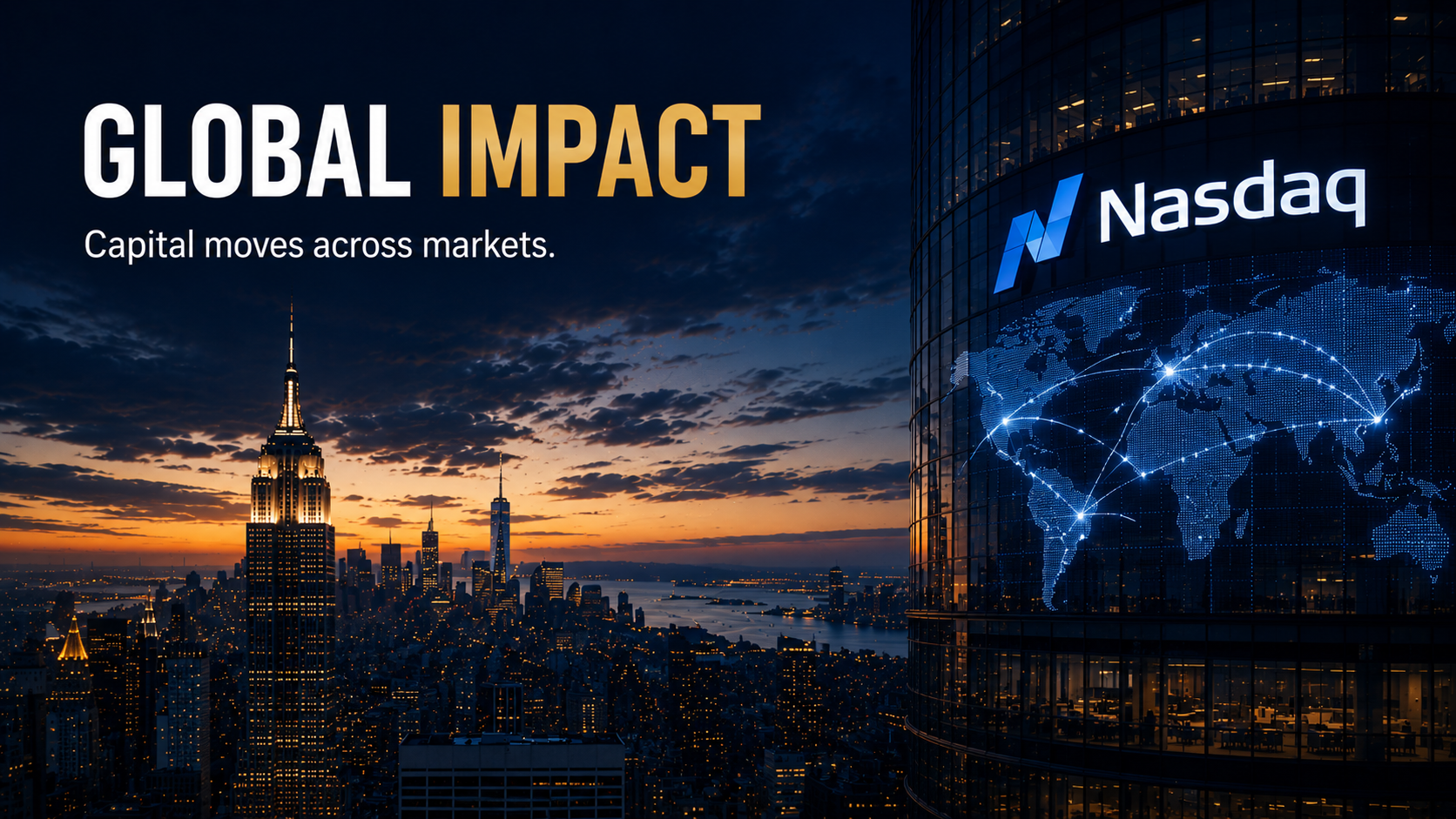
How the Nasdaq Affects Other Markets
| Asset Class | Typical Impact |
| U.S. Technology Stocks | Higher capital inflows support valuations |
| Semiconductors | Benefit from AI and infrastructure investment |
| U.S. Dollar | Often strengthened by international capital inflows |
| Treasury Bonds | Risk-on sentiment can reduce bond demand |
| Gold | May outperform during risk-off periods |
| Bitcoin | Often benefits when liquidity and risk appetite improve |
No market relationship is permanent, but these patterns frequently appear during major economic cycles.
What Long-Term Investors Should Watch
The Nasdaq's long-term performance has been impressive, but sustainable investing requires discipline.
Rather than focusing only on price, pay attention to
- Corporate earnings growth
- Free cash flow
- Market breadth
- Federal Reserve policy
- Valuation levels
- Innovation trends
Markets reward businesses that continue creating economic value—not simply those with exciting stories.
What Wealthy Investors See Differently
Most investors ask
"How much did NVIDIA go up today?"
Experienced investors ask
"Where is global capital flowing over the next decade?"
They focus on
Capital Allocation
Which industries continue attracting investment?
Cash Flow
Can these businesses fund future growth without depending on outside financing?
Competitive Advantages
Do they possess durable moats that competitors struggle to replicate?
Long-Term Survival
Can they continue generating value through multiple economic cycles?
Before making any investment decision, ask yourself
- Does this company produce durable cash flow?
- Is it benefiting from a long-term structural trend or just short-term excitement?
- Would I still own it during a major market correction?
Long-term investing is rarely about predicting tomorrow's price.
It is about owning businesses that can continue compounding value for many years.
Final Thoughts
The Nasdaq's rise is not simply the result of speculation or AI enthusiasm.
It reflects a broader shift in global capital toward companies with exceptional profitability, innovation, and long-term competitive advantages.
Of course, no bull market lasts forever.
Valuations can become stretched. Market leadership can narrow. Interest rates and economic conditions will continue to create volatility.
But investors who understand how capital flows, how businesses generate cash, and why innovation attracts investment are better positioned to navigate those cycles.
In the end, successful investing isn't about predicting the next headline.
It's about recognizing which businesses are most likely to create value for the next decade.
This is MasterMind
designing success through insight.
'[Global] Success Blueprints' 카테고리의 다른 글
| Why Is Bitcoin Dropping Today? ETF Outflows, Options Expiry & Market Fear Explained (0) | 2026.06.26 |
|---|---|
| How Interest Rates Affect the Nasdaq and Tech Stocks (0) | 2026.06.26 |
| What Micron Earnings Mean for the Nasdaq and AI Stocks (0) | 2026.06.25 |
| What Is the NASDAQ-100 and Why Does It Matter to Investors? (0) | 2026.06.25 |
| What Is the NASDAQ? Why It Matters to Investors (0) | 2026.06.25 |