How Interest Rates Affect the Nasdaq and Tech Stocks


Welcome to MasterMind.
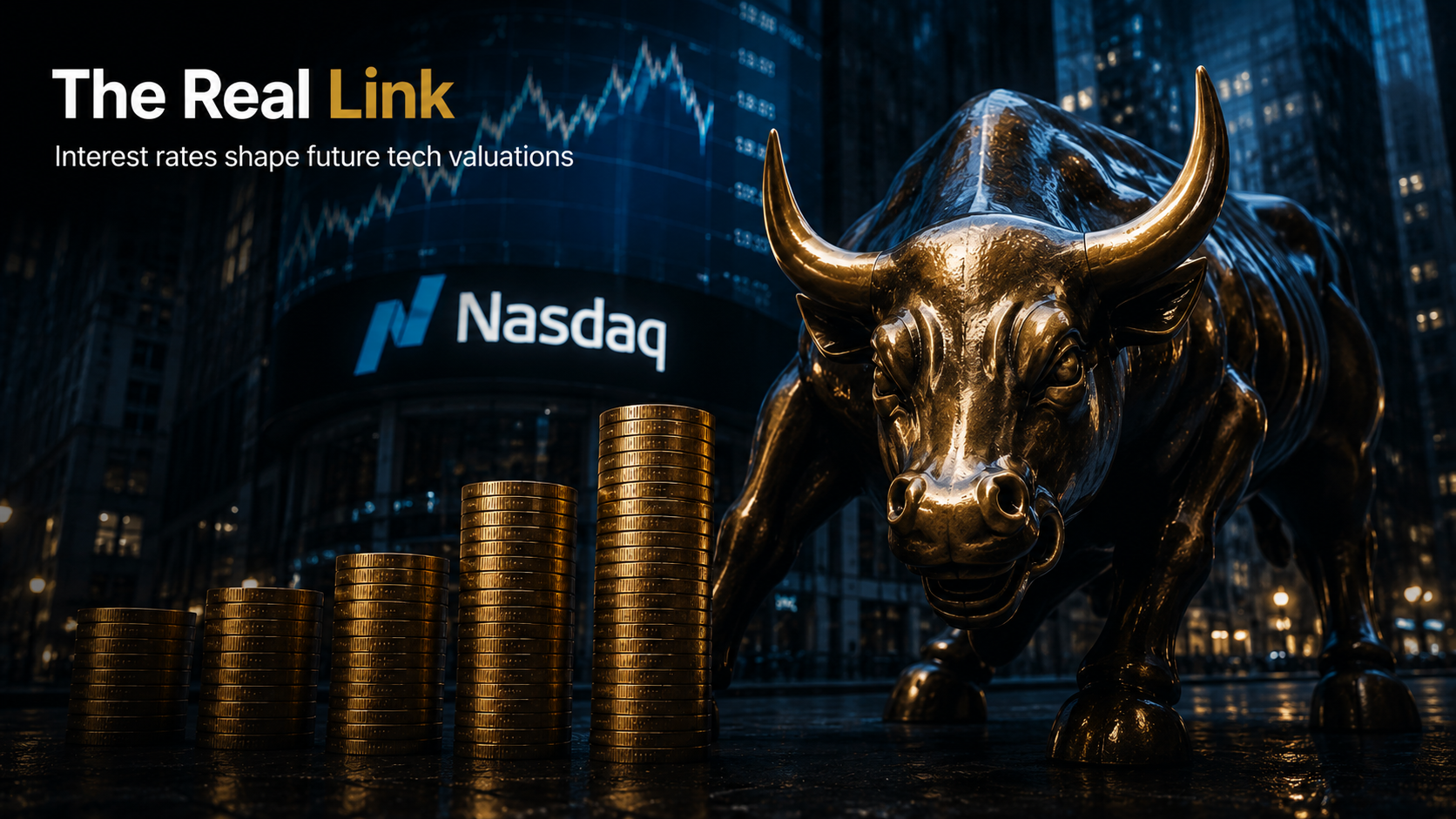
Every time the Federal Reserve hints at raising or cutting interest rates, one market seems to react first: the Nasdaq.
But why?
Why do technology stocks often rally before a rate cut actually happens? And why can a single speech from the Fed send billions of dollars flowing into—or out of—the biggest tech companies in the world?
The answer isn't simply that "higher rates are bad for stocks."
The real story is about money, future value, and liquidity.
Understanding this relationship can help investors see the market through a completely different lens.
Key Takeaway
Interest rates determine the value of future cash flows. Since Nasdaq companies are valued primarily on future growth, they are naturally more sensitive to changes in interest rates than most other sectors.
What Is the Relationship Between the Nasdaq and Interest Rates?
The Nasdaq is home to many of the world's largest technology companies, including Apple, Microsoft, Nvidia, Amazon, Meta, and Alphabet.
Unlike mature industries, many technology companies command high valuations because investors expect them to generate significantly larger profits years into the future.
Interest rates, meanwhile, represent the cost of money.
When borrowing becomes more expensive, companies invest less, consumers spend less, and investors begin to rethink how much future earnings are worth today.
That's why changes in interest rates often have an outsized impact on growth stocks.
How Interest Rates Affect the Nasdaq

1. Higher Rates Reduce the Present Value of Future Earnings
Stock prices are based on expectations of future cash flows.
Investors estimate how much a company may earn over the next five, ten, or even twenty years and then discount those future earnings back to today's dollars.
A simplified valuation formula looks like this
Present Value = Future Cash Flow ÷ (1 + Discount Rate)
Interest rates are a major component of that discount rate.
When rates rise, future earnings become less valuable in today's terms.
The farther those profits are expected to arrive, the greater the impact.
That's why high-growth technology companies tend to experience larger valuation swings than mature businesses.
2. Borrowing Becomes More Expensive
Innovation requires capital.
Whether it's building AI data centers, expanding cloud infrastructure, or investing in semiconductor manufacturing, technology companies often spend aggressively to fuel future growth.
Higher interest rates increase financing costs.
As borrowing becomes more expensive, companies may slow hiring, reduce capital spending, or delay expansion projects.
Even businesses with strong revenue growth can face lower valuations if investors believe future growth will slow.
3. Capital Rotates Toward Safer Assets

Markets are constantly comparing risk and reward.
When U.S. Treasury yields are close to zero, investors are more willing to take risks by buying growth stocks.
But when Treasury yields climb to 4% or 5%, the equation changes.
Institutional investors, pension funds, and asset managers may shift part of their portfolios from high-growth equities into government bonds that now offer attractive returns with lower risk.
The result is simple
Liquidity leaves risk assets, putting pressure on the Nasdaq.
Markets don't just trade companies.
They trade the movement of capital.
4. Markets Price Expectations, Not Headlines

One of the biggest misconceptions among new investors is believing that markets react only after the Federal Reserve changes interest rates.
In reality, markets move long before policy changes occur.
If inflation begins to cool...
If unemployment starts rising...
If economic growth slows...
Investors may anticipate future rate cuts months in advance.
That's why the Nasdaq often rallies before the Fed officially lowers rates.
Financial markets continuously price tomorrow's expectations—not yesterday's news.
Why Investors Should Pay Attention
Interest rates influence far more than borrowing costs.
They shape liquidity across the entire financial system.
Higher rates generally mean
- Slower economic activity
- Lower corporate investment
- Reduced consumer spending
- Stronger demand for defensive assets
Lower rates often encourage
- Greater market liquidity
- Increased risk appetite
- Higher valuations for growth companies
- More capital flowing into technology stocks
Understanding where money is moving is often more valuable than simply following headlines.
As experienced investors know
Markets follow liquidity before they follow the news.
Why Can the Nasdaq Rise Even When Interest Rates Are High?
Higher rates don't automatically mean lower stock prices.
Strong earnings can outweigh the negative effects of rising interest rates.
The AI-driven rally is a good example.
Despite elevated interest rates, companies like Nvidia and other large-cap technology firms continued to attract significant investment because earnings growth dramatically exceeded market expectations.
In other words, exceptional business performance can overcome macroeconomic headwinds.
Likewise, lower interest rates don't guarantee higher stock prices.
If the economy enters a deep recession and corporate profits collapse, technology stocks may still struggle despite easier monetary policy.
Successful investing requires looking at multiple forces simultaneously
- Corporate earnings
- Economic growth
- Liquidity
- Interest rates
- Investor expectations
How Interest Rates Affect Major Asset Classes
| Asset | Rising Rates | Falling Rates | Primary Driver |
| Nasdaq | Valuation pressure | Higher growth expectations | Future cash flow discounting |
| Bonds | Prices fall | Prices rise | Bond prices move inversely to yields |
| U.S. Dollar | Often strengthens | Often weakens | Global capital flows |
| Gold | May face pressure | Often benefits | Opportunity cost of holding non-yielding assets |
| Bitcoin | Higher volatility | Often benefits from increased liquidity | Risk appetite and liquidity conditions |
The key isn't simply watching prices.
It's understanding where capital is flowing.
What Every Long-Term Investor Should Know
Watch Expectations, Not Just Interest Rates
Markets often react to expected policy changes months before official announcements.
Follow Treasury Yields
Treasury yields frequently provide early signals about changing economic expectations.
Many professional investors monitor bond yields as closely as they monitor Federal Reserve decisions.
Earnings Still Matter Most
Companies with durable competitive advantages and strong cash flow can outperform even during periods of elevated interest rates.
Macroeconomic conditions matter.
Business quality matters even more.
Survival Beats Prediction
Trying to predict every Federal Reserve decision is nearly impossible.
Owning businesses that can thrive across different economic environments is a far more durable investment strategy.
What Wealthy Investors Focus On

Professional investors rarely ask whether interest rates are "good" or "bad."
Instead, they ask a different question
Where is capital moving next?
They pay close attention to
- Liquidity across financial markets
- Corporate cash flow
- Balance sheet strength
- Competitive advantages
- Long-term resilience
During periods of high interest rates, financially strong companies often become even stronger as weaker competitors struggle.
Market downturns don't simply eliminate value.
They frequently redistribute it.
Questions Worth Asking Yourself
- Can the companies I own generate strong cash flow even when borrowing costs rise?
- Do these businesses possess durable competitive advantages?
- Am I investing based on headlines—or on long-term fundamentals?
- Am I following stock prices, or am I following the flow of capital?
Successful investing isn't about predicting every market move.
It's about owning businesses capable of surviving—and thriving—through multiple economic cycles.
Final Thoughts
The relationship between the Nasdaq and interest rates goes far beyond a simple rule that "higher rates hurt stocks."
It is fundamentally about the price of money, the value of future growth, and the flow of liquidity throughout the financial system.
Investors who understand these forces are better equipped to interpret market movements with greater clarity and confidence.
Because in the end, successful investing isn't about predicting the future.
It's about owning businesses that can survive whatever the future brings.
This is MasterMind
designing success through insight.
'[Global] Success Blueprints' 카테고리의 다른 글