How Do Insurance Companies Make Money? Understanding Insurance Profits, Float, and Investing


Hello, this is MasterMind.
Most people think insurance companies make money by collecting premiums and paying out less in claims.
At first glance, the business seems simple.
Customers pay monthly premiums.
Insurance companies pay claims when accidents, illnesses, or other covered events occur.
But if some policyholders eventually receive far more money than they ever paid into the system, how can insurance companies remain consistently profitable?
And why did Warren Buffett build a significant portion of Berkshire Hathaway around insurance businesses?
The answer reveals one of the most powerful financial models ever created.
Insurance companies are not just risk management firms.
They are some of the largest asset managers in the world.
Understanding how they operate can provide valuable insight into capital flows, interest rates, and long-term investing.
Key Takeaway
Insurance companies generate profits not only from underwriting policies but also by investing vast pools of capital collected from policyholders over long periods of time.
What Is an Insurance Company's Business Model?

Unlike traditional businesses that manufacture and sell products, insurance companies operate on a unique financial structure.
They receive cash today and may not need to pay much of it out for years or even decades.
This creates a powerful time gap between collecting premiums and paying claims.
That time gap becomes the foundation of the insurance industry's profitability.
In simple terms, insurance companies sell protection today while investing the money until future obligations come due.
How Do Insurance Companies Make Money?
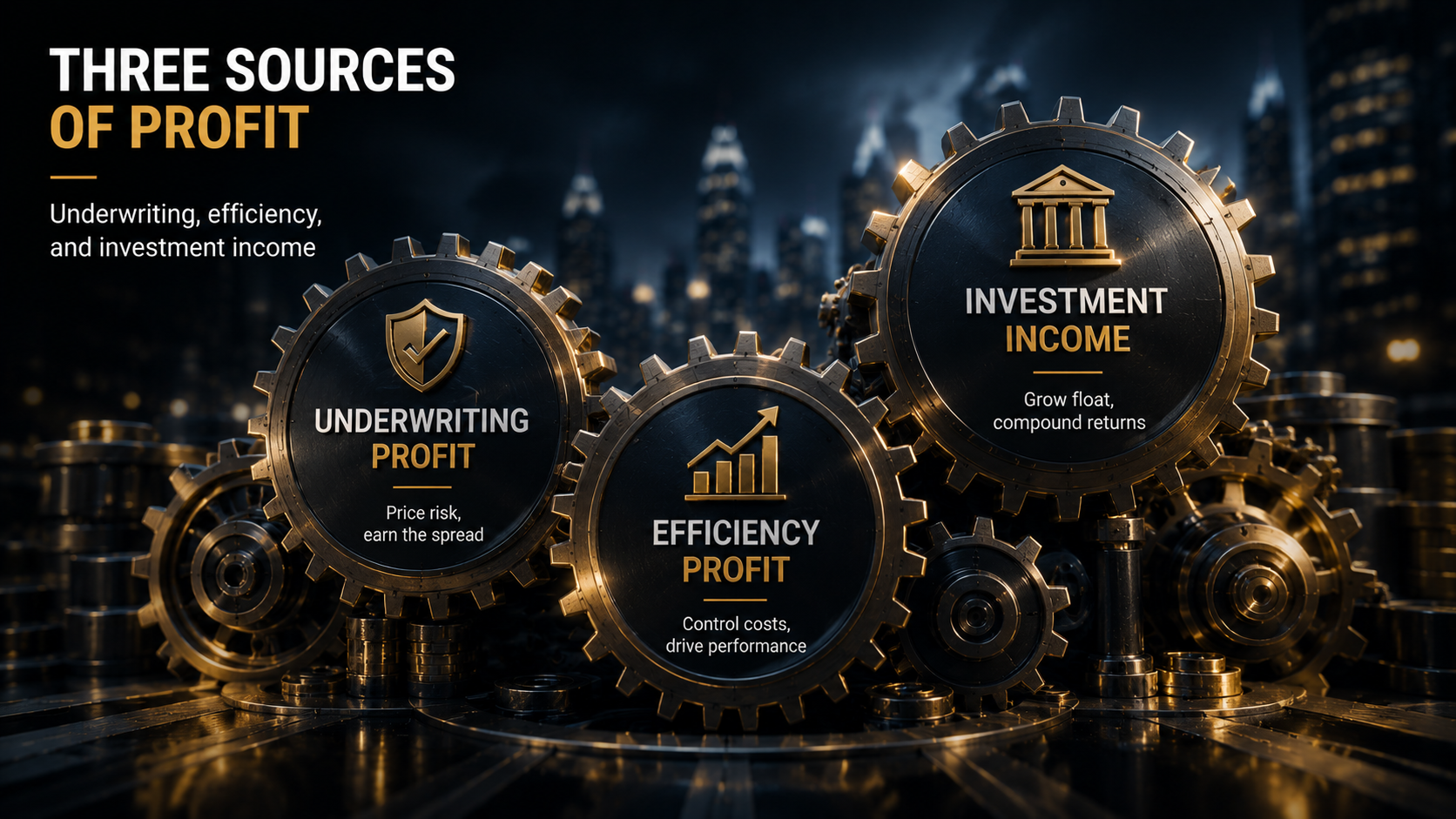
Insurance companies generally generate profits through three primary sources.
1. Underwriting Profit
This is the most straightforward source of earnings.
Insurance companies estimate the likelihood of future claims and set premiums accordingly.
If actual claims are lower than expected, the company keeps the difference as profit.
For example
- Premiums collected: $10 billion
- Claims paid: $7 billion
- Operating expenses: $2 billion
The remaining $1 billion becomes underwriting profit.
Strong underwriting discipline is often a sign of a well-managed insurer.
2. Expense Efficiency
Insurance premiums include costs for sales commissions, marketing, administration, and operations.
When companies operate more efficiently than expected, they generate additional profit.
Digital platforms, AI-powered underwriting, and automated claims processing have become increasingly important competitive advantages in this area.
3. Investment Income (The Real Engine)
This is where the insurance business becomes truly interesting.
Insurance companies do not immediately distribute all premium income.
Life insurance policies, annuities, and long-term protection products may not require payouts for decades.
Meanwhile, insurers invest this capital in
- U.S. Treasury bonds
- Corporate bonds
- Dividend-paying stocks
- Real estate
- Infrastructure projects
- Alternative investments
For many insurers, investment income can contribute as much as or more than underwriting profits.
What Is Float and Why Does It Matter?
One of the most important concepts in insurance investing is Float.
Float refers to money that insurance companies collect today but do not yet owe to policyholders.
This capital effectively becomes investable funds.
Warren Buffett famously described float as one of the greatest financial assets a business can possess.
Insurance companies gain access to enormous pools of capital without issuing debt or selling equity.
When managed properly, float becomes a powerful long-term compounding machine.
This is one reason why Berkshire Hathaway's insurance operations have played such a critical role in its success.
Why Do Insurance Companies Buy So Many Bonds?
If you examine the balance sheet of major insurance companies, you'll notice that bonds dominate their investment portfolios.
This is because insurance companies prioritize liability matching rather than maximizing short-term returns.
Their objectives include
- Preserving capital
- Generating predictable cash flow
- Matching future liabilities
As a result, insurers are among the largest buyers of government bonds and investment-grade corporate debt.
This makes them highly sensitive to changes in interest rates.
Why Insurance Companies Matter to Investors

Insurance companies are not just financial firms.
They are major participants in global capital markets.
Every premium dollar collected eventually gets allocated somewhere.
That money may flow into
- U.S. Treasuries
- Corporate bonds
- Commercial real estate
- Infrastructure projects
- Equity markets
As a result, insurers influence liquidity throughout the financial system.
Many investors focus on headlines.
Professional investors often focus on where institutional capital is moving.
Insurance companies represent some of the largest pools of institutional capital in the world.
How Insurance Companies Affect Financial Markets
Asset ClassImpact of Insurance Capital
| Bonds | Major source of long-term demand |
| Stocks | Selective allocation toward quality and dividend-paying companies |
| Real Estate | Significant investor in commercial property |
| Infrastructure | Long-term funding provider |
| U.S. Dollar | Increased demand through global fixed-income investments |
Because insurers invest with multi-decade horizons, their capital allocation decisions can influence market trends for years.
Key Metrics Investors Should Watch
Combined Ratio
The combined ratio measures underwriting performance.
A ratio below 100% generally indicates profitable insurance operations.
A ratio above 100% means claims and expenses exceed premiums.
Float Growth
Growing float often signals an expanding insurance franchise.
More float means more investable capital.
For long-term investors, this can be extremely valuable.
Interest Rate Sensitivity
Insurance companies are highly affected by interest rates.
Higher rates often improve future investment returns.
Lower rates can create pressure on profitability, especially for insurers with long-term guarantees.
What Do Wealthy Investors See in This Business?

Experienced investors rarely focus only on insurance policies.
Instead, they study the structure behind the business.
Capital Flows
Insurance companies collect millions of small premium payments and transform them into massive pools of institutional capital.
Stable Cash Flow
Even during economic slowdowns, insurance premiums tend to remain relatively resilient.
This creates predictable recurring cash flow.
Asset Survival
Insurance companies excel at balancing assets and liabilities over long periods.
Their success depends on surviving economic cycles rather than predicting them perfectly.
Long-Term Compounding
The true power of insurance lies in time.
A steady stream of float invested wisely over decades can create extraordinary wealth.
Investors should ask themselves
"Where is institutional capital flowing today, and what assets are attracting long-term investment?"
The answer often reveals more than short-term market headlines.
Final Thoughts
Insurance companies are often misunderstood.
They are not simply businesses that collect premiums and pay claims.
They are sophisticated financial institutions that transform risk into investable capital.
Through underwriting discipline, operational efficiency, and long-term investing, insurers have become some of the most influential players in global finance.
Markets are ultimately driven by capital flows.
And insurance companies sit at the center of some of the largest capital flows in the world.
Understanding how they operate provides valuable insight into both investing and the broader financial system.
This is MasterMind
designing success through insight.
'[Global] Success Blueprints' 카테고리의 다른 글