[INSIGHT] Your $100 is Dying: Why Saving Cash is a Losing Game


Hello, this is Mastermind.
There’s a common phenomenon happening all around the world right now.
From New York to Seoul, people are saying the same thing:
“Everything is getting too expensive.”
But here’s a deeper question:
Are prices really going up?
Or is the money in your wallet quietly losing its value?
Today, on Success Blueprints, we’re uncovering the hidden system behind inflation — and why millions of people are unknowingly experiencing a slow form of wealth destruction inside their own bank accounts.
A few nights ago, I walked into a convenience store to buy a simple snack: one rice triangle and a canned coffee.
The total came out to over $5.
For a moment, I just stared at the screen.
Not because I couldn’t afford it — but because I suddenly realized how different money feels today compared to just a few years ago.
A simple grocery run that once cost $40 can now easily reach $70 or more. Rent, insurance, and even fast food prices continue climbing year after year.
The numbers in our bank accounts may look the same.
But what those numbers can actually buy is changing rapidly.
And that changes everything.
1. The Death of Purchasing Power
Most people still believe that saving cash is the “safe” choice.
And technically, cash feels safe because the number doesn’t go down overnight.
But the wealthy understand something most people ignore:
Cash doesn’t disappear dramatically.
It melts slowly.
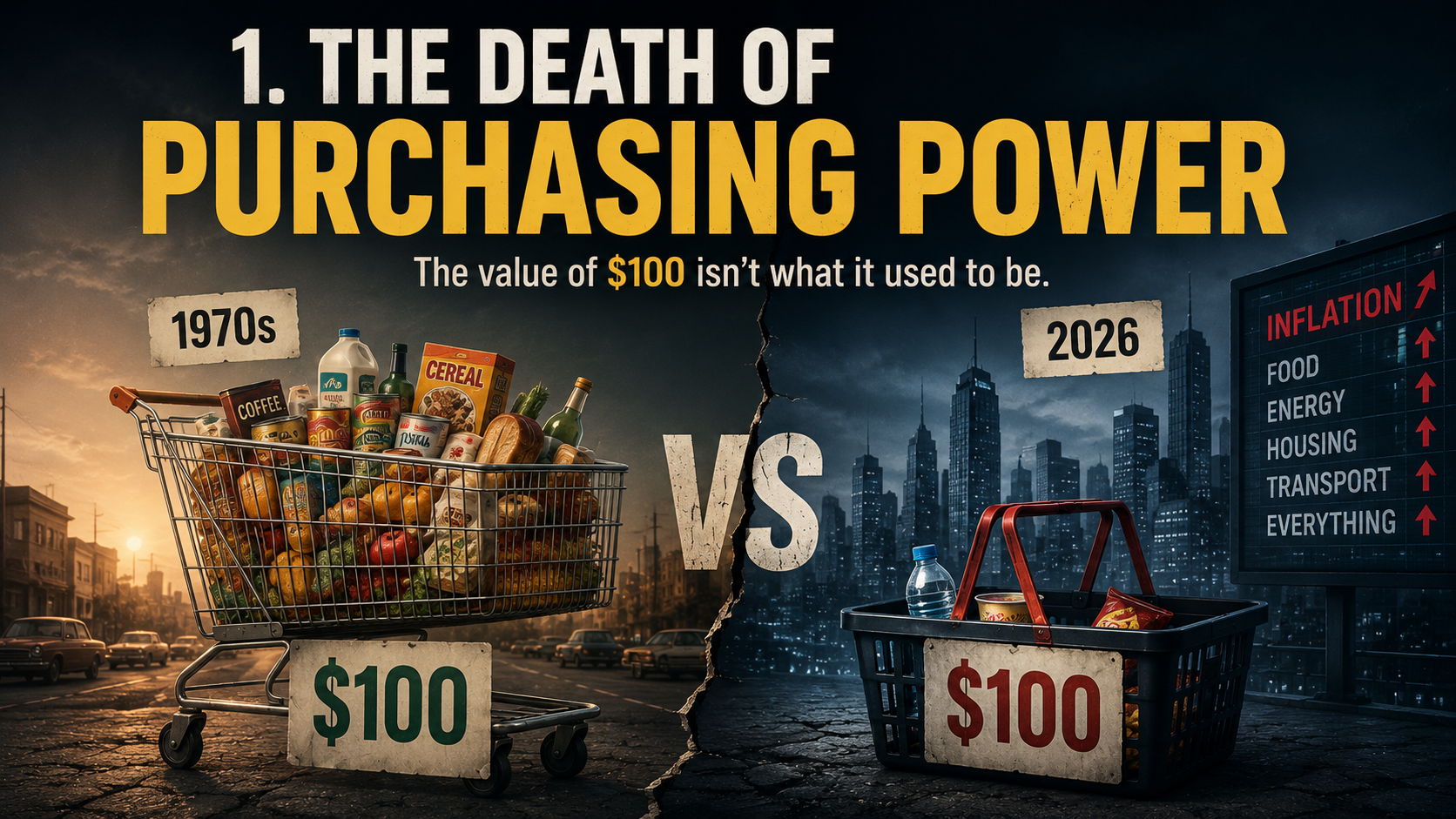
In the 1970s, $100 could feed an entire family for weeks.
Today, in 2026, that same $100 might barely cover a few grocery bags.
This isn’t simply about “higher prices.”
It’s about declining purchasing power.
Your money may still say “100,” but the real-world value behind it keeps shrinking.
You can see it everywhere:
- smaller portions,
- higher rent,
- more expensive groceries,
- rising insurance costs,
- and everyday essentials quietly becoming luxuries.
Inflation rarely destroys wealth overnight.
It erodes it silently, year after year.
📌 Mastermind Insight
The wealthy do not measure money by numbers alone.
They measure it by:
“What will this money still be able to buy in the future?”
That single mindset shift changes everything.
Some people wait for higher salaries.
Others learn how currency systems actually work.
And over time, those two paths lead to completely different financial futures.
2. The Silent Tax Nobody Voted For
Economists call it “inflation.”
But many investors see it differently:
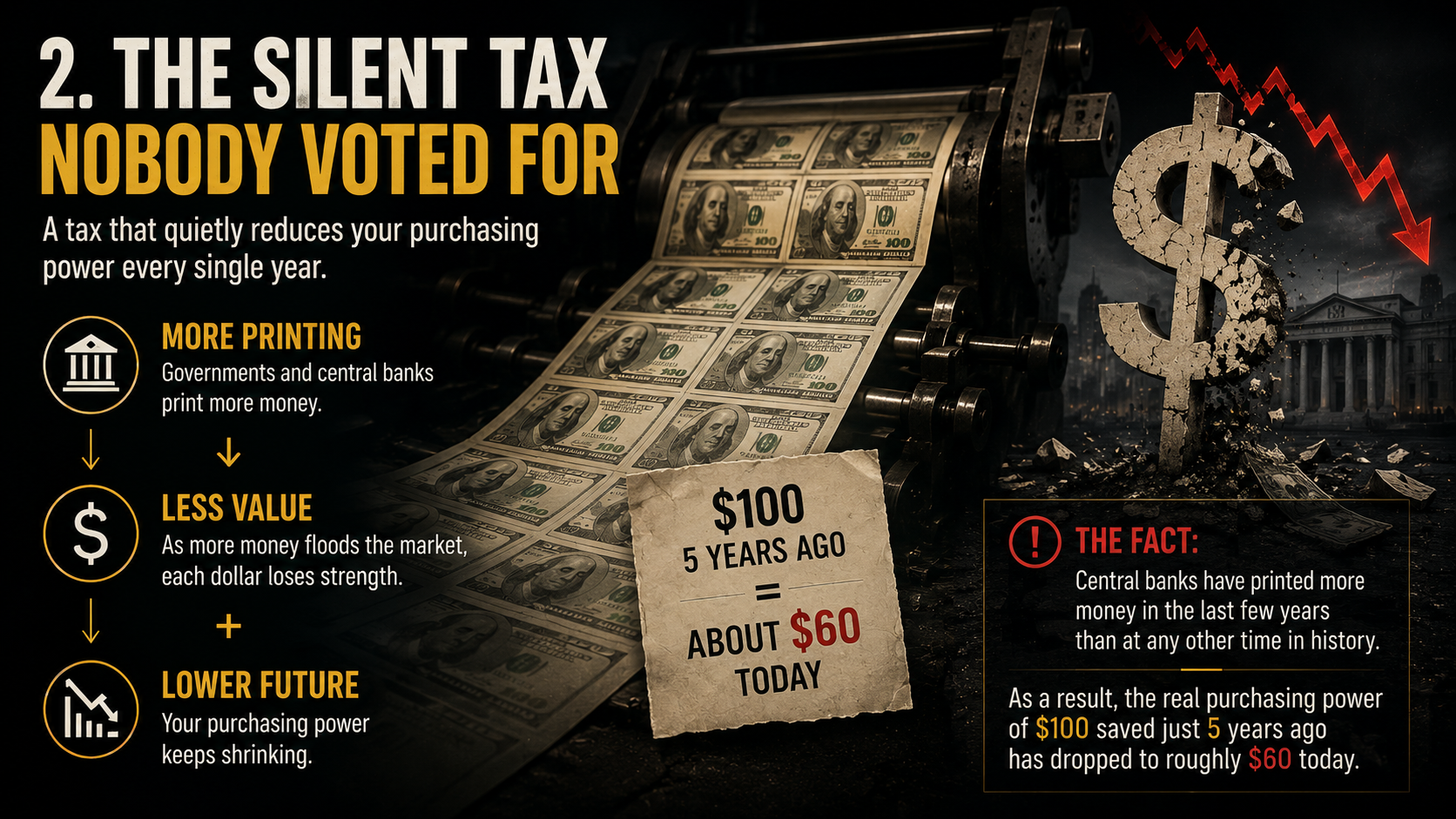
A Silent Tax.
A tax that quietly reduces your purchasing power every single year without a single vote being cast.
Modern economies continuously expand the money supply through:
- stimulus programs,
- debt expansion,
- monetary easing,
- and central bank liquidity measures.
While these policies may stabilize economies during crises, they also dilute the long-term value of fiat currencies.
The result?
The same paycheck buys less over time.
The same savings lose strength.
And the same middle-class lifestyle becomes harder to maintain.
[Fact Check 01] Why Everything Feels More Expensive
Over the past several years, global inflation has pushed up the cost of:
- food,
- energy,
- transportation,
- housing,
- and healthcare.
Meanwhile, wage growth in many countries has struggled to keep pace with rising living costs.
This is why so many people feel financially squeezed — even if they are technically earning more money than before.
The problem isn’t always income.
Sometimes, it’s the declining strength of the currency itself.
3. Why Rich People Don’t Hold Too Much Cash
Here’s something important:
The wealthy do not buy assets because they are reckless gamblers.
They buy assets because they understand that:
Holding too much cash can become a hidden risk.
Successful investors move portions of their wealth from:
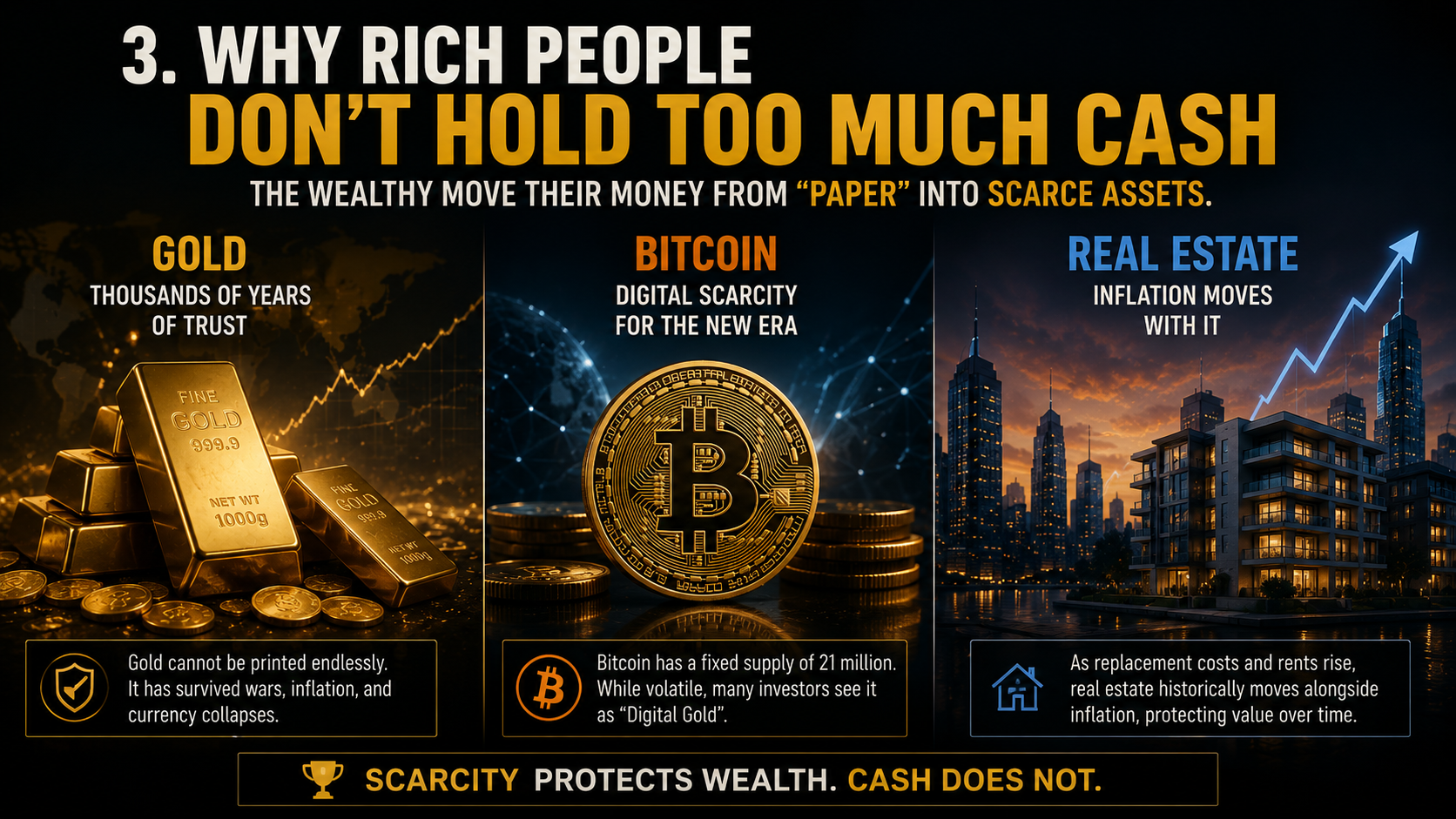
“paper money” → into scarce assets.
Why?
Because scarcity matters.
Gold: Thousands of Years of Trust
Gold has survived:
- wars,
- inflation,
- currency collapses,
- and political instability.
Unlike fiat currencies, gold cannot be printed endlessly by governments or central banks.
That scarcity gives it long-term psychological and financial value.
For thousands of years, when people lost trust in paper money, they returned to gold.
That pattern still continues today.
Bitcoin: Digital Scarcity
Bitcoin introduced something new to the modern financial world:
A digitally scarce asset with a fixed supply.
Of course, Bitcoin remains highly volatile.
But many investors are less interested in short-term price swings and more interested in the idea behind it:
A decentralized asset outside traditional monetary systems.
That’s why some people now refer to Bitcoin as:
“Digital Gold.”
Real Estate: Inflation Moves With It
Real estate doesn’t just survive inflation — it often rises alongside it.
As replacement costs increase and rents climb higher, property values historically tend to move upward over long periods of time.
Hard assets adapt to inflation.
Cash often does not.
4. The Blueprint for 2026: Stop Thinking Like a Saver
This doesn’t mean cash is useless.

Emergency funds and liquidity still matter.
But relying entirely on cash savings in an inflationary environment can become dangerous.
The key is balance.
Many investors now focus on diversification across:
- cash,
- global currencies,
- stocks,
- gold,
- real estate,
- and alternative assets.
The goal isn’t to chase hype.
The goal is to protect purchasing power.
📌 Mastermind Insight
The biggest financial shift happens when you stop asking:
“How much money do I have?”
…and start asking:
“Will my money still hold value 10 years from now?”
That question separates consumers from long-term wealth builders.
5. The Difference Between Consumers and Masterminds
When inflation rises, most people react emotionally.

They complain about prices.
They cut spending.
They blame companies or politicians.
But Masterminds look deeper.
They ask:
- Where is money flowing?
- Which assets benefit from inflation?
- How do currency systems actually work?
- How can I position myself ahead of the shift?
That’s the real difference.
Successful investors aren’t simply people who make more money.
They are people who understand the system earlier than everyone else.
Final Thoughts
The $100 bill in your wallet is lighter today than it was yesterday.
And tomorrow, it may be lighter still.
The real danger isn’t simply inflation.
It’s living through a changing financial system without realizing it.
Some people will spend the next decade complaining about rising prices.
Others will spend it learning how wealth actually moves.
Wealth is no longer built by saving harder —
but by understanding the system earlier.
And in the years ahead:
The people who understand money will own the future.
So now the question becomes:
Will you remain a consumer of the system?
Or become a Mastermind who learns how to navigate it?
What is your strategy for surviving the decline of purchasing power?
Share your thoughts in the comments.
For deeper breakdowns on money, inflation, Bitcoin, and the future of wealth, follow the Success Blueprints channel.
Success Blueprints — Master Your Mind.
'[Global] Success Blueprints' 카테고리의 다른 글