[Blueprints of Giants #01] Why Did Elon Musk Never Believe in “Impossible”?


The Reality Behind First Principles Thinking
Hello, this is Mastermind.
Most people hear the word “impossible” and give up.
Elon Musk hears it and reaches for a calculator.

People often call him a genius.
But what truly separates Musk from others is not his IQ — it’s the way he thinks.
When the world says,
“That can’t be done,”
Musk asks a completely different question:
“Why do we think it’s impossible in the first place?”
That single question reshaped the automotive industry, disrupted space exploration, and is now influencing the AI race itself.
Today, we’re diving into Elon Musk’s core mindset:
First Principles Thinking — and the real-world cases that prove why it works.
1. Why Humans Naturally Follow Existing Systems
Most people solve problems by referencing existing examples.
- What are competitors doing?
- What do experts say?
- How has the market always operated?
This approach feels safe.
But it rarely creates innovation.
Because in the end, you’re still thinking inside frameworks built by other people.
Imagine someone says:
“Electric cars are naturally expensive.”
“Rockets are supposed to cost billions.”
Most people stop thinking right there.
Elon Musk didn’t.
2. Musk Didn’t Accept “Impossible” — He Broke It Down
Musk approaches problems by reducing them to their most fundamental components.
Here are some of the most famous examples.
The Secret Behind Rocket Prices
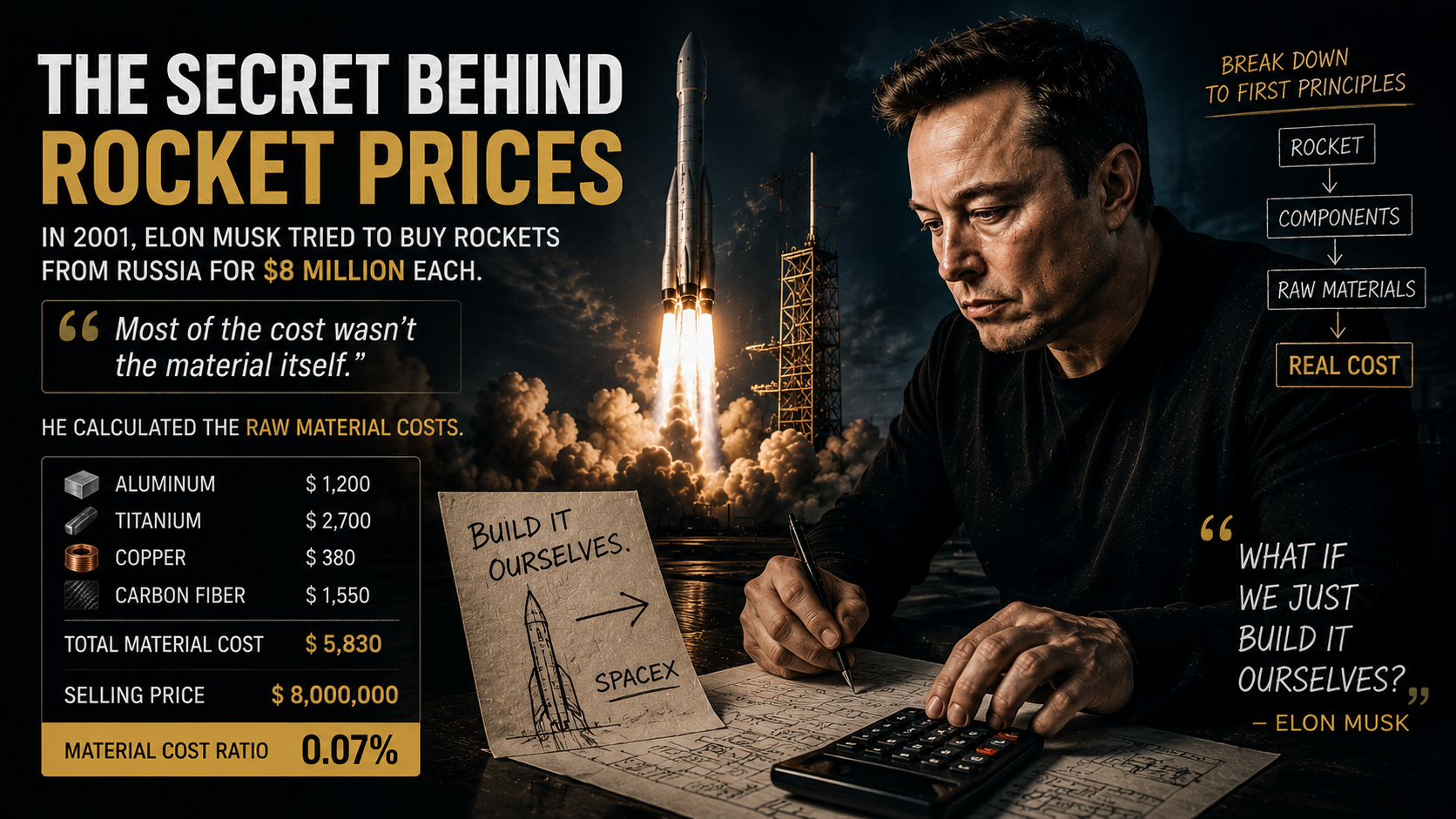
In 2001, Musk attempted to buy rockets from Russia.
The price shocked him.
“Eight million dollars per rocket.”
According to reports, he was even mocked during negotiations.
Most people would have walked away.
Instead, Musk returned to the plane and began calculating the raw material costs of a rocket.
- Aluminum
- Titanium
- Copper
- Carbon fiber
And he reached a surprising conclusion:
“Most of the cost wasn’t the material itself.”
The raw materials represented only a tiny fraction of the final price.
The rest came from inefficient processes and outdated industry structures.
That’s when Musk came to a radical conclusion:
“What if we just build it ourselves?”
That idea became SpaceX.
Breaking the Battery Cost Barrier
People said the same thing about electric vehicles.
“EVs will never become mainstream.”
“Battery costs can’t go lower.”
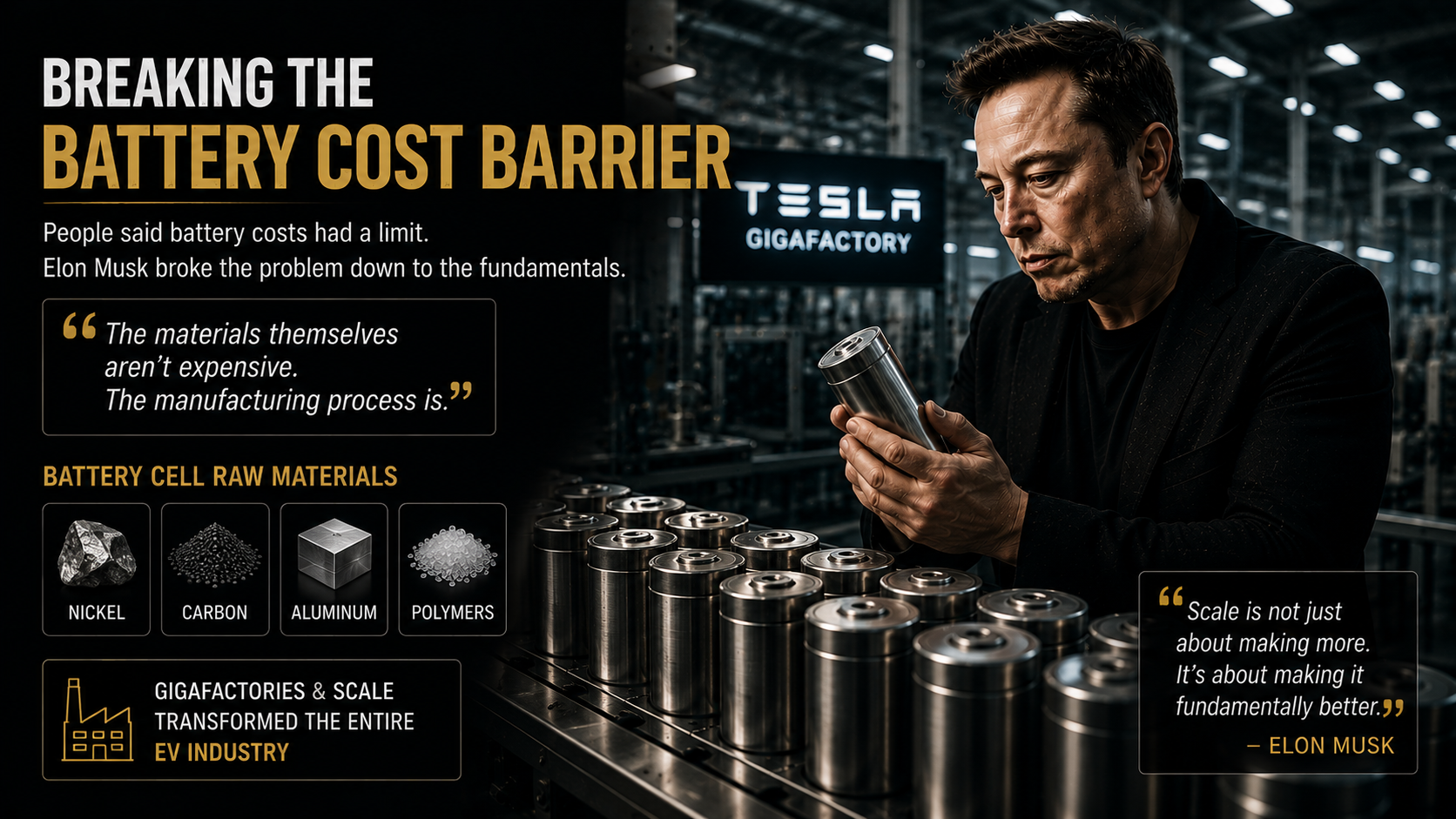
Experts believed battery prices had a hard limit.
But Musk once again broke the problem down into fundamentals.
He analyzed the market prices of:
- Nickel
- Carbon
- Aluminum
- Polymers
Then he realized something important:
“The materials themselves aren’t expensive.
The manufacturing process is.”
That realization eventually led to Gigafactories and large-scale battery production — transforming the entire EV industry.
Why Musk Chose Stainless Steel
While developing Starship, the aerospace industry favored lightweight and expensive carbon fiber materials.
Musk went in the opposite direction.
He chose stainless steel.
Why?
Because he focused on a fundamental physical property:
Stainless steel becomes stronger under extremely cold temperatures.
While others said,
“Nobody uses that material,”
Musk asked:
“Why not?”
That shift in thinking dramatically reduced development costs while improving structural durability.
“The Best Part Is No Part”
Musk’s mindset also appears inside Tesla’s manufacturing systems.
At one point, Tesla used expensive fiberglass mats in production to reduce noise.
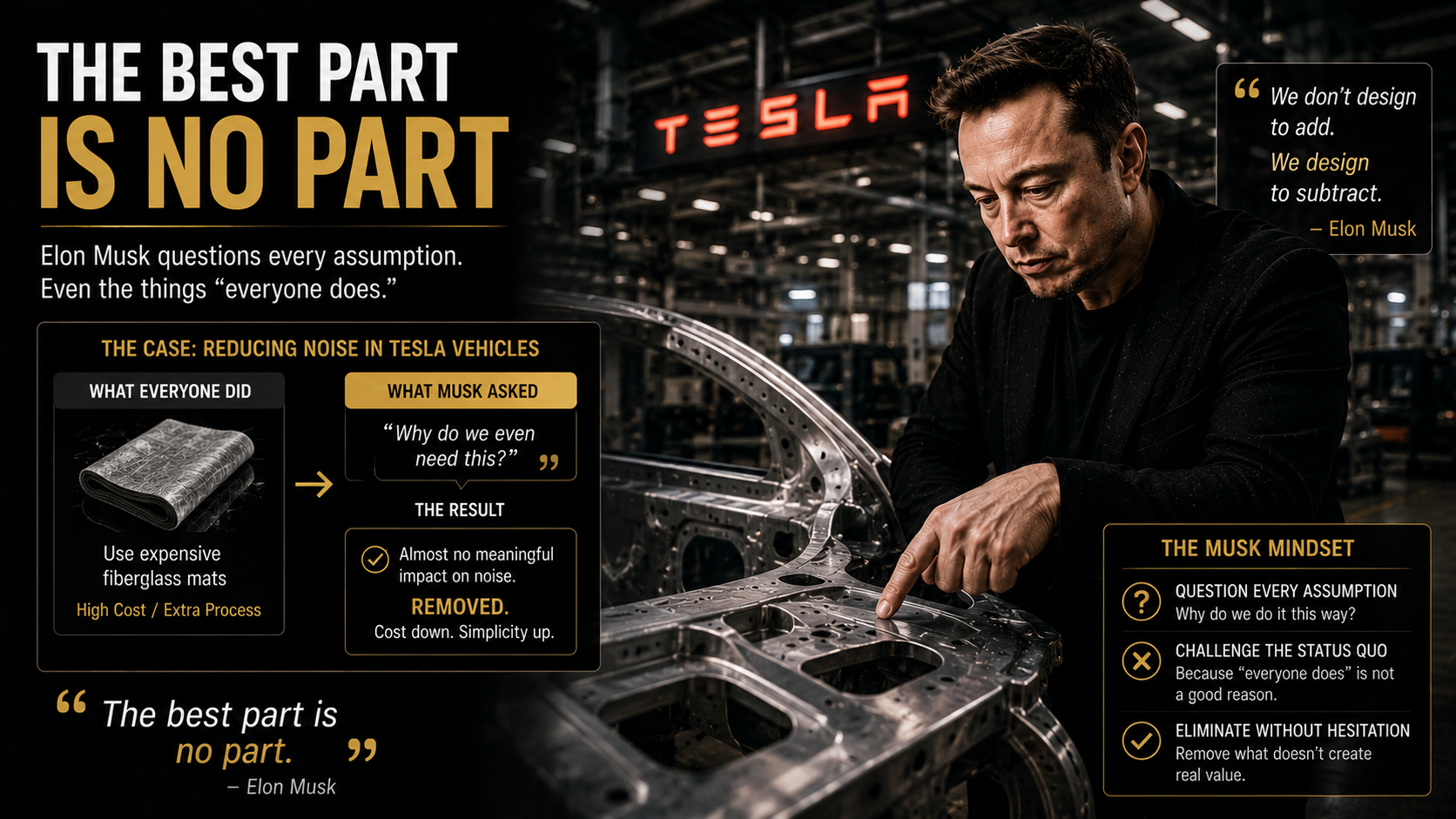
Musk asked engineers:
“Why do we even need this?”
The response was simple:
“Because everyone does it.”
But after testing, the component turned out to have almost no meaningful effect.
Musk removed the entire process immediately.
He often says:
“The best part is no part.”
This isn’t just about reducing costs.
It’s about questioning assumptions people never think to challenge.
3. What Is First Principles Thinking?
In simple terms, it means:
- Remove assumptions
- Remove traditions
- Remove popular opinions
- Keep only the fundamental facts
Then rebuild your thinking from the ground up.
It’s not about:
“What do people believe?”
It’s about:
“What is fundamentally true?”
Musk says he learned this mindset from physics.
Because physics doesn’t care about tradition or public opinion.
It starts with the laws of reality itself.
4. The Same Pattern Exists in Investing
Interestingly, this mindset also applies powerfully to investing.
Most people react to prices.

- Gold is rising, so they buy.
- Bitcoin is pumping, so they enter.
- Fear spreads in the news, so they panic sell.
But First Principles Thinking asks deeper questions.
For gold:
- What gives gold intrinsic value?
- Why are central banks accumulating gold?
- How does gold relate to the U.S. dollar?
For Bitcoin:
- What are the weaknesses of the current monetary system?
- Why do people want decentralization?
- What real problem is Bitcoin trying to solve?
The moment you ask these questions, you stop becoming a follower.
You begin seeing the structure underneath the market.
And in the long run, the people who survive are usually the ones who understand fundamentals — not just price movements.
5. Thinkers vs Reactors
Modern society moves too fast.
News floods endlessly.
Social media manipulates emotion.
Markets shake people every day.
As a result, most people stop thinking and simply react.
But Musk focuses on data before emotion.
While others get trapped in fear or hype, he returns to one fundamental question:
“What is the core truth behind this?”
And that question may be the real difference between ordinary people and world-changing innovators.
Final Thoughts
The key isn’t genius.
The key is the way you question reality.
- Why?
- Is that actually true?
- What remains after removing assumptions?
The world is filled with people saying:
“That’s just how things work.”
But history’s biggest breakthroughs were created by people who questioned that sentence first.
Maybe what we truly need today isn’t more information.
Maybe we need better questions.
One-Line Summary
“Destroy assumptions. Rebuild from fundamentals.”
— Mastermind
The Blueprints of Giants series continues.
'[Global] Success Blueprints' 카테고리의 다른 글