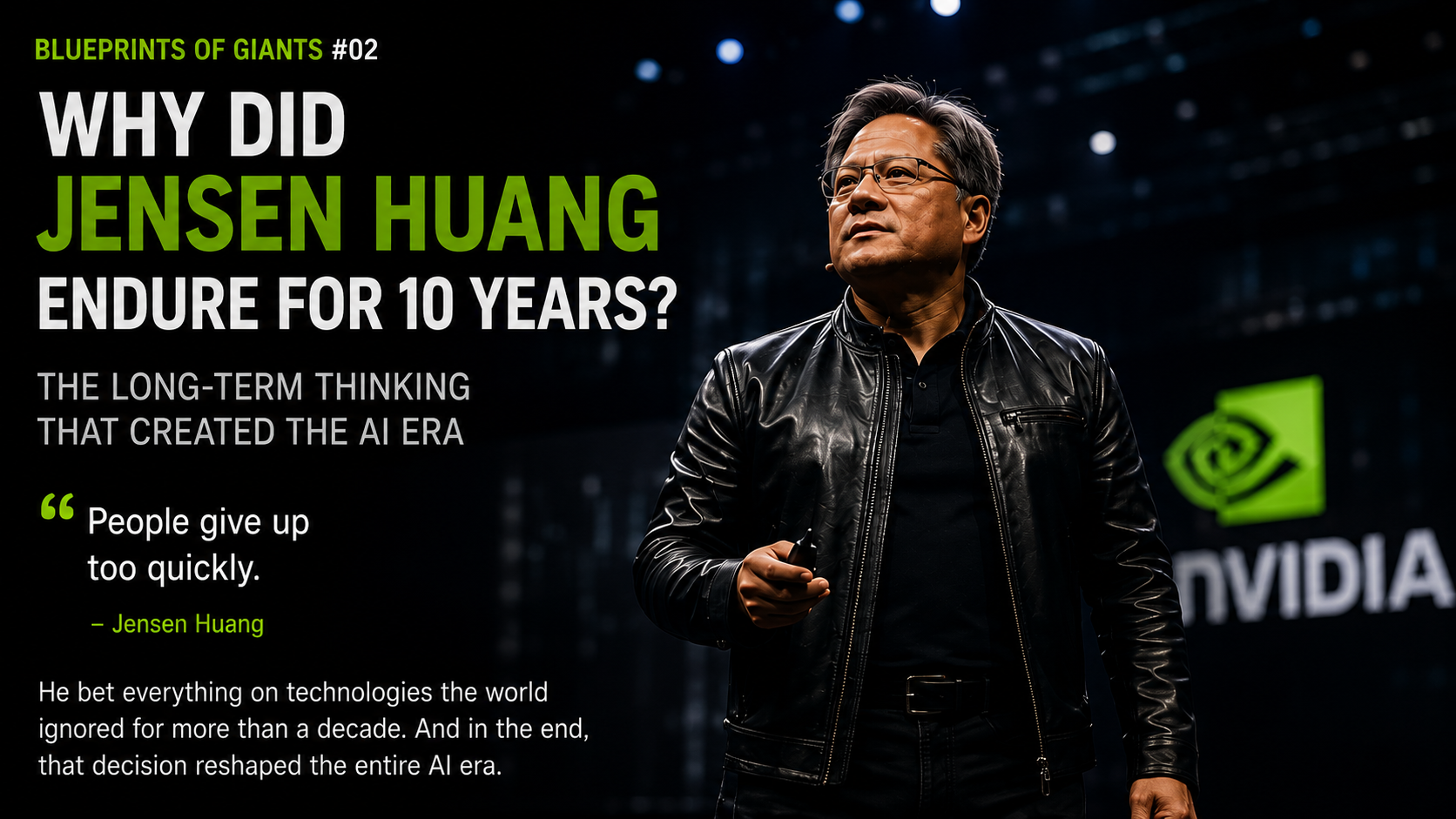
[Blueprints of Giants #02] Why Did Jensen Huang Endure for 10 Years?


The Long-Term Thinking That Created the AI Era
Hello, this is Mastermind.
Most people begin to doubt their direction when results take too long.
When effort shows no immediate reward, they lose confidence.
When the world shows no interest, they give up.
But Jensen Huang was different.
He bet everything on technologies the world ignored for more than a decade.
And in the end,
that decision reshaped the entire AI era.
“People give up too quickly.”
Jensen Huang trusted the direction of the future more than the reaction of the market.
Today, many people think of NVIDIA as simply a semiconductor company.
But in reality, NVIDIA was closer to a company quietly designing the future long before the world realized it needed one.
And at the center of it all was Jensen Huang’s unique mindset:
Long-term thinking.
1. “We Had Only 30 Days Before Bankruptcy”
People often only see the glamorous side of successful giants.
But Jensen Huang’s beginning was closer to a fight for survival.
In the mid-1990s, NVIDIA’s first major product, the NV1, completely failed in the market.
Sales collapsed.
The company was falling apart.
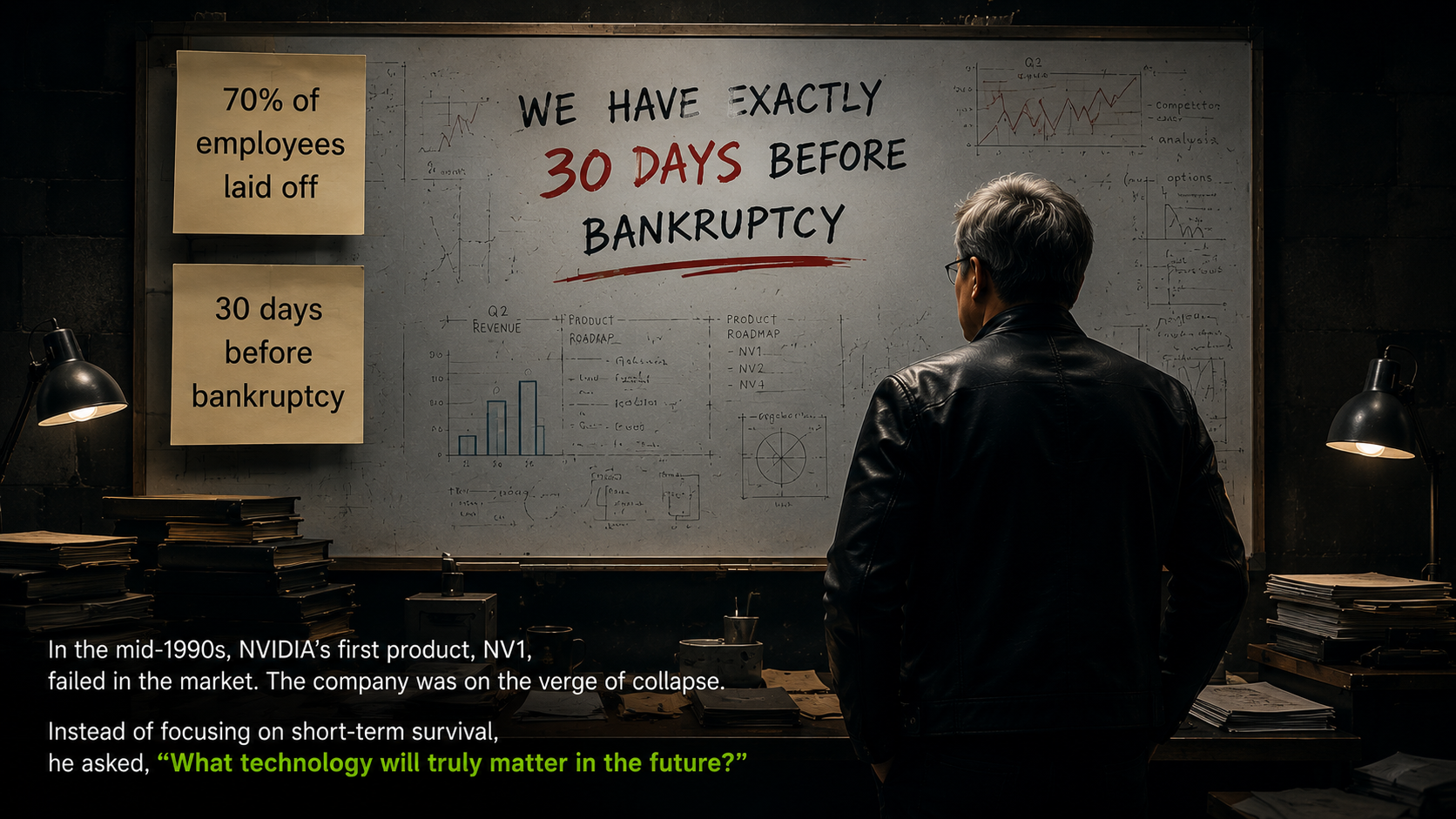
Eventually, nearly 70% of the employees had to be laid off, and NVIDIA stood on the edge of shutting down entirely.
That was when Jensen Huang told his employees:
“We have exactly 30 days before bankruptcy.”
Most people would have been crushed by fear.
But Huang transformed that desperation into focus.
Instead of obsessing over short-term survival, he asked himself the most fundamental question:
“What technology will truly matter in the future?”
And from that moment, he concentrated everything on one core direction.
Ironically, the long-term mindset of a giant began from an extreme survival instinct.
2. The Man Who Chose the Future Over Pride
Jensen Huang’s long-term thinking was not stubbornness.
One famous story proves it:
the SEGA incident.
At the time, NVIDIA was developing a graphics chip for SEGA’s game console.
That contract was critical for NVIDIA’s survival.
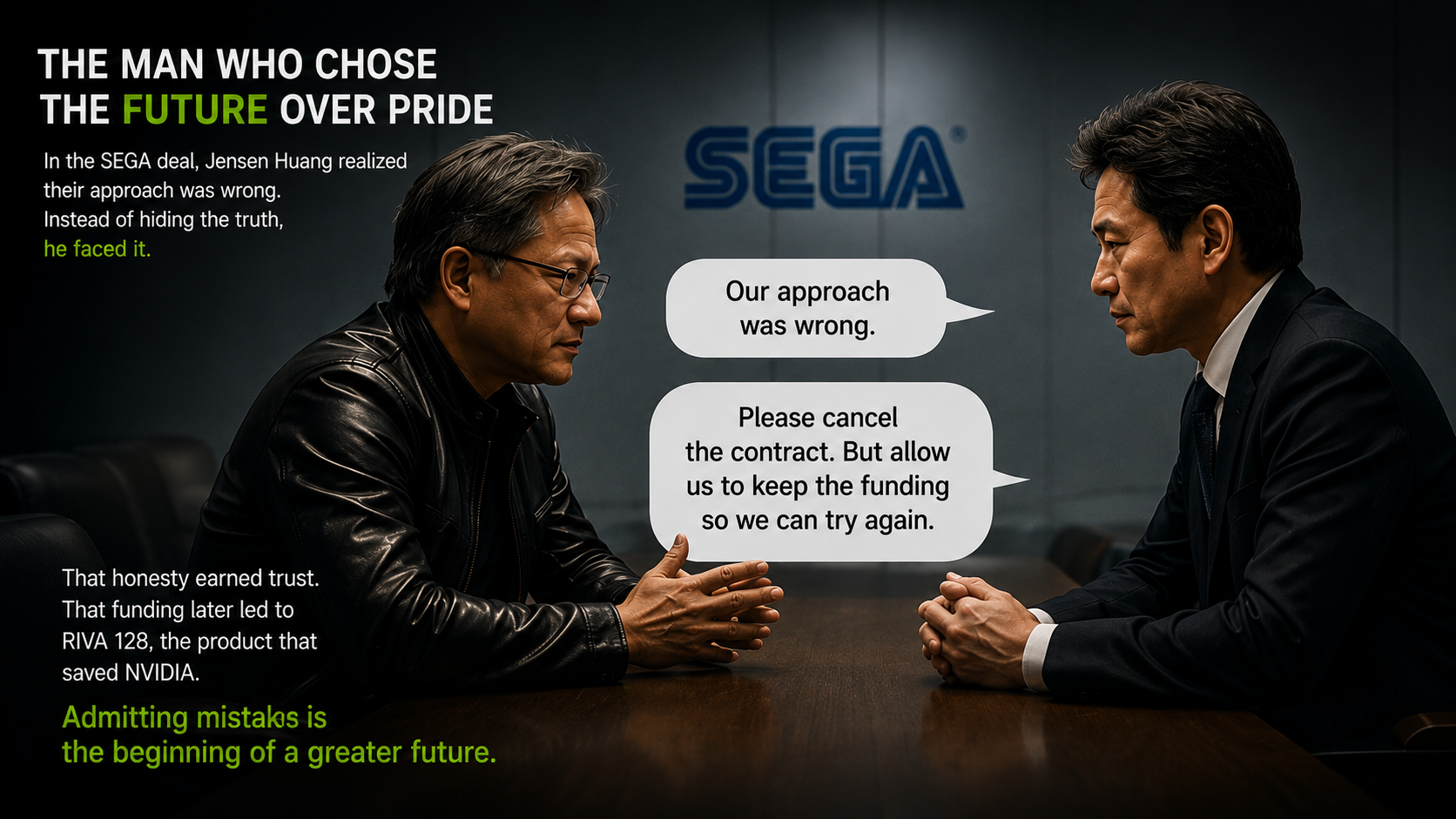
But during development, Huang realized something terrifying:
“Our approach is wrong.”
He understood that their technology direction would not survive future competition.
Most companies would have ignored reality at that point.
Too much money, time, and pride had already been invested.
But Jensen Huang made a shocking decision.
He personally visited SEGA’s executives and said:
“Our approach was wrong.
Please cancel the contract.
But if possible, allow us to keep the funding so we can try again.”
It sounded unbelievable.
Yet SEGA saw honesty, vision, and potential in Huang’s words.
That funding later helped NVIDIA develop the RIVA 128 — the product that ultimately saved the company.
The courage to admit mistakes.
The willingness to sacrifice present pride for a larger future.
That was the true essence of Jensen Huang’s long-term thinking.
3. Why Did Jensen Huang Choose a “Zero-Dollar Market”?
Most companies compete inside already established markets.
But Jensen Huang moved differently.
He constantly searched for markets that nobody believed mattered yet.
The best example was GPU and CUDA.
At the time, GPUs were considered nothing more than gaming graphics components.
But Huang saw something entirely different.
A future computing engine capable of handling massive parallel processing.
In other words:
the brain of the AI era.

In 2006, NVIDIA introduced CUDA.
The market barely cared.
“It won’t make money.”
“It’s too niche.”
“CPUs are enough.”
Almost nobody believed GPU-based AI computing had a future.
But Jensen Huang refused to quit.
He invested in a market that was practically worth zero at the time.
Because he understood something others did not:
One day, the world would desperately need enormous computing power.
And when that moment arrived, GPUs would no longer be gaming chips.
They would become the electricity of the AI era.
While others focused on the present market,
Huang saw the inevitability of the future.
4. The Arrival of AI’s “iPhone Moment”
In 2023, the release of ChatGPT shocked the world.
AI was no longer a distant future technology.
At that moment, Jensen Huang made a short but powerful statement:
“The iPhone moment of AI has begun.”
The meaning behind those words was enormous.
Just as the iPhone ignited the smartphone revolution, generative AI was now opening the door to mass adoption.
And at the center of that explosion stood NVIDIA.
The GPUs, CUDA ecosystem, AI infrastructure, and data center technologies built over more than a decade had finally become the foundation of a new era.
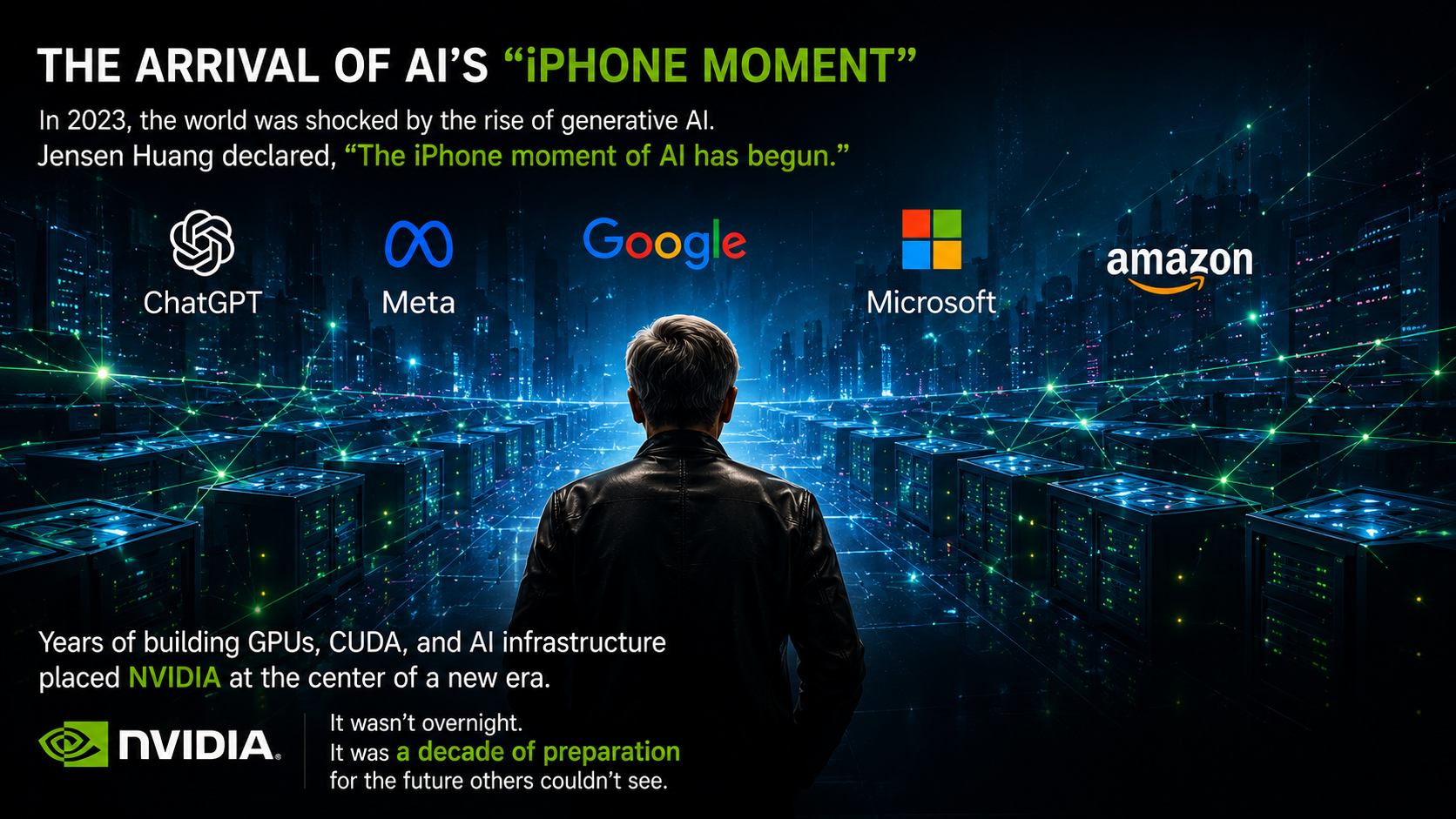
To many people, NVIDIA appeared to rise overnight.
But reality was the opposite.
NVIDIA had been preparing for this future for years.
For the unprepared, AI felt like a sudden revolution.
For Jensen Huang, it was simply the harvest of seeds planted long ago.
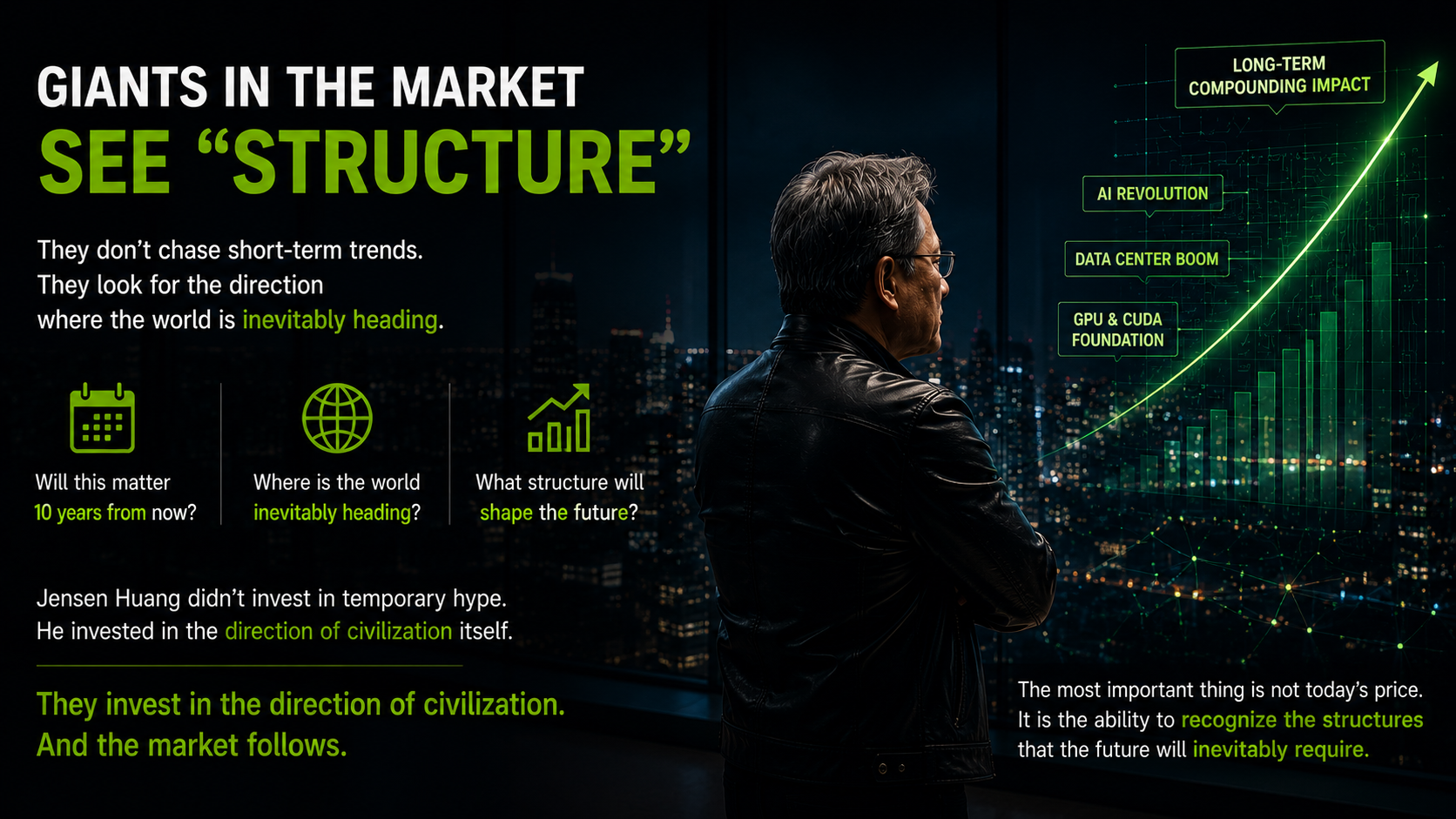
5. Giants in the Market See “Structure”
What’s fascinating is that Jensen Huang’s mindset also applies to investing.
Most people chase rising prices,
react emotionally to headlines,
and panic over short-term movements.
But people who understand massive long-term trends ask completely different questions:
“Will this technology still matter 10 years from now?”
“Where is the world inevitably heading?”
Jensen Huang didn’t invest in temporary hype.
He invested in the direction of civilization itself.
And eventually, the market followed him.
Investing works the same way.
The most important thing is not today’s price.
It is the ability to recognize the structures that the future will inevitably require.
Final Thoughts
The important thing is not genius.
The real question is:
How far can you see?
The world constantly demands faster results.
But the giants who changed history spent years quietly preparing for a future nobody else believed in.
And only those who survive that long silence eventually stand at the center of a new era.
Most people try to jump onto a future that has already succeeded.
But giants build that future while everyone else is still laughing at it.
Perhaps what we truly need today is not faster information,
but the courage to ask:
“What value will still matter 10 years from now — and am I willing to dedicate my time to it?”
One-Line Summary
“Strategy is not about predicting the future.
It is about building a structure that makes the future inevitable.”
— Mastermind
The Blueprints of Giants continues.
'[Global] Success Blueprints' 카테고리의 다른 글