Nasdaq Market Close August 28, 2026: Rising Treasury Yields Hit AI Chips, Top 5 Gainers and Losers, and Market Rotation


U.S. stocks finished modestly lower on Friday, August 28, 2026, as investors reassessed the Federal Reserve’s rate path following hawkish signals from Fed Chair Kevin Warsh at Jackson Hole.
The Nasdaq Composite fell 0.52% to 26,402.42, while the S&P 500 slipped 0.25% and the Dow Jones Industrial Average edged down just 0.02%.
The headline index moves, however, tell only part of the story.
The more important development was happening beneath the surface: money did not simply leave technology. Instead, investors took profits in AI semiconductor stocks following the previous session’s rally while selectively buying enterprise software and mega-cap platform companies.
That internal rotation may matter more than the Nasdaq’s 0.52% decline itself.
One-Sentence Market Takeaway
A hawkish repricing of the Fed outlook pushed Treasury yields higher and pressured the Nasdaq, while profit-taking hit AI semiconductor stocks and capital selectively rotated toward enterprise software and mega-cap platforms with clearer earnings and AI monetization potential.
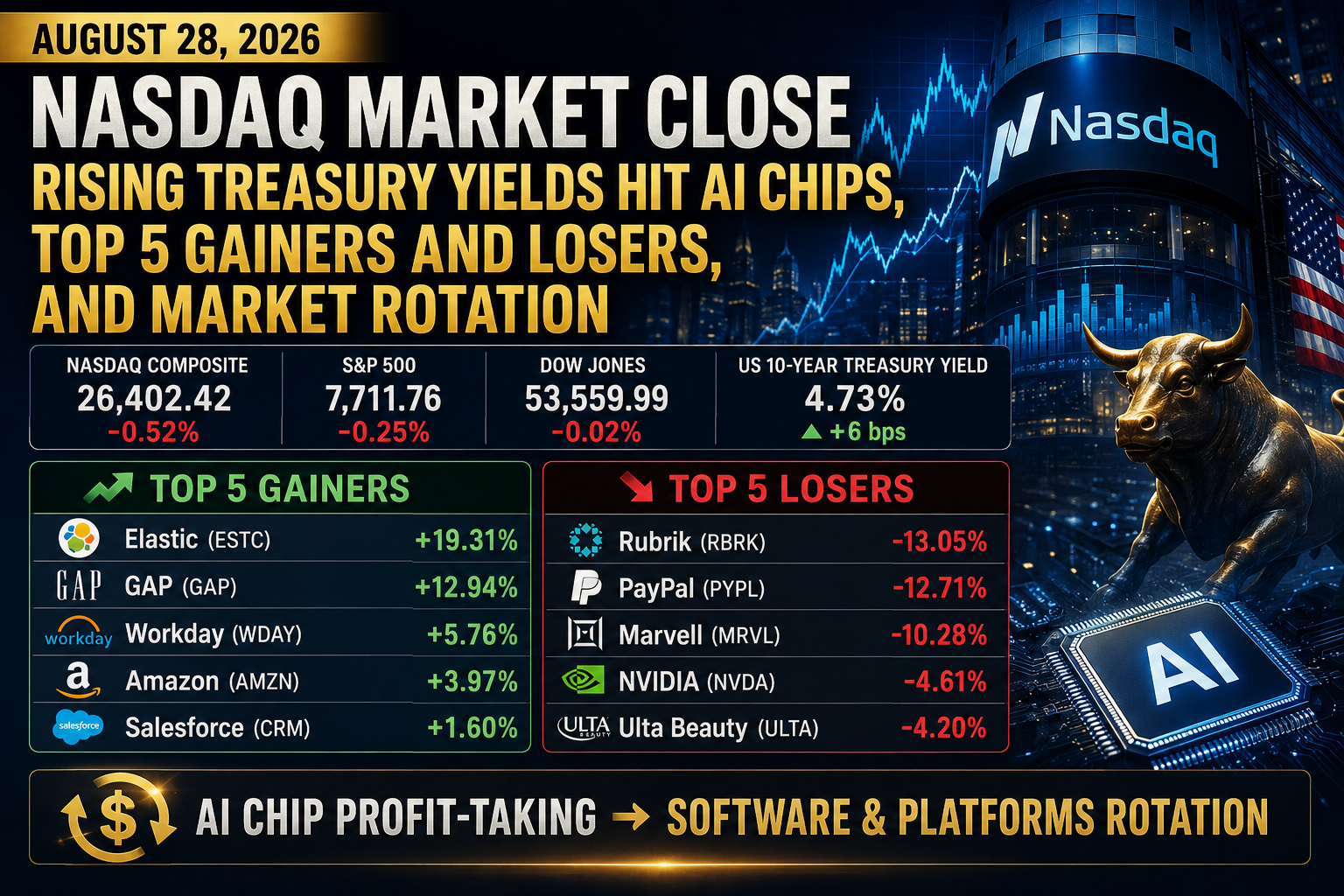
1. U.S. Stock Market Close
| Index | Close | Change |
| Nasdaq Composite | 26,402.42 | -0.52% |
| S&P 500 | 7,711.76 | -0.25% |
| Dow Jones Industrial Average | 53,559.99 | -0.02% |
| Russell 2000 | 2,972.37 | about -1.4% |
The divergence between the major indexes was notable.
The Dow was nearly flat, while the Nasdaq underperformed and the small-cap Russell 2000 fell roughly 1.4%.
That is consistent with a market becoming more sensitive to higher interest rates. Smaller companies generally face greater financing sensitivity, while long-duration growth stocks can suffer when discount rates rise.
Market breadth was also weak.
On the Nasdaq, 1,494 stocks advanced while 3,272 declined, meaning declining stocks outnumbered advancing stocks by roughly 2.2 to 1.
On the NYSE, decliners outnumbered advancers by 1.77 to 1.
Total U.S. exchange volume was approximately 15.68 billion shares, close to the 20-session average of 15.8 billion.
This was therefore not simply a case of one or two mega-cap stocks pulling the indexes lower in thin trading.
Risk appetite weakened across a meaningful portion of the market.
But there was also an important distinction inside technology.
Nvidia and Marvell sold off sharply, while Amazon, Apple and Alphabet finished higher.
That makes Friday less of a broad “tech selloff” and more of an internal rotation within the technology and AI trade.
2. Why Did the Nasdaq Fall?
The central macro catalyst was Fed Chair Kevin Warsh’s Jackson Hole speech.
Warsh reinforced the Fed’s commitment to controlling inflation and left investors with the impression that policymakers could still have more work to do if inflation does not move convincingly toward the 2% target.
Markets responded by repricing the probability of additional tightening.
The transmission mechanism looked like this
Persistent inflation concerns
↓
Higher probability of additional Fed tightening
↓
September rate-hike expectations rise
↓
Treasury yields move higher
↓
Higher discount rates for growth stocks
↓
Profit-taking in AI and semiconductor leaders
↓
Nasdaq closes lower
The key point is that Friday was not primarily a recession scare.
It was a Fed-path repricing event.
The probability assigned to a 25-basis-point September rate increase moved sharply higher, from roughly 35% before Warsh’s comments toward the upper-50% to around 60% range afterward.
Meanwhile, the final August University of Michigan Consumer Sentiment Index came in at 51.7, above the consensus estimate of 51.0.
In other words, unexpectedly weak consumer sentiment was not the primary driver of the selloff.
The market was far more focused on the possibility that the Fed may need to remain restrictive—or tighten further—to finish the inflation fight.
3. The 10-Year Treasury Yield Matters Again
U.S. 10-Year Treasury yield: 4.73% / +6 basis points from the previous session
The 10-year Treasury yield increased from 4.67% to 4.73%.
More importantly, the policy-sensitive 2-year Treasury yield jumped from 4.20% to 4.34%, a 14-basis-point move.
That difference is important.
The much larger move in the 2-year yield suggests investors were primarily repricing the near-term Federal Reserve policy path rather than suddenly pricing a dramatic deterioration in the long-term economy.
Why does this matter for technology stocks?
Growth-stock valuations depend heavily on earnings expected years into the future.
Those future cash flows must be discounted back into today's dollars. When Treasury yields rise, the discount rate used to value those future profits also rises.
The higher the discount rate, the less valuable distant future earnings become today.
That is why high-multiple AI, semiconductor and software stocks can react disproportionately to sudden moves in Treasury yields.
But Friday provided an important twist
Not every growth stock sold off.
That distinction gives us a better picture of where capital was actually moving.
4. Five Notable Stocks With Heavy Buying Interest
These are not simply the five biggest percentage gainers.
The selection emphasizes a combination of price movement, trading activity, company size, market relevance and identifiable catalysts.
| Company | Business | Change | Volume | Main Catalyst |
| Elastic (ESTC) | Search & data analytics software | +19.31% | ~10.11M | Earnings beat and raised outlook |
| Gap (GAP) | Apparel retail | +12.94% | Heavy | Higher profit outlook and Old Navy leadership change |
| Workday (WDAY) | Enterprise HR & finance software | +5.76% | Elevated | Earnings improvement and AI adoption |
| Amazon (AMZN) | AWS, e-commerce & AI | +3.97% | ~49M | Price-target increase and AI monetization expectations |
| Salesforce (CRM) | Enterprise cloud software | +1.60% | Significant | Continued strength in enterprise software |
Elastic (ESTC) +19.31%
Elastic provides software that allows enterprises to search, analyze and manage large amounts of data.
Shares jumped 19.31% to $99.91, with volume reaching approximately 10.11 million shares.
That was roughly double the prior session’s volume.
The immediate catalyst was straightforward: Elastic beat expectations and raised its outlook.
But the broader message is more interesting.
Investors have spent considerable time debating whether generative AI will disrupt traditional software companies.
Elastic's move highlights the other side of that argument: software companies capable of using AI to drive measurable revenue and earnings growth can still command substantial premiums.
The market is increasingly distinguishing between AI disruption risk and AI monetization opportunity.
Gap (GAP) +12.94%
Gap operates Gap, Old Navy, Banana Republic and Athleta.
Shares surged roughly 13% after the company raised its annual profit outlook and named industry veteran Michael Francis as the new CEO of Old Navy.
This was not evidence of indiscriminate buying across consumer stocks.
It was a company-specific move driven by improving earnings expectations and potential operational improvement.
That distinction becomes important later when we compare Gap with Ulta Beauty.
Workday (WDAY) +5.76%
Workday provides cloud-based human resources and financial-management software to enterprises.
Shares rose approximately 5.8%, supported by improving results and increased adoption of AI tools among corporate customers.
Combined with Elastic's rally and recent strength across other enterprise-software names, Workday's performance reinforces an emerging question for investors
Can the next stage of the AI investment cycle move from building infrastructure toward using that infrastructure to generate productivity and recurring software revenue?
Friday's trading suggests investors are at least beginning to explore that possibility.
Amazon (AMZN) +3.97%
Amazon rose 3.97% to $266.43, with roughly 49 million shares changing hands.
Evercore ISI raised its price target and highlighted the potential for agentic AI to improve product discovery and purchase conversion across Amazon's retail ecosystem.
That is a different AI thesis from simply selling GPUs.
Amazon potentially sits at the intersection of cloud infrastructure, AI services, advertising, retail and consumer transactions.
The investment question therefore shifts from
Who sells the AI infrastructure?
to
Who can use AI infrastructure to generate additional revenue and cash flow?
Amazon's relative strength suggests investors are paying closer attention to that second question.
Salesforce (CRM) +1.60%
Salesforce gained approximately 1.6%, extending the relative strength seen across parts of enterprise software.
The percentage move itself was not extraordinary.
Its importance comes from the broader pattern.
Elastic, Workday and Salesforce showing relative strength at the same time that major semiconductor names were falling supports the argument that capital was rotating within the AI ecosystem, rather than abandoning AI exposure altogether.
5. Five Notable Stocks Under Heavy Selling Pressure
| Company | Business | Change | Volume | Main Catalyst |
| Rubrik (RBRK) | Cloud data security | -13.05% | Heavy | High expectations following earnings |
| PayPal (PYPL) | Digital payments | -12.71% | Heavy | Reported end of Stripe-Advent acquisition pursuit |
| Marvell Technology (MRVL) | AI & data-center semiconductors | -10.28% | Heavy | Concern over timing of Google AI-chip revenue |
| Nvidia (NVDA) | AI GPUs & data centers | -4.61% | Extremely heavy | Profit-taking after prior-session rally and yield pressure |
| Ulta Beauty (ULTA) | Beauty retail | -4.20% | Elevated | Slower comparable-store sales growth |
Rubrik (RBRK) -13.05%
Rubrik provides cloud-data protection, cybersecurity and ransomware-recovery services.
Shares fell roughly 13% despite strong underlying results.
The problem was not necessarily weak fundamentals.
Expectations had already become elevated.
This is a classic example of an increasingly selective growth-stock market: reporting good numbers may no longer be enough when the stock price already reflects exceptional future growth.
Investors are asking whether results are strong enough to exceed what has already been priced in.
PayPal (PYPL) -12.71%
PayPal operates one of the world's largest digital-payment ecosystems, including Venmo.
Shares plunged 12.71% after reports that private-equity firm Advent International and Stripe had ended their pursuit of a potential acquisition.
The distinction here is important.
This was not primarily a deterioration in PayPal's quarterly operating results.
Instead, the market removed an M&A premium that had become embedded in the stock.
For that reason, PayPal's selloff should not automatically be interpreted as evidence of broad structural weakness across financials or fintech.
Marvell Technology (MRVL) -10.28%
Marvell designs semiconductors used in data-center networking and custom AI accelerators.
Shares fell 10.28%.
The company beat expectations and increased its longer-term revenue outlook, but investors became concerned that meaningful revenue from its Google custom-AI-chip opportunity may arrive later than expected.
This is one of Friday's most important signals.
The market is increasingly unwilling to accept
“AI revenue will be huge.”
Investors now want to know
When does the revenue arrive?
How quickly does it convert into earnings and cash flow?
The AI trade is not disappearing.
The standard for validating AI valuations is simply getting higher.
Nvidia (NVDA) -4.61%
Nvidia fell 4.61% after surging in the previous session on a strong earnings outlook.
There was no comparable new fundamental shock on Friday.
The move is better understood as a combination of profit-taking after a sharp rally and renewed valuation pressure from rising Treasury yields.
This distinction matters.
A post-earnings pullback driven by positioning and rates carries a different message than a selloff caused by deteriorating demand for AI accelerators.
Still, Nvidia was not alone.
Weakness across Marvell and other semiconductor stocks confirms that investors were reducing exposure across portions of AI hardware.
Ulta Beauty (ULTA) -4.20%
Ulta Beauty is one of the largest specialty beauty retailers in the United States.
Shares fell 4.2%, with slowing comparable-store sales growth weighing on sentiment.
The contrast with Gap is revealing.
Gap surged on an improved profit outlook, while Ulta fell on softer underlying sales trends.
That suggests investors were not simply buying or selling “consumer stocks.”
They were increasingly discriminating based on company-level earnings quality and forward expectations.
6. Where Did the Money Go?
This is the most important part of Friday's session.
The clearest flow looked like this
AI semiconductors and hardware
↓
Profit-taking
↓
Enterprise software with visible earnings
↓
Mega-cap platforms with AI monetization potential
Consider the divergence
Nvidia -4.61%
Marvell -10.28%
versus
Elastic +19.31%
Workday +5.76%
Amazon +3.97%
Salesforce +1.60%
The easy interpretation would be
“AI stocks fell.”
But that misses what actually happened.
A better interpretation is
Capital rotated from AI hardware toward software and platforms where investors could identify more immediate earnings or monetization catalysts.
That does not mean the AI infrastructure cycle is over.
It suggests the AI trade may be entering a more selective phase.
The first stage of the investment cycle was dominated by GPUs, networking equipment and massive data-center capital expenditures.
The next question is whether that infrastructure can produce enough productivity, software revenue, advertising growth, cloud demand and consumer transactions to justify the capital already deployed.
Friday's market provided a glimpse of that transition.
There was a similar pattern in consumer stocks.
Gap surged while Ulta fell.
Again, this was not a broad sector trade.
Investors were rewarding stronger earnings trajectories and punishing weaker ones.
The common denominator was selectivity.
7. MasterMind's Insight
First, the Bond Market Moved More Than the Stock Indexes
A 0.52% Nasdaq decline is not particularly dramatic by itself.
The more significant development was underneath the surface.
The 2-year Treasury yield jumped from 4.20% to 4.34%, while the 10-year moved from 4.67% to 4.73%.
That tells us the market's view of the Fed changed more dramatically than the headline stock indexes suggest.
For growth investors, the bond market may therefore be the more important screen to watch heading into the next round of economic data.
If upcoming employment and manufacturing reports remain strong, expectations for additional tightening could increase further.
Second, the AI Trade Is Moving From “How Big?” to “When?”
Marvell may be the best example.
The company beat expectations and raised its long-term revenue outlook, yet the stock dropped more than 10%.
Why?
Because investors are no longer satisfied with hearing that AI revenue will eventually be enormous.
They increasingly want to know when that revenue will appear and how quickly it will translate into profits.
This is not necessarily bearish for AI.
It is a sign that the market is moving from thematic enthusiasm toward fundamental verification.
That transition naturally creates larger differences between winners and losers inside the same AI value chain.
Third, Watch Whether AI Capital Broadens Into Software
Elastic, Workday, Salesforce and Amazon deserve attention as a group rather than as isolated stock moves.
If AI infrastructure spending represents the first phase of the cycle, the next phase should eventually appear in companies that use that infrastructure to generate revenue and productivity.
The potential progression looks like this
Semiconductors → Cloud → Enterprise Software → AI Services
One trading session does not establish a durable rotation.
But if rising prices, increasing volume and broad participation across software and platform companies continue over several sessions, it would provide stronger evidence that AI leadership is broadening beyond hardware.
8. What to Watch Next
The next regular U.S. trading session is Monday, August 31.
1. The 10-Year Treasury Yield Around 4.7%
The 10-year finished Friday at 4.73%.
If yields remain above the 4.7% area or push higher, valuation pressure could persist across AI semiconductors, small caps and other long-duration growth stocks.
If yields stabilize, investors will get a better indication of whether Friday's technology weakness was primarily short-term profit-taking.
2. Selling Volume in Nvidia and Marvell
Price alone is not enough.
The key question is whether heavy selling volume continues.
Another high-volume decline would strengthen the case that investors are actively reducing AI-semiconductor exposure.
A sharp decline in volume accompanied by price stabilization would support the interpretation that Friday was primarily a post-rally reset.
3. Enterprise Software Follow-Through
Elastic and Workday were among the notable software winners.
The next step is to determine whether that strength spreads.
If multiple enterprise-software companies rise together while trading volume increases, the argument for a broader rotation from AI hardware toward software becomes much stronger.
4. August 31 U.S. Manufacturing PMI
The final U.S. Manufacturing PMI for August is scheduled for 9:45 a.m. ET on Monday.
The report will provide another read on business conditions just as investors are reassessing the Fed's rate path.
5. September 1 ISM Manufacturing and JOLTS
The next major macro test arrives Tuesday.
The ISM Manufacturing Index and JOLTS job-openings report are scheduled for 10:00 a.m. ET on September 1.
Following Warsh's Jackson Hole remarks, unexpectedly strong manufacturing or labor-market data could reinforce expectations for additional Fed tightening and put renewed upward pressure on Treasury yields.
Softer data could produce the opposite reaction.
With ADP employment, weekly jobless claims and the U.S. employment report following later in the week, the relationship between economic data → Fed expectations → Treasury yields → growth-stock valuations is likely to remain one of the market's most important transmission mechanisms.
The Bottom Line
Renewed expectations for additional Fed tightening pushed the 10-year Treasury yield to 4.73% and pressured the Nasdaq, while profit-taking hit the previous session's AI-semiconductor winners and capital selectively rotated toward enterprise software and mega-cap platforms with clearer monetization catalysts.
Final Thoughts
Friday's market was more interesting beneath the indexes than at the index level.
The Nasdaq fell only 0.52%, but Treasury yields moved sharply higher and market breadth weakened.
At the same time, Nvidia and Marvell sold off while Elastic, Workday, Amazon and other software or platform companies showed relative strength.
The key message was therefore not simply that AI stocks were falling.
It was that capital was being reallocated within the AI ecosystem.
As valuations remain elevated, investors appear increasingly focused on three questions
When does AI-related revenue arrive?
How much of that revenue becomes profit?
Which companies can turn AI investment into sustainable cash flow?
That is why the most useful framework for reading the U.S. market remains
Indexes → Treasury Yields → Volume → Sectors → Individual Stocks
The headline tells us what the market did.
The flow of capital tells us why it mattered.
Going forward, the key question is whether Friday's rotation from AI hardware toward software and platforms proves temporary—or develops into a broader shift in AI market leadership.
This was MasterMind, designing the path to success.
Disclaimer: This article is for market information and investment education purposes only and does not constitute a recommendation to buy or sell any security.
'[Global] Success Blueprints' 카테고리의 다른 글