Nasdaq Market Close August 25, 2026: Tech Stocks Rebound, Top 5 Gainers & Losers and Market Rotation


U.S. stocks finished higher on August 25, with the Nasdaq Composite leading the major indexes as Treasury yields eased and investors moved back into growth stocks ahead of Nvidia’s highly anticipated earnings report.
The Nasdaq Composite gained approximately 0.45% to close at 26,096.52, while the S&P 500 and Dow Jones Industrial Average each advanced about 0.19%. The Russell 2000 also finished higher, suggesting that the rebound extended beyond a handful of mega-cap technology stocks.
But the index move itself was not the most important development.
The bigger question was
Where did the money actually go?
Tuesday’s trading showed a relatively clear divide. Capital returned to selected AI semiconductor and server infrastructure stocks, while Moderna attracted heavy buying on biotech-specific momentum. At the same time, consumer-related stocks faced significant selling pressure after Dick’s Sporting Goods cut its outlook.
Key Takeaway
Easing Treasury yields reduced valuation pressure on growth stocks and helped the Nasdaq rebound, while capital rotated back into AI semiconductors, server infrastructure, and catalyst-driven biotech. Consumer stocks moved in the opposite direction as weaker earnings expectations triggered heavy selling.
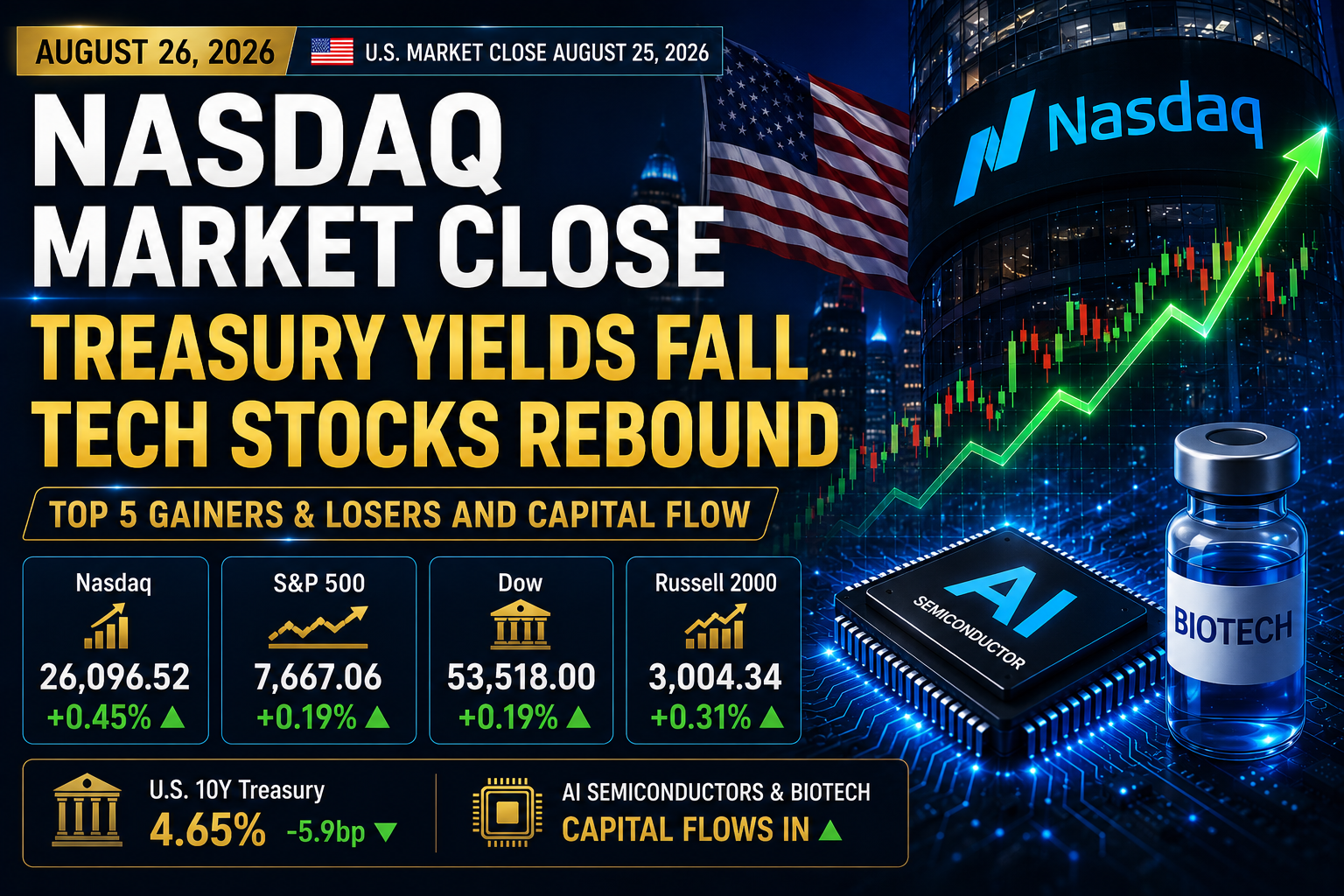
1. U.S. Stock Market Close
| Index | Close | Change |
| Nasdaq Composite | 26,096.52 | +0.45% |
| S&P 500 | 7,667.06 | +0.19% |
| Dow Jones Industrial Average | 53,518.00 | +0.19% |
| Russell 2000 | 3,004.34 | +0.31% |
The Nasdaq outperformed after technology stocks recovered from the previous session’s weakness.
More importantly, market breadth improved. This was not simply a case of one mega-cap stock dragging the indexes higher. Small caps also advanced, while buying returned to several areas of the technology complex.
Still, this was not a broad risk-on rally.
Investors remained cautious ahead of Nvidia’s earnings, and sector performance showed considerable dispersion. Semiconductors and selected biotech names attracted capital, while consumer-related stocks struggled.
The session was therefore better characterized as a selective growth-stock rebound rather than a full-scale return of risk appetite.
2. Why Did the Nasdaq Rise?
Three factors were particularly important.
Softer Economic Data Helped Pull Treasury Yields Lower
Recent housing and consumer data showed signs that U.S. economic momentum may be cooling.
For equity investors, weaker economic data can produce two opposing effects.
Slower growth can hurt corporate earnings expectations. But if the data reduces fears of persistent inflation and higher-for-longer interest rates, it can also push Treasury yields lower.
That second effect mattered more for technology stocks on Tuesday.
The transmission mechanism looked roughly like this
Softer economic data
↓
Less concern about overheating
↓
Treasury buying
↓
Lower long-term yields
↓
Lower discount-rate pressure on growth stocks
↓
Technology and semiconductor rebound
The key point is that the market was not necessarily celebrating weaker economic growth.
It was responding to what the data did to interest rates and valuations.
Bond-Market Pressure Eased
Long-term Treasury yields have been one of the biggest obstacles facing expensive growth stocks.
When yields rise sharply, investors can earn more from relatively low-risk government bonds while the present value of distant corporate earnings falls.
That combination can be particularly painful for high-multiple technology stocks.
With the 10-year Treasury yield moving back toward the mid-4.6% range, some of that valuation pressure eased.
Recent Treasury buyback initiatives may have helped the broader backdrop for bond-market liquidity, but they should not be treated as the sole reason stocks rose Tuesday.
The more immediate story was simpler
Treasury yields fell, and beaten-down growth stocks responded.
Investors Positioned Ahead of Nvidia Earnings
Nvidia remains the most important near-term catalyst for the AI trade.
After several consecutive sessions of weakness, Nvidia rebounded ahead of earnings. AMD and other semiconductor and AI infrastructure stocks also moved higher.
That matters because Nvidia’s report is no longer just about Nvidia.
Investors will use it to evaluate the health of the entire AI capital-spending cycle
GPUs → CPUs → networking → memory → servers → cooling → power infrastructure
If Nvidia confirms that hyperscaler spending and next-generation accelerator demand remain strong, the impact could extend across the entire data-center ecosystem.
3. The 10-Year Treasury Yield
U.S. 10-Year Treasury Yield: approximately 4.65% / down about 5.9 basis points
The decline in Treasury yields was one of the most important macro developments of the session.
For growth investors, the reason is straightforward.
A stock’s value represents the present value of the cash flows investors expect the company to generate in the future.
When interest rates rise, the discount rate used to value those future earnings also tends to rise.
The farther those earnings are in the future, the greater the valuation impact.
That is why companies priced around long-duration growth expectations — including many AI, semiconductor, and software stocks — can be particularly sensitive to movements in long-term Treasury yields.
Tuesday provided the opposite environment.
As the 10-year yield retreated from around the 4.7% area toward 4.65%, valuation pressure eased and investors had more room to re-enter growth stocks.
For the next leg of the Nasdaq, the direction of the 10-year yield may therefore matter more than a single day’s index gain.
4. Five Major Stocks That Attracted Buying
These are not simply the five stocks with the largest percentage gains. The selection focuses on trading activity, market relevance, company size, identifiable catalysts, and what each move says about broader market positioning.
| Company | Business | Change | Trading Activity | Main Catalyst |
| Moderna (MRNA) | mRNA biotechnology and vaccines | ~+13% | Heavy volume | Cancer-vaccine momentum and analyst target increases |
| Super Micro Computer (SMCI) | AI servers and data-center infrastructure | ~+8.8% | Tens of millions of shares | Renewed buying across AI server infrastructure |
| Robinhood Markets (HOOD) | Online brokerage and trading platform | ~+8% | Active trading | Improving risk appetite and trading-platform expectations |
| AMD (AMD) | CPUs, GPUs and AI accelerators | ~+4.5% | Heavy large-cap activity | Raymond James upgrade |
| Nvidia (NVDA) | AI GPUs and accelerated computing | ~+2% | Heavy volume | Rebound ahead of earnings after a seven-session decline |
Moderna (MRNA) ~+13%
What it does: Moderna develops vaccines and therapeutics using its mRNA technology platform.
Trading activity: The stock continued to attract unusually heavy interest following its recent sharp moves.
Why it rose: The move reflected continued reassessment of Moderna following encouraging personalized cancer-vaccine data, with analyst target increases providing an additional catalyst.
Why it matters: This was not simply a broad biotech rally. Investors appeared to favor companies with identifiable clinical catalysts and potentially meaningful changes to future revenue opportunities.
That distinction matters.
The market is rewarding data-backed biotech catalysts, not simply buying the sector indiscriminately.
Super Micro Computer (SMCI) ~+8.8%
What it does: Super Micro Computer builds high-performance servers and rack-scale infrastructure used in AI data centers.
Trading activity: Tens of millions of shares changed hands as the stock posted one of the session’s strongest moves among major AI infrastructure names.
Why it rose: Buying returned to AI server infrastructure after recent weakness across the broader AI complex.
Why it matters: Nvidia and AMD were not the only beneficiaries of Tuesday’s rebound.
SMCI’s strength suggests that capital was moving beyond the GPU layer and back into the physical infrastructure required to deploy AI computing.
That includes servers, racks, cooling systems, and other data-center equipment.
Robinhood Markets (HOOD) ~+8%
What it does: Robinhood operates a retail trading platform covering stocks, options, cryptocurrencies, and other financial products.
Trading activity: The stock saw active trading as risk appetite improved.
Why it rose: Expectations for stronger trading activity and renewed interest in risk assets supported the stock.
Why it matters: Robinhood can function as a proxy for retail investor activity.
When speculative and risk assets become more active, transaction-driven platforms can benefit from higher engagement and trading volumes.
AMD (AMD) ~+4.5%
What it does: AMD develops CPUs, GPUs, and AI accelerators for PCs, servers, gaming systems, and data centers.
Trading activity: AMD attracted substantial large-cap trading interest.
Why it rose: Raymond James upgraded the stock, helping reinforce optimism around AMD’s position in the AI and server computing market.
Why it matters: AI infrastructure does not run on GPUs alone.
Data centers also require CPUs, networking, memory, and supporting infrastructure.
AMD’s strength suggests investors are again looking beyond a single GPU leader toward the broader computing architecture required for AI deployment.
Nvidia (NVDA) ~+2%
What it does: Nvidia is the dominant supplier of accelerated computing GPUs used in modern AI data centers.
Trading activity: Volume remained substantial ahead of one of the market’s most important earnings releases.
Why it rose: The stock rebounded after seven consecutive declining sessions as investors repositioned ahead of earnings.
Why it matters: Nvidia remains the central read-through for the AI investment cycle.
Its upcoming report will influence expectations not only for Nvidia itself but also for AMD, Micron, Marvell, Super Micro Computer, networking suppliers, storage companies, and data-center power and cooling providers.
5. Five Major Stocks Under Selling Pressure
| Company | Business | Change | Trading Activity | Main Reason |
| Dick’s Sporting Goods (DKS) | Sporting-goods retail | ~-29% | Volume surged | Earnings weakness and lower full-year outlook |
| Nike (NKE) | Athletic footwear and apparel | ~-4% | Selling spread across sector | Consumer-demand concerns following DKS results |
| Target (TGT) | Discount retail | ~-4% | Elevated activity | Weak consumer-sector sentiment |
| Lululemon (LULU) | Athletic apparel | ~-3% | Sector-wide weakness | Concerns about athletic-apparel demand |
| Chevron (CVX) | Integrated energy | ~-1.1% | Large-cap energy selling | Lower oil prices |
Dick’s Sporting Goods (DKS) ~-29%
What it does: Dick’s Sporting Goods is one of the largest sporting-goods retailers in the United States.
Trading activity: Volume surged as investors aggressively repriced the stock.
Why it fell: Quarterly weakness and a reduced full-year outlook triggered the selloff, with Foot Locker-related challenges and softer footwear demand adding pressure.
Why it matters: This was not a routine profit-taking move.
The combination of
weaker results + lower guidance + surging volume
suggests investors materially reduced their expectations for the company’s future earnings.
More importantly, the damage did not remain isolated to Dick’s.
Nike (NKE) ~-4%
Nike fell as the implications of Dick’s results spread through the athletic footwear and apparel industry.
The important question is whether the weakness reflects company-specific execution problems at Dick’s or something broader about discretionary consumer demand.
If similar signals emerge from additional retailers, the market may increasingly treat the issue as an industry-level demand problem.
Target (TGT) ~-4%
Target also traded lower as sentiment toward discretionary and retail stocks deteriorated.
With consumer confidence showing signs of weakness, investors are becoming increasingly sensitive to any indication that household spending is slowing.
That makes upcoming retail earnings and guidance particularly important.
Lululemon (LULU) ~-3%
Lululemon joined the broader weakness in athletic apparel.
The decline reinforced the idea that investors were not viewing Dick’s problems entirely in isolation.
Instead, the market appeared to be pricing in some risk that demand weakness could extend across parts of the athletic and discretionary-consumer ecosystem.
Chevron (CVX) ~-1.1%
Chevron moved lower alongside weakness in the energy sector as crude oil prices declined.
Unlike the consumer names, this was primarily a commodity-driven move rather than a company-specific deterioration in earnings expectations.
6. Where Did the Money Actually Go?
This is the most important part of Tuesday’s session.
The market’s internal rotation can be summarized as
Consumer earnings disappointment
DKS → athletic apparel and retail weakness
↓
10-year Treasury yield falls toward 4.65%
↓
Growth-stock valuation pressure eases
↓
NVDA → AMD → SMCI
AI semiconductors → AI server infrastructure
MRNA
Clinical-catalyst biotech
AI Money Expanded Beyond GPUs
The clearest chain was
Nvidia → AMD → Super Micro Computer
Nvidia rebounded, AMD gained roughly 4.5%, and SMCI jumped close to 9%.
That makes the session more interesting than a simple Nvidia rebound.
The better description is
Capital began moving back from core AI semiconductors into the broader server and data-center infrastructure layer.
If that rotation continues, investors should watch networking, memory, storage, power, and cooling companies for confirmation.
Biotech Capital Favored Real Clinical Catalysts
Moderna’s strength provides another clue about market behavior.
Investors were not indiscriminately chasing biotechnology stocks.
Instead, money concentrated in a company where clinical data could materially change future revenue expectations.
That is a much healthier signal than a purely thematic rally.
Consumer Stocks Told the Opposite Story
Dick’s Sporting Goods represented the other side of the market.
When management reduced expectations for future performance, investors quickly pulled capital out.
Weakness then spread into athletic footwear and apparel stocks.
In other words, Tuesday’s market paid up for future AI growth and clinical upside, while aggressively discounting deteriorating consumer earnings expectations.
7. MasterMind's Insight
First: The 4.65% Treasury Yield Matters More Than the Nasdaq’s 0.45% Gain
The Nasdaq finished higher, but the more important move occurred in the bond market.
Long-term Treasury yields had recently become a major headwind for technology valuations.
Moving back from roughly 4.7% toward 4.65% gave growth stocks breathing room.
The next question is therefore not simply whether the Nasdaq can rise again.
It is whether the 10-year Treasury yield can remain in the mid-4.6% range rather than moving back above 4.7%.
Second: AI Money Is Returning, but the Trend Has Not Been Confirmed Yet
AMD and SMCI posted strong gains while Nvidia rebounded.
That is constructive.
But the most important test is still ahead.
Nvidia’s earnings need to provide evidence on
Data-center growth
Next-generation accelerator demand
Margins
Hyperscaler AI capital spending
Forward guidance
Tuesday showed that investors are willing to move back into AI.
Nvidia will determine whether they have a reason to stay.
Third: Forward Expectations Matter More Than Backward-Looking Earnings
Dick’s Sporting Goods demonstrated how unforgiving this market can be when management lowers expectations.
The market does not care only about what a company earned last quarter.
It cares about what analysts may need to assume for the next several quarters.
That same mechanism worked in the opposite direction for Moderna.
If new clinical evidence increases the probability of future commercial revenue, investors may rapidly revise valuation assumptions higher.
The market is increasingly separating companies according to one question
Are forward earnings expectations moving up or down?
8. What to Watch Next
The next session could be significantly more volatile.
Nvidia Earnings
Nvidia’s earnings report is the largest near-term catalyst for the AI trade.
The market will focus less on whether the company beats the headline EPS estimate and more on data-center growth, forward guidance, next-generation product demand, and hyperscaler spending.
The reaction could spread throughout the AI infrastructure ecosystem.
The 10-Year Treasury Yield
Tuesday’s technology rebound was supported by falling yields.
If the 10-year Treasury yield moves back above 4.7%, valuation pressure could quickly return.
If yields remain near the mid-4.6% area, growth stocks will have a more supportive macro backdrop.
AMD and SMCI Volume
One-day price gains are not enough to establish a new trend.
If capital is genuinely returning to AI infrastructure, trading activity should remain elevated in AMD, SMCI, and other companies surrounding Nvidia.
Marvell Technology
Marvell remains an important company to watch because its data-center business provides insight into demand for custom AI silicon and connectivity infrastructure.
Strong results and guidance could strengthen the case that AI spending is broadening beyond general-purpose GPUs into custom ASICs and networking.
Bottom Line
Falling Treasury yields gave the Nasdaq room to rebound, but the real story was underneath the index: capital returned to AI semiconductors and server infrastructure while catalyst-driven biotech attracted heavy interest, and consumer stocks with deteriorating forward expectations suffered aggressive selling.
Final Thoughts
At first glance, Tuesday looked like a fairly ordinary Nasdaq rebound.
Underneath the surface, however, the market sent a much clearer message.
Lower Treasury yields gave investors room to return to Nvidia, AMD, and Super Micro Computer, creating a rotation from AI chips into the broader server and data-center infrastructure ecosystem.
At the same time, Moderna showed that investors remain willing to pay for biotech companies with credible clinical catalysts.
Consumer stocks told the opposite story. Dick’s Sporting Goods demonstrated how quickly capital can leave when forward earnings expectations deteriorate.
That is why daily market analysis should follow a consistent sequence
Indexes → Treasury yields → volume → sectors → individual stocks
The question is not simply whether the Nasdaq rose or fell.
The questions that matter are
Why did it move? Where did trading activity concentrate? And did that money spread across an industry or remain isolated to a few stocks?
The next major test is now clear
Will the money that returned to AI semiconductors and server infrastructure remain there after Nvidia reports earnings?
That answer could determine the Nasdaq’s next move.
This was MasterMind, designing the path to success.
Disclaimer: This article is for market information and investment education purposes only and does not constitute a recommendation to buy or sell any security.
'[Global] Success Blueprints' 카테고리의 다른 글