What Is a Goldilocks Economy? How It Affects Stocks, Bonds, and Financial Markets


Hello, this is MasterMind.
What if the U.S. economy could keep growing without reigniting inflation, while the Federal Reserve no longer needed to keep tightening monetary policy?
For investors, that combination is close to an ideal macroeconomic environment.
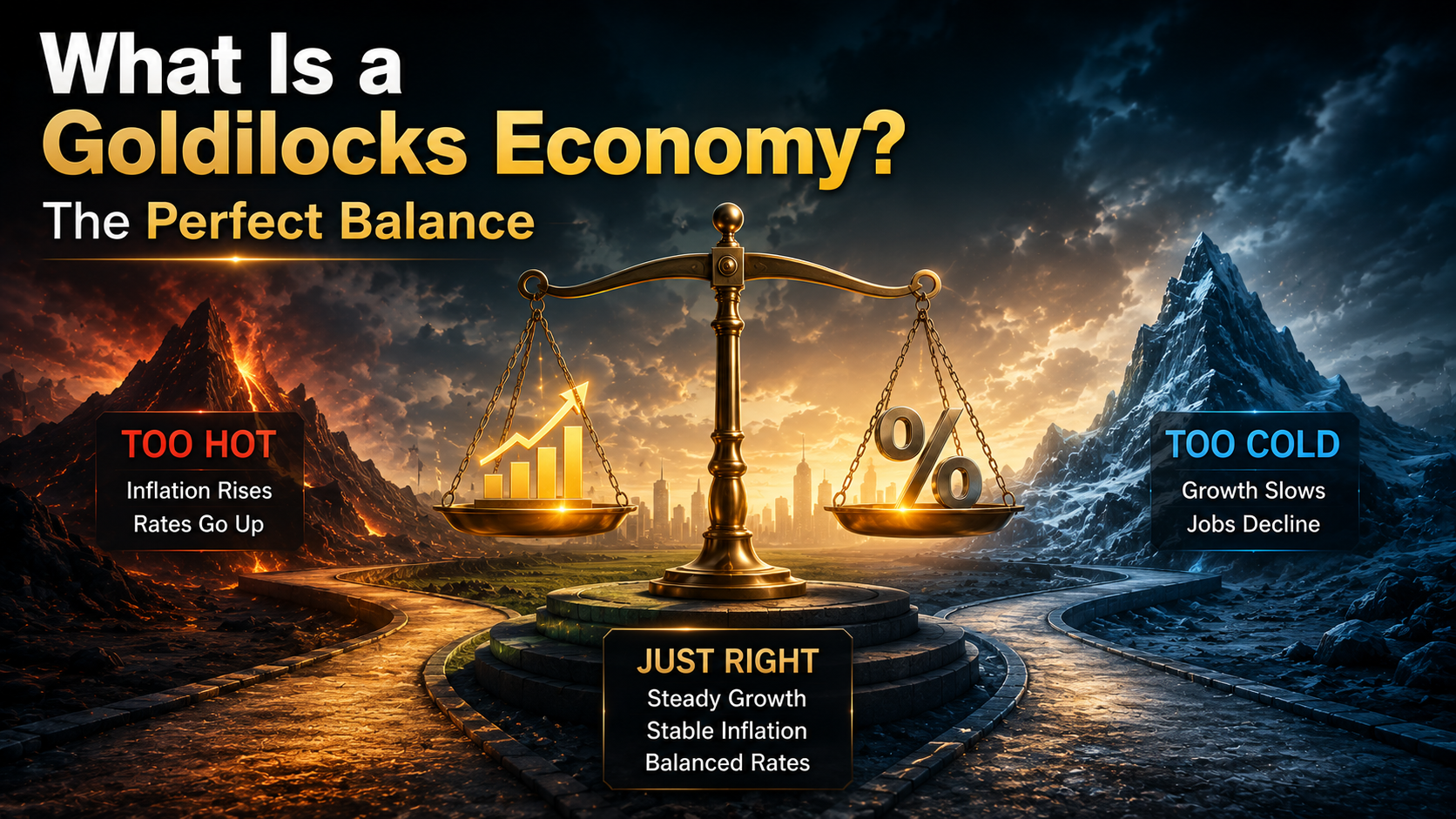
It is commonly known as a Goldilocks economy—an economy that is neither too hot nor too cold.
Growth remains strong enough to support corporate earnings and employment, but not so strong that inflation forces the Federal Reserve into aggressive rate hikes.
But for long-term investors, simply knowing the definition of a Goldilocks economy is not enough.
The more important questions are why this environment tends to favor financial markets, where capital moves when Goldilocks conditions emerge, and what eventually causes the balance to break down.
The Bottom Line
A Goldilocks economy is an environment in which economic growth remains healthy enough to avoid recession while inflation stays under control, reducing pressure on the Federal Reserve to tighten monetary policy and potentially creating favorable conditions for stocks, bonds, and other risk assets.
What Is a Goldilocks Economy?
The term comes from the story Goldilocks and the Three Bears.
Goldilocks rejects things that are too hot or too cold and chooses what is "just right."
Economists and investors use the same idea to describe an economy that sits between two dangerous extremes.
If the economy grows too quickly, strong demand can create inflationary pressure. The Federal Reserve may then need to raise interest rates or keep monetary policy restrictive.
If the economy becomes too weak, inflation may fall, but unemployment can rise, consumer spending can deteriorate, and corporate earnings can decline.
A Goldilocks economy exists somewhere between those two extremes.
The Key Conditions of a Goldilocks Economy
| Economic Factor | Typical Goldilocks Condition |
| GDP growth | Moderate and sustainable |
| Labor market | Healthy without severe overheating |
| Consumer spending | Resilient |
| Inflation | Stable or gradually declining |
| Federal Reserve policy | Limited need for additional tightening |
| Corporate earnings | Stable or improving |
| Financial markets | Generally supportive of risk-taking |
In simple terms
Companies can continue making money without forcing the Federal Reserve to slam on the economic brakes.
That combination explains why investors pay so much attention to Goldilocks conditions.
How Does a Goldilocks Economy Work?
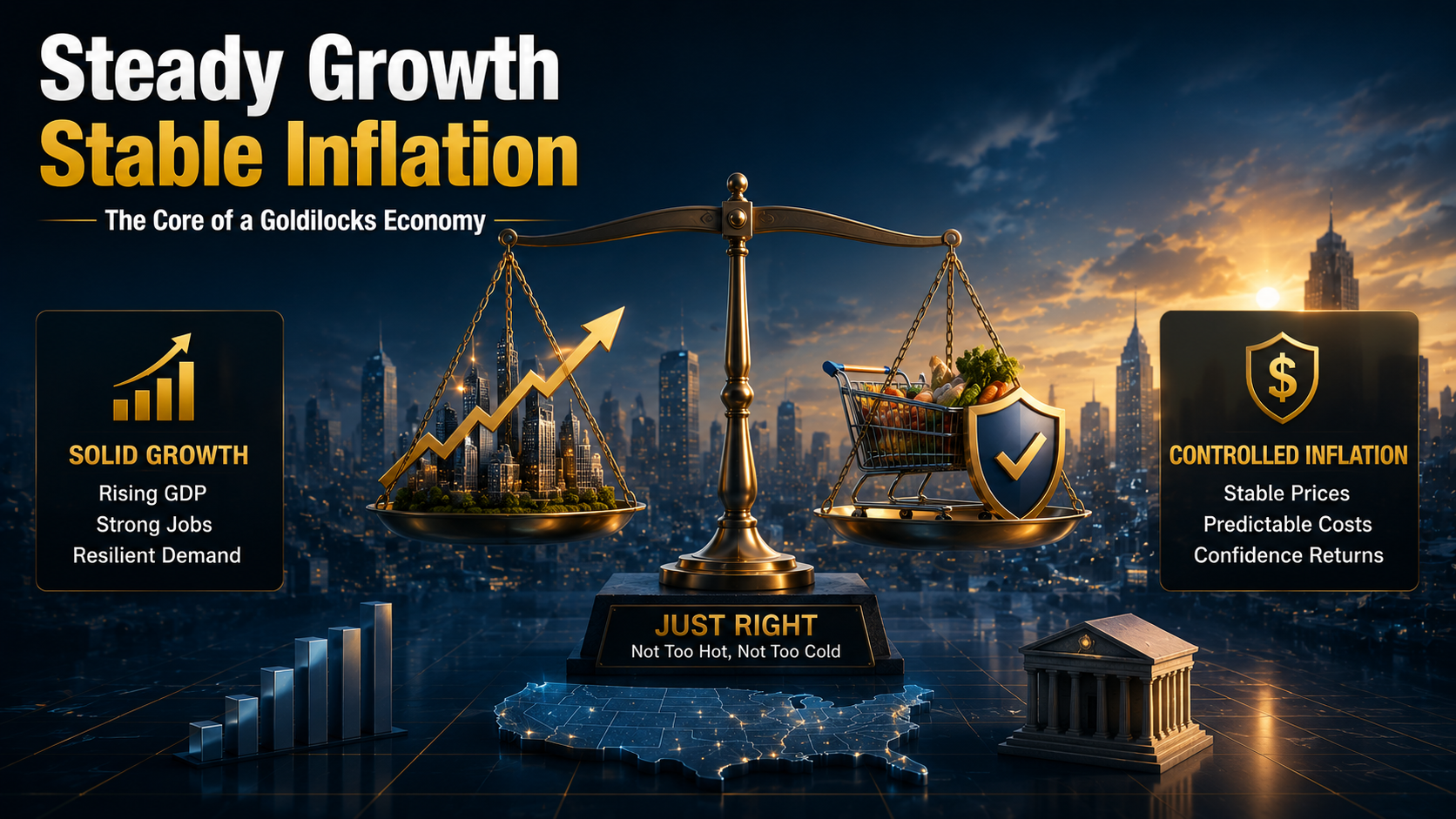
Normally, economic growth and inflation create a difficult balancing act.
Strong consumer demand encourages companies to increase production, hire workers, and invest.
But if demand grows faster than the economy's ability to supply goods and services, prices can rise.
The Federal Reserve may respond by raising interest rates.
Higher rates then increase borrowing costs for consumers and businesses, eventually slowing economic activity.
A Goldilocks environment can emerge when the economy expands without creating excessive inflationary pressure.
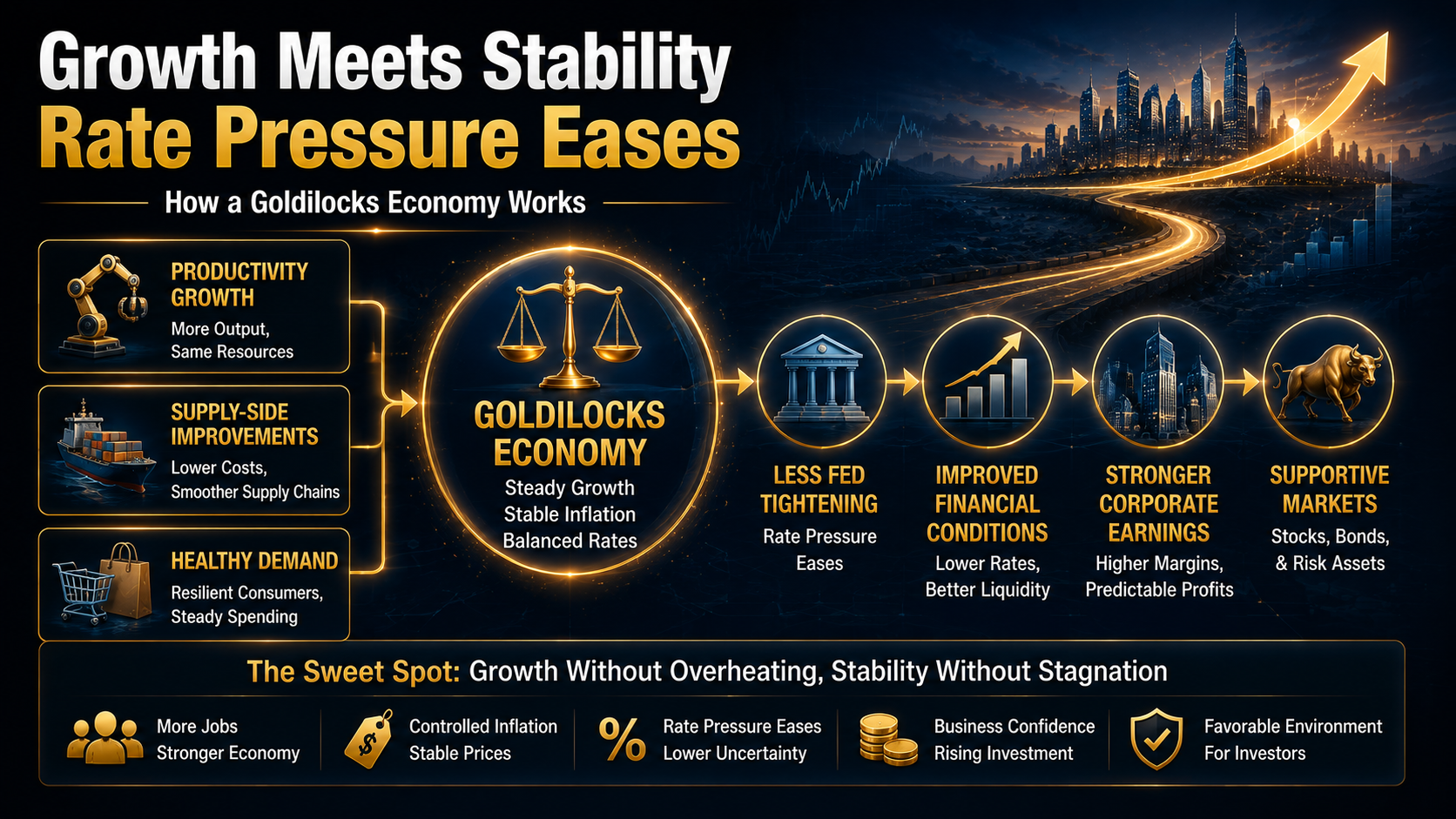
Several forces can contribute to this outcome.
Productivity Growth
Productivity allows businesses to produce more output from the same amount of labor and capital.
Technology, automation, artificial intelligence, better logistics, and improved business processes can potentially increase economic output without creating the same level of inflationary pressure.
For U.S. investors, this relationship is especially important because sustained productivity growth can support both corporate margins and economic expansion.
Supply-Side Improvements
Improving supply chains, falling transportation costs, stable commodity prices, or greater production capacity can reduce inflation pressure even when consumer demand remains relatively healthy.
This allows growth to continue without necessarily forcing the Fed to tighten further.
Stable Inflation
When inflation moves toward a sustainable level, the Federal Reserve has less reason to maintain increasingly restrictive monetary policy.
Markets may then begin pricing in stable rates or eventual rate cuts.
Importantly, financial markets usually move before the Federal Reserve actually changes policy.
Treasury yields, stock valuations, credit spreads, and the U.S. dollar can begin adjusting as investors change their expectations.
Healthy Corporate Earnings
If economic growth remains positive, businesses can continue generating revenue.
If inflation also cools without destroying demand, companies may benefit from a more predictable cost environment.
The basic Goldilocks mechanism therefore looks like this
Productivity and supply improvement → sustainable growth → cooling inflation → less Fed tightening → healthier financial conditions → stronger support for corporate earnings and risk assets
Why Is a Goldilocks Economy Important to Investors?
Financial markets do not simply want the strongest economy possible.
An economy can actually become too strong for the stock market.
Suppose U.S. employment, consumer spending, and GDP growth dramatically exceed expectations.
At first glance, that sounds bullish.
But investors may quickly ask
"Will inflation accelerate again?"
"Will the Fed delay rate cuts?"
"Could Treasury yields move higher?"
Those questions can push bond yields upward and pressure stock valuations, particularly in long-duration growth sectors such as technology.
The opposite extreme can also be problematic.
If economic data deteriorates rapidly, Treasury yields may fall and the Fed may cut rates, but corporate earnings could collapse at the same time.
That is why the market often prefers something in between
Positive growth → resilient earnings → cooling inflation → manageable interest rates
This leads to one of the most important principles in financial markets
Markets do not respond simply to whether the economy is good or bad. They respond to the difference between expectations and reality—and to what new economic data implies for future earnings and interest rates.
The same strong jobs report can therefore be bullish in one environment and bearish in another.
Goldilocks Economy vs. Soft Landing: What's the Difference?
American investors frequently hear Goldilocks economy and soft landing used in the same discussion.
They are related, but they are not identical.
A soft landing generally describes a situation in which the Federal Reserve successfully brings inflation under control without causing a severe recession.
Goldilocks describes the favorable economic environment that can exist when growth, inflation, interest rates, and employment settle into a sustainable balance.
One way to think about it is
Soft landing = the landing process
Goldilocks = the favorable economic environment that may follow
A successful soft landing can create Goldilocks conditions.
But a soft landing does not guarantee that those conditions will last.

How a Goldilocks Economy Affects the Stock Market
Stocks are usually among the assets most closely associated with Goldilocks conditions.
There are two major reasons.
First, continued economic growth supports corporate revenue and earnings.
Second, stable or declining interest rates can reduce the discount rate investors apply to future corporate cash flows.
That creates a potentially powerful combination
Earnings growth + lower rate pressure
Growth stocks can be particularly sensitive to this environment because a larger share of their expected value comes from profits projected further into the future.
Lower long-term Treasury yields can increase the present value investors assign to those future earnings.
However, there is an important catch.
A Good Economy Does Not Automatically Mean Cheap Stocks
Suppose the S&P 500 has already rallied significantly because investors expect
- falling inflation,
- multiple Fed rate cuts,
- strong earnings growth,
- no recession,
- and continued productivity gains.
The economy could subsequently perform well and stocks could still struggle.
Why?
Because the good news may already be reflected in valuations.
This is why investors should ask not only
"Is the economy healthy?"
but also
"How much economic optimism is already priced into stocks?"
How a Goldilocks Economy Affects Bonds
Goldilocks conditions can also be favorable for bonds.
If inflation is cooling and investors believe the Fed is finished tightening, Treasury yields may stabilize or decline.
Because bond prices generally move inversely to yields, falling market rates can support existing bond prices.
But investors should distinguish between the federal funds rate and longer-term Treasury yields.
The Fed can cut short-term rates while the 10-year or 30-year Treasury yield remains elevated.
Long-term yields are influenced by additional factors including
- inflation expectations,
- economic growth,
- federal deficits,
- Treasury issuance,
- and the term premium investors demand for holding long-duration debt.
For equity investors, the 10-year Treasury yield can be particularly important because it influences financial conditions and valuation models across the U.S. market.
What Happens to the U.S. Dollar?
The relationship between a Goldilocks economy and the U.S. dollar is more complicated.
It is tempting to assume that lower Fed rates automatically mean a weaker dollar.
But currencies are relative.
If the U.S. economy remains significantly stronger than Europe, Japan, or other major economies, global capital may continue flowing toward U.S. assets.
That can support the dollar even if the Fed is gradually easing policy.
On the other hand, if U.S. rate expectations decline relative to other economies, the dollar may weaken.
Investors therefore need to watch relative growth and relative interest rates, not U.S. monetary policy in isolation.
What Happens to Gold?
Gold is influenced by several forces, particularly real interest rates and the U.S. dollar.
If nominal Treasury yields decline while inflation remains controlled, real yields may fall.
Lower real yields reduce the opportunity cost of holding an asset like gold that does not generate interest income.
That can support gold prices.
However, a strong risk-on environment can also reduce some safe-haven demand.
Gold therefore does not have a simple one-direction relationship with Goldilocks conditions.
What Happens to Bitcoin and Other Risk Assets?
Bitcoin and other highly volatile assets can benefit when financial conditions become easier and investor risk appetite improves.
If markets expect lower interest rates, improved liquidity, and reduced recession risk, investors may become more willing to own higher-volatility assets.
That does not mean liquidity automatically pushes every crypto asset higher.
Valuation, positioning, leverage, regulation, and investor expectations still matter.
A favorable macro environment can provide a tailwind, but it does not eliminate asset-specific risk.
Goldilocks Economy: Asset Market Summary
| Asset | Potential Goldilocks Impact | Key Variable |
| U.S. stocks | Generally positive | Earnings and valuations |
| Growth stocks | Potentially favorable | 10-year Treasury yield |
| Treasury bonds | Neutral to positive | Inflation and rate expectations |
| U.S. dollar | Mixed | Relative global growth and rates |
| Gold | Potentially favorable if real yields fall | Real yields and dollar |
| Bitcoin | Potentially favorable in risk-on conditions | Liquidity and risk appetite |
The important point is that Goldilocks does not guarantee that every asset rises simultaneously.
Starting valuations and investor expectations still matter.
How Does a Goldilocks Economy End?
Goldilocks conditions rarely last forever.
For investors, the more useful question is often not whether Goldilocks has arrived but which direction the balance is beginning to break.
There are two major risks.
Scenario 1: The Economy Becomes Too Hot
Suppose consumer spending accelerates, employment remains extremely tight, wages rise rapidly, and inflation begins climbing again.
The sequence could look like this
Strong growth → renewed inflation → higher Treasury yields → tighter financial conditions
The Fed may delay rate cuts or maintain restrictive policy for longer.
Stocks with expensive valuations can become especially sensitive to rising yields.
In this scenario, good economic news can actually become bad news for financial markets.
Scenario 2: The Economy Becomes Too Cold
Now imagine inflation continues falling, but unemployment rises sharply, consumer spending weakens, and corporate earnings expectations deteriorate.
The sequence changes
Slowing growth → weaker earnings → recession concerns → risk-off positioning
The Fed may cut interest rates aggressively.
But those rate cuts would be happening because the economy is deteriorating.
This illustrates another critical investing principle
A rate cut is not automatically bullish. Why the Fed is cutting rates matters more than the rate cut itself.
Key Indicators Investors Should Watch
Determining whether the U.S. economy is approaching Goldilocks conditions requires more than watching GDP.
Inflation
Investors should monitor measures such as CPI and PCE inflation.
The composition of inflation also matters.
Persistent services inflation and wage growth can tell a different story from falling goods prices.
Labor Market
Payroll growth and unemployment are important, but they are not the entire picture.
Wage growth, job openings, labor-force participation, and unemployment claims can provide additional information about whether the labor market is gradually cooling or deteriorating rapidly.
Corporate Earnings and Cash Flow
Ultimately, stock prices need support from corporate fundamentals.
Investors should monitor
- revenue growth,
- operating margins,
- free cash flow,
- earnings revisions,
- debt levels,
- and interest expense.
A widening gap between macroeconomic optimism and corporate cash flow can be an important warning sign.
Treasury Yields
The 10-year Treasury yield provides valuable information about growth, inflation expectations, and financial conditions.
Investors should not assume that Fed rate cuts automatically mean long-term yields will decline.
Market Expectations
This may be the most overlooked variable.
Markets are forward-looking.
If investors already expect perfect disinflation, strong earnings, aggressive Fed easing, and no recession, even a healthy economy can disappoint.
The real question is not simply
"Is the economy good?"
It is
"How much good news is already priced into financial assets?"
Does Goldilocks Always Mean a Bull Market?
No.
A favorable economy and an attractive investment are two different things.
Even an excellent company can become a poor investment at an extreme valuation.
The same principle applies to the broader market.
If asset prices already reflect an almost perfect macroeconomic outcome, the margin for disappointment becomes smaller.
A mild inflation surprise, weaker earnings guidance, or an unexpected rise in Treasury yields can then trigger substantial volatility.
This is why Goldilocks should be treated as an economic environment, not a buy signal.
What Do Wealthy Investors Look for in a Goldilocks Economy?
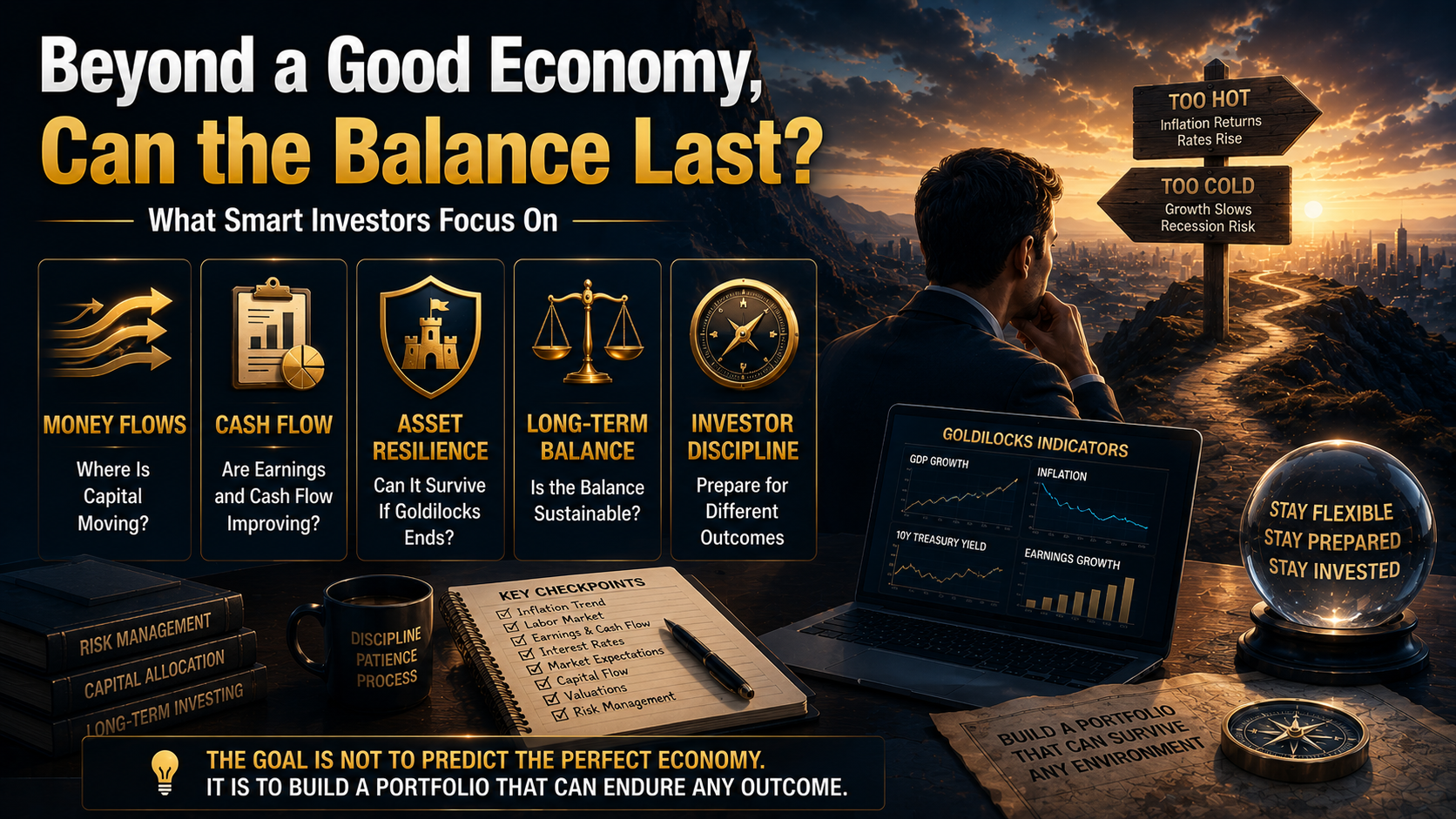
Experienced investors are rarely focused only on whether the S&P 500 will rise next month.
They are more likely to focus on capital flows, cash generation, asset resilience, and whether the economic balance can persist.
Where Is the Money Moving?
When recession risk declines and interest-rate pressure eases, capital may gradually move away from cash and short-duration defensive positions toward risk assets.
Leadership may initially concentrate in high-quality large-cap stocks.
If confidence broadens, money can begin rotating into cyclical industries, smaller companies, credit, or other higher-risk assets.
Watching where capital is moving beneath the major indexes can therefore reveal more than the index level itself.
Is Cash Flow Actually Improving?
Narratives change constantly.
Cash flow is harder to fake over long periods.
A strong macroeconomic story is much more convincing when corporate earnings, operating margins, and free cash flow are moving in the same direction.
If stock prices rise while underlying cash generation deteriorates, investors should examine the gap carefully.
Can the Asset Survive if Goldilocks Ends?
This may be the most important question.
What happens if inflation returns?
What happens if the 10-year Treasury yield rises?
What happens if economic growth slows faster than expected?
Companies with strong balance sheets, manageable debt, durable competitive advantages, and reliable cash flow are generally better positioned to survive unexpected changes in the economic environment.
The same principle applies to portfolio construction.
Investing is not about perfectly predicting the future. It is about building a structure that can survive when the future turns out differently than expected.
Questions Long-Term Investors Can Ask
- Is inflation structurally cooling or only temporarily declining?
- Is the labor market cooling gradually or deteriorating rapidly?
- Are corporate earnings and cash flows actually improving?
- What is happening to the 10-year Treasury yield?
- Are financial conditions becoming easier or tighter?
- Where is capital moving within the market?
- Do current valuations already assume a perfect Goldilocks outcome?
- Can my portfolio survive both renewed inflation and a recession?
These questions are ultimately more useful than simply asking whether the economy has entered a Goldilocks phase.
Final Thoughts
A Goldilocks economy is not simply a strong economy.
It is an unusual balance in which economic growth remains healthy, inflation stays under control, interest-rate pressure is manageable, and corporate earnings continue to support financial markets.
That combination can create favorable conditions for stocks, bonds, and other risk assets.
But Goldilocks does not mean every asset should rise, nor does it mean risk has disappeared.
If the economy becomes too strong, inflation and Treasury yields can return.
If the economy becomes too weak, corporate earnings can deteriorate and recession risk can replace inflation as the market's primary concern.
And above all, financial markets price the future before it arrives.
The most important question for investors is therefore not simply whether a Goldilocks economy exists.
It is
Which direction are growth, inflation, interest rates, earnings, and capital flows moving—and how much of that future is already reflected in today's prices?
A favorable economy can still produce poor investment outcomes when expectations become excessive.
For long-term investors, survival remains more important than predicting the perfect macroeconomic scenario.
The goal is not to predict the ideal economy. It is to own assets and build a portfolio capable of surviving when the economy turns out differently than expected.
This was MasterMind.
'[Global] Success Blueprints' 카테고리의 다른 글