What Is the Standing Repo Facility (SRF)? How the Fed’s Liquidity Backstop Protects U.S. Financial Markets


Hello, this is MasterMind.
What is one of the most dangerous things that can happen in financial markets?
A stock market correction is painful. Falling corporate earnings can trigger a bear market. Rising interest rates can pressure valuations.
But at the financial-system level, something potentially more dangerous can happen beneath the surface
Cash can suddenly stop moving.
A bank, securities dealer, or other financial institution may own plenty of high-quality assets, including U.S. Treasury securities, yet still face an immediate need for cash.
If many institutions need cash at the same time, short-term funding rates can spike. Institutions may then begin selling Treasuries to raise liquidity, pushing bond prices lower and yields higher.
What begins as a temporary funding problem can spread into the Treasury market, credit markets, and eventually risk assets.
That is where the Federal Reserve's Standing Repo Facility (SRF) becomes important.
The SRF rarely attracts the attention given to the federal funds rate, quantitative easing, or quantitative tightening. Yet it is an important piece of the plumbing supporting U.S. financial markets.
Understanding the SRF helps investors understand something much bigger
how Treasury collateral, bank reserves, repo markets, short-term interest rates, and Federal Reserve liquidity interact beneath asset prices.
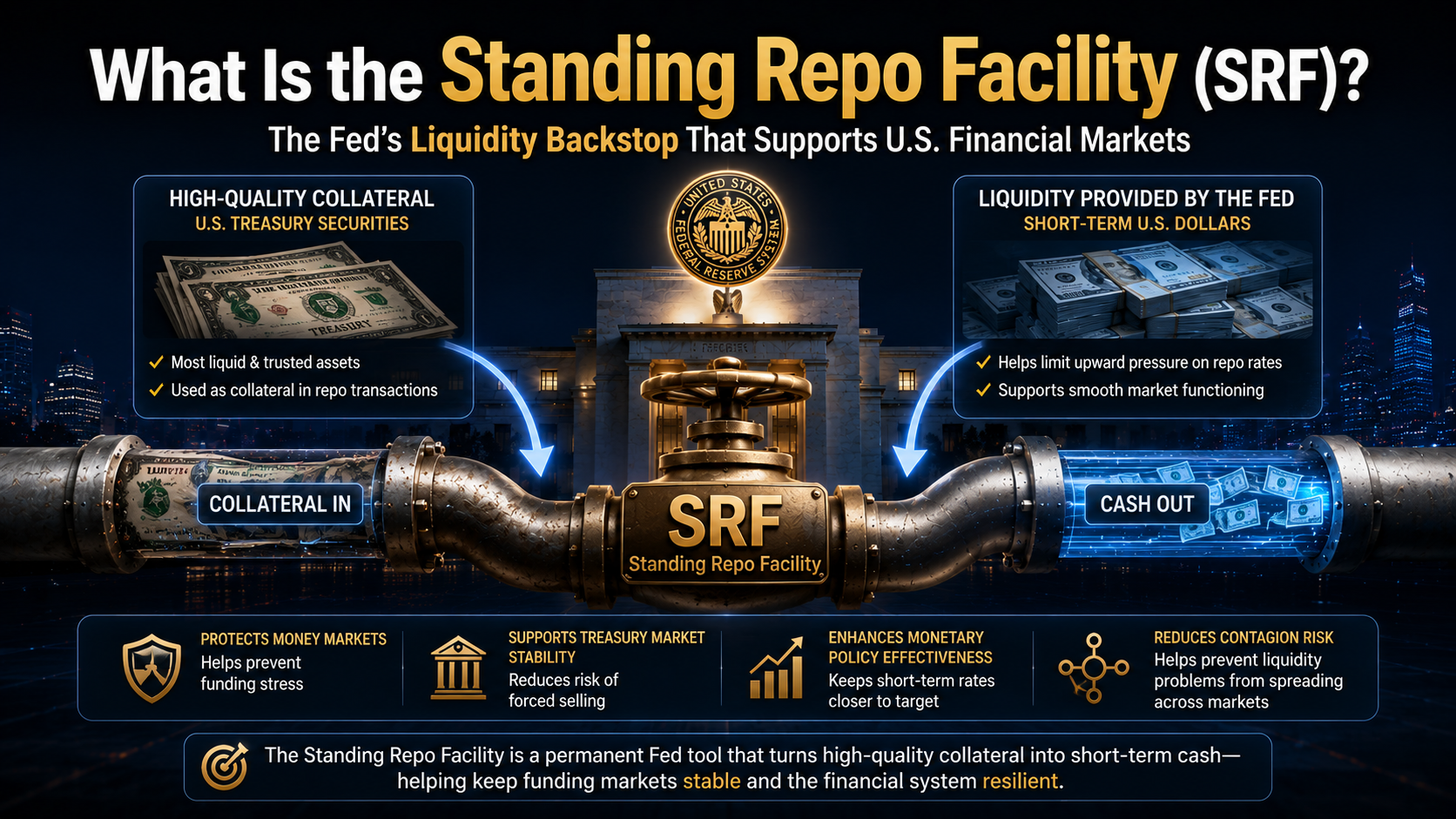
Key Takeaway
The Standing Repo Facility is a permanent Federal Reserve liquidity backstop that allows eligible counterparties to obtain short-term cash against high-quality securities, helping limit extreme upward pressure on repo rates and reducing the risk that a temporary cash shortage develops into broader financial stress.
What Is the Standing Repo Facility?
The Standing Repo Facility, or SRF, is a Federal Reserve facility through which eligible counterparties can conduct repurchase agreement transactions with the Fed using eligible securities as collateral.
To understand why that matters, we first need to understand the repo market.
What Is a Repo?
Repo is short for repurchase agreement.
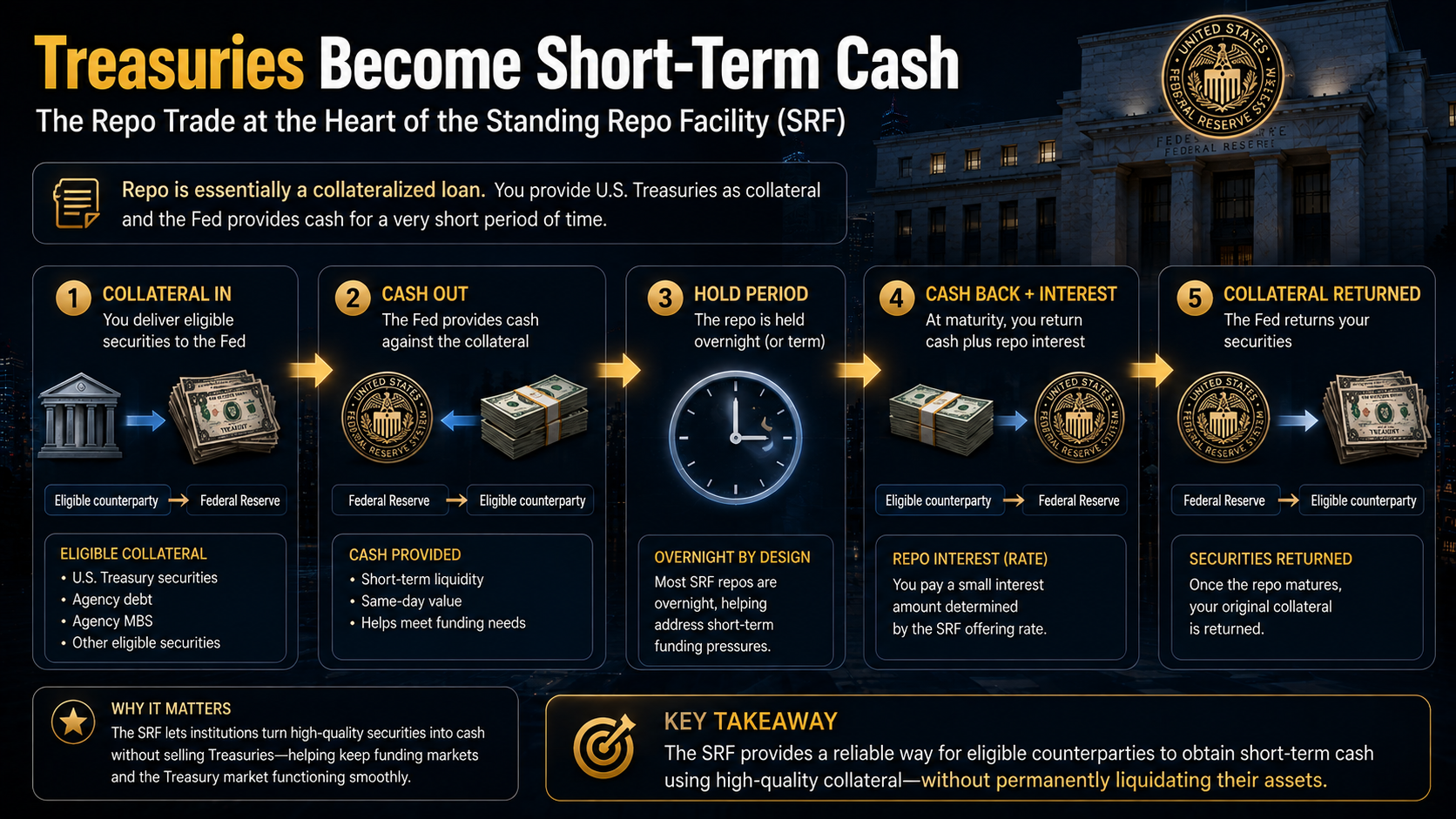
Economically, a repo transaction resembles a short-term collateralized loan.
Imagine that a financial institution owns $100 million in U.S. Treasury securities but needs cash today to settle transactions.
Instead of permanently selling those Treasuries, the institution can use securities as collateral in a repo transaction and receive cash.
At maturity, the transaction is reversed according to the agreed terms.
In simplified form
Eligible Counterparty
↓
Provides Eligible Securities

Federal Reserve
↓
Provides Cash

Repo Matures
↓
Cash + Repo Interest Returned
↓
Securities Returned
The crucial point is that the institution can obtain liquidity without having to permanently liquidate its Treasury holdings simply because it temporarily needs cash.
Why Is It Called "Standing"?
The word "standing" is important.
The facility is designed as an ongoing part of the Federal Reserve's monetary-policy implementation framework rather than something that must be invented from scratch every time short-term funding markets experience stress.
Conceptually, the SRF creates a standing backstop where eligible counterparties can transform high-quality securities into short-term liquidity under the facility's terms.
That distinction becomes especially important when cash becomes scarce.
Why Was the Standing Repo Facility Created?
One of the most important episodes for understanding the modern U.S. repo market occurred in September 2019.
Short-term funding conditions suddenly tightened, and overnight repo rates experienced an extraordinary spike.
The underlying issue was not that the entire U.S. banking system had become insolvent.
The problem was more subtle
Cash was not available in the right places, in sufficient quantity, at the right moment.
This distinction between solvency and liquidity is fundamental to understanding financial crises.
An institution can own high-quality assets and still experience serious problems if it cannot turn those assets into cash when obligations come due.
When many market participants experience the same problem, the consequences can spread.
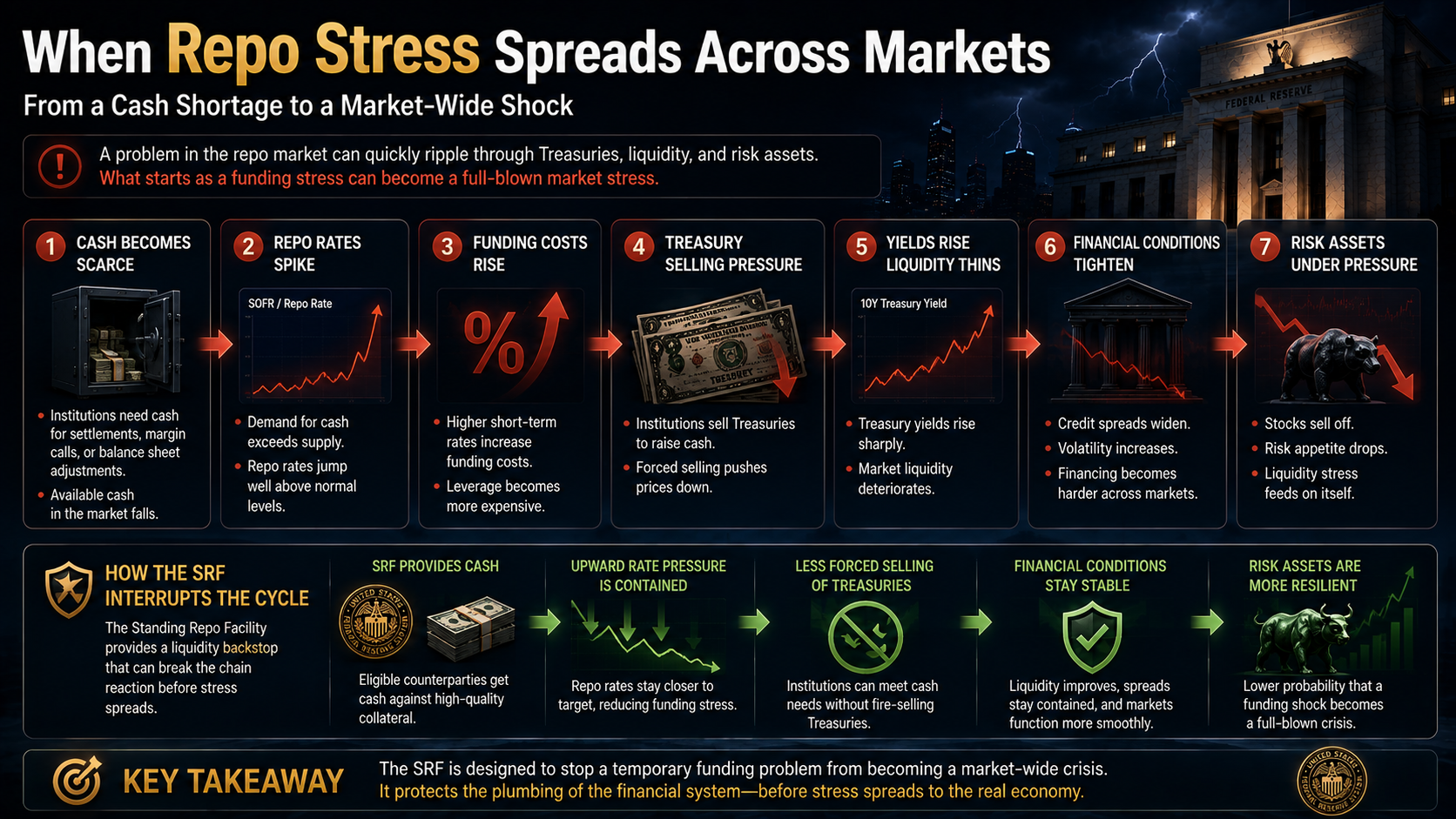
A simplified chain might look like this
Cash Becomes Scarce
↓
Repo Rates Rise
↓
Funding Costs Increase
↓
Treasury Selling Pressure Grows
↓
Treasury Prices Fall
↓
Market Yields Rise
↓
Financial Conditions Tighten
↓
Demand for Cash Increases Further
A problem that begins in overnight funding can therefore affect one of the most important markets in the world: the U.S. Treasury market.
The Federal Reserve established the Standing Repo Facility in 2021 as part of its framework for supporting effective monetary-policy implementation and smooth functioning in short-term funding markets.
How Does the Standing Repo Facility Work?
The basic mechanics of the SRF are relatively straightforward.
The central idea is to provide an established channel through which eligible securities can be converted into temporary cash liquidity.
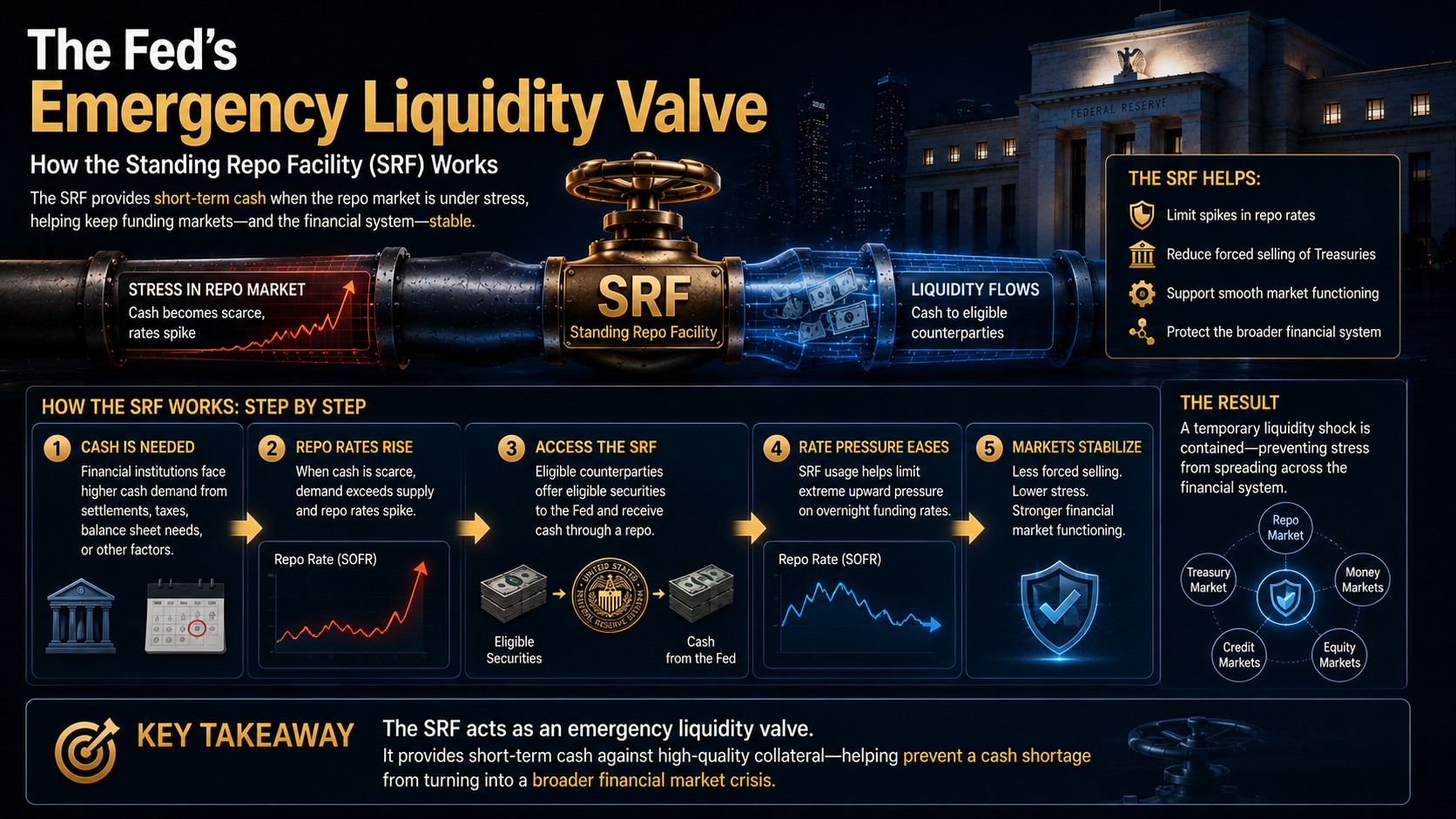
Step 1: Demand for Cash Increases
Financial institutions regularly experience changes in cash needs.
Possible drivers include Treasury settlements, tax payments, quarter-end or year-end balance-sheet adjustments, and large movements of funds through the financial system.
Under normal conditions, private repo markets handle these transactions without significant disruption.
Problems can emerge when many institutions simultaneously want additional cash.
Step 2: Repo Rates Come Under Upward Pressure
Cash has a price.
In short-term funding markets, that price is reflected in interest rates.
When demand for cash suddenly exceeds available supply, repo rates can rise sharply.
If the move becomes large enough, short-term market rates can move away from the range consistent with the Federal Reserve's intended monetary-policy stance.
Step 3: Eligible Counterparties Can Access the SRF
Eligible counterparties can provide eligible securities and receive cash from the Federal Reserve through repo transactions conducted under the facility.
This provides an alternative source of short-term funding when private-market rates become unusually expensive.
Step 4: The SRF Helps Limit Extreme Upward Rate Pressure
Suppose repo funding becomes available in the private market only at unusually high rates while an eligible counterparty can transact with the Federal Reserve at the SRF offering rate.
That creates an economic incentive to use the Fed facility rather than accept dramatically more expensive private funding.
For this reason, the SRF is designed to help limit upward pressure on overnight money-market rates.
Step 5: Forced-Selling Pressure Can Be Reduced
This is where the facility becomes particularly relevant to investors.
Without access to adequate cash, institutions may be forced to sell liquid assets—including Treasuries—to raise money.
A functioning repo backstop can reduce the need for such fire sales.
That can help interrupt the feedback loop of
cash shortage → forced Treasury selling → rising yields → tighter financial conditions → additional liquidity stress.
Why Does the SRF Matter to U.S. Investors?
The Standing Repo Facility is not simply about providing cash to financial institutions.
Its broader significance comes from the role short-term funding markets play in transmitting monetary policy throughout the U.S. financial system.
It Supports Short-Term Interest Rate Control
The Federal Reserve establishes a target range for the federal funds rate, but monetary policy ultimately matters through actual market rates.
If repo and other overnight rates become severely dislocated because cash is scarce, monetary-policy implementation can become less effective.
The SRF provides another mechanism designed to help contain that upward pressure.
It Supports the Treasury Market's Financial Plumbing
U.S. Treasuries are much more than investments held by retirement accounts and bond funds.
They are foundational collateral throughout the global financial system.
Banks, dealers, hedge funds, money-market participants, and other institutions depend on Treasury securities for financing and collateralized transactions.
Problems in Treasury-market liquidity therefore have the potential to spread far beyond the bond market.
It Can Reduce Liquidity Contagion
Financial crises frequently become dangerous through feedback loops.
A temporary funding problem at one institution can lead to asset sales. Falling prices can then create losses elsewhere, producing additional margin requirements, redemptions, or liquidity needs.
The SRF is one mechanism intended to prevent temporary funding pressure from unnecessarily developing into a broader market disruption.
Why the SRF Matters During Quantitative Tightening
The Standing Repo Facility becomes particularly interesting when the Federal Reserve is shrinking its balance sheet through quantitative tightening (QT).
Under QT, securities held by the Fed decline over time, affecting the liability side of the Federal Reserve's balance sheet and eventually the amount and distribution of reserves in the banking system.
The key issue is not simply whether reserves are "high" or "low."
What matters is whether reserves remain ample enough for money markets to function smoothly.
The 2019 repo episode demonstrated that identifying the exact point where reserves transition from abundant to scarce can be difficult.
The SRF therefore provides a potential backstop as liquidity conditions tighten.
But investors should avoid an important misconception
The existence of the SRF does not guarantee that QT can never create market stress.
It is a safety mechanism, not an elimination of liquidity risk.
SRF vs. IORB vs. ON RRP
The Standing Repo Facility makes more sense when viewed alongside other components of the Federal Reserve's monetary-policy implementation framework.
| Tool | Basic Cash Direction | Primary Function |
| IORB | Fed → Banks | Pays interest on reserve balances |
| ON RRP | Market → Fed | Provides an overnight investment option and helps support a floor under overnight rates |
| SRF | Fed → Eligible Counterparties | Supplies overnight liquidity against eligible securities and helps limit upward rate pressure |
These mechanisms should not be interpreted as completely independent programs.
Together, they help the Federal Reserve influence overnight interest rates and manage monetary-policy implementation.
From an investor's perspective, this is an important reminder
The federal funds rate is only the visible headline. Underneath it sits an entire liquidity infrastructure.
Is the Standing Repo Facility the Same as Quantitative Easing?
No.
This is one of the most important distinctions investors should understand.
Both QE and the SRF involve the Federal Reserve's balance sheet, but their objectives and structures are fundamentally different.
| Standing Repo Facility | Quantitative Easing | |
| Primary Goal | Short-term funding stability | Broader monetary accommodation |
| Mechanism | Temporary repo transactions against collateral | Outright securities purchases |
| Nature | Standing liquidity backstop | Active monetary-policy tool |
| Primary Market Impact | Repo and overnight rates | Longer-term yields and financial conditions |
| Transaction Structure | Temporary | Adds securities to Fed holdings until they mature or are sold |
| Key Purpose | Prevent funding-market disruption | Ease broader financial conditions |
This distinction matters enormously when interpreting Federal Reserve liquidity data.
If SRF usage rises, it does not automatically mean "QE is back."
Investors should always ask
Why is the Fed's balance sheet changing?
A dollar of temporary liquidity provided to stabilize overnight funding does not carry the same economic message as a dollar associated with a sustained asset-purchase program designed to ease financial conditions.
SRF vs. the Discount Window
Another useful comparison is the Federal Reserve's Discount Window.
Both mechanisms can provide liquidity, but they serve different functions and counterparties.
The Discount Window is a traditional central-bank lending mechanism through which eligible depository institutions can obtain funding from Federal Reserve Banks under specified terms.
The SRF, by contrast, operates through repo transactions with eligible counterparties and is closely connected to the functioning of Treasury collateral and overnight funding markets.
Rather than treating every Fed liquidity facility as "money printing," investors should ask three questions
Who is borrowing?
What collateral or transaction structure is involved?
Why is the liquidity needed?
Those questions reveal far more than the headline size of the Federal Reserve's balance sheet.
How Could the SRF Affect Stocks, Bonds, the Dollar, Gold, and Bitcoin?
The SRF is not designed to raise asset prices.
Its effects on most asset classes are therefore indirect.
| Asset | Potential Connection to the SRF |
| U.S. Treasuries | Can reduce forced-selling pressure caused by temporary funding shortages |
| Stocks | May reduce the probability that money-market stress develops into a broader liquidity shock |
| U.S. Dollar | Can help relieve certain domestic dollar-funding pressures |
| Gold | Mostly affected indirectly through rates, the dollar, and monetary-policy expectations |
| Bitcoin | Primarily affected indirectly through broader liquidity conditions and risk appetite |
Stocks
An increase in SRF usage does not mean the S&P 500 or Nasdaq must rise.
Equities ultimately depend on earnings, economic growth, interest rates, valuations, positioning, and many other variables.
But if the facility prevents a repo-market disruption from turning into systemic deleveraging, it can help reduce one source of extreme downside risk.
Treasury Bonds
The connection is more direct.
Institutions facing temporary cash needs may be able to finance Treasury collateral rather than selling securities solely to obtain liquidity.
This can help reduce the risk of disorderly selling caused by funding stress.
The U.S. Dollar
During periods of financial stress, demand for dollar liquidity can increase rapidly.
The SRF can help address certain domestic short-term funding pressures, but investors should not treat it as a standalone dollar indicator.
Interest-rate differentials, economic growth, global risk aversion, and international dollar demand remain major drivers of the currency.
Gold and Bitcoin
Neither gold nor Bitcoin has a mechanical relationship with SRF usage.
Both can nevertheless respond indirectly if funding stress changes expectations for monetary policy, real interest rates, dollar liquidity, or global risk appetite.
This leads to a broader principle
When analyzing liquidity, the most important question is not simply whether money was supplied. It is why the money was needed and where it went.
Is Rising SRF Usage a Warning Sign?
Potentially—but context is essential.
A sudden increase in SRF activity deserves attention because it may indicate that eligible counterparties find Federal Reserve funding attractive relative to private-market alternatives.
But SRF usage alone does not prove that a financial crisis is beginning.
Short-term funding demand can change for technical reasons, including Treasury settlements and balance-sheet effects around reporting dates.
Investors should therefore look for confirmation across multiple indicators.
Useful variables include
- SRF usage
- SOFR and other repo rates
- Bank reserve balances
- Treasury-market liquidity
- ON RRP balances
- Treasury General Account (TGA)
- The Federal Reserve balance sheet
- Other Federal Reserve liquidity facilities
If SRF usage increases while repo rates rise sharply, Treasury liquidity deteriorates, and other funding indicators simultaneously show stress, the signal becomes much more meaningful.
A useful analogy is a fire extinguisher.
Seeing one fire extinguisher being used does not prove that the entire building is burning. But if extinguishers are suddenly being used throughout the building, investors should find out where the fire started.
The Liquidity Chain Investors Should Understand
Rather than watching SRF data in isolation, investors can think about U.S. financial liquidity as an interconnected system
Federal Reserve Balance Sheet
↓
Bank Reserves
↓
TGA / ON RRP / Other Liquidity Flows
↓
Repo Market and SOFR
↓
Standing Repo Facility
↓
Treasury Market
↓
Interest Rates and Financial Conditions
↓
Stocks, Bonds, Dollar, Gold and Bitcoin
The exact relationship is more complicated than this simplified diagram, but the framework highlights an important investing principle
Liquidity should be analyzed as a system, not as a single number.
What Should Long-Term Investors Watch?

Professional investors and wealthy asset owners generally have little reason to make portfolio decisions based on one day's SRF usage.
The more valuable question is whether the underlying financial plumbing remains healthy.
Follow the Movement of Money
Is liquidity disappearing from certain parts of the financial system?
Are repo funding costs rising?
Are banks becoming more protective of reserves?
Are Treasury dealers facing balance-sheet constraints?
The location of liquidity can matter almost as much as the total amount of liquidity.
Focus on Cash Flow
Easy financial conditions can make fragile assets appear stronger than they really are.
When funding becomes more expensive, the differences become visible.
Companies with weak cash generation, heavy refinancing needs, or excessive leverage may become more vulnerable.
Businesses with durable cash flow and manageable debt structures may have greater financial resilience.
Think About Asset Survivability
During periods of abundant liquidity, markets tend to reward growth and risk-taking.
When liquidity becomes scarce, markets begin asking a different question
Who can survive?
That is why balance-sheet strength, cash generation, financing needs, and liquidity can matter enormously over a full market cycle.
Maintain a Long-Term Perspective
Long-term investors do not need to predict every repo-market disruption.
Instead, they can ask
Is the current market rally being supported by sustainable earnings and cash flow, or primarily by easy financial conditions?
Could the companies I own withstand significantly higher funding costs?
How vulnerable is my portfolio to forced deleveraging elsewhere in the financial system?
If markets behave completely differently from my expectations, can my portfolio survive?
Successful investing is not only about predicting what comes next.
It is also about remaining financially capable of participating when the prediction is wrong.
Final Thoughts
The Standing Repo Facility is not one of the Federal Reserve's most famous policy tools.
But it sits close to one of the most important pieces of U.S. financial infrastructure: the market where Treasury collateral and short-term dollar funding meet.
Its basic logic can be summarized simply
Eligible securities → SRF → short-term cash → reduced upward repo-rate pressure → less forced selling → more resilient market functioning
Understanding the SRF also reveals why investors should not analyze Federal Reserve policy solely through changes in the federal funds rate.
Bank reserves, IORB, ON RRP, SOFR, the Treasury General Account, the Fed's balance sheet, and the Standing Repo Facility are interconnected pieces of the monetary and liquidity system supporting U.S. financial markets.
And when stress appears, the most important question is rarely just
"Is the Fed injecting liquidity?"
Better questions are
Why is cash suddenly needed?
Where is liquidity disappearing?
Who is being forced to raise cash?
Is the stress remaining inside money markets, or spreading into Treasuries, credit, and equities?
The fundamental purpose of the Standing Repo Facility is not to make stocks go up.
It is to help prevent institutions holding high-quality collateral from being forced into unnecessary asset sales simply because short-term cash has become scarce.
Financial crises do not always begin because money has disappeared.
Sometimes they begin because money can no longer reach the place where it is needed at the moment it is needed.
Understanding that distinction is one of the foundations of understanding market liquidity.
This was MasterMind.
'[Global] Success Blueprints' 카테고리의 다른 글