Why Is the World Collecting Encrypted Data Right Now?


Hello, this is Mastermind.
Most people believe encrypted data is safe.
Bank records, private messages, corporate documents, government files —
we assume that once something is encrypted, it’s protected.
But around the world, intelligence agencies and hackers are starting to operate very differently.
They are not trying to crack the encryption today.
Instead, they are stealing the data first.
And quietly storing it.

Because in the future, data that is impossible to unlock today may eventually become readable.
This strategy has a name
Harvest Now, Decrypt Later (HNDL)
In other words
“Collect the data today. Decrypt it in the future.”
And many cybersecurity experts believe this is no longer a theoretical scenario.
What Is “Harvest Now, Decrypt Later”?
Modern internet security is built on public-key cryptography systems like RSA and ECC.
Almost every major digital system depends on them
- Online banking
- Encrypted messaging apps
- Government security infrastructure
- Military communications
- Corporate networks
For decades, these systems have been considered practically impossible to break using traditional computers.
The problem is
Quantum computing.
Why Quantum Computers Could Change Everything

With today’s computers, calculating a private key from a public key would take an astronomical amount of time.
But quantum computers may completely change that equation.
In particular, a quantum algorithm known as Shor’s Algorithm has been repeatedly cited as a potential threat to current encryption standards.
In simple terms
Encryption that is impossible to crack today
may become vulnerable in the future.
And this is exactly where the Harvest Now, Decrypt Later strategy begins.
Why Are Hackers Stealing Data They Can’t Read?

At first glance, it sounds irrational.
Why steal encrypted information if you can’t decrypt it?
But for intelligence agencies and cyber-espionage groups, the real question is not
“Can we read it today?”
The real question is
“Will this data still be valuable in 10 or 20 years?”
Think about the kinds of information that could remain valuable for decades
- Government secrets
- Military strategies
- Diplomatic communications
- Financial records
- Medical data
- Corporate intellectual property
Even if the encryption is unbreakable today, the data may still become useful once future quantum computers arrive.
So instead of decrypting it now, they simply collect it.
And wait.
The Most Disturbing Part? This May Already Be Happening
This sounds like science fiction.
But governments and major institutions are already preparing for it as if it were a real threat.
One of the most famous examples is the NSA’s massive Utah Data Center in the American desert.
The facility has long been associated with the large-scale collection and storage of global internet traffic and encrypted communications.
The logic is simple
Even if the data cannot be decrypted today,
it may become accessible in the future.
From an intelligence perspective, the most important thing is not decrypting information immediately.
It’s securing as much data as possible before the technology catches up.
Even the Global Financial System Is Preparing
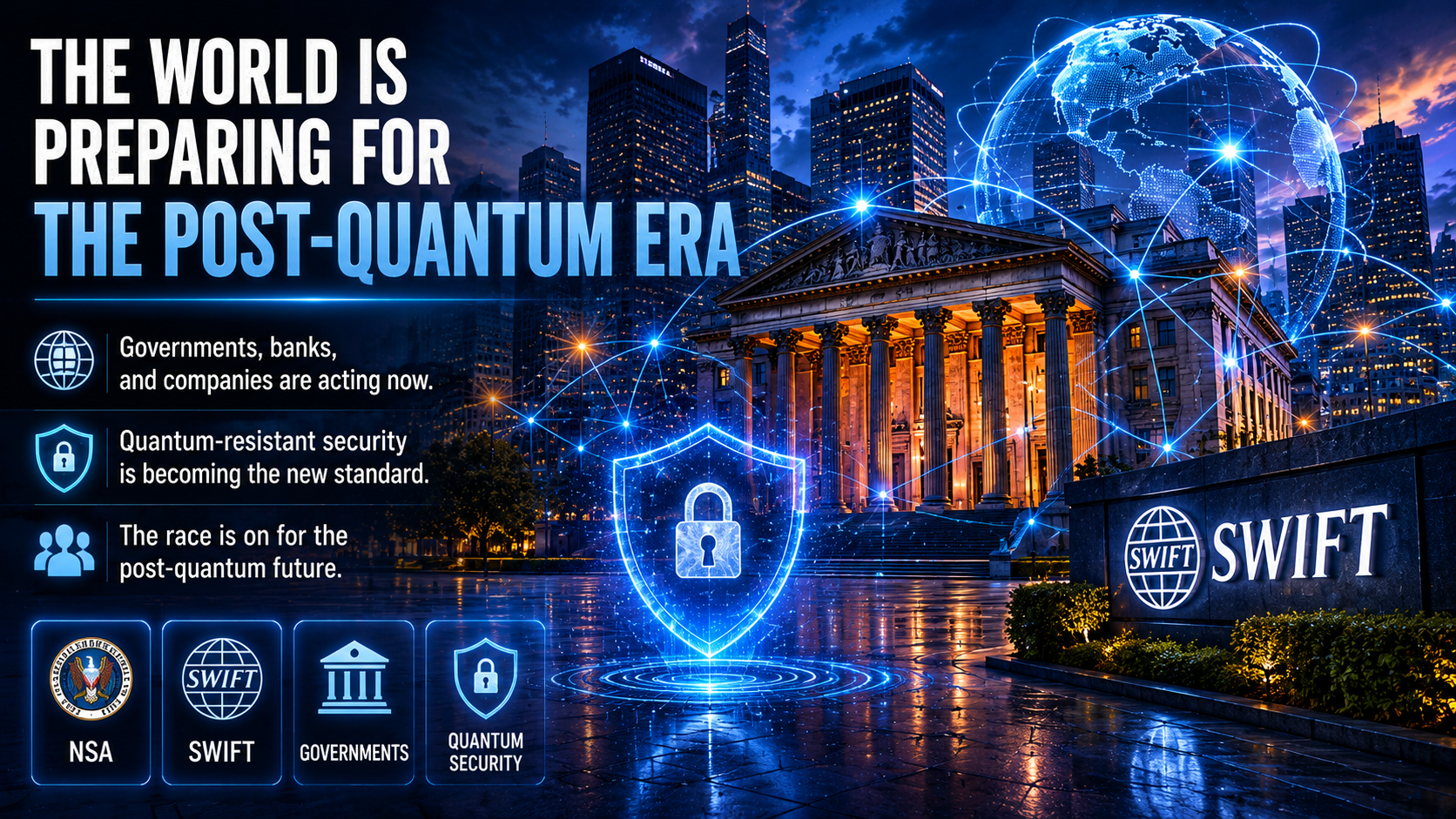
This is no longer just a national security issue.
The global financial system is preparing as well.
SWIFT — the network responsible for much of the world’s international banking communication — has already begun experimenting with quantum-resistant security systems.
The concern is clear
Will today’s encryption still protect global financial transactions in the future?
The Bank for International Settlements (BIS) has also participated in quantum security testing initiatives.
Meanwhile, governments around the world are racing to transition critical infrastructure toward post-quantum cryptography standards.
South Korea, for example, has announced plans to transition national infrastructure toward quantum-resistant encryption systems by 2035.
Big Tech Companies Are Moving Too
Governments are not alone.
Major technology companies have already started responding to the threat.
Recently, Apple introduced a next-generation security protocol called PQ3 for iMessage, specifically designed to strengthen protection against future quantum attacks.
Apple even directly referenced the possibility of
Harvest Now, Decrypt Later attacks.
That means this is no longer viewed as a distant possibility.
It is increasingly being treated as a real-world cybersecurity risk.
Apple
Google
IBM
Microsoft
Cybersecurity Experts Already Have a Name for the Threat
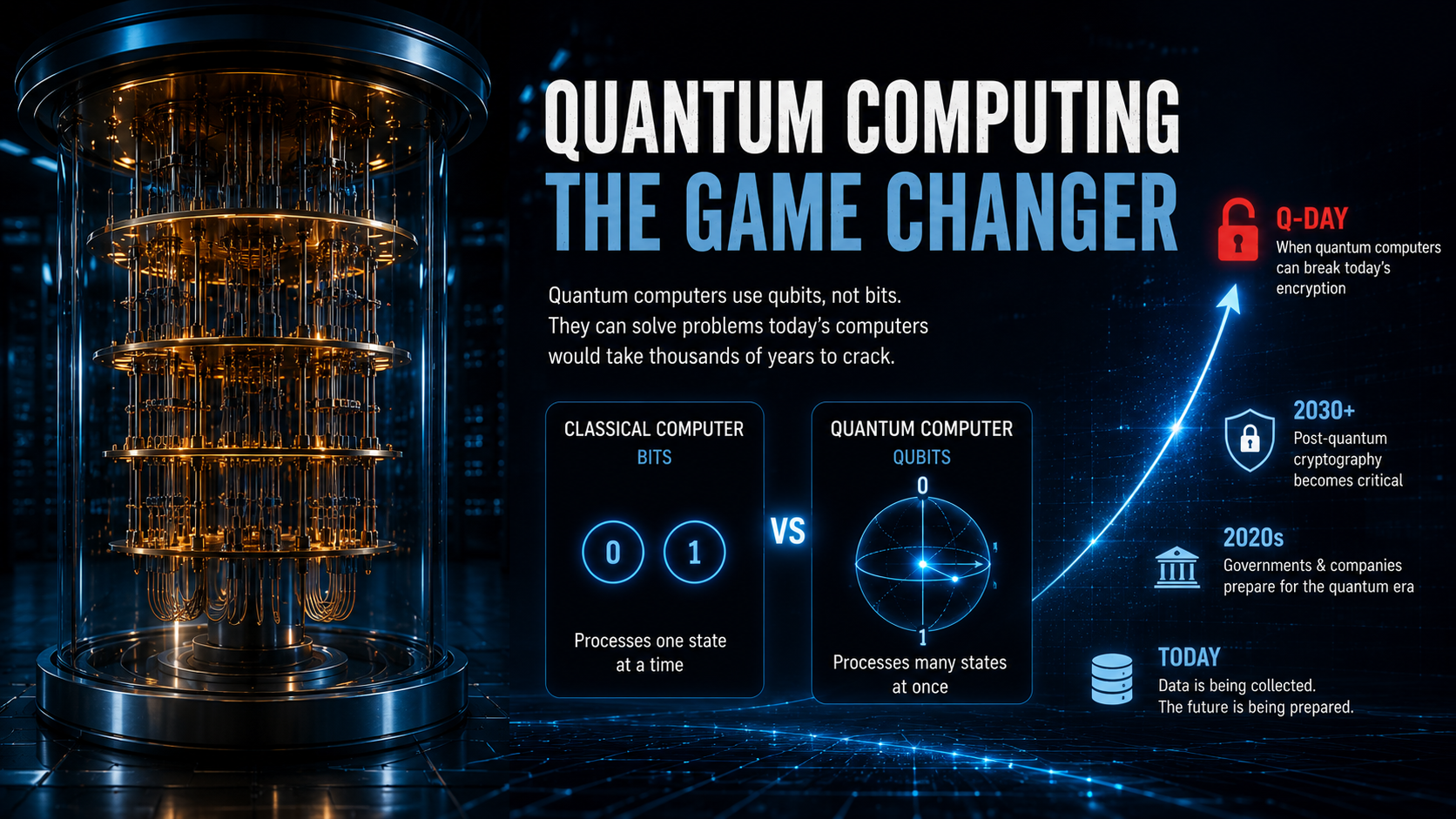
In cybersecurity circles, the moment when quantum computers become capable of breaking modern encryption is sometimes referred to as
Q-Day
No one knows exactly when it will happen.
But many experts believe the transition toward the post-quantum era has already begun.
And that changes the nature of security itself.
The question is no longer
“Is this data secure today?”
The real question is
“Will it still be secure in the future?”
The Most Vulnerable Data Is Long-Term Data
Ironically, the greatest risk may not involve short-term information at all.
The real concern is data that must remain protected for decades
- Medical histories
- National security documents
- Biometric data
- Corporate research
- Diplomatic archives
Because once data is stolen and stored, time may no longer matter.
A file encrypted today could become readable years later.
And that is why many experts consider Harvest Now, Decrypt Later one of the most serious long-term cybersecurity threats of the coming decade.
Final Thoughts
Most people think quantum computers are simply faster computers.
But the real story may be much bigger than that.
This is not just a race for computational power.
It may become a race to determine
Who can unlock the world’s encrypted information first.
And Harvest Now, Decrypt Later may be the first sign that this silent war has already begun.
This was Mastermind,
designing success.
'[Global] Success Blueprints' 카테고리의 다른 글
| [Blueprints of Giants #04] Why Did Jeff Bezos Accept Losses for 20 Years? (0) | 2026.05.29 |
|---|---|
| Micron Surged 21%… So Why Did the Nasdaq Barely Move? (0) | 2026.05.28 |
| The Real Way Quantum Computers Could Break Bitcoin (0) | 2026.05.28 |
| Why Are Retail Investors Struggling While Nasdaq Keeps Soaring? (0) | 2026.05.23 |
| Why America Is Obsessed With Quantum Computing (0) | 2026.05.23 |