The Real Way Quantum Computers Could Break Bitcoin


The Risk Behind Satoshi’s Wallet

Hello, this is MasterMind.
Many people believe that once quantum computers arrive, Bitcoin will instantly collapse.
For years, the crypto market has repeated the same fear
“Quantum computers will destroy Bitcoin.”
But the real danger may not be what most people think.
People usually assume the biggest risk is
- crypto exchanges getting hacked
- modern Bitcoin wallets being attacked
- investors losing access to their funds
But the market may actually fear something else entirely.
The real concern is old Bitcoin wallets that nobody can touch anymore.
And at the center of that discussion is one wallet in particular
Satoshi Nakamoto’s wallet.
Today, let’s talk about why quantum computing has become such a serious topic in crypto — and why Bitcoin’s biggest weakness may not be future technology, but the past itself.
Is Bitcoin Really Vulnerable to Quantum Computers?
Not exactly.
Even if powerful quantum computers eventually become reality, Bitcoin itself would not instantly disappear overnight.
Why?
Because Bitcoin’s cryptography can still evolve.
Security researchers and cryptographers are already developing
Post-Quantum Cryptography (PQC)
These are new encryption systems designed to resist attacks from quantum computers.
In theory, Bitcoin could eventually upgrade to quantum-resistant security.
But this is where Bitcoin’s structure creates a unique problem.
Bitcoin is not a bank.
There is no central authority that can automatically update everyone’s security.
Users must move their own funds into newer, safer wallets.
And that creates a dangerous vulnerability.
What happens to wallets that nobody can update anymore?
Why Old Bitcoin Wallets Are the Real Target
To understand the risk, we need to look at how Bitcoin wallets work.
Bitcoin security relies on two key components
- Public Keys
- Private Keys
The private key is essentially the password that controls ownership.
Right now, Bitcoin’s security depends on one assumption
It is practically impossible to calculate a private key from a public key.
But quantum computing could challenge that assumption.
In particular, researchers often point to
Shor’s Algorithm
A sufficiently advanced quantum computer could theoretically use this algorithm to reverse-engineer private keys from exposed public keys.
In simple terms
Public Key → Private Key Calculation → Asset Theft

That’s the fear.
But here’s the important part
Not all Bitcoin wallets face the same level of risk.
The biggest concern is older Bitcoin addresses created during Bitcoin’s early years.
Quantum Computers May Target Dormant Wallets First
Some early Bitcoin wallets were created using structures that exposed public keys more directly on the blockchain.

Modern wallets improved this significantly.
But many older wallets still remain exposed.
Think of it like this
Modern WalletsEarly Bitcoin Wallets
| Vault location hidden | Parts of the vault exposed |
| Better protection | Older security structure |
| Harder to attack | Easier quantum target |
That’s why many analysts believe quantum computers would not attack modern Bitcoin wallets first.
They would likely go after dormant wallets that nobody can defend anymore.
And that’s where Satoshi’s wallet becomes so important.
Why Google’s Quantum AI Research Matters
This discussion is no longer just science fiction.
Major tech companies are taking quantum computing very seriously.
Google Quantum AI researchers recently published findings suggesting that the resources required to break Bitcoin’s ECDSA encryption could eventually become far lower than previously expected.
Some researchers argue that once quantum systems reach sufficient scale, exposed Bitcoin addresses could become vulnerable within extremely short timeframes.
The market’s question is no longer
“Will quantum computing become possible?”
Instead, it has become
“How close are we to a real-world threat?”
Some researchers refer to that future turning point as
Q-Day
The moment quantum computers become capable of breaking existing cryptographic systems.
And increasingly, markets are beginning to treat this as a realistic long-term risk.
Why Satoshi Nakamoto’s Wallet Is a Time Bomb

Satoshi Nakamoto is believed to control roughly
1.1 million Bitcoin
And those coins have barely moved for more than a decade.
That alone makes the wallet one of the most closely watched addresses in financial history.
But the real issue is deeper than that.
Satoshi is gone.
Nobody can log in and move those coins into quantum-resistant wallets.
Nobody can upgrade the security.
Nobody can protect those addresses if quantum attacks ever become viable.
And that creates a strange philosophical problem for Bitcoin itself.
Bitcoin’s core principle has always been
“Nobody can control someone else’s money.”
But ironically, that same principle may leave old wallets permanently vulnerable forever.
The Real Fear Is Not Hacking — It’s Loss of Trust
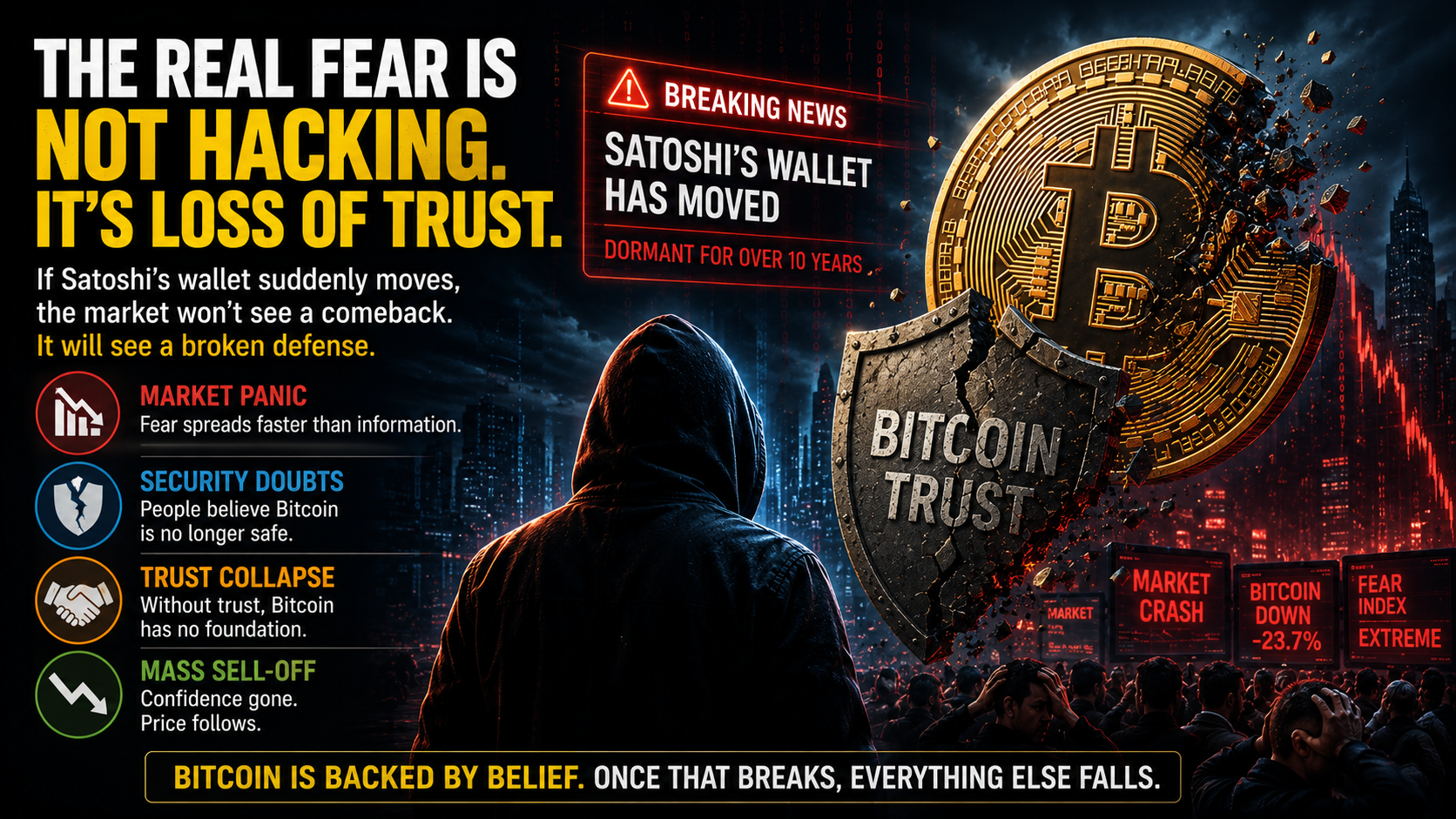
The market’s biggest fear is not simply stolen Bitcoin.
The real fear is
A collapse in confidence.
Imagine waking up one day to headlines saying
“Satoshi Nakamoto’s wallet has suddenly moved.”
The market reaction could be massive.
People might not assume Satoshi returned.
Instead, many could believe
- Bitcoin’s security has been compromised
- Quantum attacks have begun
- Old wallets are no longer safe
And once trust begins to break, panic can spread extremely fast across financial markets.
Because in the end, Bitcoin is not backed by a government.
It is backed by belief.
Bitcoin May Eventually Face a Philosophical Crisis
Some developers and researchers have already discussed extreme solutions.
Ideas such as
- freezing vulnerable dormant wallets
- forcing migration to quantum-safe addresses
- invalidating extremely old exposed coins
But these ideas collide directly with Bitcoin’s philosophy.
Because Bitcoin was built on one fundamental belief
No authority should control another person’s assets.
If the network ever starts forcibly modifying wallets to survive quantum threats, Bitcoin may end up challenging its own reason for existing.
And that may become Bitcoin’s biggest dilemma in the quantum era.
Final Thoughts
Many people believe quantum computers will destroy Bitcoin directly.
But the real threat may look very different.
Modern wallets can still upgrade.
Living users can still adapt.
The real vulnerability may be the forgotten wallets frozen in Bitcoin’s past.
Satoshi’s wallet.
Lost coins.
Dormant addresses untouched for over a decade.
In the end, Bitcoin’s greatest weakness may not be future technology itself —
but the parts of its past that nobody can ever update again.
This was MasterMind, designing success through understanding the systems behind the world.
'[Global] Success Blueprints' 카테고리의 다른 글
| Micron Surged 21%… So Why Did the Nasdaq Barely Move? (0) | 2026.05.28 |
|---|---|
| Why Is the World Collecting Encrypted Data Right Now? (0) | 2026.05.28 |
| Why Are Retail Investors Struggling While Nasdaq Keeps Soaring? (0) | 2026.05.23 |
| Why America Is Obsessed With Quantum Computing (0) | 2026.05.23 |
| ASML May Be More Important Than Nvidia in the AI Era (0) | 2026.05.22 |