[INSIGHT] What Happens If the Strait of Hormuz Closes? Why America Should Care About a Narrow Waterway in the Middle East


Hello, this is Mastermind.
For many Americans, the Strait of Hormuz feels like a distant geopolitical issue happening somewhere far away in the Middle East.
But every time tensions rise between Iran, Israel, and the United States, financial markets react almost instantly.
Oil prices jump.
Inflation fears return.
Stocks become volatile.
And suddenly, a narrow stretch of water most people have never seen starts affecting everything from gas prices to the Federal Reserve.
A few days ago, while watching energy prices move higher again, I found myself thinking:
“Why does a conflict thousands of miles away still have the power to shake the entire global economy?”

The answer is simple.
Because the Strait of Hormuz is not just another shipping route.
It is one of the most important economic chokepoints on Earth.
Today, let’s break down why Wall Street watches Hormuz so closely — and why the next major market shock could begin there.
1. The Strait of Hormuz: The World’s Energy Artery
The Strait of Hormuz sits between Iran and Oman.
At its narrowest point, it is only about 24 miles wide.
Yet despite its size, roughly 20% of the world’s oil trade passes through this corridor.
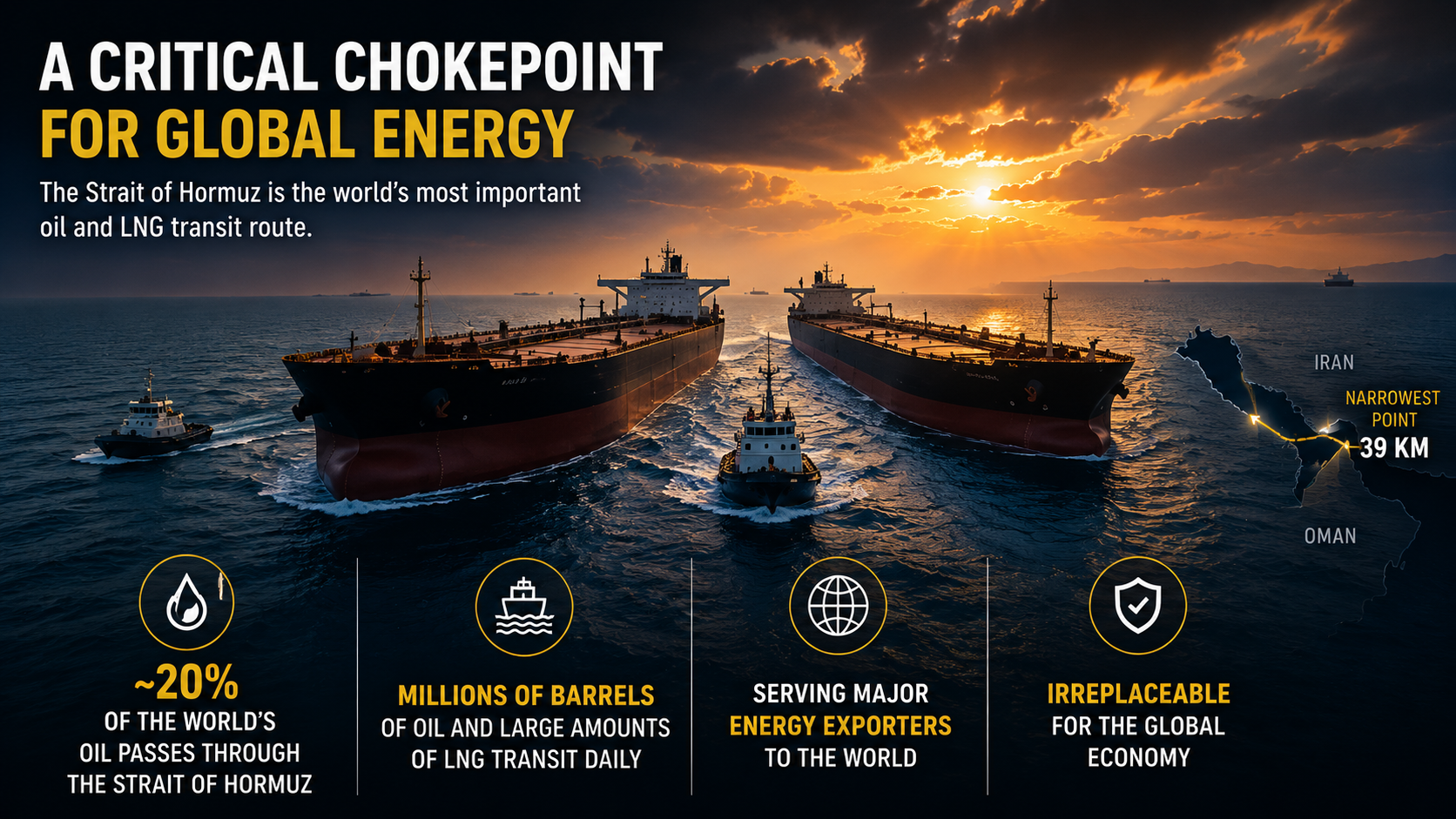
Massive amounts of liquefied natural gas (LNG) also move through the region every single day.
Countries like Saudi Arabia, Iraq, Kuwait, Qatar, and the UAE rely heavily on this route to export energy to the global market.
If the strait were blocked or disrupted, the consequences would extend far beyond the Middle East.
This would not simply be an “oil story.”
It would become a global inflation story,
a supply chain story,
and potentially a financial market crisis.
2. Why Wall Street Takes This Seriously
Markets do not react to headlines alone.
They react to risk.
And history shows that Hormuz disruptions are not theoretical.
The Tanker War
During the Iran-Iraq War in the 1980s, the region experienced what became known as the “Tanker War.”
Hundreds of commercial ships were attacked in the Persian Gulf.
Shipping insurance costs exploded.
Global oil transportation became unstable.
Energy markets experienced severe volatility.
This history matters because it proves something important:
The Strait of Hormuz has already been a battlefield before.
That is why investors pay attention whenever tensions escalate.
3. What Happens If Oil Explodes Higher?
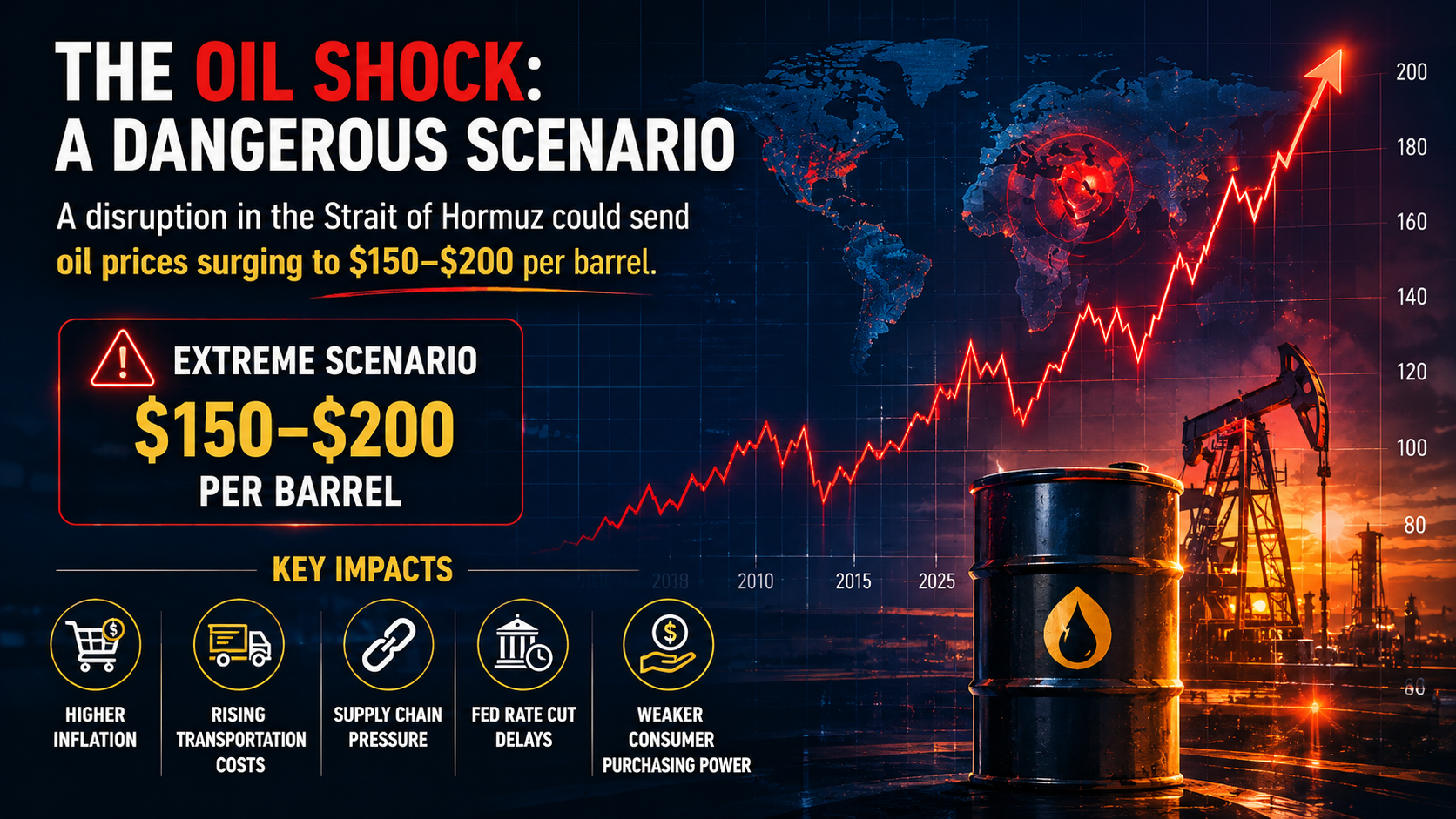
Some analysts have warned that a major disruption in Hormuz could push oil prices dramatically higher.
Extreme scenarios estimate crude oil could surge toward $150–$200 per barrel.
If that happens, the impact would spread across the entire U.S. economy.
Because oil affects almost everything.
Higher oil prices mean:
- More expensive transportation
- Rising airline costs
- Higher shipping expenses
- More expensive consumer goods
- Increased manufacturing costs
- Persistent inflation pressure
And that creates a serious problem for the Federal Reserve.
If inflation starts rising again because of energy prices, the Fed may delay interest-rate cuts for longer than markets expect.
That would pressure consumers, businesses, and even high-growth technology stocks.
4. Why Americans Would Feel It Everywhere
Many people think rising oil prices only affect gasoline.
But energy sits underneath the entire economy.
When fuel costs rise, companies pass those costs onto consumers.
That means Americans eventually pay more for:
- Groceries
- Online deliveries
- Flights
- Utilities
- Consumer products
Even if wages rise slowly, inflation can quietly reduce real purchasing power.
This is why energy shocks often create frustration across the economy.
Consumers feel squeezed from every direction.

5. Then Why Isn’t the Market Crashing?
This is where things get interesting.
If geopolitical risks are this dangerous, why has the Nasdaq remained relatively resilient?
Because the market is balancing two massive forces at once.
Fear vs. the AI Boom
On one side:
- War risks
- Energy instability
- Inflation fears
- Global uncertainty
On the other side:
- Artificial intelligence
- Semiconductor growth
- Data center expansion
- Productivity optimism
Wall Street understands the geopolitical risks.
But at the same time, institutional money continues pouring into companies connected to AI infrastructure and the future economy.
Why?
Because investors believe AI could drive a productivity revolution large enough to offset many long-term economic pressures.
Ironically, AI itself also increases energy demand.
Modern AI data centers consume enormous amounts of electricity and require huge infrastructure investments.
That means the future of technology may depend even more heavily on stable energy systems.
In other words:
AI and energy are becoming deeply connected stories.
6. The Industries That Could Benefit
Periods of instability often reshape capital flows.
As energy security becomes more important, several sectors may attract increased investor attention.
Energy Infrastructure
Oil storage, LNG facilities, pipelines, and power infrastructure could become strategically critical.
Defense Companies
Geopolitical instability often increases military spending and global demand for defense systems.
Nuclear Energy
As countries search for reliable long-term energy solutions, nuclear power could regain strategic importance.
Shipping and Logistics
Global trade disruptions often create new demand for specialized transportation and alternative supply routes.
The key is understanding that crises do not only destroy value.
They also redirect it.
7. The Bigger Picture Most Investors Miss
Most people see rising gas prices and feel anxiety.
Long-term investors often look deeper.
They ask:
“Where will capital flow next?”
Historically, some of the largest wealth shifts happened during periods of uncertainty.
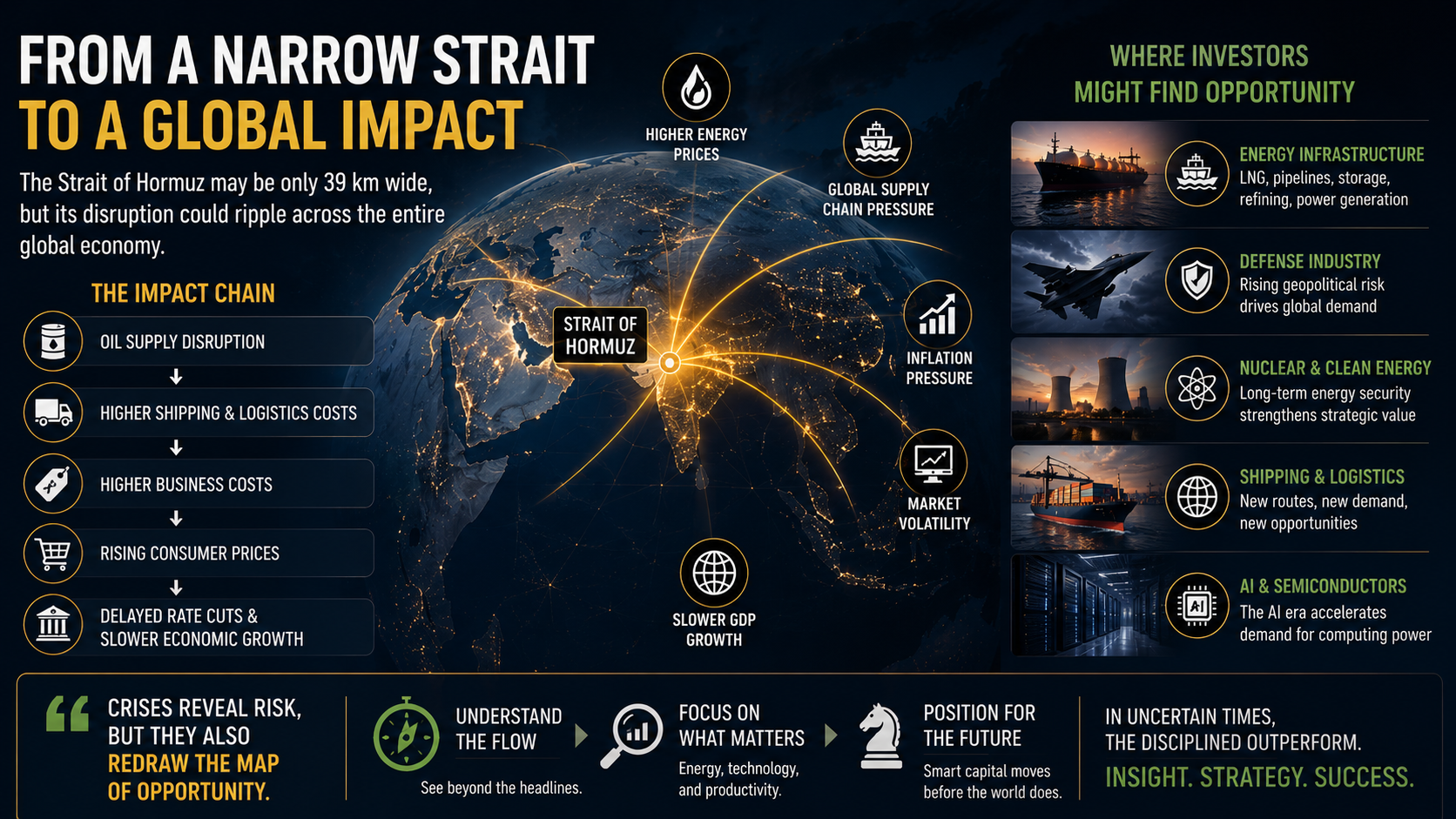
The market constantly searches for the next generation of strategic assets.
Today, the world appears to be caught between two powerful forces:
an old era shaped by geopolitical conflict,
and a new era driven by artificial intelligence.
The intersection between those two forces may define the next decade of investing.
Final Thoughts
The Strait of Hormuz may seem geographically distant from the United States.
But financially, it is deeply connected to everyday American life.
Gas prices,
inflation,
interest rates,
consumer spending,
and stock market sentiment can all be influenced by what happens in that narrow waterway.
That is why Wall Street watches it so carefully.
Because markets do not simply react to fear.
They react to the possibility of structural change.
And throughout history, moments of uncertainty have often created the foundation for the next era of opportunity.
This was Mastermind,
designing success through insight.
'[Global] Success Blueprints' 카테고리의 다른 글