What Is BESS? AI Data Center Power Demand, Battery Energy Storage, and Stocks to Watch


Hello, this is MasterMind.
AI investing has largely focused on GPUs, semiconductors, cloud computing, and networking.
But as AI infrastructure expands across the United States, another constraint is becoming increasingly important.
Power.
The question is no longer just whether companies can secure enough NVIDIA GPUs or build enough data center capacity.
The more important question is whether they can get enough electricity to those facilities fast enough.
Large AI data centers require enormous amounts of power, while new transmission lines, substations, and grid interconnections can take years to build.
This gap between the speed of AI investment and the speed of power infrastructure development is creating a new bottleneck.
That is where BESS, or Battery Energy Storage Systems, enters the picture.
The Key Takeaway
BESS does not generate electricity. It stores electricity and delivers it when and where it is needed, making the power system more flexible around large AI data centers.
As AI infrastructure expands, investors may need to look beyond battery manufacturers alone.
The opportunity can extend across battery cells, cooling systems, power conversion equipment, transformers, energy management software, and full-scale energy storage integration.
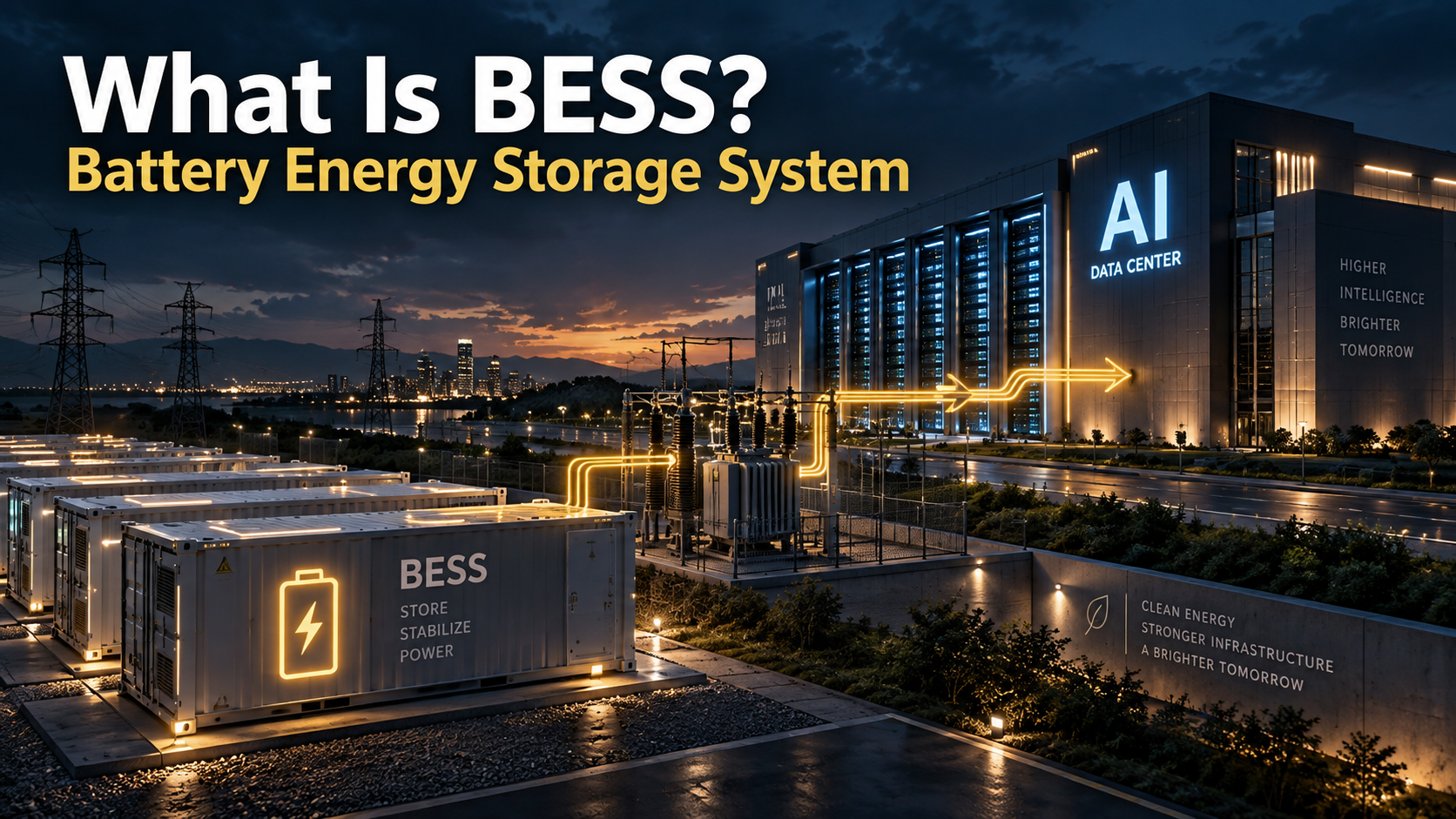
What Is BESS
BESS stands for Battery Energy Storage System.
At the simplest level, it works like an industrial-scale rechargeable battery.
Electricity is stored when power is available or relatively inexpensive, then discharged when demand increases or the grid needs additional support.
A utility-scale BESS, however, is much more than a battery.
It is an integrated power system that combines batteries, power electronics, software, thermal management, and grid equipment.
The Main Components of a BESS
| Component | Primary Function |
| Battery cells, modules, and racks | Store electrical energy |
| PCS | Converts electricity between AC and DC |
| BMS | Monitors battery temperature, voltage, and safety |
| EMS | Optimizes charging and discharging |
| Thermal management | Controls heat and reduces safety risks |
| Transformers and switchgear | Connect the system to the facility and grid |
| Safety systems | Detect abnormal conditions and thermal events |
This is why the BESS investment theme is broader than the battery industry alone.
ESS and BESS Are Not Exactly the Same Thing
ESS stands for Energy Storage System.
It is the broader category that includes many different forms of energy storage.
BESS refers specifically to energy storage systems that use batteries.
In simple terms, BESS is one type of ESS.
Other energy storage technologies include pumped hydro, compressed air, thermal storage, and flywheels.
BESS usually relies on electrochemical batteries such as lithium-ion and LFP, while sodium-ion batteries could also become more relevant over time.
For modern power grids and data centers, BESS has become one of the fastest-growing forms of energy storage because it can be deployed relatively quickly and respond to changes in electricity demand almost instantly.
Why AI Data Centers Need BESS
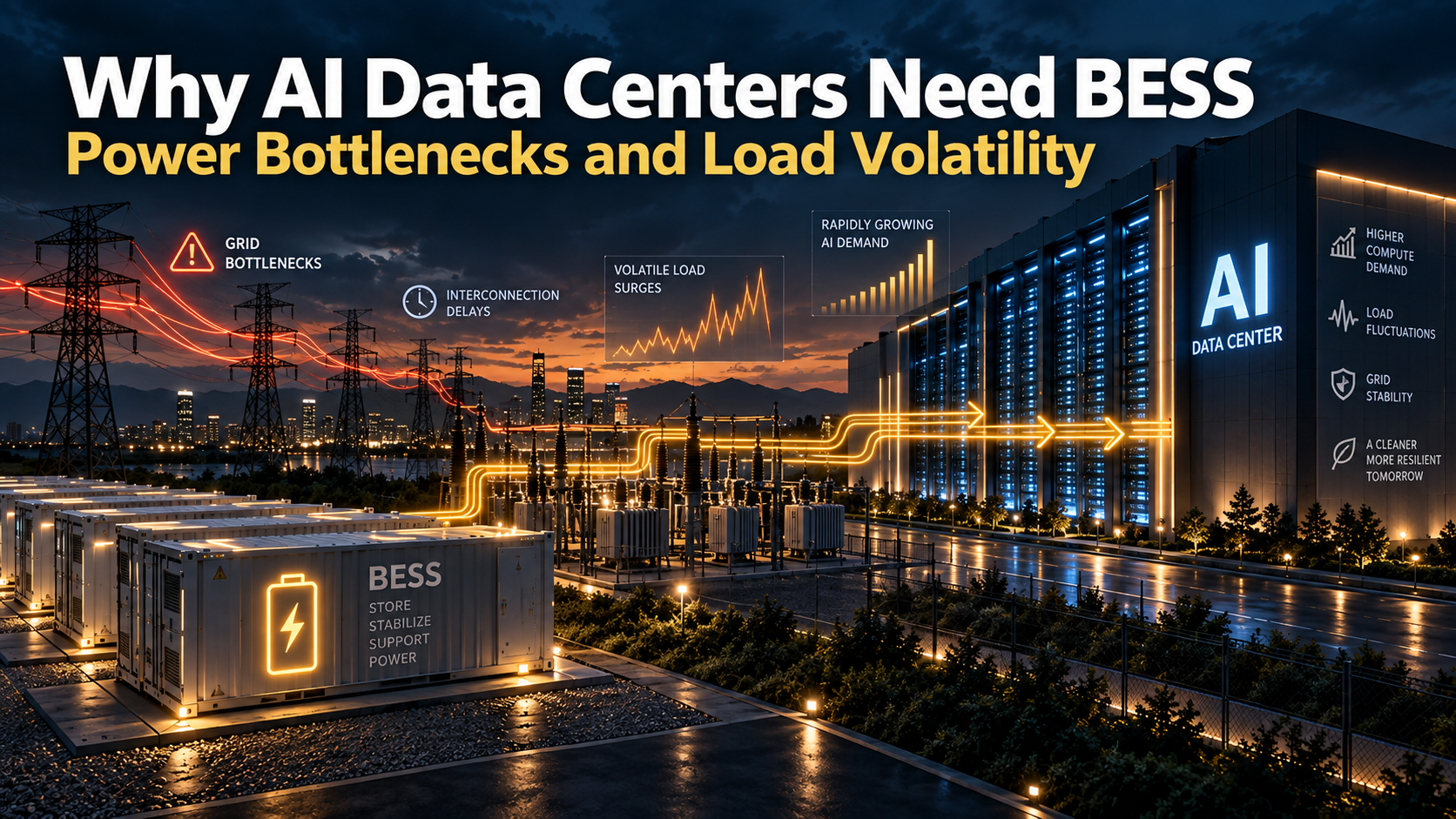
The power challenge created by AI data centers is different from the electricity demand of a typical commercial building.
There are three major structural issues.
Higher power density.
More volatile power demand.
Data center construction is moving faster than grid infrastructure.
BESS can help address all three.
1. BESS Can Smooth AI Power Demand
AI workloads are highly compute-intensive.
Large clusters of GPUs can ramp up or down depending on training and inference activity.
That means electricity consumption can also change rapidly.
For the grid, the challenge is not simply how much power the data center consumes.
The speed at which demand changes matters as well.
BESS can act as a power buffer.
When electricity demand suddenly increases, the system can discharge stored power.
When demand falls, it can recharge.
A useful analogy is a suspension system in a vehicle.
It does not remove every bump in the road, but it prevents every shock from being transferred directly into the vehicle.
BESS can play a similar role between AI compute loads and the power grid.
2. BESS Can Help Bridge Grid Bottlenecks
One of the most important concepts in the AI infrastructure boom is Time-to-Power.
This refers to how quickly a data center can secure enough electricity to begin operating.
A company may have the land.
It may have the building.
It may even have thousands of GPUs ready to install.
But if the local grid cannot provide sufficient power, the project can still be delayed.
Transmission lines, substations, and interconnection upgrades often require much longer development cycles than data center construction.
BESS can be combined with on-site generation, renewable energy, and microgrid infrastructure to improve flexibility while larger grid upgrades are being developed.
There is an important distinction, however.
BESS is not a replacement for power generation.
A battery does not create electricity.
It stores electricity that was generated somewhere else.
Its real economic value comes from shifting electricity across time and improving the flexibility of the broader power system.
3. BESS Can Reduce Peak Power Demand
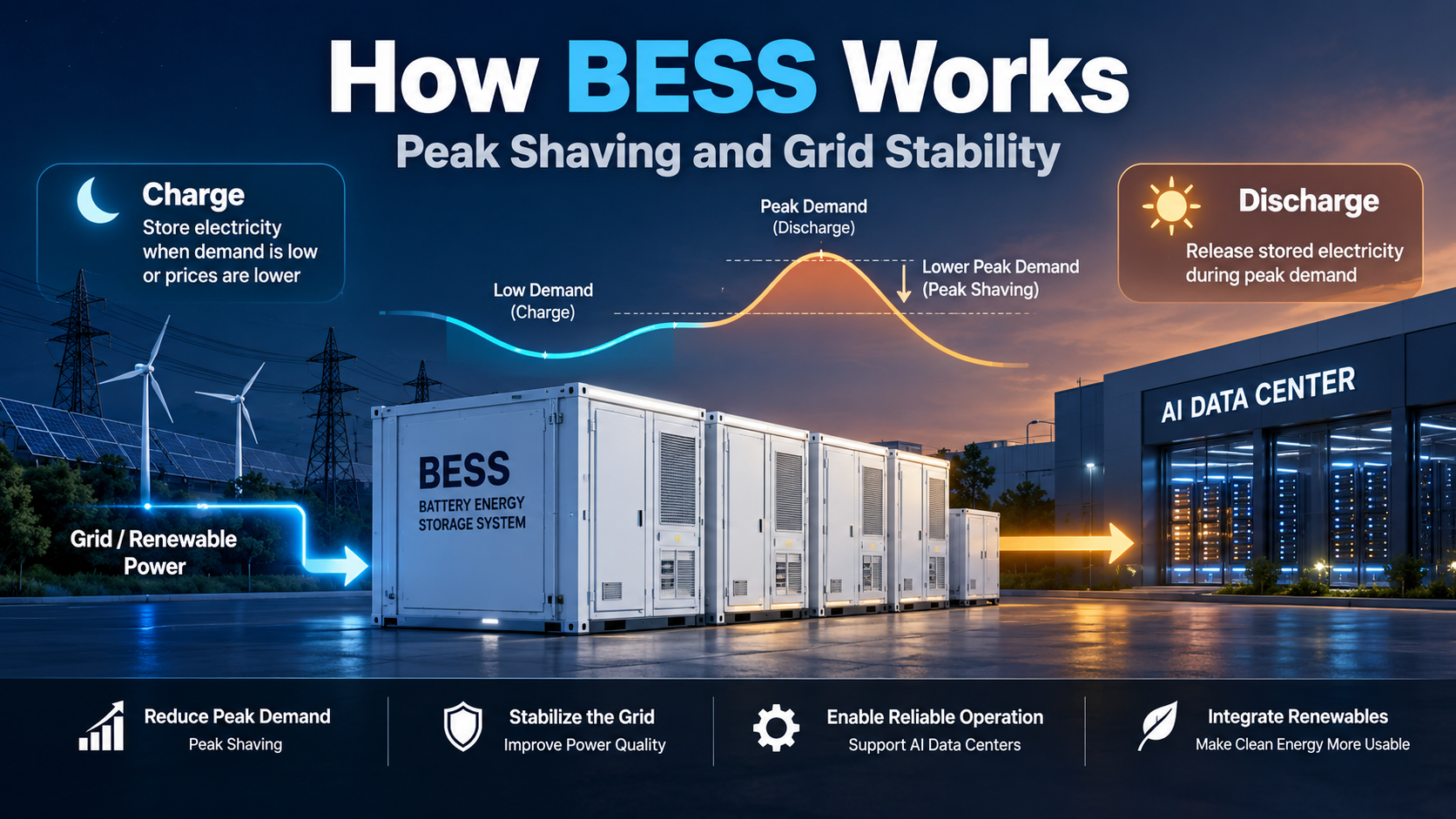
Data centers do not necessarily consume their maximum possible electricity every second of the day.
There can be periods when demand rises significantly above the normal operating level.
BESS can discharge during those periods and reduce the amount of electricity that must be drawn from the grid at peak demand.
This process is known as peak shaving.
Depending on local electricity tariffs and market structure, peak shaving can reduce grid stress and potentially lower operating costs.
4. BESS Can Support Power Reliability
Reliability is critical for data centers.
A power disruption that lasts only a short time can interrupt expensive computing workloads and create operational risks.
Traditional data centers rely heavily on UPS systems and backup generators.
BESS, UPS systems, and rack-level battery backup units can increasingly work together as part of a broader backup and resilience architecture.
This is particularly relevant for AI facilities where extremely expensive GPU clusters must remain operational.
5. BESS Can Make Renewable Energy More Useful
Solar and wind power do not produce electricity on demand.
Solar generation disappears at night.
Wind generation changes depending on weather conditions.
AI data centers, however, operate around the clock.
This creates a timing mismatch between electricity production and electricity consumption.
BESS can store renewable electricity when it is available and release it later.
That makes energy storage an increasingly important component of power systems that combine data centers with renewable generation.
Why the AI Power Bottleneck Matters
One of the most important ideas for investors is that total electricity generation and usable electricity capacity are not the same thing.
A region may theoretically produce enough electricity overall.
But if transmission capacity, transformers, or substations cannot deliver that power to a specific data center site, the electricity is not economically useful to that facility.
The AI data center power chain can be viewed as a sequence.
Generation → Transmission → Substation → Distribution → Data Center → Servers
A bottleneck anywhere in that chain can delay AI compute capacity.
This changes how investors should think about AI infrastructure.
The opportunity is no longer limited to companies producing GPUs.
Companies that solve the physical bottlenecks around those GPUs can become equally important.
Time-to-Power Could Become a Competitive Advantage
AI competition increasingly depends on how quickly companies can deploy computing capacity.
Owning advanced GPUs does not create value if those GPUs cannot be powered.
Building a data center does not create value if the facility cannot connect to the grid.
For hyperscalers and data center operators, three questions are becoming increasingly important.
How much power can be secured.
How reliably can that power be delivered.
How quickly can the facility begin operating.
BESS can potentially improve all three by adding flexibility between the grid and the data center.
That is why Time-to-Power is becoming a major part of the AI infrastructure investment story.
The AI Infrastructure Bottleneck Is Expanding Beyond GPUs
The first stage of the AI investment cycle centered on GPUs and advanced memory.
But every new GPU creates additional infrastructure requirements.
More GPUs require faster networking.
More computing power generates more heat.
More servers require more electricity.
The AI infrastructure chain therefore continues to expand.
GPU → HBM → Optical Networking → Cooling → Power Equipment → BESS → UPS and BBU
This is an important principle for investors.
Capital often follows bottlenecks.
When one constraint is solved, the next constraint becomes more valuable.
That is one reason investor attention has gradually expanded from semiconductor companies toward power equipment, cooling infrastructure, electrical systems, and energy storage.
The BESS Value Chain
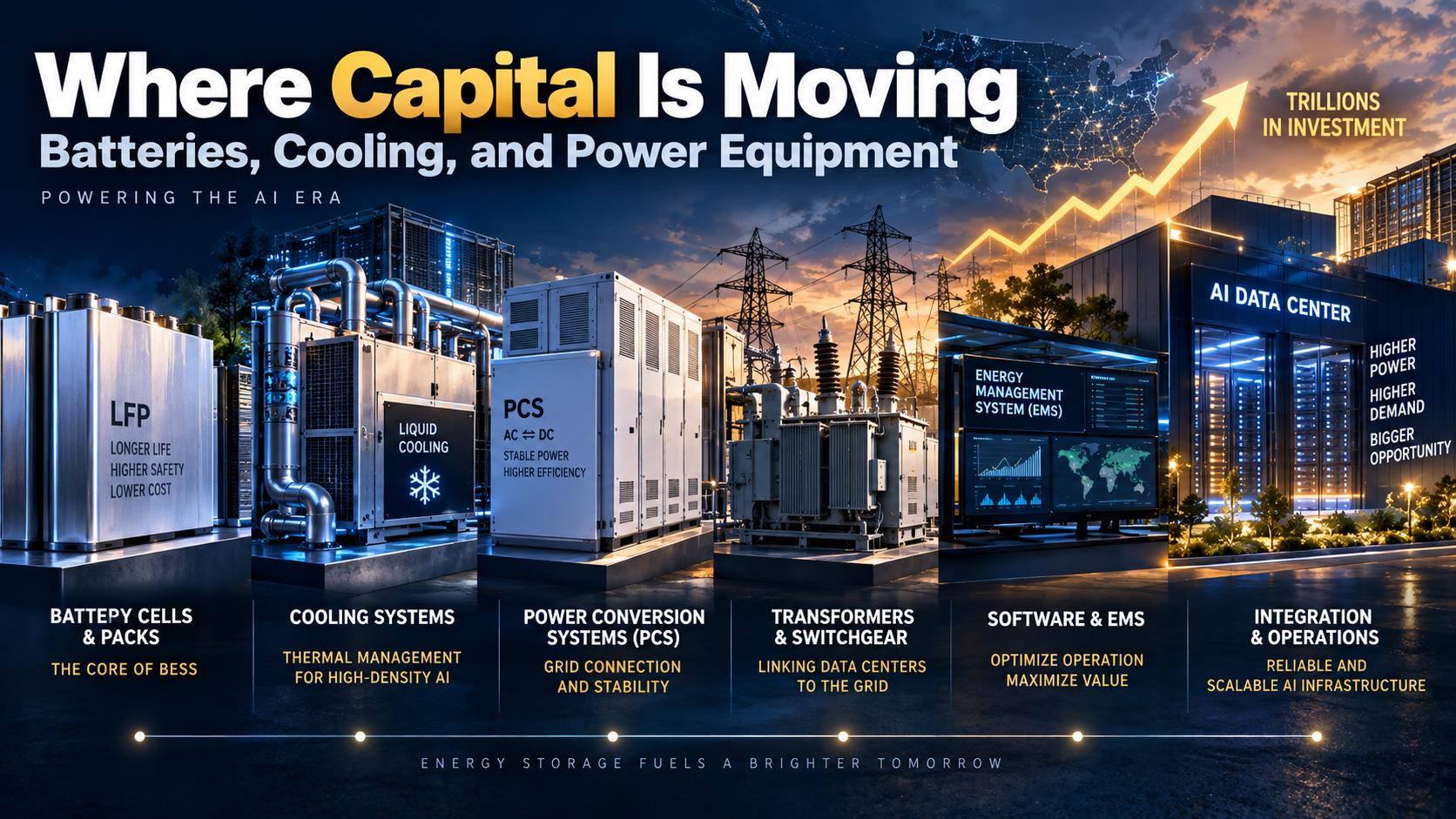
The growth of AI-related BESS demand does not benefit only battery manufacturers.
A large energy storage project requires multiple layers of hardware and software.
1. Battery Cells and Packs
The battery remains the core storage component.
For utility-scale energy storage, the most important characteristics can differ from electric vehicles.
Energy density still matters, but cost, lifespan, cycle life, safety, and reliability become especially important.
LFP batteries have become particularly important in stationary energy storage because of their cost structure and thermal stability.
Sodium-ion technology may also become worth watching as the market evolves.
2. Cooling and Enclosures
As energy storage systems become larger, thermal management becomes increasingly important.
Thousands of battery cells can be packed into a relatively small space.
Excess heat can reduce performance and increase safety risks.
This creates demand for air cooling, liquid cooling, thermal monitoring, and specialized battery enclosures.
Cooling should therefore be viewed as part of the BESS infrastructure opportunity rather than as a completely separate market.
3. Power Conversion Systems and Electrical Equipment
Batteries store DC electricity.
The power grid and most facilities operate primarily on AC electricity.
A PCS converts electricity between these two forms.
Large BESS installations also require transformers, switchgear, protection equipment, and distribution systems.
This is why the BESS theme overlaps with the broader U.S. power equipment investment cycle.
4. Energy Management Software
A battery only creates economic value when it knows when to charge and when to discharge.
An EMS can optimize operations based on electricity prices, grid conditions, battery health, and facility demand.
This could become an increasingly important part of the long-term BESS business model.
Energy storage may ultimately become less about selling a battery once and more about managing an intelligent power asset over many years.
5. System Integration
A company cannot simply purchase batteries, transformers, cooling equipment, and software separately and expect the project to work automatically.
All of those components must be engineered into one reliable system.
This creates an important role for BESS system integrators.
Large data centers may favor suppliers with proven engineering experience because reliability can matter more than simply offering the lowest upfront price.
6. VPP and Long-Term Operations
Another long-term opportunity is the virtual power plant model.
Multiple distributed batteries can be connected through software and operated like a single power resource.
If this market expands, the BESS industry could move beyond one-time equipment sales toward recurring software and operating revenue.
That distinction could become important for long-term investors.
BESS Value Chain at a Glance
| Segment | Main Role | What Investors Should Watch |
| Battery cells and packs | Energy storage | Cost, production capacity, ESS exposure |
| Cooling and enclosures | Thermal management | Liquid cooling, safety technology |
| PCS | Power conversion | Efficiency and scale |
| Transformers and switchgear | Grid connection | Data center and utility orders |
| EMS | Operating optimization | Software capabilities |
| System integration | Project deployment | Backlog and execution |
| VPP and operations | Long-term optimization | Recurring revenue |
U.S. BESS Stocks and Companies to Watch
For U.S. investors, the most visible names are not necessarily traditional battery companies.
The investment landscape includes energy storage integrators, power equipment suppliers, cooling companies, and grid infrastructure providers.
Tesla
Tesla is best known for electric vehicles, but its energy storage business has become increasingly important.
Megapack is designed for utility-scale and commercial energy storage applications.
The company combines battery hardware with energy management software, creating exposure to both the physical and digital sides of the energy storage market.
For investors, the key question is not simply whether Megapack deployments grow.
It is whether the energy storage business can generate durable margins and attractive cash returns as competition increases.
Fluence Energy
Fluence Energy is one of the most recognizable pure-play energy storage companies in the U.S. market.
Its business includes large-scale battery energy storage systems and software.
Fluence offers more direct exposure to the growth of BESS than diversified industrial companies.
But that direct exposure can also create higher execution risk.
Project delays, supply chain disruptions, pricing pressure, and margin volatility can materially affect results.
This illustrates an important investment principle.
A growing industry does not automatically create profitable companies.
What About Battery Manufacturers
The slowdown in electric vehicle growth has increased investor interest in stationary energy storage as another demand driver for batteries.
However, EV batteries and BESS batteries should not be treated as identical markets.
Electric vehicles place a premium on weight and energy density.
Stationary energy storage does not move.
For BESS, factors such as cost, cycle life, safety, operating life, and system economics can matter more.
This helps explain why LFP chemistry has become so important in stationary storage.
When evaluating battery manufacturers, investors may increasingly want to track several indicators.
ESS shipment growth.
ESS revenue exposure.
LFP manufacturing capacity.
North American production.
Long-term supply agreements.
Energy storage customers.
Margins and free cash flow.
How BESS Could Affect Other Asset Classes
The AI data center energy storage buildout can also influence other parts of financial markets.
| Asset or Industry | Potential Impact |
| Equities | Demand for batteries, PCS, cooling, transformers, and software |
| Copper | More transmission, transformers, and electrical equipment |
| Lithium | Additional battery demand |
| Power markets | Peak shaving and grid stabilization |
| Infrastructure finance | Capital spending on grids and energy storage |
| Renewable energy | Greater ability to shift solar and wind power across time |
For equity investors, the broader lesson is particularly important.
The investment opportunity may not be confined to battery companies.
It may spread across the entire power infrastructure chain.
Can BESS Solve the Entire AI Power Problem
No.
This is one of the most important limitations to understand.
BESS can store electricity.
It cannot continuously generate electricity.
A large AI data center that consumes hundreds of megawatts over long periods still requires a reliable source of generation.
It also requires transmission capacity, transformers, and substations.
The long-term solution to AI data center electricity demand will therefore likely involve multiple technologies working together.
Natural gas, nuclear, renewable generation, transmission, transformers, BESS, UPS systems, and internal data center electrical infrastructure
BESS is best understood as a flexibility tool within that larger system.
It can improve the timing, reliability, and efficiency of electricity delivery.
It does not eliminate the need for power generation or grid expansion.
What Investors Should Watch
Actual Revenue Matters More Than the Theme
Mentioning AI and energy storage in an earnings presentation does not automatically make a company a major beneficiary.
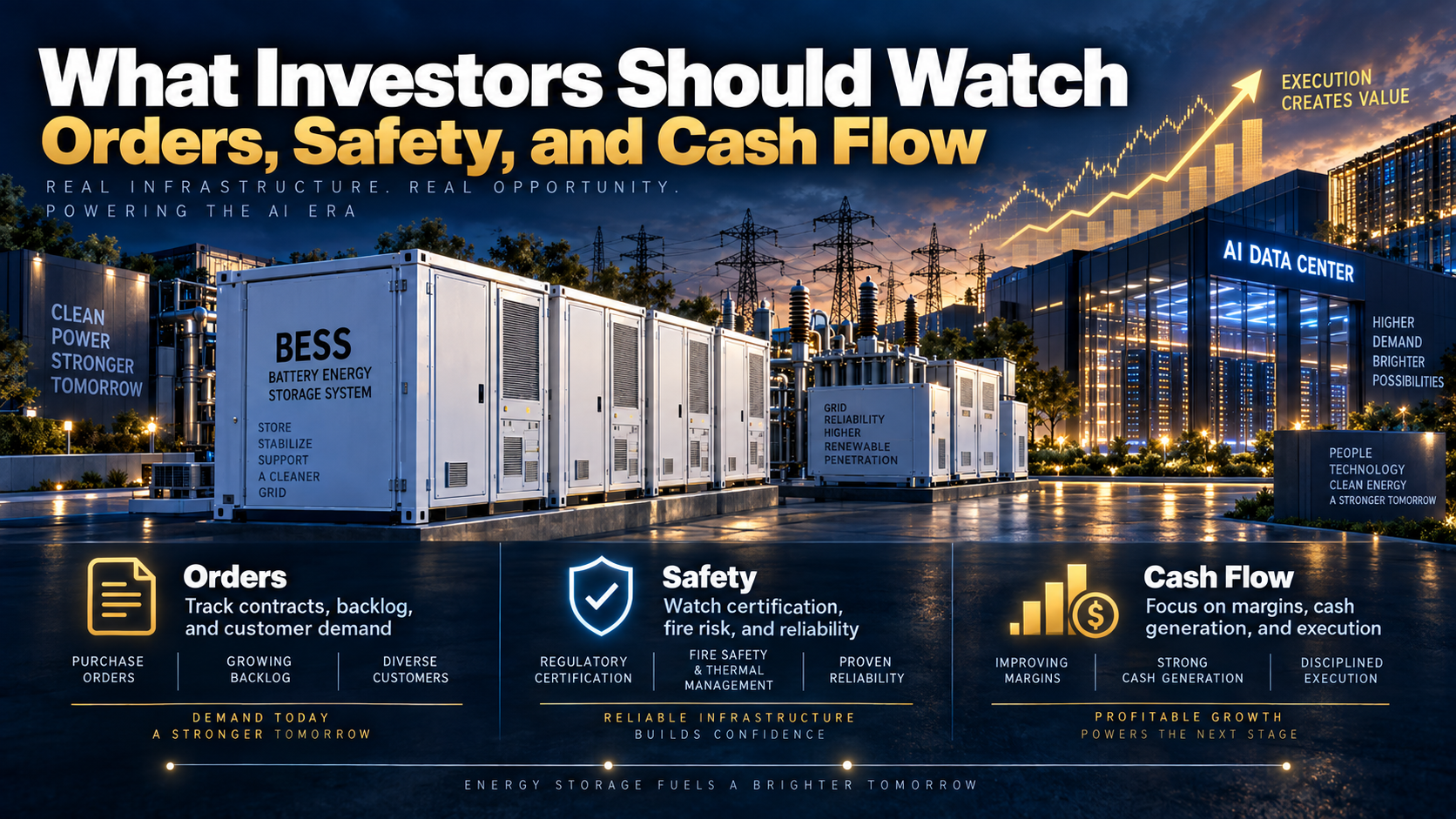
Investors should look for actual contracts, backlog growth, customer names, shipment volumes, and revenue contribution.
Separate EV Exposure From ESS Exposure
A battery company may dominate electric vehicles but have limited exposure to stationary storage.
Investors should evaluate ESS production capabilities separately.
LFP manufacturing, cost structure, and customer relationships matter.
Watch Thermal Management
As BESS installations become larger, cooling and safety become increasingly important.
Liquid cooling may gain adoption in high-density systems where temperature control becomes more difficult.
The companies supplying thermal management systems can therefore become part of the broader BESS opportunity.
North American Manufacturing Matters
The United States is becoming one of the most important markets for data center and power infrastructure investment.
Local manufacturing can reduce logistics risk and improve responsiveness to customers.
It can also become important when trade policy and supply chain rules change.
However, local production alone does not guarantee profitability.
System Integration Could Become a Competitive Moat
The long-term winners may not simply be the companies producing the cheapest batteries.
They may be the companies capable of integrating batteries, PCS, software, cooling, transformers, and grid equipment into a reliable system.
Execution history may become increasingly important as projects become larger.
Safety Cannot Be Ignored
BESS facilities concentrate large amounts of stored energy.
Thermal runaway or fire incidents can affect project economics, insurance costs, regulation, and customer confidence.
Safety performance should therefore be viewed as a business metric, not simply an engineering issue.
Follow Cash Flow
Large infrastructure projects can generate impressive revenue growth while consuming significant amounts of capital.
Investors should monitor operating cash flow, capital expenditures, working capital, and margins.
Orders are useful.
Profitable orders are better.
Cash-generating orders are what ultimately matter.
What Would Long-Term Capital Focus On
Follow the Movement of Capital
The first phase of the AI boom concentrated capital in semiconductors.
The next phase is increasingly about the physical infrastructure required to operate those chips.
Networking.
Cooling.
Transformers.
Power generation.
Energy storage.
Capital often moves toward whatever constraint becomes most valuable.
Investors therefore need to ask not only which industry has already performed well, but where the next bottleneck may appear.
Focus on Cash Flow
A strong industry does not guarantee a strong business.
Energy storage demand can grow while individual companies struggle because of falling prices, oversupply, or aggressive capital spending.
The critical question is whether growth produces durable cash flow.
Look for Business Survival
AI infrastructure spending may not grow at the same pace forever.
Companies with exposure to multiple markets may have greater resilience.
A BESS supplier that serves utilities, renewable energy developers, commercial customers, and data centers may have a more diversified demand base than a company dependent on one AI project.
Think in Decades, Not Quarters
BESS is not solely an AI investment theme.
It sits at the intersection of multiple long-term structural trends.
Grid modernization.
Renewable energy deployment.
Electricity demand growth.
Data center expansion.
Energy security.
This leads to a more useful question for long-term investors.
Would this infrastructure still be needed if the AI investment cycle slows down
Additional questions are worth asking.
Is real BESS revenue increasing.
Are orders turning into earnings and cash flow.
Can the company remain competitive as new suppliers enter the market.
Does it have demand beyond AI data centers.
Can it generate recurring revenue after the equipment is installed.
Long-term investment survival usually depends less on the size of a trend and more on whether a company can consistently turn that trend into cash.
Final Thoughts
AI may look like a software and semiconductor revolution.
But beneath the software is an enormous physical infrastructure system.
GPUs cannot run without electricity.
Data centers cannot operate without grid capacity.
And electricity is not valuable to an AI facility unless it can arrive at the right place, at the right time, with sufficient reliability.
That is where BESS becomes important.
It does not solve every power problem.
It does not replace power plants or transmission infrastructure.
Instead, it improves the flexibility of the energy system and helps bridge the gap between rapidly expanding AI computing demand and slower-moving power infrastructure.
For investors, this means the AI opportunity is becoming broader.
The next phase may not be only about who makes the fastest GPU.
It may also be about who generates the electricity, who moves it, who stores it, and who manages it.
The deeper lesson is simple.
When bottlenecks move, capital often moves with them.
But the companies that ultimately create long-term value will be the ones that convert infrastructure demand into profitable contracts, durable margins, and sustainable cash flow.
In investing, predicting the future perfectly matters less than owning businesses capable of surviving when the future unfolds differently than expected.
This was MasterMind.
'[Global] Success Blueprints' 카테고리의 다른 글