What Is Big Tech? How to Calculate SBC-Adjusted Free Cash Flow


Hello, this is MasterMind.
When Big Tech companies report billions of dollars in free cash flow every quarter, should investors simply take those numbers at face value?
Companies such as Apple, Microsoft, Alphabet, Amazon, Meta Platforms, and Nvidia are often viewed as some of the strongest cash-generating businesses in the world.
That reputation is largely justified.
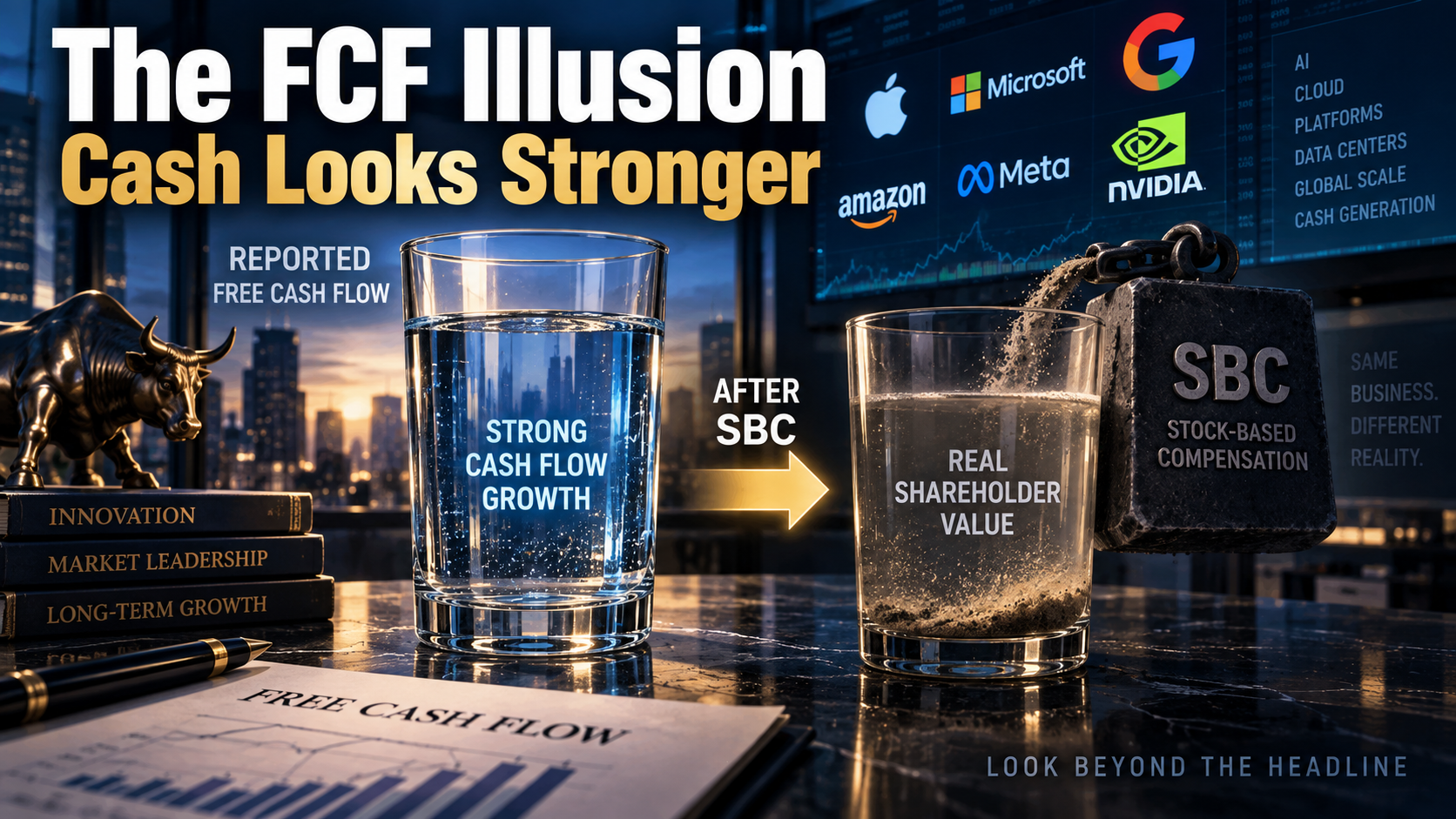
But there is an important accounting issue that can make reported free cash flow look stronger than the economic value ultimately retained by shareholders.
That issue is stock-based compensation, or SBC.
SBC does not immediately require a cash payment, but it can dilute existing shareholders or force companies to spend significant amounts of cash on share repurchases simply to offset that dilution.
For that reason, investors analyzing Big Tech should look beyond headline free cash flow and consider an SBC-adjusted version of FCF as well.
The Key Takeaway
Reported free cash flow can overstate the cash economics experienced by shareholders when stock-based compensation is large. A useful conservative measure is
SBC-Adjusted FCF = Operating Cash Flow - Capital Expenditures - Stock-Based Compensation
This is not an official GAAP metric, but it can help investors evaluate how much economic value remains after accounting for equity compensation.

1. What Is Big Tech?
The term Big Tech generally refers to the largest and most influential technology companies in the global economy.
There is no formal accounting definition, but the group often includes companies such as
- Apple
- Microsoft
- Alphabet
- Amazon
- Meta Platforms
- Nvidia
What makes these companies important is not merely their market capitalization.
They control critical parts of the digital economy, including
- cloud computing
- artificial intelligence
- semiconductors
- digital advertising
- operating systems
- smartphones
- e-commerce
- data centers
Many of these companies combine strong network effects, scalable business models, high margins, and enormous cash-generation capacity.
That is why investors often focus heavily on free cash flow, or FCF, when valuing them.
But FCF deserves a closer look.
2. What Is Stock-Based Compensation?
Stock-based compensation is compensation paid to employees and executives in the form of equity rather than cash.
This may include
- restricted stock units
- stock options
- performance shares
- other equity awards
For example, an employee might receive total annual compensation of $300,000 consisting of
- $200,000 in cash salary
- $100,000 in stock-based compensation
For the company, this has an important advantage.
The $100,000 equity award does not require an immediate $100,000 cash payment.
For fast-growing technology companies competing for engineers, AI researchers, chip designers, and senior executives, that flexibility can be extremely valuable.
But from the shareholder's perspective, the cost has not disappeared.
It has simply changed form.
If new shares are issued to employees, existing investors may own a smaller percentage of the company.
In other words
No immediate cash outflow does not mean no economic cost.

3. What Is Free Cash Flow?
Free cash flow measures the cash a business generates after funding the capital expenditures required to operate and grow the company.
A common formula is
Free Cash Flow = Operating Cash Flow - Capital Expenditures
Suppose a company generates
- $120 billion in operating cash flow
- $30 billion in capital expenditures
Its reported free cash flow would be
$90 billion
This cash can then be used for
- share repurchases
- dividends
- debt repayment
- acquisitions
- reinvestment
- cash accumulation
This is why FCF is one of the most widely used measures of corporate financial strength.
Unlike accounting earnings, it focuses on actual cash generated by the business.
But there is a catch.
Stock-based compensation can materially influence that number.
4. Why SBC Can Make Free Cash Flow Look Better
To understand the issue, it helps to follow the accounting treatment step by step.
Step 1: SBC Reduces GAAP Earnings
Stock-based compensation is recorded as an expense on the income statement.
That reduces
- operating income
- pretax income
- net income
So far, SBC appears to be treated like a normal business expense.
Step 2: SBC Is Added Back in the Cash Flow Statement
Because stock-based compensation does not involve an immediate cash outflow, it is added back when calculating operating cash flow under the indirect method.
That boosts operating cash flow relative to net income.
Step 3: Dilution Still Has an Economic Cost
The company may still issue shares to employees.
That can increase the diluted share count.
Alternatively, management may repurchase shares to offset this dilution.
In that case, actual cash leaves the business through buybacks.
So while SBC does not directly reduce operating cash flow, it can still reduce the economic value accruing to existing shareholders.
This is the core reason investors should not assume that every dollar of reported FCF is equivalent to a dollar of shareholder value.
5. How to Calculate SBC-Adjusted Free Cash Flow
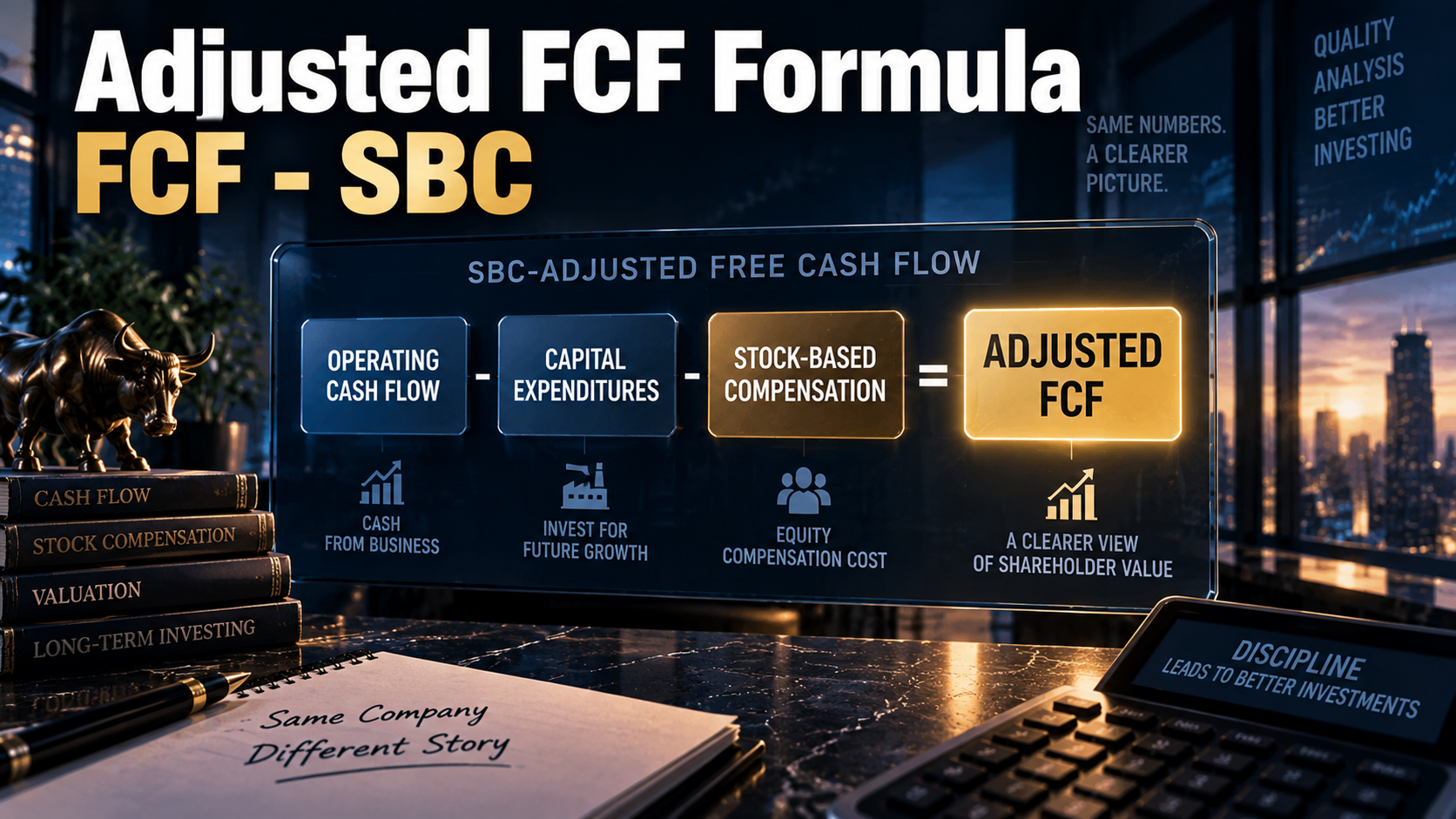
One conservative way to evaluate the issue is to subtract SBC from reported free cash flow.
Standard FCF
FCF = Operating Cash Flow - CapEx
SBC-Adjusted FCF
SBC-Adjusted FCF = Operating Cash Flow - CapEx - SBC
Or
SBC-Adjusted FCF = Reported FCF - SBC
Consider a simplified example
| Item | Amount |
| Operating Cash Flow | $120B |
| Capital Expenditures | -$30B |
| Reported FCF | $90B |
| Stock-Based Compensation | -$20B |
| SBC-Adjusted FCF | $70B |
On the surface, the company produces $90 billion in free cash flow.
But if investors treat the $20 billion of SBC as an economic cost borne by shareholders, adjusted FCF falls to $70 billion.
That is a meaningful difference.
However, one distinction is important.
FCF minus SBC is not an official GAAP definition of “true free cash flow.”
It is better understood as a conservative analytical adjustment.
Reported FCF remains a legitimate cash-flow measure.
SBC-adjusted FCF answers a different question
How much economic cash-generation power remains after treating equity compensation as a shareholder cost?
Both numbers are useful.
6. Why SBC Matters So Much for Big Tech
Technology is an unusually human-capital-intensive industry.
The competitive advantage of a software, semiconductor, cloud, or AI company often depends heavily on a relatively small group of highly skilled employees.
That makes equity compensation an important part of the business model.
High SBC is therefore not automatically a negative sign.
The better question is whether the company is creating value faster than it is issuing equity.
For example, suppose
- revenue grows 20%
- FCF grows 25%
- SBC grows 8%
The economic burden of SBC may actually be declining relative to the size of the business.
Now consider the opposite case
- revenue grows 8%
- FCF grows 5%
- SBC grows 30%
That deserves closer attention.
The issue is not simply whether SBC is high.
It is whether shareholder value is compounding faster than dilution.
The market does not ultimately reward accounting size. It rewards economic value per share.
7. Why Investors Should Analyze Buybacks and SBC Together
Big Tech companies regularly announce massive share repurchase programs.
These programs are often presented as shareholder returns.
Sometimes they are.
But not every dollar spent on buybacks necessarily increases existing shareholders' ownership percentage.
Part of the buyback may simply offset shares issued through employee compensation.
Imagine a company that
- spends $20 billion on share repurchases
- issues substantial equity through SBC
The headline number says the company returned $20 billion through buybacks.
But if most of that repurchase activity merely offsets new employee shares, the net benefit to existing shareholders may be much smaller.
That is why investors should examine three items together
Stock-Based Compensation → Share Repurchases → Diluted Share Count
The final share count tells you whether ownership is actually becoming more concentrated or more diluted.
8. The Diluted Share Count Reveals the Final Result
A company can report large SBC expenses without necessarily creating major dilution.
Aggressive share repurchases may offset equity issuance.
That is why the final diluted share count matters.
Consider this simplified example
| Year | Diluted Shares Outstanding |
| Year 1 | 1.00B |
| Year 2 | 1.03B |
| Year 3 | 1.07B |
Even if total earnings and FCF are increasing, the value created for each share may be growing more slowly because the denominator keeps expanding.
Now consider a different company.
It reports substantial SBC but consistently reduces its diluted share count through repurchases.
The shareholder outcome may be very different.
The important point is simple
Investors do not own the entire company. They own shares.
That makes per-share economics critical.

9. Look Beyond FCF Margin
Investors often compare companies using free cash flow margin.
The formula is
FCF Margin = Free Cash Flow / Revenue
Suppose a company generates
- $100 billion in revenue
- $25 billion in FCF
Its FCF margin is
25%
That appears extremely strong.
But suppose the company also records $10 billion in annual SBC.
Then
SBC-Adjusted FCF = $15 billion
And
SBC-Adjusted FCF Margin = 15%
The business is still cash-generative.
But the economics look materially different.
This distinction becomes especially important when comparing mature technology companies with high-growth businesses that rely heavily on stock compensation.
10. SBC Can Change Big Tech Valuations
Free cash flow is widely used in valuation.
Common metrics include
- Price-to-FCF
- EV-to-FCF
- FCF Yield
- discounted cash flow models
If the FCF denominator includes substantial SBC add-backs, valuation can look more attractive than it would under an SBC-adjusted framework.
Consider a company with a $100 billion enterprise value.
If reported FCF is $10 billion
FCF Yield = 10%
But if SBC is $3 billion
SBC-Adjusted FCF = $7 billion
The adjusted yield becomes
7%
Nothing about the stock price changed.
Only the definition of economic cash flow changed.
That is why SBC-heavy companies can look significantly more expensive when viewed through an adjusted FCF lens.
11. Does SBC Affect the Broader Market?
Stock-based compensation is not a macro variable like interest rates, inflation, Treasury yields, or the dollar.
It does not directly determine the direction of bonds, gold, Bitcoin, or commodities.
Its primary impact is on individual company economics and equity valuation.
Still, market conditions can change how much investors care about SBC.
| Market Area | Why SBC Matters |
| Growth Stocks | Reported FCF may look stronger than shareholder economics |
| FCF Yield | Adjusted yield can be materially lower |
| Buybacks | Repurchases may primarily offset dilution |
| Per-Share Value | Share-count growth can dilute FCF growth |
| High-Rate Environment | Investors may become less tolerant of weak cash economics |
| Management Compensation | Equity issuance affects value allocation between employees and shareholders |
During periods of abundant liquidity, investors may focus primarily on revenue growth.
When capital becomes more expensive, the quality of cash flow often matters more.
That is when SBC can receive greater scrutiny.
12. Six Metrics Investors Should Track
1. SBC as a Percentage of Revenue
Calculate
SBC / Revenue
There is no universal threshold that automatically separates good companies from bad ones.
The ratio should be compared with
- peers
- the company's historical range
- its growth rate
- its profitability
2. SBC as a Percentage of Free Cash Flow
Calculate
SBC / FCF
This shows how large the equity-compensation burden is relative to reported free cash flow.
The higher the ratio, the larger the gap between reported and SBC-adjusted cash generation may become.
3. Revenue Growth Versus SBC Growth
If SBC consistently grows faster than revenue and FCF, the burden on shareholders may be increasing.
4. Share Repurchases
Do not stop at the headline buyback number.
Ask whether repurchases actually reduced the share count.
5. Diluted Shares Outstanding
This is one of the clearest measures of whether shareholders are ultimately being diluted.
6. Free Cash Flow Per Share
A useful formula is
FCF Per Share = Free Cash Flow / Diluted Shares Outstanding
Total FCF can rise while FCF per share barely improves.
For long-term owners, the second number often matters more.
13. Is High Stock-Based Compensation Always Bad?
No.
That conclusion would be too simplistic.
Stock-based compensation can be a rational and productive form of investment in human capital.
If a company grants $1 billion in equity compensation to retain world-class engineers who later create several billion dollars of incremental revenue and cash flow, the program may create substantial shareholder value.
The real question is not
“Does this company have high SBC?”
The better question is
“Is this company creating per-share value faster than it is issuing equity?”
Ignoring SBC entirely can understate the cost of dilution.
Treating all SBC as inherently destructive can underestimate the value of attracting and retaining exceptional talent.
Good analysis requires both sides.
14. What Do Long-Term Capital Allocators Look For?
During bull markets, rising stock prices can hide many weaknesses.
When liquidity tightens, investors tend to rediscover the importance of cash flow quality.
Long-term capital allocators often focus on four things.
Where the Money Goes
Big Tech cash flow can be directed toward
- AI infrastructure
- data centers
- research and development
- acquisitions
- dividends
- buybacks
- employee compensation
The important question is whether today's cash outflows create larger cash flows tomorrow.
Cash Flow Quality
High reported FCF is valuable.
But it becomes even more informative when investors understand how much of it depends on large non-cash compensation add-backs.
Financial Resilience
The strongest companies can fund growth internally even when financing conditions deteriorate.
Businesses that depend heavily on constant equity issuance may become more vulnerable when market sentiment changes.
Per-Share Compounding
Over long periods, total revenue and total FCF matter less than what happens to each shareholder's economic claim.
The ultimate question is
Is the company increasing long-term cash flow and intrinsic value per share?
That leads to several useful questions investors can ask
- How large is SBC relative to FCF?
- Is SBC growing faster than revenue?
- Is the diluted share count rising or falling?
- Are buybacks creating net share reduction?
- Is FCF per share increasing?
- Does the valuation still make sense using SBC-adjusted FCF?
- Is equity compensation generating future returns that justify its cost?
15. Final Thoughts
Big Tech deserves its reputation for extraordinary cash generation.
But headline free cash flow does not always tell the full economic story.
Stock-based compensation is expensed through the income statement, yet because it is non-cash, it is added back in operating cash flow.
That can create a meaningful gap between reported FCF and the economic value ultimately accruing to shareholders.
For that reason, investors should examine at least four things together
Reported FCF, SBC-Adjusted FCF, Share Repurchases, and Diluted Share Count.
And ultimately, the analysis comes down to one question
Is the company creating more cash flow and intrinsic value per share over time?
The strongest companies are not simply those that generate the most cash in absolute terms.
They are the companies that continue increasing the economic value of each share even after accounting for reinvestment, compensation, and dilution.
This is MasterMind.
'[Global] Success Blueprints' 카테고리의 다른 글