U.S. Jobs Report: 4 Key Employment Indicators Every Investor Should Watch


Hello, this is MasterMind.
On the first Friday of almost every month, Wall Street slows down for one event: the U.S. Jobs Report.
Whether you're investing in stocks, bonds, Bitcoin, or gold, you've probably noticed that markets can swing dramatically within minutes of the employment data being released.
But here's the catch: professional investors aren't focused on just one headline number.
Most retail investors look at Nonfarm Payrolls (NFP) and stop there. Institutional investors look deeper.
They analyze multiple employment indicators together because the real question isn't simply whether jobs increased or decreased. The real question is
How will this data change the Federal Reserve's next move?
This article explains the four employment indicators every investor should understand and why they often matter more than corporate earnings in the short term.

Key Takeaway
The U.S. Jobs Report isn't just about employment. It's one of the strongest signals for future interest rates, liquidity, and the direction of financial markets.
Why the U.S. Jobs Report Matters
Employment is the foundation of the American economy.
When people have jobs, they earn income.
Income fuels consumer spending.
Consumer spending drives corporate profits.
Corporate profits support stock prices.
Since consumer spending accounts for roughly 70% of U.S. GDP, labor market data becomes one of the clearest windows into the overall health of the economy.
That is why investors across the globe closely watch every monthly employment report.
How Employment Data Moves Financial Markets

The relationship is surprisingly straightforward.
Employment → Income → Consumer Spending → Inflation → Federal Reserve Policy → Asset Prices
A strong labor market usually leads to higher wages and stronger consumer demand.
That sounds positive at first.
However, stronger demand can also keep inflation elevated.
If inflation remains stubborn, the Federal Reserve may keep interest rates higher for longer.
Higher interest rates generally reduce liquidity, making financial conditions tighter.
On the other hand, weaker employment may signal slowing economic growth, but it can also increase expectations that the Fed will begin cutting rates.
That is why markets sometimes rally after disappointing jobs data.
Investors are not reacting to employment itself.
They are reacting to what employment data implies about future liquidity.
Markets price the future, not the present.
Employment data is valuable because it changes expectations about tomorrow's monetary policy—not yesterday's economy.
Why Investors Pay Close Attention
The Federal Reserve has two primary objectives
- Price stability
- Maximum employment
As inflation begins to cool, labor market conditions become increasingly important.
If employment weakens significantly, the Fed may eventually shift toward lower interest rates to support economic growth.
If hiring remains exceptionally strong, policymakers may hesitate to ease monetary policy too quickly.
Ultimately, investors monitor employment reports because labor market trends influence interest rates, and interest rates influence virtually every major asset class.
Four Employment Indicators Every Investor Should Watch
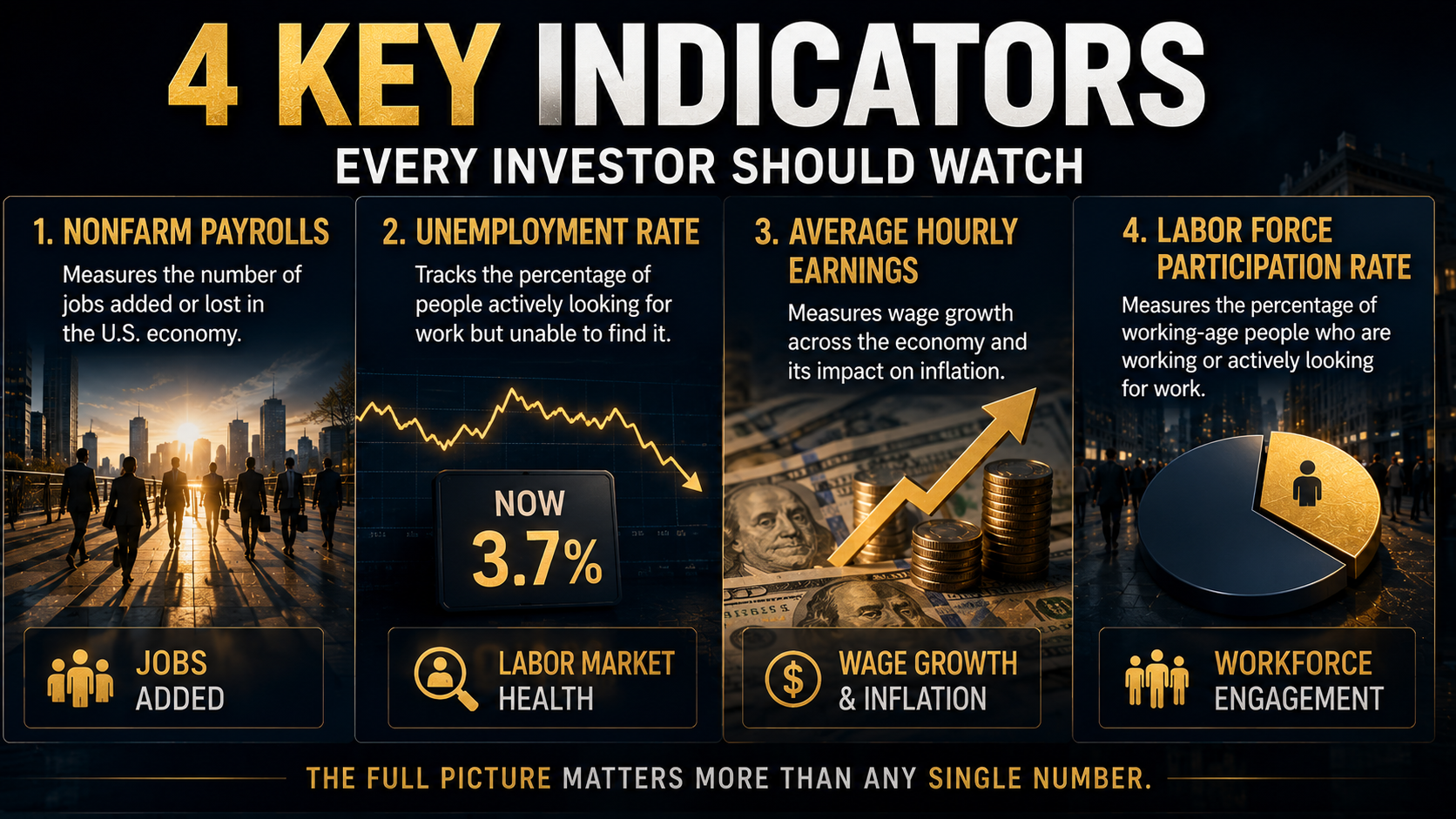
1. Nonfarm Payrolls (NFP)
Nonfarm Payrolls measure the number of jobs added or lost across the U.S. economy, excluding farm workers.
It is the headline figure reported by financial media and often generates the largest immediate market reaction.
A stronger-than-expected reading typically signals economic strength, while a weaker report may increase expectations for future rate cuts.
Related Reading
Want to understand why Nonfarm Payrolls (NFP) often move the stock market?
→ What Is NFP? Why the Non-Farm Payrolls Report Moves Stocks, Bitcoin, and Global Markets
2. Unemployment Rate
The unemployment rate measures the percentage of people actively seeking work but unable to find a job.
Even small changes can influence recession expectations and Federal Reserve policy.
A rising unemployment rate often signals that labor market conditions are beginning to soften.
Many economists also watch longer-term trends, such as the Sahm Rule, which has historically helped identify the early stages of economic downturns.
Related Reading
Learn how the unemployment rate influences Federal Reserve policy and recession expectations.
→ What Is the Unemployment Rate? Why It Moves Interest Rates and Stocks
3. Average Hourly Earnings
Average Hourly Earnings measure wage growth across the U.S. economy.
Many investors underestimate its importance.
Persistent wage growth can keep inflation elevated because higher incomes often support stronger consumer spending.
For that reason, wage growth is one of the Federal Reserve's preferred indicators when evaluating underlying inflation pressures.
Sometimes wage growth matters more than payroll growth itself.
Related Reading
Wage growth is one of the Fed's favorite inflation indicators.
→ What Is Average Hourly Earnings? Why It Matters for Inflation, Interest Rates, and Stocks
4. Labor Force Participation Rate
The Labor Force Participation Rate measures the percentage of working-age Americans who are either employed or actively looking for work.
A low unemployment rate does not always indicate a healthy labor market.
If fewer people are participating in the workforce altogether, unemployment may appear lower for the wrong reasons.
Participation helps investors evaluate the overall quality of labor market conditions rather than focusing on one headline statistic.
Why These Four Indicators Should Be Viewed Together
Professional investors rarely analyze these numbers in isolation.
For example
- Payroll growth may exceed expectations while wage growth slows.
- Employment may weaken, but participation could improve.
- Payrolls might disappoint while unemployment remains stable.
Each combination tells a different economic story.
Markets are not solving a single equation.
They are assembling a puzzle.
The complete picture matters far more than any individual number.
How Different Asset Classes Typically React

| Asse | Strong Jobs Report | Weak Jobs Report |
| U.S. Stocks | Economic optimism vs. higher-rate concerns | Rate-cut optimism vs. recession fears |
| U.S. Treasury Bonds | Bond prices often fall as yields rise | Bond prices often rise as yields decline |
| U.S. Dollar | Usually strengthens | Often weakens |
| Gold | May face pressure from higher real yields | Often benefits from lower rates and a weaker dollar |
| Bitcoin | Liquidity concerns may weigh on prices | Easier monetary policy expectations can be supportive |
The market's reaction depends on what investors fear more at that particular moment
Persistent inflation—or economic recession.
The same employment report can produce completely different market reactions depending on the broader macroeconomic environment.
What Smart Investors Focus On
Instead of chasing headlines, experienced investors ask better questions.
- Was the report above or below expectations?
- Were previous months revised higher or lower?
- Which indicator changed the overall narrative?
- Will this report likely influence the Federal Reserve's next meeting?
- Has market sentiment shifted more than the data itself?
The objective isn't to predict every market move.
The objective is to understand how expectations are changing.
What Wealthy Investors See That Others Often Miss

Large institutional investors rarely make decisions based on a single economic release.
Instead, they study how capital is likely to move over the coming months.
If strong employment keeps interest rates elevated, money may rotate toward defensive assets and fixed income.
If labor conditions weaken enough to support monetary easing, liquidity may gradually flow back into growth stocks and other risk assets.
Long-term investing isn't about predicting every data release.
It's about building a portfolio that can survive multiple economic environments.
Ask yourself
- Is my portfolio prepared for both higher and lower interest rates?
- Am I reacting to headlines or following a long-term investment process?
- Am I watching individual numbers—or the broader flow of capital?
The investors who build lasting wealth are rarely the ones who memorize economic statistics.
They are the ones who understand how those statistics influence the movement of money.
Related Articles
If you'd like to learn more about the U.S. labor market and how it affects investing, these guides may help
- What Is NFP? Why the Non-Farm Payrolls Report Moves Stocks, Bitcoin, and Global Markets
- What Is the Unemployment Rate? Why It Moves Interest Rates and Stocks
- What Is Average Hourly Earnings? Why It Matters for Inflation, Interest Rates, and Stocks
- What Is the Labor Force Participation Rate?
- What Is the ADP Employment Report? Why It Matters to Investors
- What Are Initial Jobless Claims? Meaning, Market Impact, and Why Investors Watch Them
- Why Do Stocks Rise When Jobs Data Is Weak? The Hidden Link to Interest Rates
Final Thoughts
The monthly U.S. Jobs Report is far more than an employment update.
It is one of the most important signals shaping expectations for Federal Reserve policy, interest rates, liquidity, and financial markets.
Rather than focusing on one headline figure, successful investors evaluate the entire labor market through four key indicators
- Nonfarm Payrolls
- Unemployment Rate
- Average Hourly Earnings
- Labor Force Participation Rate
Economic data cannot predict the future with certainty.
But it can help investors understand where the market believes the future is heading.
In investing, understanding the flow of capital is often more valuable than trying to predict the next headline.
This is MasterMind
designing success through insight.
'[Global] Success Blueprints' 카테고리의 다른 글