What Is the ROIC-WACC Spread? How Capital Efficiency Drives Long-Term Enterprise Value


Hello, this is MasterMind.
How can investors tell whether a company is truly creating value rather than simply getting bigger?
Revenue growth can look impressive. Earnings can rise. Management can announce new factories, acquisitions, product launches, and aggressive expansion plans.
But growth alone does not create shareholder value.
If a business must continually invest large amounts of capital while earning returns that barely cover—or fail to cover—the cost of that capital, expansion can actually destroy economic value over time.
That is why one of the most useful frameworks in fundamental investing is the ROIC-WACC spread.
It helps answer a simple but powerful question
Is this company earning more on its invested capital than that capital actually costs?
For long-term investors, that question often matters more than headline revenue growth.
The Core Idea in One Sentence
The ROIC-WACC spread measures the difference between a company’s return on invested capital and its weighted average cost of capital; a sustainably positive spread suggests that the company is creating economic value with each incremental dollar invested.
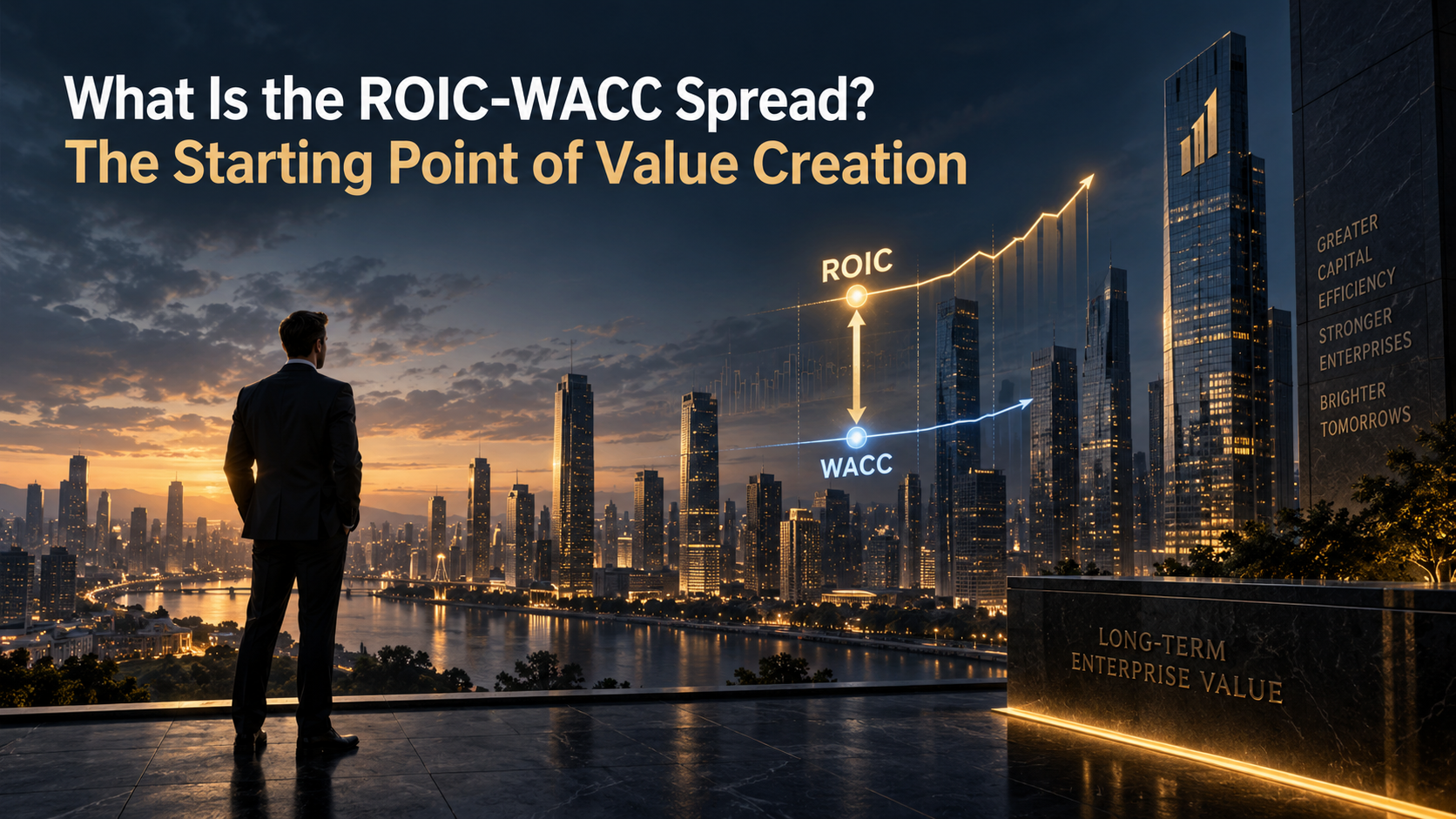
What Is the ROIC-WACC Spread?
The ROIC-WACC spread combines two important concepts
- ROIC — Return on Invested Capital
- WACC — Weighted Average Cost of Capital
Together, they help investors evaluate whether a company is using capital productively.
What Is ROIC?
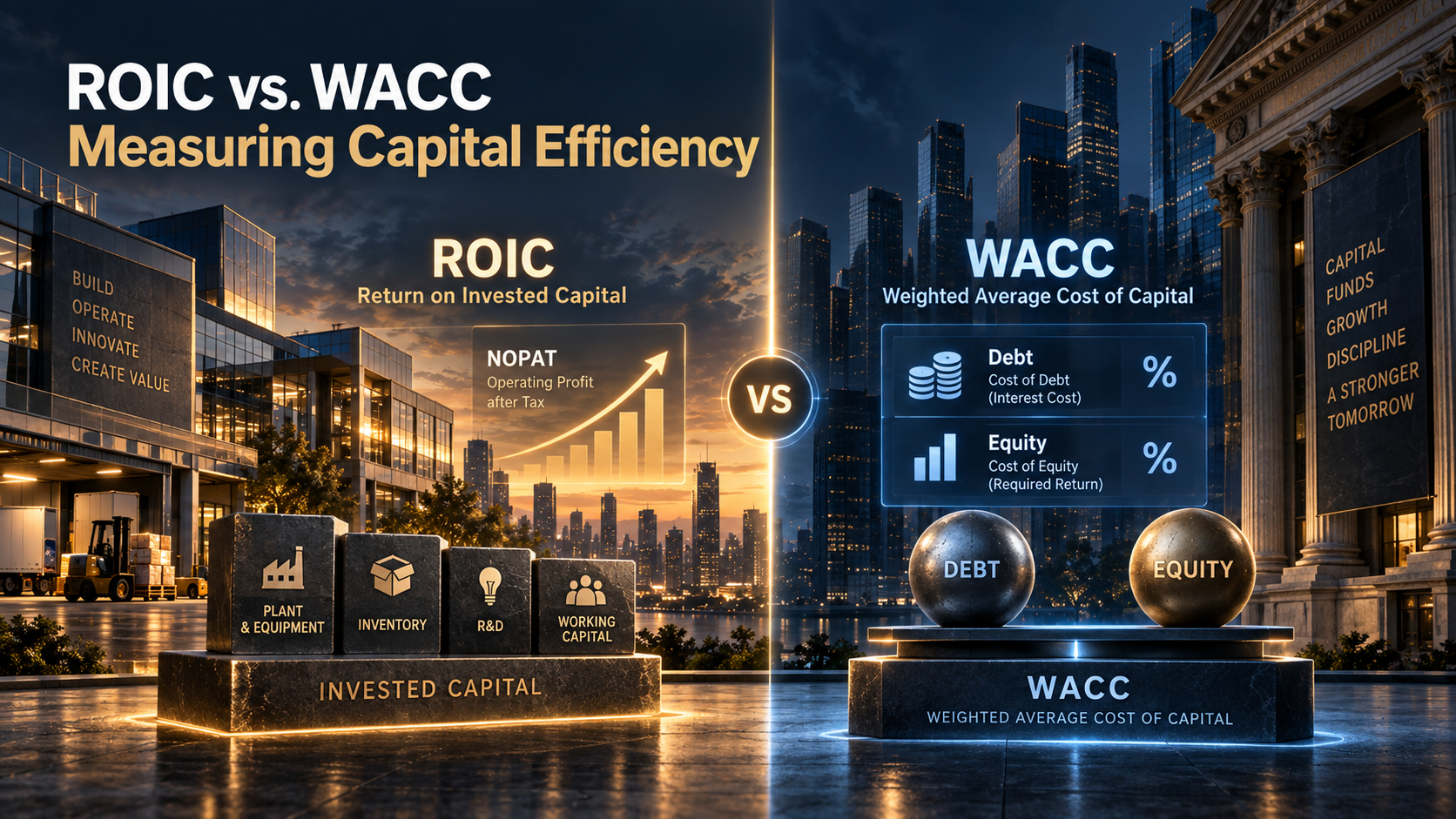
ROIC measures how effectively a business generates after-tax operating profit from the capital invested in its operations.
A simplified version is
ROIC = NOPAT / Invested Capital
Where
- NOPAT = Net Operating Profit After Tax
- Invested Capital = Capital committed to operating the business
Suppose a company has $10 billion of invested capital and generates $1.5 billion of NOPAT.
Its ROIC would be approximately 15%.
In practical terms, ROIC asks
For every dollar committed to this business, how much after-tax operating profit does the company generate?
A higher ROIC generally indicates greater capital efficiency.
But ROIC alone is not enough.
Capital is not free.
That is where WACC comes in.
What Is WACC?
WACC represents the average return required by the investors who provide capital to a company.
Companies generally finance themselves through a combination of
- equity
- bonds
- bank debt
- other forms of financing
Debt investors expect interest payments.
Equity investors do not receive a contractual interest payment, but they still require compensation for taking risk.
WACC blends these financing costs based on the company’s capital structure.
A simplified formula is
WACC = Cost of Equity × Equity Weight + After-Tax Cost of Debt × Debt Weight
If a company has an estimated WACC of 8%, investors can think of that as the approximate return hurdle the business must exceed to create economic value.
This leads directly to the ROIC-WACC spread.
How to Calculate the ROIC-WACC Spread
The formula is straightforward
ROIC-WACC Spread = ROIC - WACC
Consider two companies.
| Metric | Company A | Company B |
| ROIC | 15% | 6% |
| WACC | 8% | 8% |
| ROIC-WACC Spread | +7 percentage points | -2 percentage points |
| Interpretation | Likely value creation | Potential value destruction |
Company A earns 15% on capital that effectively costs 8%.
That creates a positive spread of 7 percentage points.
Company B earns only 6% while its cost of capital is 8%.
Even if Company B reports positive accounting earnings, its business may not be earning enough to compensate investors for the capital being employed.
This leads to one of the most important principles in corporate finance
Growth creates value only when the return on incremental capital exceeds the cost of that capital.
How the ROIC-WACC Spread Works
The framework becomes easier to understand if we follow the life cycle of capital inside a company.
Step 1: The Company Raises Capital
A business needs capital to grow.
It may borrow money, issue bonds, retain earnings, or raise equity.
Every source of funding has a cost.
The blended economic cost of that funding is reflected in WACC.
Step 2: The Company Invests the Capital
Management deploys that capital into activities such as
- factories
- data centers
- inventory
- R&D
- software infrastructure
- acquisitions
- sales organizations
- new stores
- distribution networks
The return generated from those operating investments is reflected in ROIC.
Step 3: The Spread Determines Whether Value Is Being Created
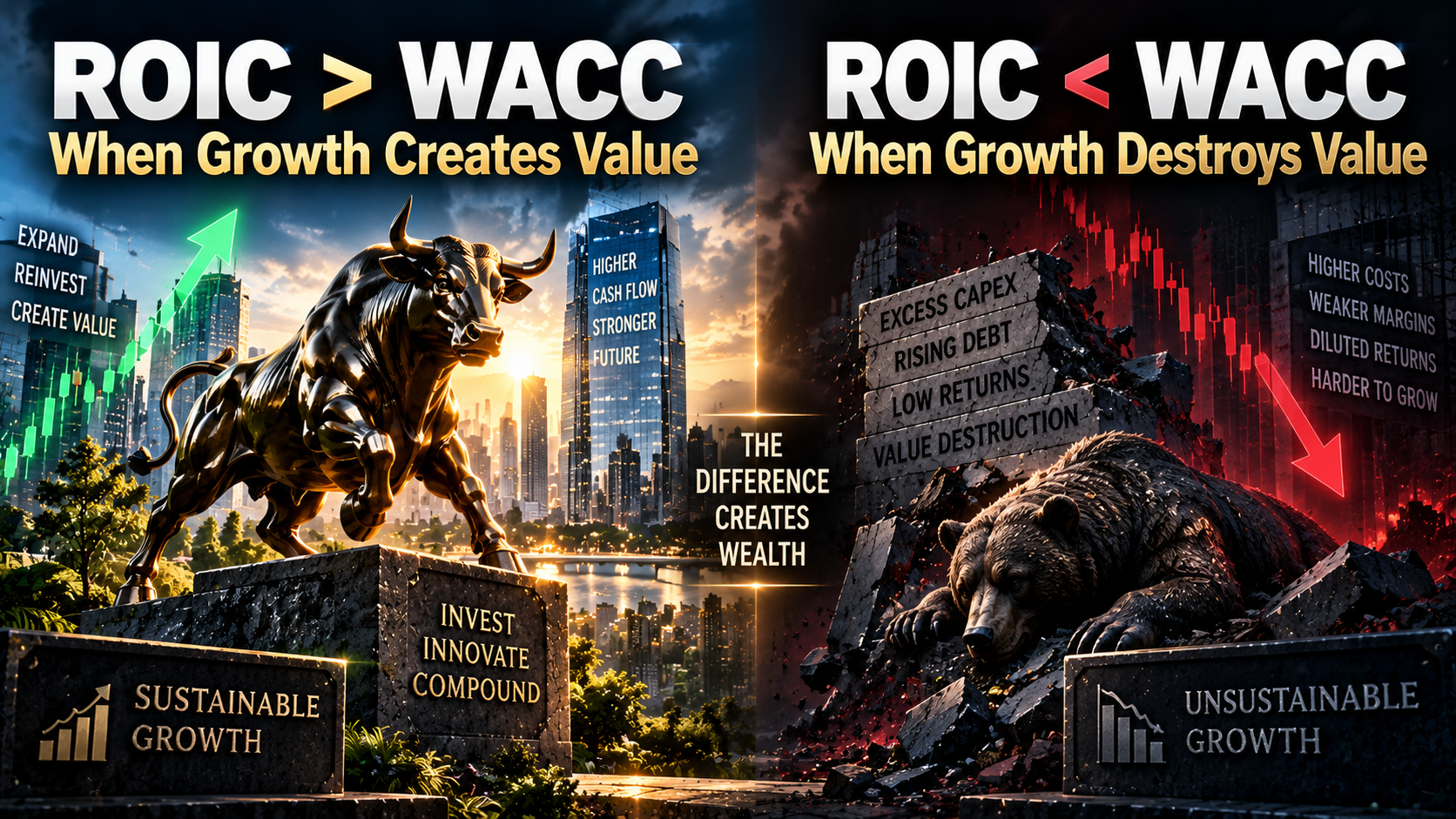
If
ROIC > WACC
the company earns more than its capital costs.
If
ROIC < WACC
the company is not generating a sufficient economic return.
That distinction matters enormously.
A company can grow revenue while still destroying value.
It can increase assets, expand internationally, hire more employees, and even grow EPS under certain circumstances—yet still allocate capital poorly.
The real question is not whether the company is expanding.
The real question is
What return is management earning on the capital required to support that expansion?
Why the ROIC-WACC Spread Matters to Investors
It Separates High-Quality Growth From Expensive Growth
Wall Street naturally pays attention to revenue growth.
But not all growth is equal.
A software company that can add customers with modest incremental capital is fundamentally different from a company that must spend billions of dollars every year just to sustain growth.
If a company grows at 20% but generates returns below its cost of capital, the growth may not be economically attractive.
By contrast, a company growing at 10% while reinvesting at very high returns may create far more shareholder value over time.
For investors, this means the better question is not
“How fast is the company growing?”
It is
“At what return on capital is the company growing?”
ROIC-WACC Spread and Economic Moats
Sustaining a high ROIC is difficult.
In competitive markets, excess returns usually attract competition.
If one business earns unusually high returns, new competitors tend to enter, prices may fall, margins may compress, and capital returns can move lower.
That is why companies that maintain a wide ROIC-WACC spread for many years deserve closer attention.
Persistent excess returns may indicate structural advantages such as
- strong brands
- network effects
- switching costs
- proprietary technology
- patents
- economies of scale
- cost leadership
- distribution advantages
- data advantages
- regulatory barriers
- customer lock-in
In other words, a durable ROIC-WACC spread can serve as one financial expression of an economic moat.
It does not prove that a moat exists.
But it gives investors a strong clue that the business may possess an advantage competitors have difficulty eroding.
The Most Important Part: Reinvestment
A high ROIC is attractive.
But for long-term compounding, one additional factor matters
Can the company continue reinvesting at high returns?
Consider two businesses.
Company X earns a 30% ROIC but has little room to expand.
Company Y earns a 17% ROIC but can reinvest billions of dollars every year for the next decade at roughly similar returns.
Company Y may ultimately create more total value.
This is why long-term investors should think about
ROIC × Reinvestment Rate × Duration
The most powerful compounding businesses typically combine
- high returns on capital
- meaningful reinvestment opportunities
- long growth runways
- disciplined capital allocation
This is where the ROIC-WACC framework becomes especially useful for U.S. investors analyzing large technology platforms, semiconductor companies, industrial businesses, retailers, or capital-intensive infrastructure companies.
The key is not just the current ROIC.
It is the incremental ROIC on the next dollar invested.
ROIC-WACC Spread and Enterprise Value
A company’s value ultimately depends on the cash flows it can generate in the future and the rate at which those cash flows are discounted.
The ROIC-WACC spread connects directly to that logic.
If a company earns returns above its cost of capital and reinvests at those attractive rates, additional investment can increase enterprise value.
If a company earns below its cost of capital, additional investment can reduce economic value.
The framework can be summarized like this
| ROIC-WACC Profile | Growth | Interpretation |
| High spread | High growth | Strong value-creation potential |
| High spread | Low growth | High-quality business, but limited reinvestment runway |
| Low or negative spread | High growth | Growth may destroy value |
| Low or negative spread | Low growth | Business model and capital allocation require scrutiny |
One of the most dangerous combinations for investors is
Low ROIC + aggressive growth
That can produce impressive revenue numbers while consuming enormous amounts of capital.
Eventually, the market may stop rewarding growth and begin asking a more difficult question
Where is the free cash flow?
Why Interest Rates Matter So Much
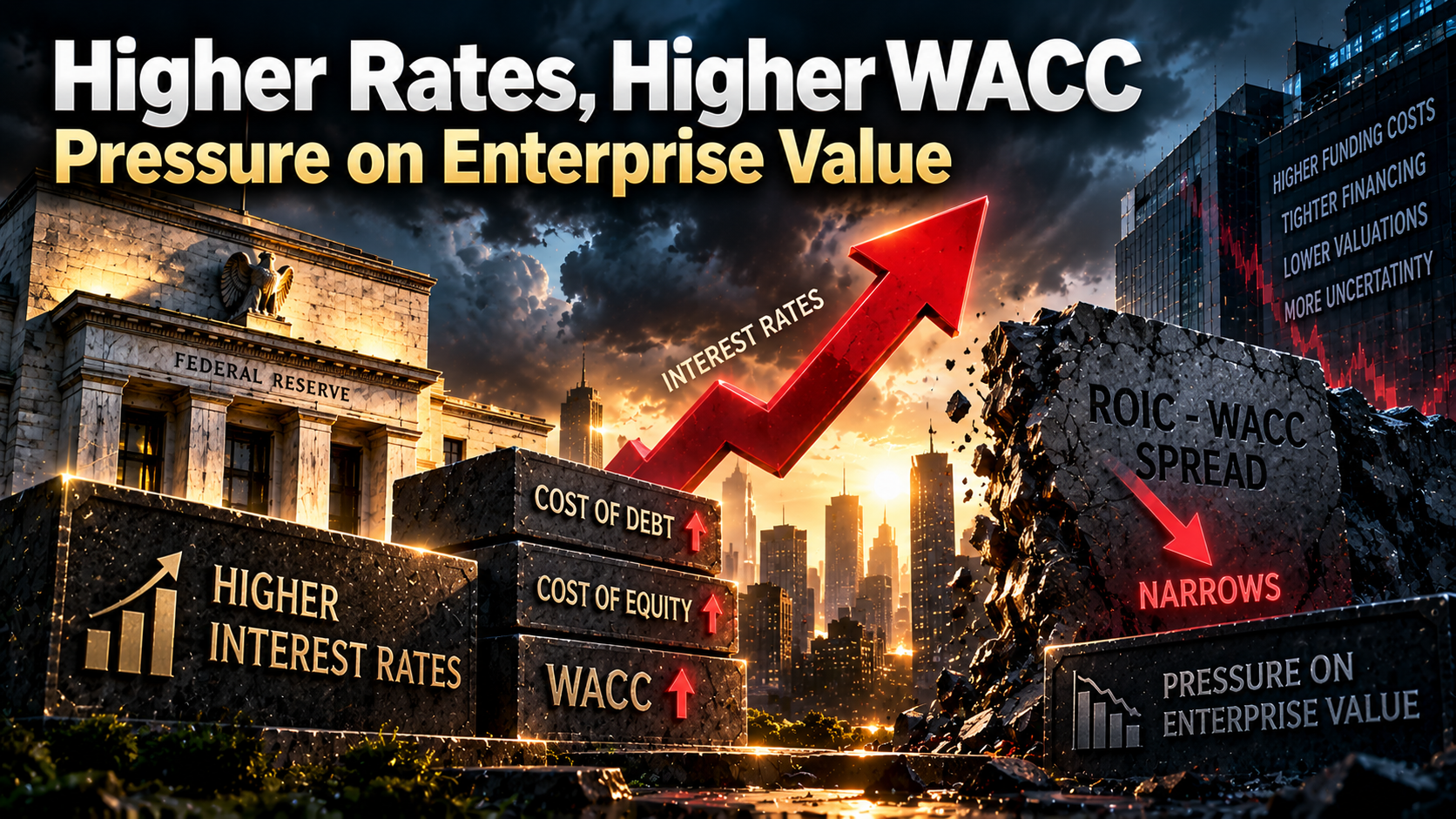
The ROIC-WACC framework also explains why interest rates affect equity valuations.
When market rates rise, several things can happen.
The cost of debt rises.
The risk-free rate embedded in valuation models rises.
The return investors demand from equities can also increase.
As a result, WACC may move higher.
Suppose a company consistently earns a 12% ROIC.
| ROIC | WACC | Spread |
| 12% | 6% | +6 pts |
| 12% | 8% | +4 pts |
| 12% | 10% | +2 pts |
The operating business has not changed.
But the company’s margin of economic value creation has narrowed.
This is one reason higher-rate environments often expose weaker business models.
When money is cheap, a thin ROIC-WACC spread can be hidden by abundant liquidity and easy financing.
When capital becomes expensive, the difference between high-quality and low-quality businesses becomes more visible.
What the ROIC-WACC Spread Means Across Markets
ROIC-WACC is primarily a corporate-finance framework, but it connects with broader financial markets through interest rates, liquidity, and credit conditions.
| Market | Connection |
| Stocks | Firms with durable positive spreads can compound capital more effectively |
| Corporate Bonds | Rising borrowing costs increase WACC and pressure highly leveraged firms |
| Interest Rates | Higher rates raise the hurdle rate for new corporate investment |
| U.S. Dollar | A stronger dollar can increase pressure on global firms with dollar-denominated liabilities |
| Gold | Not directly analyzed through ROIC, but influenced by the same real-rate environment affecting discount rates |
| Bitcoin | Does not generate operating cash flow, but remains sensitive to liquidity and required returns across risk assets |
Equities
For equity investors, companies with strong ROIC-WACC spreads deserve attention because they may be able to turn retained earnings into more valuable future earnings.
But a high ROIC does not automatically make a stock attractive.
Valuation still matters.
A great business bought at an extreme price can still generate disappointing investment returns.
That distinction is critical.
Business quality and stock price are not the same thing.
What Investors Should Check
1. Look at the Trend, Not Just One Year
A single year can be misleading.
Commodity cycles, temporary shortages, post-pandemic demand, one-time pricing power, or unusual cost structures can temporarily inflate ROIC.
Investors should generally examine several years of history.
For example
20% → 17% → 14% → 11%
may indicate weakening competitive economics.
By contrast
8% → 10% → 12% → 15%
may suggest improving scale economics, pricing power, operating leverage, or capital discipline.
The direction of the spread can matter as much as its current level.
2. Consider the Capital Expenditure Cycle
Capital-intensive businesses require special treatment.
Semiconductor manufacturers, utilities, telecom operators, energy producers, railroads, and industrial companies often spend heavily before new assets begin generating full earnings.
During major investment cycles, ROIC may temporarily decline.
That does not necessarily mean the business is deteriorating.
Investors should ask
- Is capacity utilization rising?
- Are new assets producing acceptable returns?
- Is free cash flow improving after the investment phase?
- Is incremental ROIC recovering?
The key is whether large CAPEX ultimately produces returns above the cost of capital.
3. Remember That WACC Is an Estimate
ROIC is calculated using reported financial data, although adjustments may be required.
WACC is more subjective.
The cost of equity depends on assumptions such as
- the risk-free rate
- equity risk premium
- beta
- capital structure
That means investors should avoid treating a WACC estimate of 7.4% as if it were a precisely observable fact.
A better approach is often to use scenarios.
For example
- WACC at 7%
- WACC at 9%
- WACC at 11%
Then ask whether the company still produces an attractive positive spread.
A strong business should not require perfect assumptions to look economically attractive.
Compare ROIC Within the Right Industry
Industry context matters.
A cloud software company and an integrated steel producer operate with completely different capital structures.
Asset-light businesses can often generate high ROIC because relatively little physical capital is required.
Capital-intensive sectors require far more property, plant, equipment, inventory, and working capital.
For that reason, ROIC comparisons are usually most informative when made
- against direct peers
- against the company’s own history
- across a full business cycle
The goal is not simply to find the highest number.
The goal is to understand whether the company creates unusually strong returns relative to the capital intensity and competitive economics of its industry.
ROIC and Free Cash Flow Should Be Analyzed Together
ROIC tells investors how productively capital is being used.
Free cash flow helps show whether that economic efficiency is ultimately converting into cash.
Investors should therefore examine ROIC alongside
- operating cash flow
- free cash flow
- capital expenditures
- working capital
- net debt
- stock-based compensation
- share repurchases
- dividends
- acquisitions
A company with high ROIC and strong free cash flow can generate substantial internal capital.
Management then has several choices
- reinvest in the core business
- acquire other companies
- repay debt
- repurchase shares
- pay dividends
The quality of those capital-allocation decisions can determine whether a great business remains great.
Why ROIC-WACC Should Never Be Used Alone
The framework is powerful, but it has limitations.
Accounting Can Distort ROIC
R&D, goodwill, acquired intangibles, leases, and acquisition accounting can all affect the calculation.
For technology companies in particular, accounting rules may expense investments that are economically closer to long-lived assets.
That means reported ROIC sometimes requires adjustment.
High ROIC Can Fade
Competition eventually pressures excess returns.
Technology changes.
Customer behavior changes.
Pricing power weakens.
A company that earned a 25% ROIC in the past may not earn 25% in the future.
Investors should therefore ask
Why is ROIC high, and what could cause it to fall?
Valuation Still Matters
A company can have
- an excellent business model
- high ROIC
- a wide ROIC-WACC spread
- strong free cash flow
and still be a poor investment if investors pay too much for it.
Long-term returns depend on both
Business economics + Entry valuation
That is why quality investing is not simply about finding great companies.
It is about understanding what future performance is already priced into the stock.
What Do Long-Term Wealth Builders Look For?
Experienced investors tend to focus less on the next quarterly earnings surprise and more on the long-term movement of capital.
Follow the Capital
Capital tends to migrate toward businesses that can use it productively.
A company with a wide ROIC-WACC spread can often finance growth internally.
A company with weak capital returns may remain dependent on debt issuance or equity financing.
That distinction becomes especially important when liquidity tightens.
The deeper question is not simply
“Where is money flowing today?”
It is
“Where can capital be reinvested at attractive rates for years?”
Focus on Cash Generation
Accounting earnings matter, but long-term investors eventually need cash.
A high-quality business should ideally turn operating profits into sustainable free cash flow.
That cash can then fund
- organic expansion
- R&D
- acquisitions
- buybacks
- dividends
- balance-sheet improvement
The strongest companies do not merely generate cash.
They allocate it intelligently.
Look for Financial Survivability
Investing is not only about predicting growth.
It is also about surviving the periods when predictions fail.
Compare two companies.
Company A
- ROIC: 10%
- WACC: 9%
Company B:
- ROIC: 20%
- WACC: 8%
Company B has a much wider economic cushion.
If interest rates rise, margins fall, or the economy enters recession, it has more room before value creation disappears.
That is why a wide ROIC-WACC spread can also be viewed as a form of financial resilience.
Think in Terms of Long-Term Compounding
The most powerful corporate compounding model often looks like this
High ROIC + Wide Spread Over WACC + Long Reinvestment Runway + Strong Free Cash Flow
Add disciplined management and rational capital allocation, and the business may have the ingredients for long-term value creation.
The challenge for investors is determining how durable those conditions really are.

Questions Investors Should Ask
Before investing in a company, consider asking
- Is ROIC consistently above WACC?
- Is the ROIC-WACC spread widening or shrinking?
- What explains the company’s high ROIC?
- Can competitors replicate its economics?
- What is the return on new capital being invested today?
- How much additional capital is required to sustain growth?
- Would the company still create value if rates remained higher?
- Is accounting profit converting into free cash flow?
- Is management reinvesting cash intelligently?
- Does the company have a long runway for high-return reinvestment?
Ultimately, the most important question is
Does this business become more valuable when management invests another dollar, or does it simply become larger?
Final Thoughts
The ROIC-WACC spread is one of the clearest ways to understand whether a company is truly creating economic value.
The formula itself is simple
ROIC-WACC Spread = Return on Invested Capital - Weighted Average Cost of Capital
But the investment implications run much deeper.
A business with ROIC above WACC can create value when it reinvests capital.
A business with ROIC below WACC may destroy value even while reporting growth.
For investors, that means revenue growth should never be analyzed in isolation.
The better question is
Is the company growing at returns above its cost of capital?
And beyond that
How long can it keep doing so?
The companies capable of creating exceptional long-term value are often those that can combine high returns on capital, disciplined reinvestment, healthy free cash flow, and a long runway for compounding.
The key lesson is simple
Growth alone does not create value. Growth creates value when incremental capital earns returns above the cost of capital.
This was MasterMind.
'[Global] Success Blueprints' 카테고리의 다른 글