What Is Free Cash Flow (FCF)? How Investors Measure a Company's True Financial Strength


Hello, this is MasterMind.
When investors review a company’s earnings, revenue growth and net income usually receive most of the attention.
Headlines often focus on questions such as
How much did sales grow?
Did earnings beat Wall Street estimates?
Did the company report record profits?
These numbers can move a stock in the short term. But experienced investors often ask a more important question
After paying all operating costs and making the investments required to keep the business competitive, how much real cash did the company actually keep?
That question leads directly to Free Cash Flow, or FCF.
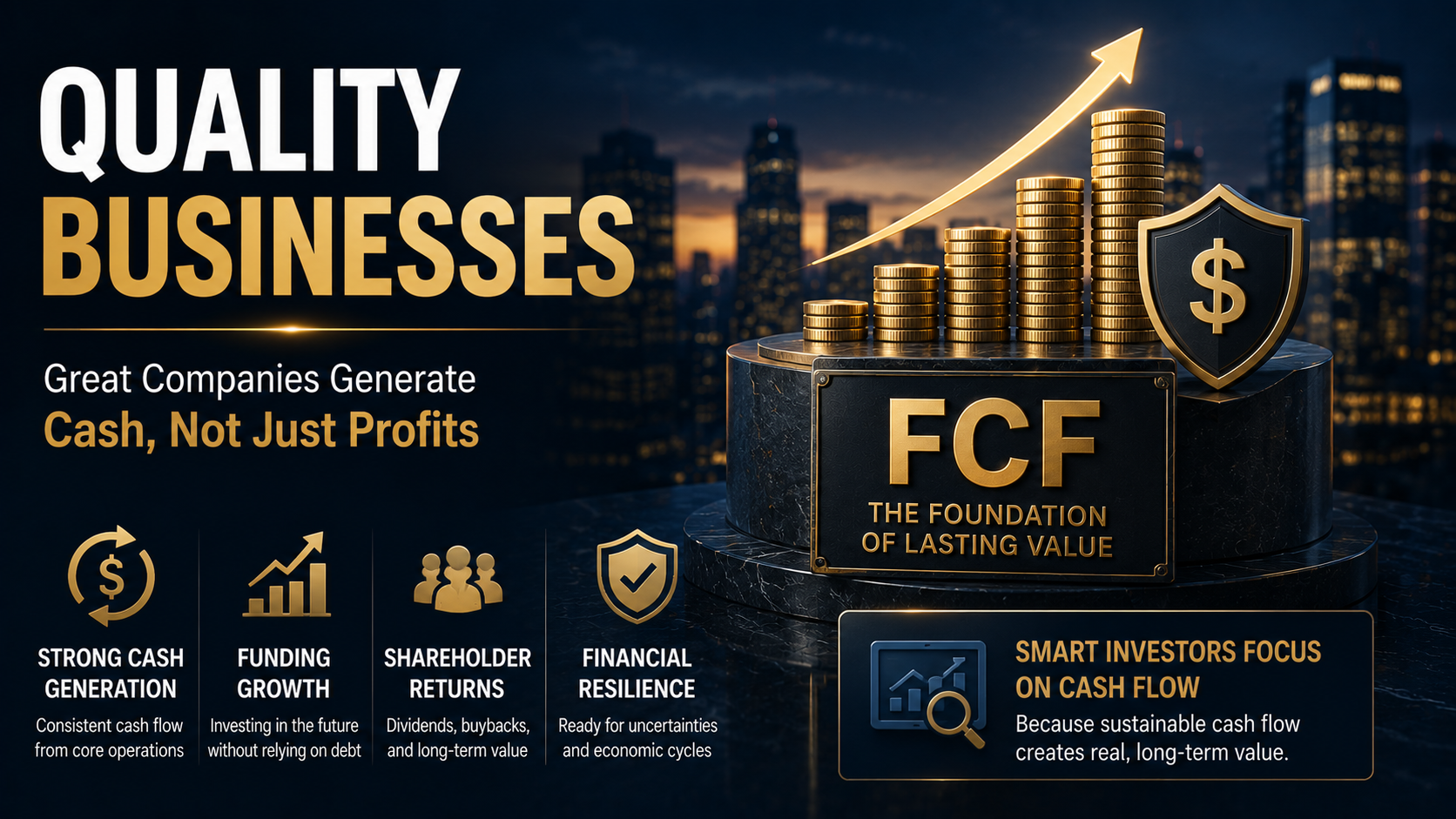
Free Cash Flow is one of the most useful metrics for evaluating a company’s financial strength, capital allocation, shareholder returns, and long-term intrinsic value.

The Bottom Line
Free Cash Flow is the cash a company generates from its operations after subtracting the capital expenditures required to maintain and grow the business.
It represents the cash management can use for dividends, stock buybacks, debt reduction, acquisitions, and future investment.
What Is Free Cash Flow?
Free Cash Flow measures how much cash remains after a company pays for the investments necessary to operate its business.
The word “free” is important.
It refers to cash that is no longer tied to routine operating needs or required capital spending. Management can allocate this money in several ways
- Paying dividends
- Repurchasing shares
- Reducing debt
- Acquiring other businesses
- Investing in new products or markets
- Holding cash for future opportunities
In simple terms, Free Cash Flow shows how much financial flexibility a business truly has.
A company may report strong revenue and accounting profits, but if it must spend nearly all of its cash on factories, equipment, data centers, or infrastructure, very little may remain for shareholders.

How Is Free Cash Flow Calculated?
The most common formula is
Free Cash Flow = Operating Cash Flow − Capital Expenditures
Operating Cash Flow
Operating Cash Flow, often abbreviated as OCF, measures the cash generated by a company’s core business operations.
It reflects actual cash collected from customers and cash paid to employees, suppliers, and other operating expenses.
Capital Expenditures
Capital Expenditures, or CapEx, include spending on long-term assets such as
- Factories
- Machinery
- Data centers
- Servers
- Vehicles
- Retail locations
- Production equipment
For example, suppose a company reports
- Operating Cash Flow: $12 billion
- Capital Expenditures: $4 billion
Its Free Cash Flow would be
$12 billion − $4 billion = $8 billion
That $8 billion represents cash that management can allocate more freely.

Why Free Cash Flow Can Be More Useful Than Net Income
Net income and cash flow are not the same thing.
Under accrual accounting, companies can recognize revenue before receiving the actual cash.
For example, if a company sells $100 million of products on credit, it may record the revenue immediately even though customers have not yet paid.
The income statement may show a profit, but the company’s bank account may not have received the cash.
The opposite can also occur.
Depreciation reduces accounting earnings, but it does not represent a current cash payment. It is a non-cash expense that spreads the cost of a long-term asset over several years.
This creates a gap between accounting profit and economic reality.
Free Cash Flow helps investors look through that gap.
Earnings tell investors what a company reported. Cash flow shows what the business actually generated.
This does not mean net income is useless. It means investors should analyze net income together with cash flow rather than relying on earnings alone.
Why Free Cash Flow Matters to Investors
1. It Reveals Financial Resilience
Companies do not usually fail because they run out of accounting profits.
They fail because they run out of cash.
During recessions, credit tightening, or industry downturns, companies with strong Free Cash Flow are less dependent on banks, bond markets, or new stock issuance.
That gives them more time and flexibility to survive.
A business that generates cash internally can continue paying employees, investing in operations, and servicing debt even when external funding becomes expensive.
2. It Supports Dividends and Stock Buybacks
Dividends must ultimately be paid with cash.
The same is true for share repurchases.
A company can temporarily fund shareholder returns with debt, but that strategy is not sustainable over long periods.
The most reliable dividends and buyback programs are supported by recurring Free Cash Flow.
Investors should therefore ask whether shareholder returns are funded by genuine cash generation or by borrowing.
3. It Funds Future Growth
Strong Free Cash Flow gives management the ability to invest in the future without depending entirely on outside capital.
That may include
- Building new manufacturing capacity
- Expanding cloud infrastructure
- Developing artificial intelligence systems
- Funding research and development
- Entering new markets
- Acquiring strategic competitors
Cash-rich companies often gain an advantage during downturns because they can continue investing while weaker competitors cut spending.
4. It Is Central to Business Valuation
Free Cash Flow is also the foundation of Discounted Cash Flow analysis, commonly known as DCF.
A DCF model estimates a company’s value by projecting future cash flows and discounting them back to their present value.
The logic is straightforward
A business is worth the present value of the cash it can generate for investors over time.
That is why Free Cash Flow is closely connected to intrinsic value.

How the Market Interprets Changes in Free Cash Flow
| Free Cash Flow Trend | Common Market Interpretation |
| Consistent growth | Improving business quality and financial flexibility |
| Better than expected | Potential positive earnings reaction |
| Temporary decline | May reflect growth investment or higher CapEx |
| Persistent decline | Possible weakening in operating performance |
| Long-term negative FCF | Greater dependence on debt or equity financing |
A decline in Free Cash Flow is not automatically negative.
The reason behind the decline matters.
A company may experience lower FCF because it is building semiconductor plants, data centers, logistics networks, or new production facilities.
That spending may reduce current cash flow while creating greater future capacity.
The key question is whether the investment is likely to generate attractive returns.
How Free Cash Flow Affects Different Asset Classes
| Asset Class | Potential Impact |
| Stocks | Strong FCF may support higher valuations, buybacks, dividends, and long-term earnings stability |
| Corporate Bonds | Strong cash flow can improve debt repayment capacity and reduce credit risk |
| U.S. Dollar | The direct effect is limited, though stronger corporate investment may support broader economic activity |
| Gold | Weak corporate cash flow during periods of stress may increase demand for defensive assets |
| Bitcoin and Risk Assets | The direct relationship is limited, but stronger liquidity and corporate balance sheets may support risk appetite |
Free Cash Flow is primarily a company-level metric rather than a macroeconomic indicator.
However, when large companies across the S&P 500 generate rising FCF, it can strengthen the broader equity market through capital spending, dividends, debt repayment, and share repurchases.
Important Limitations of Free Cash Flow
Investors should not assume that positive FCF always means a company is attractive.
Free Cash Flow must be interpreted in context.
High-Growth Companies May Have Negative FCF
Young companies often spend heavily to expand capacity, acquire customers, or build infrastructure.
Negative FCF may be reasonable when revenue is growing rapidly and the company is investing at attractive returns.
This was true at different stages for companies such as Amazon and Tesla.
The important question is whether current spending is building a profitable future business or simply delaying financial weakness.
Mature Companies Can Inflate FCF by Underinvesting
A slow-growing company may report high Free Cash Flow because it has reduced capital spending.
That can look attractive in the short term.
But if management is failing to replace aging equipment, develop new products, or defend market share, high FCF may reflect underinvestment rather than strength.
Industry Structure Matters
Capital-intensive businesses naturally require more CapEx than asset-light companies.
Semiconductor manufacturers, automakers, utilities, telecom companies, and industrial firms generally need more physical investment.
Software and platform companies often require less capital spending.
For this reason, FCF margins should usually be compared with companies in the same industry.
Key Free Cash Flow Metrics Investors Should Know
Free Cash Flow Margin
FCF Margin = Free Cash Flow ÷ Revenue
This shows how much Free Cash Flow a company generates from each dollar of sales.
A rising FCF margin may indicate improving efficiency, pricing power, or operating leverage.
Free Cash Flow Yield
FCF Yield = Free Cash Flow ÷ Market Capitalization
FCF yield compares a company’s cash generation with its stock market value.
A higher yield may indicate a cheaper valuation, but investors must still examine growth, debt, cyclicality, and business quality.
A high FCF yield can also signal that the market expects future cash flow to decline.
FCF Conversion
Investors can compare Free Cash Flow with net income.
When FCF regularly matches or exceeds net income, reported earnings may be supported by strong cash generation.
When net income rises but FCF remains weak, investors should examine working capital, receivables, inventory, and capital spending more closely.
What Should Investors Check?
When reviewing Free Cash Flow, investors should consider the following questions
- Is FCF growing consistently over several years?
- Is operating cash flow improving?
- Is CapEx being used to maintain the business or expand it?
- Are dividends and buybacks supported by recurring cash flow?
- Is the company borrowing money despite reporting high FCF?
- Is FCF growth coming from stronger operations or temporary cost cuts?
- How does the company’s FCF margin compare with competitors?
- Is management reinvesting cash at attractive returns?
One year of strong Free Cash Flow is less important than a durable pattern.
The trend matters more than the snapshot.
What Do Wealthy Investors and Institutions Look For?
Sophisticated investors do not focus only on whether a company is profitable.
They study how cash moves through the business.
They want to know
- Where the cash comes from
- How much must be reinvested
- How much remains after investment
- How management allocates the remaining cash
A company with rising Free Cash Flow can become less dependent on outside financing.
That creates a more self-sustaining business model.
It can fund growth internally, survive periods of weak credit availability, and take advantage of opportunities when competitors are under pressure.
This is why predictable cash flow often receives a premium valuation.
Markets are ultimately mechanisms for pricing future cash flows.
Capital tends to move toward businesses that can generate more cash with less financial risk and less dependence on external funding.
Questions to Ask Yourself
- Does this company produce real cash, or only accounting profits?
- Is capital spending strengthening the business or consuming cash without adequate returns?
- Could the company survive a recession without issuing new shares or taking on excessive debt?
- Is shareholder return funded by sustainable FCF?
- Does management allocate cash in ways that increase long-term value?
Final Thoughts
There is a well-known idea in investing
Earnings can be influenced by accounting assumptions, but cash is harder to ignore.
Revenue and net income remain important.
But Free Cash Flow shows whether a company can convert business activity into usable cash.
In the short term, stock prices can move on earnings surprises, market sentiment, interest rates, and investor expectations.
Over the long term, however, business value tends to follow the company’s ability to generate sustainable cash.
That is why investors should look beyond the income statement and ask where the cash is coming from, where it is going, and how much remains after the business has funded its future.
The goal of investing is not to predict every market move.
It is to identify businesses that can survive uncertainty, fund their own growth, and continue generating cash across different economic environments.
This was MasterMind.
'[Global] Success Blueprints' 카테고리의 다른 글