What Is a Single-Stock ETF? How It Works and the Risks Every Investor Should Know


Hello, this is MasterMind.
Have you ever looked at a stock like Nvidia, Tesla, Apple, or Meta and wondered, “Can I amplify my exposure to this one company without using options or margin?” Or maybe you have thought, “Is there an easier way to bet against a single stock when I believe it may fall?”
That is exactly where single-stock ETFs come in.
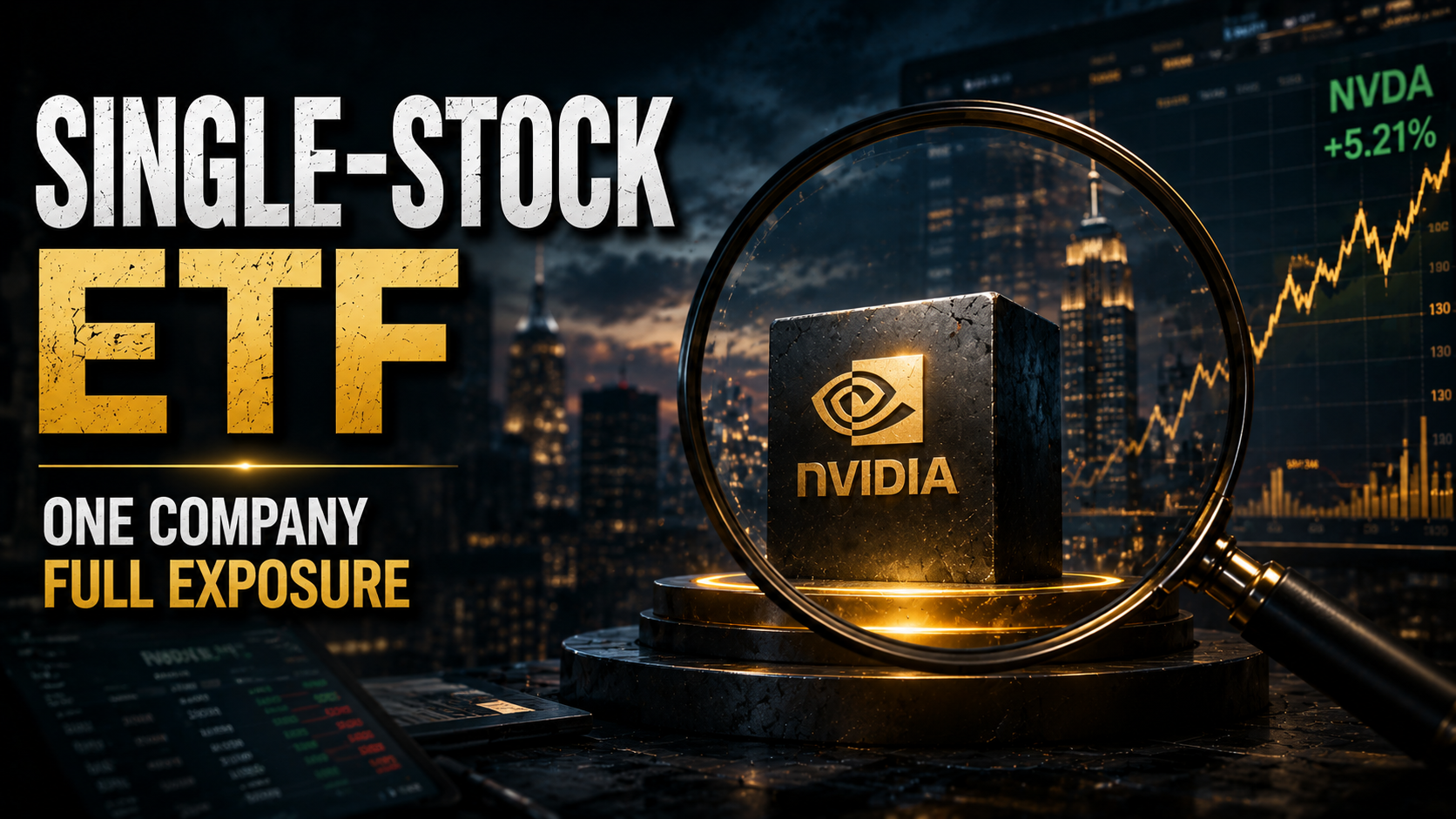
A single-stock ETF is designed to track the performance of one individual company, often with leverage or inverse exposure. Unlike traditional ETFs, which spread money across dozens or hundreds of stocks, a single-stock ETF concentrates exposure into one name.
That makes it convenient, but also dangerous.
Key Takeaway
A single-stock ETF gives investors targeted exposure to one company, but it often uses leverage, inverse exposure, derivatives, and daily resets, making it much riskier than a traditional diversified ETF.
What Is a Single-Stock ETF?
A traditional ETF is usually built for diversification.
For example, an S&P 500 ETF gives investors exposure to hundreds of U.S. companies. A semiconductor ETF may hold multiple chipmakers. A technology ETF may own a basket of software, hardware, cloud, and AI companies.
A single-stock ETF is different.
It focuses on one company.
That company could be Nvidia, Tesla, Apple, Microsoft, Amazon, Meta, or another highly traded stock. Some single-stock ETFs aim to deliver the stock’s daily return. Others aim to deliver leveraged returns, such as 1.5x or 2x. Some are inverse ETFs, designed to rise when the underlying stock falls.
In simple terms, a single-stock ETF is not a normal long-term diversification tool. It is a concentrated trading instrument.
How Single-Stock ETFs Work

Many single-stock ETFs do not simply buy and hold the underlying stock. Instead, they often use derivatives such as swaps to achieve their target exposure.
A swap is a contract between the ETF issuer and a financial institution. Through this contract, the ETF can receive the return of a specific stock, or a multiple of that return, without directly owning the stock in the same way a regular shareholder would.
The most important feature is the daily reset.
Most leveraged and inverse single-stock ETFs are designed to track daily returns, not long-term returns.
For example, if a 2x Nvidia ETF aims to deliver twice Nvidia’s daily return, then
| Nvidia Daily Move | 2x ETF Target Move |
| +3% | +6% |
| -3% | -6% |
| +5% | +10% |
| -5% | -10% |
That may sound simple, but over time the results can become very different from what investors expect.
Why Daily Reset Matters

Daily reset means the ETF recalibrates its exposure every trading day.
This creates a major issue for long-term holders: compounding does not work in a straight line.
Suppose a stock starts at 100.
On day one, it rises 10% to 110.
On day two, it falls 9.09% back to 100.
The stock is back where it started.
But a 2x leveraged ETF would move like this
| Day | Underlying Stock | 2x ETF |
| Start | 100 | 100 |
| Day 1 | 110 | 120 |
| Day 2 | 100 | 98.18 |
The stock returned to its starting point, but the leveraged ETF lost money.
This is called volatility drag.
The more the underlying stock swings up and down, the more this effect can damage returns.
Single-Stock ETF vs. Owning the Stock
| Category | Single-Stock ETF | Individual Stock |
| Exposure | One company, often through derivatives | Direct ownership in a company |
| Leverage | Often available | Not built in |
| Inverse exposure | Often available | Not available through normal stock ownership |
| Daily reset | Common in leveraged/inverse products | None |
| Long-term suitability | Requires caution | Can be suitable if fundamentals support it |
| Risk level | High | Depends on the company |
This is the key difference: owning a stock means owning a piece of a business. Owning a leveraged or inverse single-stock ETF means holding a financial product built around short-term price movement.
Why Investors Care
Single-stock ETFs became popular because they make aggressive strategies easier.
Investors can use them to
- amplify exposure to high-growth stocks
- bet on short-term momentum
- hedge against a decline in a single company
- trade major earnings events
- express a strong view without using options
But convenience does not remove risk.
In fact, easy access can make risk feel smaller than it really is.
Markets are not moved only by stories. They are moved by liquidity, expectations, positioning, and forced flows. Single-stock ETFs can concentrate all of those forces into one highly traded product.
Market Impact of Single-Stock ETFs
Single-stock ETFs can affect market behavior in several ways.
| Market Area | Possible Impact |
| Individual stocks | May increase volatility in heavily traded names |
| Options market | Can amplify demand for hedging and short-term positioning |
| Broader stock market | May strengthen crowding into popular mega-cap stocks |
| Risk assets | Can compete with speculative capital in crypto and high-beta stocks |
| Investor behavior | May encourage shorter holding periods and higher turnover |
When large amounts of money rush into leveraged products tied to the same stock, the market can become more sensitive to daily price moves.
This is especially important around earnings reports, AI-related news, Federal Reserve decisions, and major market selloffs.
The Biggest Risks of Single-Stock ETFs

1. Concentration Risk
Traditional ETFs reduce risk by spreading money across many companies. Single-stock ETFs remove that protection.
If the underlying company falls sharply, the ETF can fall even faster.
2. Leverage Risk
A 2x product can double gains, but it can also double losses.
That sounds obvious, but many investors focus only on the upside.
3. Volatility Drag
Volatility drag can cause losses even when the underlying stock goes nowhere over time.
This is one of the biggest misunderstandings about leveraged ETFs.
4. Long-Term Tracking Difference
A leveraged single-stock ETF does not promise to deliver twice the stock’s long-term return. It usually targets daily performance.
That difference matters.
5. Cost and Derivative Risk
These ETFs may carry higher fees and derivative costs than traditional ETFs. Those costs can reduce returns over time.
What Investors Should Check Before Buying
Before investing in a single-stock ETF, investors should ask
- Is this product leveraged or inverse?
- Does it reset daily?
- What is the expense ratio?
- What derivatives does it use?
- How volatile is the underlying stock?
- Am I trading a short-term view or investing in a long-term business?
- Can I survive a large loss if the trade goes against me?
The most important question is not “How much can I make?”
It is “How much can I afford to lose and still stay in the game?”
What Wealthy Investors See in This Trend
Wealthy investors often look at single-stock ETFs differently.
They may not see them as long-term investments. Instead, they may see them as signals of market psychology.
When money floods into leveraged ETFs tied to a popular stock, it can suggest that speculative appetite is rising. When inverse products become popular, it may show that fear is increasing.
In other words, these products can reveal where money is moving.
Wealthy investors focus on cash flow, durability, liquidity, and survival. They understand that the market rewards patience, but it punishes overexposure.
A strong portfolio is not built only to capture upside. It is built to survive downside.

FAQ
Are single-stock ETFs good for beginners?
Generally, they require caution. Beginners should understand leverage, inverse exposure, daily resets, and volatility drag before using them.
Are single-stock ETFs safer than options?
They may be easier to trade than options, but that does not mean they are safe. Leveraged and inverse single-stock ETFs can still produce large losses.
Can I hold a single-stock ETF long term?
It depends on the product. Leveraged and inverse single-stock ETFs are usually designed for short-term exposure, not long-term holding.
Why not just buy the stock?
Buying the stock gives direct exposure to the company. A single-stock ETF may provide leverage or inverse exposure, but it also adds structural risks.
What is the biggest risk?
The biggest risk is misunderstanding the product. Many investors assume a 2x ETF will deliver twice the stock’s long-term return, but most leveraged ETFs are designed around daily returns.
Conclusion
Single-stock ETFs are one of the clearest examples of modern financial engineering.
They give investors easy access to leveraged or inverse exposure on individual companies, but they also introduce risks that many investors underestimate.
The key is to understand the structure.
A single-stock ETF is not the same as owning a stock. It is not the same as holding a diversified ETF. It is a high-volatility trading product that can magnify both opportunity and loss.
In investing, survival matters more than prediction.
The investors who last are not always the ones chasing the biggest returns. They are the ones who understand risk before risk reveals itself.
This was MasterMind.
'[Global] Success Blueprints' 카테고리의 다른 글